
Freelancer Bank Account vs Personal Account: Why Commingling Costs You Money

About the Author

Marcus Delray
Fintech Analyst, Business Banking Researcher & Founder
Marcus Delray is an independent fintech analyst and financial technology writer who covers digital banking apps, neobanks, and money tools built for freelancers and small businesses. This guides specifically enlightens freelancer bank account vs personal account, he breaks down fee structures, APY tiers, FDIC coverage, and automated tax features so solo earners and SMB owners can choose the right account with confidence.
- Nearly a decade reviewing freelance banking platforms and business checking accounts
- Deep knowledge of FDIC insurance structures and sweep network coverage limits
- Specialist in neobank fee analysis and APY comparisons for solo business owners
Editorial Integrity
Sources & References
Verified IRS, SBA, FinCEN & Consumer Banking Guidance
Tech Capital Hub reviews freelancer banking topics using authoritative public guidance from tax, compliance, consumer-finance, and small-business agencies. Claims related to commingling, recordkeeping, audit exposure, entity separation, and business account setup should always be verified against current government guidance and provider disclosures before acting.
- IRS: 2026 Standard Mileage Rates — reference for the 2026 business mileage rate and related deduction standards mentioned in this article.
- IRS: Recordkeeping — guidance on maintaining business records, documentation, and expense support for self-employed taxpayers and Schedule C filers.
- Consumer Financial Protection Bureau: Bank Accounts and Services — consumer guidance on account features, fees, and account management considerations relevant to separating personal and business finances.
- FinCEN: Beneficial Ownership Information Reporting — official BOI reporting guidance relevant to LLC compliance, entity separation, and business-account setup context.
- U.S. Small Business Administration: Open a Business Bank Account — overview of why a dedicated business account matters for separation, documentation, and financial operations.
- Provider Terms & Disclosures: Official product pages, fee schedules, onboarding requirements, and eligibility disclosures from the banking platforms referenced in this article.
🛡️ Our Editorial Standards
Tech Capital Hub publishes freelancer banking content using a research process grounded in publicly available government guidance, compliance resources, and provider disclosures. For articles like this one, we review how account structure, documentation quality, recordkeeping, and business-banking setup affect audit exposure, bookkeeping accuracy, legal separation, and day-to-day financial operations for solo business owners. We clearly distinguish general educational guidance from financial, tax, or legal advice.
Emily got a letter from the IRS in March.
She’d been freelancing as a copywriter for three years. Good income. Growing client list. She ran everything through her personal Chase account because it was easier — clients paid there, she spent from there, she moved money when she needed it.
The fix starts with picking the right account, and our guide to the best digital banking apps for freelancers lays out the strongest options.
The letter wasn’t about fraud. It was a request for documentation on her Schedule C deductions. Her claimed business expenses totaled $23,400 across the year. The IRS wanted receipts, logs, and proof of business purpose for every item.
Emily spent six weeks pulling records. Her accountant spent 20 hours sorting through three years of personal and business transactions that had lived in the same account. The professional fee for that cleanup was $2,800.
She would have paid about $180 for a business checking account that year. She paid 15 times that to untangle the mess.
The freelancer bank account vs personal account question isn’t really about preference. It’s about what mixing those two accounts actually costs — in taxes, in legal risk, in audit exposure, and in time. This article covers all of it.
Can freelancers use a personal bank account?
Yes — many freelancers, especially sole proprietors, can legally use a personal bank account for business income. But mixing personal and freelance money usually creates weaker tax documentation, messier bookkeeping, higher audit risk, and less credible business records. If you operate as an LLC, commingling can also weaken the separation between you and the business.
What You’ll Learn in This Guide
- Whether using a personal account for freelance income is actually legal
- How commingling affects taxes, bookkeeping, and audit-readiness
- Why LLC owners face higher separation risk
- How account structure affects lending and financial credibility
- How to switch to a business account cleanly
Freelancer Bank Account vs Personal Account: Quick Comparison
If you want the short version before the deeper explanation, start here.
| Factor | Personal Account | Business Account |
|---|---|---|
| Usually legal for sole proprietors | Yes | Yes |
| Clean audit trail | Weak | Strong |
| Deduction support | Harder to document | Easier to defend |
| Bookkeeping efficiency | Messier | Cleaner |
| Loan readiness | Weaker | Stronger |
| LLC separation support | Can weaken protection | Supports entity separation |
| Best for long-term freelance operations | Usually no | Usually yes |
Table of Contents

Why Freelancers Should Separate Business and Personal Finances
Emily’s $2,800 cleanup wasn’t a fine. It was the price of proof.
That’s the part most freelancers miss. Separation isn’t about looking professional. It’s about controlling what it costs to prove a transaction was what you say it was. Every deduction you claim, every dollar of income you report, every loan you apply for eventually comes back to one question: can you show it? A mixed account makes answering that question expensive.
Run the math. IRS recordkeeping rules expect a clear business purpose behind each deduction. In a personal account, purpose is ambiguous by default — so someone has to rebuild it, usually a bookkeeper billing by the hour. A commingled year runs 15 to 20 hours to untangle. That’s often more than a decade of business account fees, spent fixing a problem separation prevents for free.
The risk isn’t the same for everyone, though. A sole proprietor who commingles mostly pays in time and missed deductions — expenses that were genuinely deductible get dropped because nobody could label them with confidence. An LLC owner pays in something harder to get back: liability protection. Courts pierce the veil using “alter ego” reasoning, and commingled funds are the factor they cite most. One personal charge on the business card won’t collapse the shield alone. It just hands the other side ammunition.
Separation also decides what your data can do. Found, Lili, and Holdings only categorize cleanly when the signal is clean. Feed them groceries and streaming next to client payments, and the automation drops back into guesswork you still have to check by hand.

Why the IRS Cares About a Freelancer Bank Account vs Personal Account
Commingling funds means running personal and business money through the same account. A client payment deposits alongside your grocery spending. A software subscription for work sits next to a streaming service you use personally. Your quarterly tax estimate comes from the same pool as last month’s rent.
Most new freelancers do this because opening a second account feels like extra friction. It is extra friction. The question is whether that friction is more or less painful than what it prevents.
The IRS cares about commingling for one reason: audit trail. When a tax examiner reviews a Schedule C, they’re verifying that every deducted expense was genuinely business-related. A mixed personal account makes that verification harder and more suspicious. It doesn’t prove you did anything wrong. It just means you have to prove you didn’t.
In 2026, the IRS has deployed AI-powered auditing tools specifically designed to flag income mismatches and unusual deduction patterns on Schedule C returns. High-mileage claims. Home office deductions. Business equipment write-offs. These are watched. A clean, separated business account makes these deductions defensible. A mixed personal account makes them look like guesses.
The 2026 standard mileage rate is 72.5 cents per mile. You can verify this change directly on the official IRS 2026 Standard Mileage Rates Notice. Claiming significant mileage without a contemporaneous log — one maintained as you drive, not reconstructed in November — is one of the primary audit triggers in the current environment.
A mixed personal account makes freelance deductions harder to document and easier to question. A separate business account creates a cleaner audit trail and stronger expense support.

The Legal Risk Is Real and Often Overlooked
Most freelancers think about commingling as a tax problem. It’s also a legal one.
If you’re operating as an LLC, the core benefit of that structure is liability protection. The account setup differs by entity, so it’s worth knowing how sole proprietor vs LLC bank accounts differ. Your personal assets — your car, your home, your savings — are supposed to be shielded from business debts and lawsuits.
That protection exists as long as your LLC maintains its identity as a separate legal entity.
Commingling funds is one of the fastest ways to lose that protection.
The Nebraska Supreme Court’s 2026 decision in Perkins v. RMR Building Group, which you can review fully on is the clearest recent example. Courts apply a doctrine called piercing the corporate veil — when a judge determines that the business and the owner didn’t actually operate as separate entities, the liability shield disappears. Personal assets become fair game for business creditors.
The factors courts look at in these cases: paying personal expenses from a business account, taking money out of the business for personal use at the expense of creditors, failing to maintain separate financial records, not keeping dedicated accounts.
Emily was a sole proprietor, so the LLC issue didn’t apply to her directly. But solo operators who later want to form an LLC and inherit old account habits carry that risk forward.
Even without the LLC liability question, the practical legal exposure matters. If you’re ever in a contract dispute with a client, a business bank account with clean transaction records supporting your invoice history is significantly more useful than a personal account statement where your business activity is buried in grocery runs and gym fees.
For LLC owners, account separation is not just administrative. It helps support the distinction between the owner and the business when legal or creditor pressure appears.

The Tax Cost of Using a Personal Account for Freelancing
Let’s run the numbers on what mixing accounts actually costs.
The IRS allows self-employed freelancers to deduct legitimate business expenses from gross income on Schedule C. Home office. Software subscriptions. Equipment. Professional development. Health insurance premiums. Retirement contributions. The Qualified Business Income (QBI) deduction under the One Big Beautiful Bill Act is now permanently at 23% of net business income — a significant reduction in taxable income for eligible freelancers.
None of these deductions are automatic. They require documentation. And when your tax professional has to dig through a personal account to find and categorize business transactions, you pay for that time.
The average cost for a bookkeeper to clean up a mixed-account year runs between $800 and $2,500 depending on transaction volume. The average cost for a CPA to prepare a Schedule C from a clean business account is considerably lower than preparing one from reconstructed records.
Beyond preparation cost, mixed accounts produce less accurate deductions. Expenses you legitimately could have claimed get missed because they weren’t clearly labeled. Expenses that weren’t business-related get claimed by accident and create audit exposure. A business account where every transaction has a clear business purpose produces a better tax return with less risk — and costs your accountant less time to prepare.
For a solo operator who runs $80,000 in annual freelance revenue, a QBI deduction at 23% removes $18,400 from taxable income. The deduction only applies to properly documented business income. A clean separation between personal and business accounts is what makes that documentation defensible.
Mixing personal and business transactions usually increases tax prep costs, makes deductions harder to defend, and creates avoidable documentation problems.

The Bookkeeping Headache Is Preventable
Emily’s $2,800 cleanup fee wasn’t punishment for anything illegal. It was the cost of reconstruction. Her accountant had to read three years of personal account statements, identify every transaction that might be business-related, flag the ones that needed documentation, and reconcile the whole thing against her invoices.
That process exists entirely because of commingling.
A business account eliminates this reconstruction problem. Every transaction in the account is presumptively business-related. The rare personal transaction stands out and gets noted. Your bookkeeper — or your accounting software — has clean data to work with.
Modern freelance banking platforms make this even easier. Holdings uses an AI-native accounting engine that categorizes transactions with over 95% accuracy. Found automatically calculates quarterly tax estimates and generates Schedule C data. Lili creates automatic tax buckets every time income arrives.
You can take that further and automate quarterly freelance tax savings on every payment.
These tools don’t work well on personal accounts because the signal-to-noise ratio is too low. A personal account has rent, groceries, streaming services, and business software all mixed together. The AI can’t reliably distinguish which is which. A dedicated business account gives the AI clean input and produces reliable output.
The bookkeeping headache isn’t an accounting problem. It’s a bank account structure problem. Solve the structure, and the bookkeeping largely solves itself.
Commingling turns normal bookkeeping into reconstruction work. A dedicated business account gives your software, bookkeeper, and accountant much cleaner data.

The Loan Application Problem Nobody Talks About
Here’s the commingling cost that surprises most freelancers.
On March 1, 2026, the SBA eliminated the mandatory use of the FICO Small Business Scoring Service (SBSS) for small loans. You can read more about how lenders now evaluate these files on the official U.S. Small Business Administration. Lenders who had been using that automated shortcut for underwriting now had to go back to manual cash flow analysis.
What that means practically: if you apply for a business loan in 2026, the lender will ask for at least two years of Profit & Loss statements and balance sheets. They’ll calculate your Debt-Service Coverage Ratio — typically requiring the business to generate at least 110% of the cash needed to cover debt payments.
A personal account with business income running through it creates what underwriters call “financial transparency” failures. Personal spending in a business account looks like cash flow leakage. The lender can’t tell whether the money leaving your account is a business expense or a personal spending decision. That ambiguity makes the business look riskier than it actually is.
Freelancers who commingled funds are being denied business loans at higher rates right now specifically because of this problem. Not because their income is insufficient. Because their records don’t tell a clean story.
If you ever want access to an SBA 7(a) loan (rates between 9.75% and 14.75%), a business line of credit, or even invoice factoring — having two to three years of clean business account history is the asset you’re building.
Freelancers who may need financing later should treat clean business account history as a real business asset, not an optional extra.

Is It Illegal to Use a Personal Account for Freelancing?
The direct answer is no. Using a personal account for business income is not illegal for most freelancers.
Sole proprietors aren’t legally required to maintain a separate business account. The IRS doesn’t mandate it. Your bank probably doesn’t prohibit it (though some personal account terms of service technically restrict commercial use — worth checking).
The problem isn’t legality. The problem is exposure.
A personal account used for business creates audit risk, harder bookkeeping, weaker legal protection for LLC structures, reduced loan eligibility, and higher professional service costs. None of these are illegal outcomes. They’re all expensive ones.
The 2026 1099-NEC reporting threshold changed to $2,000 under the One Big Beautiful Bill Act. The 1099-K threshold reverted to $20,000 and 200 transactions. What this means: fewer clients are required to issue forms for your work. The IRS still has the ability to identify your income through bank deposit analysis even without a 1099 in hand. AI-powered income-matching tools don’t depend on form receipt — they flag the deposit patterns. A personal account where business and personal deposits mix can make this harder to defend, not easier.
Using a personal account is often legal for sole proprietors, but legality is not the same as good structure. The real issue is the extra cost, friction, and risk it creates.
When a Personal Account Usually Stops Being Good Enough
- If you claim several business deductions and need cleaner records
- If you use bookkeeping software or work with an accountant
- If you may apply for financing or a business line of credit later
- If you operate as an LLC and want stronger entity separation
- If you want less cleanup, less ambiguity, and better financial visibility

Do Freelancers Need a Separate Business Bank Account?
The honest answer depends on your structure — but for most working freelancers, the account earns its keep faster than you’d expect.
If you’re an LLC, treat it as non-negotiable. Your entity separation and the liability shield you formed the LLC to get both live or die by it. If you’re a sole proprietor, it’s technically optional and practically close to essential once real money starts moving.
Here’s the threshold nobody names. A separate account stops being a “nice to have” the moment you clear roughly $20,000 to $30,000 in annual revenue. That’s where the QBI deduction, quarterly estimates, and financing readiness start carrying serious dollars. The Qualified Business Income deduction now sits permanently at 23% of net business income — but only on income you can document as genuinely business-related. On $80,000 of net income, that’s $18,400 pulled out of your taxable base. A clean account is what keeps it defensible when the IRS asks.
Lending is where sole proprietors get blindsided. Since the SBA shifted back to manual cash-flow underwriting, lenders want two to three years of clean Profit & Loss statements and calculate debt-service coverage straight from your records. A personal account reads as leakage — the lender can’t tell a business expense from a grocery run, so your business looks riskier than it is. And you can’t build that history backward. You can only start it now.
So the real question isn’t whether you need one today. It’s what you want to hand the version of yourself two years out — clean records, or a reconstruction bill.
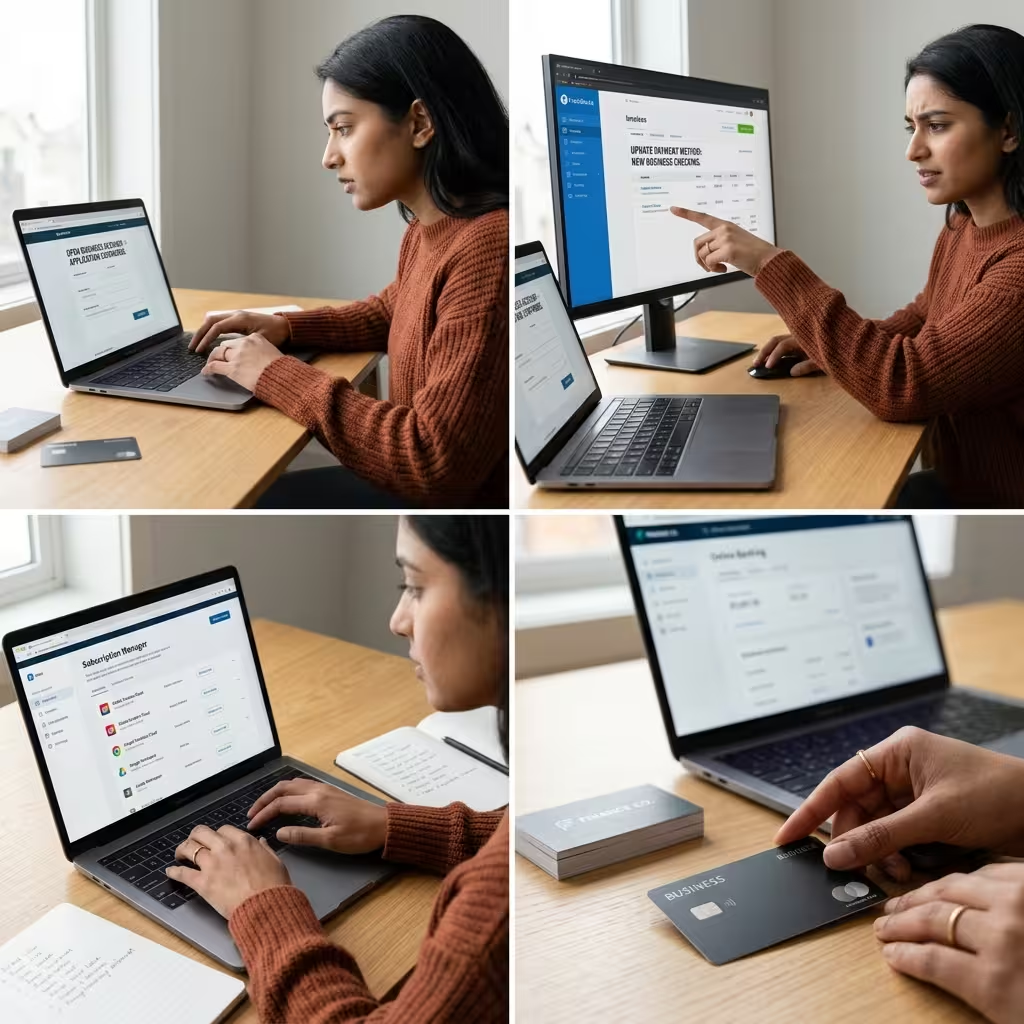
How to Transition from a Personal Account to a Freelancer Business Bank Account
The transition is genuinely straightforward. The freelancers who avoid it are usually avoiding it because it feels administrative and non-revenue-generating. It is administrative. So is paying $2,800 to clean up three years of mixed records. One of these is preventable.
Quick Transition Checklist
- Open the new business account first
- Update client payment instructions
- Move recurring subscriptions and tool charges
- Stop routing freelance income through the personal account
- Connect the new account to your bookkeeping workflow
-
Open the Account:
For most freelancers, a digital neobank like Mercury, Found, or Lili takes 15 to 30 minutes and requires an EIN or SSN, a business name, and a government-issued ID. There is no credit check or branch visit required.
Here’s the full list of documents needed to open a business bank account. - Notify Your Clients: Update your invoice payment instructions to the new account right away. Send a short, professional note to your recurring clients with the updated banking information.
- Redirect Your Subscriptions: Move any business software subscriptions, tool renewals, and recurring business charges over to your new business debit card or account number.
- Stop All Commingling: From this point forward, every single transaction in the business account must have a clear business purpose. Keep your personal expenses strictly in your personal account.
- Connect to Accounting Software: Link your business account to tools like QuickBooks, Xero, or the bank’s built-in tools while your financial history is still clean and short.
For most freelancers, switching accounts is simpler than cleaning up mixed records later. Better structure now usually prevents bigger problems later.
Quick note: If you’re scanning for fast answers, start here. Each answer below should begin with the short version first, then explain the reasoning.
Questions People Actually Ask
Why shouldn’t I use a personal bank account for freelancing?
Because it usually creates weaker tax documentation, messier bookkeeping, and less credible business records.
The practical costs are real: higher bookkeeping fees, audit exposure from mixed records, weaker deduction documentation, reduced loan eligibility, and legal liability risk for LLC owners. None of these problems are hypothetical. They show up consistently for freelancers who commingle funds for multiple years before untangling things.
Is it illegal to use a personal account for business income?
No, it is usually not illegal for sole proprietors to use a personal account for business income.
Not for sole proprietors. There’s no legal requirement to maintain a separate account for most freelance structures. The consequences are financial rather than legal — harder documentation, higher professional fees, audit risk, and loan denial. The exception is LLC owners, where commingling can threaten the personal liability protection the LLC structure is designed to provide.
What are the benefits of opening a business account as a freelancer?
A business account gives freelancers cleaner records, easier expense tracking, stronger tax documentation, and better financial separation.
Clean audit trail. Defensible tax deductions. Lower bookkeeping costs. Better loan eligibility. Automatic tax reserve tools in platforms like Found and Lili. Legal liability protection for LLC operators. Real-time financial clarity through dashboards that personal accounts don’t typically provide.
How do I transition from a personal to a business bank account for freelancing?
Open a business account at a digital platform (Mercury, Found, Lili — no monthly fee options available). Notify clients with updated payment instructions. Move business subscriptions to the new account. Stop depositing business income into the personal account. Connect accounting software to the business account and start clean.
How does separating accounts help with IRS audits?
It creates a clearer record of which income and expenses belong to the business.
A business account creates a transaction record where every item is presumptively business-related. This makes documenting deductions faster, cheaper, and more defensible. It also removes the income-mismatch risk that comes from business deposits mixed into personal accounts — the IRS’s AI-powered systems use bank deposit analysis even when 1099 forms aren’t issued.

What Emily Did After the Cleanup
Bottom Line
A freelancer can often use a personal account legally, but that does not usually make it the better long-term setup. In most cases, a separate business account creates cleaner records, easier bookkeeping, stronger deduction support, and better financial credibility.
- Sole proprietors: Often allowed to use a personal account, but usually better off with a dedicated business account
- LLC owners: Should be much more careful about commingling because account separation helps support legal separation
- Freelancers planning to grow: A business account usually pays off in cleaner taxes, stronger records, and less cleanup later
She opened a Found account the week after her audit response was filed.
Zero monthly fee. Built-in tax estimates. Schedule C generation. Everything depositing to one place that was clearly business-only.
Her accountant’s fee for the following year dropped from $2,800 to $600. Her quarterly estimates were automated. When she applied for a business line of credit eight months later, the lender reviewed her Found account history, saw clean P&L data, and approved the application in four days.
The cleanup cost was $2,800. The prevented future cost is harder to calculate — but it’s real every year.
The business account didn’t make Emily a better freelancer. It just stopped her financial structure from working against her.
About the Author Marcus Delray covers tax strategy, small business finance, and banking tools for freelancers and independent contractors. He has written on IRS compliance, solo operator tax planning, and business banking for nine years.
Disclaimer: This article is for general informational purposes only. It is not tax, legal, or financial advice. All tax figures, thresholds, and regulatory details are based on publicly available information as of mid-2026 and are subject to change. Consult a licensed CPA, tax attorney, or financial professional before making any tax or banking decisions. The author and publisher accept no liability for outcomes based on this content.
Enjoying our content?
Click below to add us as a preferred source. Google will prioritize our latest articles in your Top Stories, AI Mode, and AI Overviews.
Preferred Source on Google