How Does AI Detect Financial Fraud in 2026? 5 Powerful Ways

AI catches financial fraud in 2026 by watching behavior, mapping networks, and scoring risk in milliseconds. Not days. Banks feed these systems billions of past transactions. The models learn what “normal” looks like for each account, then flag anything that doesn’t fit. Faster catches. Fewer false alarms. Billions recovered. No delay.

Fintech Analyst | AI Fraud Detection, Transaction Monitoring & Financial Crime Systems
That part’s not news anymore. Here’s the question nobody’s answering well: why does fraud detection keep delivering when so much of the rest of AI spending in finance falls flat? The industry’s median ROI on AI sits at 10%. The target is 20%. Fraud detection is one of the rare spots actually clearing that bar. Not because the model is smarter. Because the problem underneath it was built for AI from the start.
How Does AI Detect Financial Fraud in 2026?
AI detects financial fraud by watching account behavior, mapping linked entities, spotting anomalies, and scoring transaction risk in milliseconds — not hours or days. Banks and card networks train these models on billions of past transactions, so the system learns what normal looks like for each account and flags anything that breaks the pattern. No single method carries the load. Five layered methods work together.
The 5 Core Detection Methods
- Behavioral Analysis Builds a live profile per customer and flags out-of-pattern spending. Main defense against account takeover.
- Anomaly Detection Uses clustering and autoencoders to catch transactions that fit no known group. Surfaces fraud patterns nobody has seen yet.
- Graph Neural Networks Maps links between accounts, devices, and merchants to expose coordinated fraud rings that look mild one transaction at a time.
- Real-Time Card Fraud Scoring Scores authorizations in milliseconds to block enumeration attacks and card-testing scripts before they clear.
- AI Agents / Autonomous Workflows Act on flagged activity instead of only reporting it: freeze the transaction, request verification, and route the case to an investigator.
Bottom line: fraud detection works because the problem is high-volume, well-labeled, and tied to a number banks already track. That is the reason it clears the 20% AI ROI target most finance AI misses.
Table of Contents

How Does AI Detect Financial Fraud in 2026?
Short answer: it doesn’t wait. Older systems flagged a transaction, then a human looked at it hours or days later. AI scores risk the instant a card gets swiped or a transfer gets sent, using patterns pulled from historical transactional data. Visa trained its system on 15 billion transactions. Result: $40 billion saved in fraud losses in 2023 alone.
No single trick does this work. Layers do. A rule-based filter — say, flag any purchase over $2,000 in a new country — catches the obvious stuff and misses everything creative. Stack behavioral analysis, anomaly detection, and network mapping on top of that filter, and a transaction has to slip past several independent checks before it clears. That stacking is why false-positive rates have been dropping since 2023. Not a single breakthrough. A pile of smaller ones, working together.
How AI Actually Catches Fraud
No single model carries the load. Each method below catches a different failure that the others miss. A fraudulent transaction has to slip past all five before it clears.
Behavioral Analysis
Builds a live profile per customer: when they shop, where, how often, how much. Flags fast shifts in that pattern.
Best against: account takeoverAnomaly Detection
Uses clustering and autoencoders to group transactions, then flags whatever fits no group. Compares you to everyone, not just yourself.
Best against: brand-new fraud patternsGraph Neural Networks
Maps links between accounts, devices, merchants, and IPs. A single charge looks mild. The web connecting them gives the ring away.
Best against: coordinated fraud ringsReal-Time Card Fraud Scoring
Scores each authorization in milliseconds. Fast enough to catch enumeration attacks running thousands of test charges a minute.
Best against: card-testing scriptsAI Agents / Autonomous Workflows
Does not stop at flagging. It freezes the activity, requests verification, and routes the case to a human investigator with the transaction history already pulled together. All in one sequence.
Best against: slow, manual response gaps that let fraud clearWhat Makes AI Fraud Detection Different From Older Rule-Based Systems?
Old tools ran on static rules. A human wrote them. Someone updated the list on a schedule, and if a fraud pattern wasn’t already in that rulebook, it walked right through. AI-based risk scoring builds a live profile instead — one per customer — and flags anything that breaks the pattern. For a full side-by-side breakdown of false-positive rates and detection speed, see our complete comparison of rule-based vs AI fraud detection.
Static Rules vs Live AI Scoring
Rule-based filters catch the fraud someone already wrote a rule for. Anything new walks right through. Here is where the two approaches split.
- A human writes each rule by hand
- Updated on a schedule, not in real time
- Any pattern not in the rulebook walks right through
- Catches only what someone already knew to look for
- Same rules for every customer, no personal baseline
- Builds one live profile per customer
- Scores risk the instant a card is swiped
- Flags anything that breaks the learned pattern
- Surfaces fraud nobody has documented yet
- Adjusts as spending habits shift over time
Behavioral Analysis
Behavioral analysis tracks small stuff. What time someone usually shops. Which city they transact in. How often money moves. How big a typical purchase runs. When those numbers shift fast, risk goes up. This is the main method banks use against account takeover, where a criminal is operating inside a real account instead of using a stolen card number.
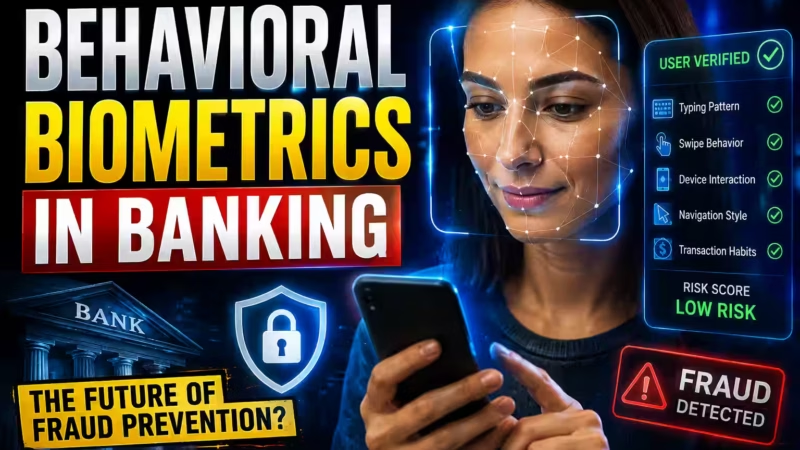
Banks increasingly pair this with behavioral biometrics in banking — typing rhythm, swipe pressure, and device handling — to keep verifying identity throughout the session, not just at login.
Anomaly Detection
Anomaly detection works differently. It uses clustering algorithms and autoencoders to group transactions, then flags whatever doesn’t belong to any group. Behavioral analysis compares a transaction to one person’s history. Anomaly detection compares it to everyone’s. That’s useful for catching fraud patterns nobody’s seen yet.
Run both at once and the gap closes. A transaction might look fine against one person’s habits but strange against the wider dataset — or the other way around. One method alone leaves that gap wide open.

What Is a Graph Neural Network and Why Does It Catch Fraud Rings?
A Graph Neural Network — GNN — maps connections. Accounts, devices, merchants, IP addresses. It doesn’t score a transaction alone. Fraud rarely happens alone either. Almost never. A stolen card number, a fake merchant account, a mule bank account: these usually share a device, an address, or a timing pattern. That’s exactly what a GNN is built to surface.
Here’s why that matters. Individual transactions from a coordinated ring often look mild by themselves. A $40 test charge here. A new account opened there. Nothing alarming on its own. It’s the web connecting them that gives the operation away, and that web is what graph-based analysis exposes. Point-in-time scoring, however good, can’t see the network sitting behind a single transaction. Graph analysis can.
This same technique — mapping accounts as nodes and transfers as edges — is exactly how graph neural networks detect money laundering chains that rule-based systems miss entirely.
How Is AI Catching Real-Time Card Fraud and Enumeration Attacks?
Card networks deal with a problem behavioral analysis doesn’t solve well on its own: enumeration attacks. Card-testing fraud. Old trick, new speed. Criminals run automated scripts, guessing valid card numbers by firing small test charges across thousands of merchants at once, hunting for which combination of card number, expiration date, and CVV clears.
Visa built its VAAI Score for exactly this. It scores the probability that an authorization attempt is part of an automated testing script instead of a real purchase. Mastercard took a parallel path and reports it has doubled its fraud detection rate using AI — 42% of issuing banks say they’ve saved more than $5 million as a direct result.
Speed ties both approaches together. Enumeration attacks run thousands of attempts per minute. Any system that needs a human review step is already too slow to matter. AI scoring has to make the call in the time it takes an authorization request to travel from a merchant’s terminal to the card network and back. Milliseconds. Not minutes.
That same speed requirement defines FedNow real-time payment fraud prevention, where a cleared transfer can’t be reversed once it settles. For online merchants specifically, a similar layered approach shows up in AI fraud prevention tools for Shopify, where card-not-present risk needs the same real-time screening.

What New Fraud Threats Is AI Also Being Used Against?
“Before it’s too late” isn’t only a headline choice here. Fraud detection AI has to keep pace with fraud creation AI, and the same tools powering a bank’s phishing detection are sitting right there for the criminals writing the phishing emails. Security researchers call this “machine speed” — attacks that used to take days of reconnaissance now take minutes, run by automated scripts testing stolen credentials and generating convincing phishing content for almost nothing.
The Deepfake Threat Is Real
A voice confirmation call sounds like solid verification until the voice on the line is generated. AI audio and video are now good enough to fool humans, and sometimes the detection systems too.
See our full breakdown of AI generated voice scams and how to detect a cloned voice before money moves.Any fraud process still leaning on a single voice or video check is already exposed.
Machine-speed attacks make it worse. Reconnaissance that used to take days now runs in minutes, driven by automated scripts testing stolen credentials and generating convincing phishing content for almost nothing. Speed is the new weapon.
Other threats moving at machine speed
- Ransomware sold as a subscription Criminal marketplaces price AI-driven ransomware and fraud tooling like legitimate software, dropping the skill floor to run a serious operation.
- Phishing content generated instantly The same tools powering a bank’s phishing detection sit right there for the criminals writing the phishing emails. Convincing lures cost almost nothing now. The best defense on the receiving end is a dedicated AI app for blocking scam calls and texts that screens unknown callers before your phone even rings.
- Machine-speed credential testing Automated scripts test stolen credentials in minutes, not days. Any process that waits on human review is already too slow to matter.
This is why layering matters more than any single tool. A deepfake can beat one check. Add device fingerprint, transaction timing, and network links through graph analysis, and the fraud has to hold up across every layer at once. Not one alone.
Social engineering is evolving just as fast on the personal side — can AI spot romance scammer scripts before a victim sends money is still mostly no, since these scripts are built to look nothing like a scam. And the identity fraud fueling many of these schemes now shows up as synthetic identity theft, where a real SSN gets stitched to a fabricated profile.
Deepfakes push this further than most people realize. AI-generated audio and video are good enough now to fool humans and, sometimes, detection systems too. That’s a direct problem for any fraud process still leaning on a voice confirmation call or a video check to approve a big transfer. Criminal marketplaces have started selling AI-driven ransomware and fraud tooling as a subscription, priced like legitimate software, which drops the skill floor needed to run a serious operation.
This is exactly why layering matters more than any single tool. A behavioral system that only checks whether a request sounds like the account holder can get fooled by a good enough deepfake. Add a check on device fingerprint, transaction timing, and network connections through graph analysis, and the fraud has to be convincing across every layer at once. Not one alone.
What’s the Difference Between a Fraud Chatbot and an Actual AI Fraud Agent?
Not every “AI fraud tool” a bank advertises does the same job. This distinction matters if you’re trying to judge whether something’s actually protecting you. A chatbot retrieves knowledge. Nothing more. It answers a question, pulling from a database, and it does nothing unless you ask it something first.
An AI agent works differently. It acts on its own, inside set guardrails, running multi-step workflows without waiting for a person to sign off on each step. In fraud, an agent doesn’t flag a suspicious transaction and stop there. It can freeze the specific activity, request extra verification, and route the case to a human investigator with the transaction history already pulled together — all in one automated sequence.
That gap explains a lot of the ROI story. Ninety percent of financial institutions already use generative AI somewhere in their fraud stack. The ones seeing the biggest returns moved past chatbot-style tools into agentic workflows that act on what they find instead of reporting it and waiting.
Fraud Chatbot vs Actual AI Fraud Agent
A chatbot and an agent sound like the same tool until fraud actually hits. One answers a question. The other acts on the flag. That gap decides whether the money is gone before anyone responds.
Fraud Chatbot
Retrieves knowledge. Nothing more. It pulls an answer from a database and does nothing until you ask it something first.
What actually happens- You ask a question, it answers
- Waits for the next prompt
- Takes no action on the transaction
- Fraud keeps clearing while you type
AI Fraud Agent
Acts on its own inside set guardrails. It runs multi-step workflows without waiting for a person to sign off on each step.
What actually happens- Freezes the suspicious activity on its own
- Requests extra verification from the customer
- Routes the case with transaction history attached
- Hands a ready file to a human investigator

Why Do 90% of Institutions Use AI for Fraud, But Most AI Projects Still Underperform?
Here’s the part most coverage skips, and it’s the real answer to why fraud detection stands out. Across the broader financial industry, median AI ROI sits at 10% — well short of the 20% target most firms set for themselves. The shortfall traces back to a handful of repeated mistakes: too many disconnected pilot programs instead of scaled deployments, AI budgets pointed at internal efficiency projects instead of high-value work like risk management, and rollouts slowed by compliance requirements, data privacy rules, and a shortage of people who understand both AI and finance well enough to deploy it safely.
Fraud detection sidesteps most of that. It has one measurable outcome: did the system stop the fraudulent transaction or not. No ambiguity about whether a pilot worked. Clean win, or not. It also funds itself — every dollar of fraud stopped is a dollar nobody has to justify to a budget committee later, unlike a chatbot rollout whose value is harder to trace to a specific number. And because fraud losses already get tracked obsessively by every bank’s finance department, fraud AI gets clean, well-labeled data to train on from day one. Other AI projects don’t get that head start.
Fraud detection isn’t winning because the AI is smarter. It’s winning because the problem was already shaped the way AI needs a problem shaped: high-volume, well-labeled, tied straight to a number the institution already tracks.
How Can You Tell If Your Bank’s Fraud Protection Is Actually Working in 2026?
Not every “AI-powered” fraud claim means the same thing. The table below breaks down what’s actually running under the hood, what each method catches best, and where it falls short alone.
| Detection Method | What It Catches Best | Speed | Main Limitation |
| Rule-Based Filters | Known, previously seen fraud patterns | Instant | Misses new or creative fraud tactics |
| Behavioral Analysis | Account takeovers, out-of-pattern spending | Real-time | Needs transaction history to build a baseline |
| Anomaly Detection (Clustering/Autoencoders) | Entirely new fraud patterns not seen before | Real-time | Can flag legitimate outliers as suspicious |
| Graph Neural Networks | Coordinated fraud rings, mule accounts, shared-device fraud | Near real-time | Needs connected data across accounts and merchants |
| AI Agents (autonomous workflows) | End-to-end response: detect, verify, act | Real-time | Needs strong guardrails to avoid wrongful account freezes |
As a customer, forget the marketing copy. Watch two things instead: does a fraud alert reach you within minutes of a suspicious charge, and does resolving it take one phone call instead of a week of dispute paperwork? That’s the real benchmark. Simple as that. Any bank claiming AI-powered fraud protection in 2026 should be able to clear it.
What To Remember
A single clever model sounds like enough until fraud finds the gap it does not cover. Here is what actually holds up once real transaction volume hits.
- No single method carries the load. Five layered checks work together, so a transaction has to slip past all of them before it clears.
- Speed is the whole game. Scoring happens in milliseconds, before an authorization request even finishes its round trip.
- Graph analysis sees what point-in-time scoring cannot. It exposes the web behind coordinated fraud rings that look mild one charge at a time.
- Agents beat chatbots on ROI. Acting on a flag beats reporting it and waiting for someone to respond.
- Judge your bank by two things. Does the alert reach you in minutes, and does resolving it take one call instead of a week of paperwork.
Bottom line: fraud detection is not winning because the AI is smarter. It wins because the problem is shaped the way AI needs it. High volume, well-labeled data, and a number the bank already tracks. That is the reason it clears the 20% ROI target most finance AI still misses.
People Also Ask – PAA’s
Does AI fraud detection replace human fraud investigators?
No. AI handles detection and scoring at a scale humans can’t match, but banks still route confirmed or ambiguous cases to people, especially for account freezes, disputes, and anything needing direct customer verification.
Can AI fraud detection cause a legitimate purchase to get declined?
Yes. That’s a false positive, and it’s still one of the tradeoffs of automated scoring. Layering methods — behavioral analysis alongside anomaly detection, for instance — is one of the main ways banks have pushed those rates down.
Is AI fraud detection only used by large banks?
No. Visa and Mastercard apply their AI models across every transaction running through their networks. Even a small community bank’s customers get covered by that same network-level AI, regardless of what the bank itself runs internally.
How fast can AI detect a fraudulent transaction?
At the card-network level, scoring happens inside the same window as the authorization request — under a second, typically. Account-level behavioral analysis can flag a pattern shift within the same session or shortly after.
Why did AI fraud detection improve so much between 2023 and 2026?
Three drivers stand out: more training data, wider use of graph-based analysis to catch coordinated rings, and a shift away from passive chatbot tools toward autonomous agents that act on a flagged transaction instead of reporting it.
Does AI fraud detection use my personal data?
Yes. It relies on your transaction history to build the behavioral baseline it compares new activity against. Financial institutions answer to data privacy and compliance rules governing how that data gets used and stored. If you want an extra layer of personal monitoring beyond what your bank provides, compare the cheapest AI identity theft protection plans with dark web monitoring.
Important Disclaimer
Please read this before relying on the information in this article.
This article is for general informational purposes only and does not constitute financial, legal, or professional advice. Fraud protection policies and AI-driven security measures vary by financial institution.
View what this means for readers ⌄
The information in this article is intended to help readers understand how AI is used in fraud detection, but it should not be treated as a substitute for institution-specific guidance or professional advice.
- Financial institutions may use different fraud detection models, response procedures, and customer notification policies.
- AI-driven monitoring tools, account protections, and dispute processes can vary by provider, region, and account type.
- Readers should confirm current fraud protection policies directly with their bank, card issuer, payment provider, or advisor where appropriate.
- This content is educational in nature and should be used as general context, not as a decision-making guarantee.
Editorial Integrity
Sources & Citations
Research on AI fraud detection, anomaly detection, graph-based risk analysis, anti-money laundering systems, payments fraud, and regulatory guidance relevant to financial crime monitoring
This article draws on research and reporting related to machine learning for fraud detection, anomaly detection in transaction streams, graph-based financial risk analysis, anti-money laundering controls, documented crypto- and payments-fraud case studies, and official regulatory guidance on AI oversight in financial services.
View full sources, methodology, and editorial notes ⌄
This article was developed using source material directly related to AI fraud detection, transaction monitoring, anti-money laundering systems, suspicious-activity modeling, and oversight expectations for AI used in financial services. Preference is given to peer-reviewed academic research, official regulatory and government documentation, and high-authority financial-crime intelligence reporting where those sources directly support claims about anomaly detection, behavioral risk scoring, graph-based analysis, laundering patterns, documented losses, and model-governance requirements. Because fraud patterns, model capabilities, enforcement activity, and regulatory expectations can change over time, readers should verify current figures and official guidance before relying on any single source operationally.
- Peer-reviewed research on GNN datasets for anti-money laundering: “The Shape of Money Laundering” (arXiv) — cited for scalable graph-based detection methods and temporal transaction-pattern modeling relevant to how AI surfaces suspicious financial relationships.
- Peer-reviewed research on GNN classification of crypto transactions: Anti-Money Laundering in Cryptocurrencies Through GNNs (IEEE Xplore) — referenced for graph-learning approaches that classify suspicious transactions beyond static rules and fixed-threshold monitoring.
- Peer-reviewed research on blockchain laundering subgraphs: “Identifying Money Laundering Subgraphs on the Blockchain” (arXiv) — used for the article’s explanation of graph-based detection of fan-in, fan-out, layering, and pass-through transaction structures.
- Public-private financial crime disruption case study: T3 Financial Crime Unit: Public-Private Disruption (TRM Labs) — referenced for real-world financial crime intervention, frozen illicit stablecoin flows, and the operational value of tracing suspicious transaction networks quickly.
- Crypto-theft investigation and laundering context: 2025 Crypto Theft Reaches $3.4 Billion (Chainalysis) — cited for recent large-scale theft patterns, laundering behavior across networks, and why adaptive models outperform simpler rule-based approaches in complex cases.
- Regulatory guidance on AI oversight in financial services: 2026 FINRA Annual Regulatory Oversight Report — GenAI (FINRA) — cited for human-oversight expectations, model risk controls, explainability concerns, and governance obligations tied to AI-assisted monitoring systems.
- Official government AML/CFT priorities documentation: FinCEN National AML/CFT Priorities (PDF) — referenced for the broader regulatory priorities, including cyber-enabled financial crime, that shape modern transaction monitoring and AML obligations.
Fact Checked & Reviewed
Verified against card network disclosures, official fraud reports, and primary industry research
Sources Checked
- AI Financial Fraud Detection 2026 — Tech Capital Hub Primary Source
- CNBC — Visa AI Fraud Prevention: $40B Stopped (2023)
- Visa Investor Relations — VAAI Score & Enumeration Attack Defense
- Mastercard — AI-Driven Fraud Detection & Security Overview
- NVIDIA — State of AI in Financial Services 2026
- Stripe Docs — Card Testing & Enumeration Attack Prevention
- Conscia — Enumeration Attacks: BIN Generation & Payment Fraud
Every fraud statistic and detection claim in this article was checked against the sources listed above. Fraud detection rates, AI capabilities, and vendor figures change over time. Verify current data directly with each provider. This content is educational and does not constitute financial or legal advice.
Our Editorial Standards
Tech Capital Hub applies Google’s E-E-A-T framework to every article on AI fraud detection, transaction monitoring, and financial crime systems, prioritizing source-backed analysis, official guidance, documented case studies, and clear system explanation over hype, vague AI claims, or unsupported performance language.
View how our editorial standards apply to this article ⌄
Grounded in Real Fraud Workflows
This article is framed around how fraud is actually detected in operational settings, not just how AI is described in marketing language. We focus on the real signals fraud teams watch in practice — unusual transaction timing, merchant anomalies, behavioral drift, linked-account activity, and suspicious transfer patterns — because many fraudulent events look normal when viewed one transaction at a time.
Fraud Models, Anomaly Detection, and System Limits
Coverage explains how AI fraud systems combine anomaly detection, behavioral scoring, rule-based controls, graph analysis, and model-driven prioritization to surface suspicious activity. We also explain where these systems struggle — including false positives, delayed escalation, fragmented data, and fast-changing attack patterns — so readers understand both the strengths and limits of AI-led fraud detection.
Research, Industry Documentation, and Regulatory Preference
Claims are anchored to peer-reviewed research, documented financial-crime investigations, official network or provider disclosures, and regulatory guidance relevant to AI oversight in financial services. We do not treat broad vendor claims, generic AI commentary, or unsupported growth narratives as sufficient support for statements about fraud performance, loss prevention, or operational impact.
Transparent, Reviewable, and Context-Aware
Fraud patterns, enforcement activity, model capabilities, and oversight expectations can change quickly, so articles are reviewed and updated as stronger source material becomes available. Nothing on this page is legal, financial, or compliance advice. Corrections or source challenges can be submitted directly to our editorial team at editorial@techcapitalhub.com.
About the Author
Marcus Delray
Fintech Analyst | AI Fraud Detection, Transaction Monitoring & Financial Crime Systems
Marcus Delray writes about how AI detects financial fraud across payments, account activity, and transaction flows. He focuses on the practical mechanics behind anomaly detection, behavioral scoring, pattern recognition, false-positive control, and the fraud-monitoring systems financial institutions use to identify suspicious activity in real time.
View full author bio, credentials, and links ⌄
Marcus Delray is a fintech analyst and founder of Tech Capital Hub, where he covers AI-driven fraud detection, anti-money laundering systems, transaction monitoring, and the data infrastructure financial institutions use to manage fraud risk.
On financial fraud topics, he focuses on how modern detection systems actually work in practice: machine learning models that flag unusual spending behavior, graph-based methods that uncover suspicious account relationships, anomaly detection systems that surface outlier transactions, and layered review workflows that balance fraud prevention against customer friction and false positives.
Rather than repeating generic AI claims or vendor marketing language, he emphasizes source-backed analysis, practical system design, enforcement context, and clear explanation of where fraud models succeed or fail. His goal is to help readers understand how AI fits into real fraud operations — from card fraud and account takeover to mule networks, suspicious transfers, and broader financial crime detection.
- Covers AI fraud detection, transaction monitoring, AML systems, payment risk models, and financial crime technology
- Explains how anomaly detection, behavioral scoring, and graph-based analysis help surface suspicious financial activity
- Tracks model tradeoffs such as false positives, review thresholds, operational escalation, and fraud-response speed
- Grounds analysis in source-backed reporting, documented fraud patterns, institutional workflows, and practical financial-risk context rather than broad vendor hype
Enjoying our content?
Click below to add us as a preferred source. Google will prioritize our latest articles in your Top Stories, AI Mode, and AI Overviews.
Preferred Source on Google