
How Does Cryptocurrency Work for Beginners, Step by Step? The Walkthrough Most Guides Skip


Fintech Analyst | Cryptocurrency, Blockchain & Digital Assets
Cryptocurrency is a form of digital money secured by cryptography and recorded on a decentralized public ledger called a blockchain. When you send crypto, your wallet signs the transaction with a private key, broadcasts it to a global network of computers, and miners or validators confirm it—permanently and without a bank in the middle. Once confirmed, the transaction cannot be reversed.
If you don’t understand how does cryptocurrency work for beginners before you send your first transaction, you can lose money with no way to get it back. There’s no bank teller to call, no fraud department, no “undo” button. Crypto transactions are final the moment the network confirms them. That single fact — more than any chart or price prediction — is what a beginner actually needs to grasp first.
If you’re still fuzzy on the bigger picture before the mechanics, our guide to what cryptocurrency is and how it works ties the whole foundation together first.
Before You Start
Who Is This Guide For, and How Do You Use It?
This is a plain-English guide for first-time cryptocurrency users in the US who are about to send their first transaction. It assumes no prior knowledge of blockchain, wallets, or crypto jargon. If you want to understand exactly what happens before you move any funds, start here.
- Complete beginners with no blockchain background
- US-based readers navigating current crypto rules
- Anyone about to send their first crypto transaction
- People who want the mechanics, not the hype
- How a crypto transaction is signed and confirmed
- The difference between a wallet and a private key
- Confirmation times on Bitcoin and Ethereum
- Common beginner mistakes that cause permanent loss
- US crypto regulation, including the GENIUS Act
This guide is not investment advice. It does not offer price predictions, trading strategies, or recommendations on which coins to buy. The focus stays on how cryptocurrency works and how to avoid costly beginner errors — nothing about timing the market or growing a portfolio.
How to Use This Guide
- Read it top to bottom before sending any funds. Each section builds on the last, so the order matters for a first-time user.
- Pay close attention to the mistakes section. Crypto transactions are irreversible once confirmed — there’s no fraud department to call.
- Send a small test amount first. Before moving anything significant, confirm the address and network work with a tiny transfer.
- Come back as a reference. Use the wallet, confirmation, and safety sections again whenever you send to a new address.
Key Topics in This Guide
Table of Contents
How Does Cryptocurrency Work for Beginners, in Plain English?
Cryptocurrency is digital money secured by math and recorded on a public ledger that no single person or company controls. When you send crypto, you’re not moving money through a bank’s private ledger. You’re broadcasting a signed message to thousands of computers around the world, and those computers agree, together, that the transaction happened. That agreement — not a company’s database — is what makes the transaction real.
This matters for anyone learning how cryptocurrency works for beginners because it flips the assumption most new users start with. There’s no customer service line standing between you and your money. The network itself is the record keeper, and once it writes something down, that record doesn’t change.

What Happens Physically When You Hit “Send”?
When you send cryptocurrency, your wallet creates a digitally signed transaction, broadcasts it to the network, and miners or validators confirm it before it’s permanently recorded on the blockchain. The whole process typically takes seconds to ten minutes for the first confirmation, depending on the network.
Picture writing a check, except the check signs itself with math, and the entire world gets a copy of it at the same time.
Here’s the sequence, in order:
Step 1: You create the transaction. You enter the recipient’s wallet address and the amount. Your wallet software uses your private key to create a digital signature — proof that you, and only you, authorized this specific transfer.
Step 2: The transaction broadcasts to the network. Your signed transaction goes out to nodes (computers running the cryptocurrency’s software) across the network. Each node checks the transaction’s validity before it can be confirmed and added to the blockchain.
Step 3: It sits in the mempool. Unconfirmed transactions wait in what’s called the mempool (short for memory pool) — a holding area of pending transactions — until miners or validators pick them up. Once your transaction passes initial checks, it moves into this waiting room. During periods of high network activity, the mempool can become congested, and transactions offering higher fees get prioritized for inclusion in the next block.
Step 4: Miners or validators confirm it. On proof-of-work networks like Bitcoin, miners group verified transactions into a block and compete to solve a cryptographic puzzle, trying billions of combinations to find a valid answer. On proof-of-stake networks like Ethereum, Solana, and Cardano, validators confirm transactions based on how much cryptocurrency they’ve staked as collateral, rather than computing power.
Step 5: The transaction gets recorded permanently. Once a transaction is included in a block, it’s considered confirmed, and each additional block added on top increases its finality and security.
That’s the whole cycle. No bank clearinghouse, no three-to-five-business-days delay for wire transfers, no manual reconciliation. Just computers agreeing with each other, in public, permanently.
💡 Beginner tip — Transaction Fees and Gas Fees: Every transaction on a cryptocurrency network costs a small fee paid to the miners or validators who confirm it. On Bitcoin, this is called a transaction fee. On Ethereum and similar networks, it’s called a gas fee. Fees vary based on network congestion: the busier the network, the higher the fee required to get your transaction confirmed quickly. Before sending, check the current fee estimate in your wallet — some wallets let you adjust the fee to trade speed for cost.

Who Actually Confirms Your Transaction — and Why Does That Matter in 2026?
Miners and validators are the computers and participants that confirm crypto transactions. As of 2026, US regulators have formally classified their role as “ministerial” — meaning no single company controls or intermediates your payment.
Beginners often assume a company is quietly running things behind the scenes. That assumption isn’t just wrong — it’s now legally settled in the United States.
On March 17, 2026, the SEC and CFTC issued joint interpretive guidance that classified mining and staking as “ministerial” rather than “managerial” activities. In plain terms, regulators decided that the people and computers validating your transaction aren’t acting as financial intermediaries selling you a security — they’re just doing maintenance work on public infrastructure. The same guidance extended that classification to wrapping tokens for cross-chain transfers and to airdrops where you didn’t pay anything to receive them.
This lands at an interesting moment for a new user. You’re learning the mechanics of sending crypto during the exact stretch when US regulators finally put a name to what miners and validators are doing — confirming that no single company “owns” the process of confirming your payment. That’s part of why crypto transactions work the way they do: no institution sits in the middle collecting a toll or claiming responsibility. The validation is distributed by design, and as of this year, that design has an actual regulatory definition behind it, not just a technical one.
What’s the Difference Between a Wallet, a Private Key, and an Exchange?
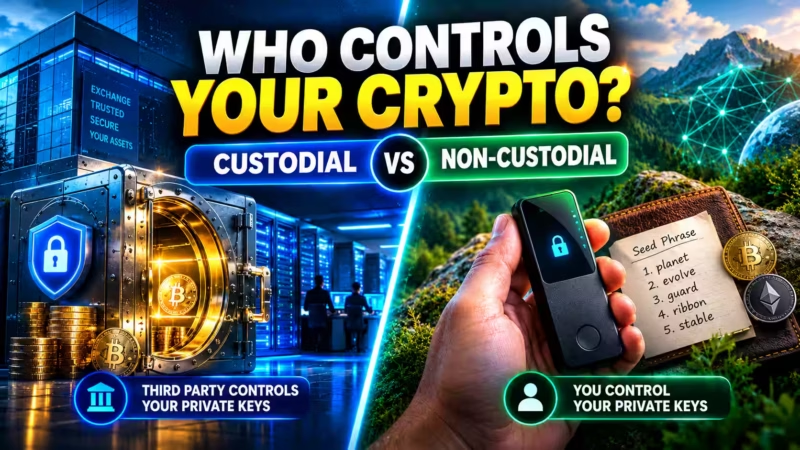
A crypto wallet stores your private keys — not your coins. A private key is the credential that authorizes transactions. An exchange is a company that holds crypto on your behalf, like a brokerage holds stocks.
These three words get mixed up constantly, and mixing them up is how beginners lose money.
A wallet doesn’t actually store your coins. It stores your keys — the credentials that prove ownership and let you spend. The coins themselves live on the blockchain; your wallet is more like the key to a safe deposit box that everyone can see but only you can open.
A private key is the piece of the wallet that matters most. Every cryptocurrency transaction requires this key to authorize the request, and only you have access to it — it’s automatically generated and unique for each transaction. Lose it, and there’s no password reset. Anyone who gets it can move your funds, and there’s no fraud department to call.
An exchange (Coinbase, Kraken, Binance.US) is a company that holds crypto on your behalf, similar to how a brokerage holds your stocks. When your crypto sits on an exchange, you’re trusting that company’s security, not managing your own private key directly. That trade-off is worth understanding before you decide where to keep your coins long-term.
These three words get mixed up constantly, so it helps to review the common crypto terms explained for beginners before you move any funds.
Wallet Types at a Glance
💡 Beginner tip — Block Explorers: A block explorer is a free public tool (e.g., Blockchain.com for Bitcoin, Etherscan for Ethereum) that lets anyone look up any wallet address or transaction ID and verify its status in real time. If your transaction shows “pending,” a block explorer will show you exactly where it is in the confirmation process — without needing to contact an exchange or support team.
| Wallet Type | Who Holds the Private Key | Best For | Main Risk |
|---|---|---|---|
| Exchange account Custodial | The exchange | Buying, selling, trading actively | Exchange gets hacked or freezes withdrawals |
| Software wallet e.g., MetaMask, Trust Wallet | You, stored on your device | Everyday transactions, connecting to apps | Device gets compromised or lost |
| Hardware wallet e.g., Ledger, Trezor | You, stored offline on a physical device | Long-term storage of larger amounts | Losing the physical device or seed phrase |

How Long Does a Crypto Transaction Take to Confirm?
It depends entirely on which network you’re using, and beginners are frequently surprised by how different the wait can be.
Bitcoin blocks, which contain the most recent batch of transactions, get added to the blockchain roughly every 10 minutes, so your first confirmation typically arrives within that window. But one confirmation isn’t the finish line. Bitcoin transactions are generally considered secure after 6 confirmations, while Ethereum transactions are considered secure after around 30 confirmations — though Ethereum’s confirmations arrive much faster per block, so the wait times end up in a similar ballpark for most everyday transfers.
| Network | Consensus Method | Confirmations for Security | Typical Block Time |
|---|---|---|---|
| Bitcoin | Proof of Work | ~6 confirmations | ~10 minutes per block |
| Ethereum | Proof of Stake | ~30 confirmations | ~12 seconds per block |
The practical takeaway for how does cryptocurrency work for beginners: don’t panic if your transaction shows “pending” for a while. Check how many confirmations the network you’re using recommends before you consider the funds fully settled, especially if you’re sending a large amount.

What Mistakes Wipe Out Beginners’ Money — and How Do You Avoid Them?
The most common beginner mistakes include sending to the wrong network, copy-paste address errors, and forgetting required memo or destination tags — all of which result in permanent, unrecoverable loss.
This is the part most beginner guides skip entirely, and it’s the part that actually costs people money.
Sending to the Wrong Network
Ethereum, BNB Smart Chain, and Polygon all generate wallet addresses that start with “0x” and look identical to the untrained eye. Because the address format looks valid, your wallet will happily process the transaction — even if you send a token using the wrong network to an exchange that only recognizes it on a different one, and the exchange’s systems never see the deposit. There’s no dramatic warning screen most of the time. The transaction just goes to a place no one can access.
Copy-Paste Errors
A single wrong character in a wallet address is enough. In one widely cited 2019 case, a user sent 800 Bitcoin, worth roughly $1 million at the time, to the wrong address because of a single character difference — and because Bitcoin transactions are irreversible, the funds were gone for good. This is not a rare edge case; it’s the single most common way beginners lose funds outright.
Forgetting a Required Memo or Tag
Some cryptocurrencies need more than an address. Coins like XRP, Stellar Lumens, and certain BNB deposits require an additional memo or tag alongside the address, and if you forget to include it, the receiving exchange won’t know which account to credit — turning a routine deposit into a support ticket that may never get resolved.
These three habits prevent nearly every irreversible slip, and our deeper guide to beginner crypto mistakes to avoid covers the rest of the errors new users repeat every cycle.
How to Protect Yourself
Always copy and paste addresses rather than typing them manually, verify the first six and last six characters match exactly, and send a small test amount before transferring anything significant. These three habits prevent nearly every irreversible mistake a beginner is likely to make.
There’s also a broader risk beyond simple errors: outright fraud. The FBI’s Internet Crime Complaint Center logged 181,565 crypto-related complaints in 2025, with total losses reaching $11.366 billion and an average loss of $62,604 per complainant. That average is worth sitting with — it’s not small-dollar mistakes driving that number. It’s people sending meaningful sums to scammers who impersonate exchanges, “support” accounts, or investment platforms. No legitimate exchange will ever ask for your private key.
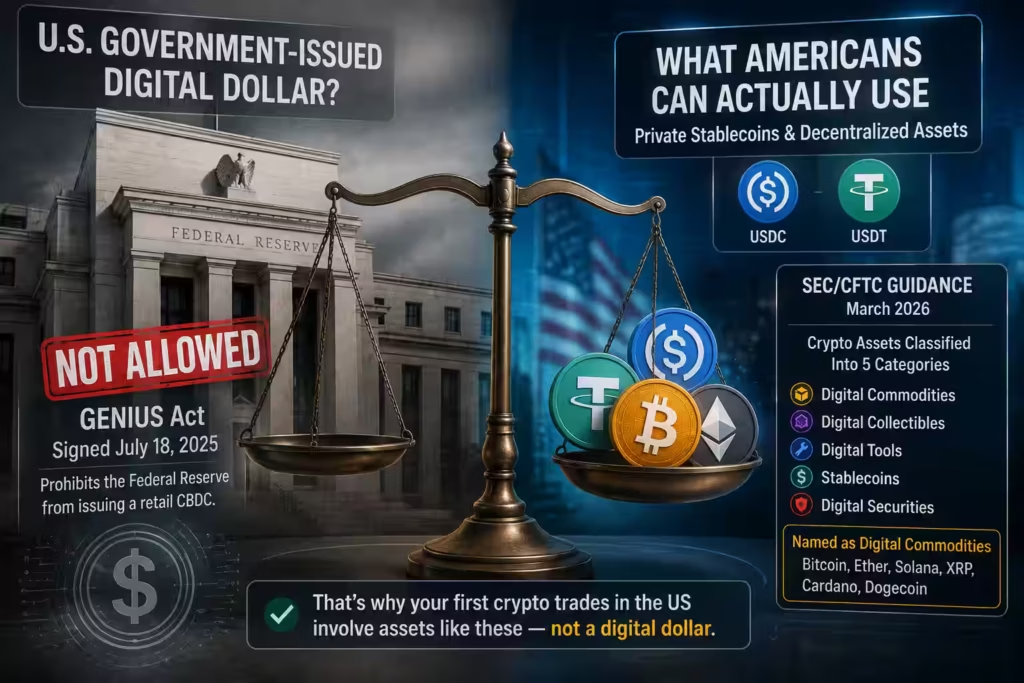
Why Doesn’t the US Government Just Issue Its Own Digital Dollar?
Because Congress decided against it, and that decision directly shapes what “beginner crypto” looks like in the US right now.
The GENIUS Act, signed into law on July 18, 2025, explicitly bars the Federal Reserve from issuing a retail Central Bank Digital Currency — meaning ordinary Americans will never hold a digital dollar directly on the Fed’s balance sheet, the way people in China can hold e-CNY through WeChat Pay and Alipay. Instead, the law built a regulatory framework for private companies to issue “payment stablecoins,” dollar-pegged tokens backed by reserves like Treasury bills.
That’s why almost every beginner’s first crypto transaction in the US involves either a decentralized asset like Bitcoin or Ether, or a private stablecoin like USDC or USDT — never a government-issued digital dollar. There isn’t one, and current law says there won’t be. Meanwhile, the March 2026 SEC/CFTC guidance sorted crypto assets into five categories — digital commodities, digital collectibles, digital tools, stablecoins, and digital securities — with Bitcoin, Ether, Solana, XRP, Cardano, and Dogecoin specifically named as digital commodities, not securities. That classification is why you can buy and hold these assets on a mainstream US exchange without the exchange treating the purchase like a stock trade.

Is Cryptocurrency Safe for a Complete Beginner in 2026?
Safe is the wrong word — accurate is better. The blockchain itself is extremely hard to tamper with once a transaction is confirmed. The risk sits almost entirely with human error and human deception: wrong addresses, wrong networks, phishing links, and fake support accounts.
Community banking groups, including the Independent Community Bankers of America, have raised a separate concern worth knowing about even as a beginner: if stablecoins start paying interest, they warn it could pull deposits away from local banks that fund small business and agricultural loans — a projected $1.3 trillion shift that could shrink local lending by an estimated $850 billion. That’s not a reason to avoid crypto personally, but it’s part of the bigger picture beginners rarely see: the technology you’re learning to use is also reshaping where money sits in the broader economy.
For a first-time user, the safest approach is small and slow. Buy a small amount on a regulated US exchange, send a test transaction before moving anything larger, write down your seed phrase on paper (never a screenshot), and treat every unsolicited message about your wallet as a scam until proven otherwise.
This article is general educational information, not financial or investment advice. Cryptocurrency values are volatile and transactions are irreversible; consult a licensed financial professional before investing.
People Also Ask
What happens when you send cryptocurrency?
Your wallet signs the transaction with your private key, broadcasts it to the network, and miners or validators confirm it before it’s permanently recorded on the blockchain. The whole process typically takes anywhere from seconds to about ten minutes for the first confirmation, depending on the network.
How does a crypto transaction get confirmed?
Nodes across the network check that the transaction is valid, then miners (proof-of-work networks like Bitcoin) or validators (proof-of-stake networks like Ethereum) group it into a block. Once added to the blockchain, each following block adds another layer of confirmation and security.
What’s the difference between a wallet and an exchange account?
A wallet where you control the private key means you hold your own funds directly. An exchange account is custodial — the company holds the private key on your behalf, similar to a bank holding your money.
Can you reverse a cryptocurrency transaction if you send it to the wrong address?
Almost never. Once a transaction is confirmed on the blockchain, it’s permanent. Recovery sometimes depends on whether the address belongs to a person or exchange willing to help, but there’s no guaranteed process, unlike a bank reversal.
Why can’t Americans use a government-issued digital dollar?
The GENIUS Act, signed in July 2025, prohibits the Federal Reserve from issuing a retail CBDC to the public. US policy instead relies on regulated private stablecoins to fill that role.
Editorial Integrity
Sources & Citations
Primary documentation on cryptocurrency basics, blockchain transaction mechanics, wallet and private key security, and current US crypto regulation directly relevant to first-time users
This article draws on the original Bitcoin whitepaper, official Ethereum developer documentation on transactions and accounts, established hardware-wallet guidance on private keys, the FBI’s 2025 Internet Crime Report, and the primary legislative text behind current US crypto policy. These sources support how the article explains sending a transaction, what a wallet and private key actually control, the real cost of beginner mistakes, and why the US has no retail digital dollar.
View full sources, methodology, and editorial notes ⌄
This article was developed using primary technical documentation and official government sources directly related to how cryptocurrency transactions work, how wallets and private keys manage ownership, the documented risks beginners face, and the US regulatory framework that shapes what a first crypto transaction looks like. Preference is given to original protocol documentation, official developer references, established wallet-security guidance, and primary government and legislative sources where those directly support claims about transaction mechanics, key custody, reported losses, and current law. Because network behavior, loss figures, and regulatory guidance can change over time, readers should verify current documentation and official guidance before relying on any single source operationally.
- Foundational blockchain and transaction mechanics: Bitcoin: A Peer-to-Peer Electronic Cash System (Satoshi Nakamoto) — cited for how a signed transaction broadcasts to a distributed network and how proof-of-work confirmation records it permanently without a central intermediary.
- How a transaction is created and signed: Transactions — Ethereum Developer Documentation — cited for the explanation that transactions are cryptographically signed instructions from an account and must be validated before they update the network.
- What a wallet and account actually control: Accounts — Ethereum Developer Documentation — cited for the distinction that an account holds a balance and sends messages on-chain, while the wallet manages the keys rather than storing the coins themselves.
- Private key and seed phrase security: Public & Private Keys Explained (Trezor) — cited for the point that a private key grants full control of funds, that there is no password reset, and why offline key storage matters for larger holdings.
- Documented losses and fraud figures for beginners: 2025 IC3 Annual Report (FBI Internet Crime Complaint Center, PDF) — cited for the 181,565 crypto-related complaints, $11.366 billion in losses, and $62,604 average loss per complainant referenced in the article.
- US stablecoin framework and no retail digital dollar: S.1582 — GENIUS Act, Full Text (119th Congress) — cited for the regulatory framework governing payment stablecoins that beginners commonly use in place of a government-issued digital dollar.
- Prohibition on a retail central bank digital currency: H.R.3633 — CBDC Prohibition, Full Text (119th Congress) — cited for the provision barring the Federal Reserve from directly issuing a retail central bank digital currency to individuals.
Our Editorial Standards
Tech Capital Hub applies Google’s E-E-A-T framework to every beginner cryptocurrency guide, prioritizing original protocol documentation, official developer references, primary government sources, and the actual text of current legislation over generic commentary, price speculation, or unsupported claims.
View how our editorial standards apply to this article ⌄
Grounded in What Actually Happens When You Hit Send
This article follows a real transaction from start to finish, not just the idea of one. We walk through the moment you sign a transfer with your private key, watch it broadcast to the network, wait in the mempool, and pass through confirmation before it settles. Each step reflects what a first-time user sees on screen, including why a “pending” status is normal rather than a cause for panic.
Wallets, Keys, and How Networks Confirm
Coverage explains the distinctions that cost beginners money: how a wallet holds keys rather than coins, why a private key grants full control with no password reset, and how custodial exchange accounts differ from self-custody. We also clarify how proof-of-work and proof-of-stake confirm transfers differently, so you understand why confirmation times and security thresholds vary between networks.
Primary Documentation and Government Sources
Claims are anchored to primary material: the original Bitcoin whitepaper, official Ethereum developer documentation on transactions and accounts, the FBI IC3 2025 report citing 181,565 crypto complaints and $11.366 billion in losses, and the legislative text of the GENIUS Act and the CBDC prohibition bill. We do not treat social posts, promotional threads, or vague commentary as sufficient support for statements about mechanics, losses, or law.
Transparent, Reviewable, and Safety-First
Crypto transactions are irreversible once confirmed, so we state risks and tradeoffs plainly rather than softening them. Network behavior, loss figures, and regulations can change, so this guide is reviewed and updated as stronger source material becomes available. Nothing here is financial or investment advice. Corrections or source challenges can be submitted directly to our editorial team at editorial@techcapitalhub.com.
About the Author
Marcus Delray
Fintech Analyst | Cryptocurrency Basics, Blockchain Technology & Digital Assets
Marcus Delray writes about how cryptocurrency actually works for people sending their first transaction. He focuses on the practical mechanics: how a transfer gets signed and confirmed, what a wallet and a private key really control, and the beginner mistakes that quietly cost people money. His goal is to turn confusing crypto concepts into clear steps you can follow before you move any funds.
View full author bio, credentials, and links ⌄
Marcus Delray is an analyst and founder of Tech Capital Hub, where he covers cryptocurrency basics, blockchain transaction mechanics, wallet and key custody, and the US regulation that shapes what a first crypto transaction looks like.
On beginner crypto topics, he focuses on what happens the moment you hit send: how your wallet signs a transfer with your private key, how the transaction broadcasts to the network and waits in the mempool, and how miners or validators confirm it before it settles permanently. He explains why a wallet holds keys rather than coins, how a custodial exchange account differs from self-custody, and why an irreversible transaction leaves no room to call a fraud department.
Rather than repeating price headlines or hype, he emphasizes source-backed explanation and the real tradeoffs a new user faces. He grounds his coverage in primary material, including protocol documentation, official developer references, the FBI IC3 loss data, and current US law, so readers understand not just how crypto works, but where the risks and safeguards actually sit.
- Explains how a crypto transaction is created, signed, broadcast, and confirmed across proof-of-work and proof-of-stake networks in plain terms
- Breaks down the difference between a wallet, a private key, and a custodial exchange account, and why that distinction protects your funds
- Details why confirmed transactions are irreversible and the beginner mistakes — wrong network, copy-paste errors, missing memos — that lead to permanent loss
- Grounds analysis in current US crypto regulation, including the GENIUS Act and the retail CBDC prohibition, alongside primary documentation over hype or unsupported claims
Enjoying our content?
Click below to add us as a preferred source. Google will prioritize our latest articles in your Top Stories, AI Mode, and AI Overviews.
Preferred Source on Google





5 thoughts on “How Does Cryptocurrency Work for Beginners, Step by Step? The Walkthrough Most Guides Skip”