
Common Crypto Terms Explained for Beginners: 15 You Need Before You Buy

Fintech Analyst | Cryptocurrency, Blockchain & Digital Assets
Common crypto terms explained for beginners include blockchain, wallet, private key, seed phrase, gas fee, staking, smart contract, stablecoin, and confirmation. In 2026, some of these terms also carry legal weight in the US, especially when the difference between a digital commodity and a digital security determines how an asset is regulated.
Most beginners treat crypto vocabulary as decoration — jargon people use to sound like they know what they’re doing. That assumption is wrong in a way that actually matters now. As of March 2026, several of these terms carry federal legal weight: whether an asset is a “digital commodity” or a “digital security” determines whether it falls under SEC oversight at all, and getting that distinction wrong isn’t just embarrassing, it’s the difference between owning a coin and owning a registered security.
If you’re brand new, it helps to first read what cryptocurrency is and how it works, then come back here to lock in the vocabulary.
Common Crypto Terms Explained for Beginners: Where Do You Actually Start?
Skip the alphabetical dictionary approach for a minute. The terms that matter fall into three groups: words that describe the technology (blockchain, wallet, private key), words that describe the money mechanics (gas fees, staking, smart contract), and words that describe your legal exposure (digital commodity, digital security, payment stablecoin). Most glossaries only cover the first group. The third group is newer, and it’s the one that actually changed in 2026.
On March 17, 2026, the SEC and CFTC jointly issued an interpretive release, effective March 23, 2026, that organized crypto assets into five legal categories, according to legal summaries of the guidance published by major law firms shortly after release. That shift matters because some of the terms below are no longer just technical shorthand. They can now affect whether an asset is treated more like a commodity, a security, or something else entirely under US law.
Key Takeaways
The terms below are the ones most likely to save a beginner from making an expensive mistake.
1 A wallet does not hold your coins It holds the credentials that let you control them
Crypto stays recorded on the blockchain. A wallet is the tool that stores the keys or credentials used to access and authorize movement of those assets.
2 Your private key and seed phrase are not normal passwords If someone gets them, they can take everything
A private key authorizes transactions. A seed phrase can restore the wallet that holds those keys. There is usually no reset button, no account freeze, and no customer support reversal if they are exposed or lost.
3 Gas fees change with network demand The same action can cost very different amounts
On networks like Ethereum, fees rise when block space is crowded and fall when activity cools off. That means timing can affect cost more than many beginners expect.
4 A confirmation is what makes a transaction stick Before that, it is not truly settled
Once a transaction is confirmed on the blockchain, reversing it is generally not something you can do by calling a bank or disputing a charge.
5 Some crypto terms now carry legal consequences Especially digital commodity, digital security, and payment stablecoin
These labels are not just technical vocabulary anymore. They can affect how an asset is regulated, what rules apply to issuers or platforms, and what kind of exposure a buyer may be taking on.
Table of Contents

Which 15 Terms Do You Need Before You Buy Anything?
These are the crypto terms beginners run into first — not in theory, but in the exact order they tend to matter once you start reading exchanges, wallets, or beginner guides.
- Blockchain — A shared digital record of transactions, copied across thousands of computers, where no single party can quietly change the history.
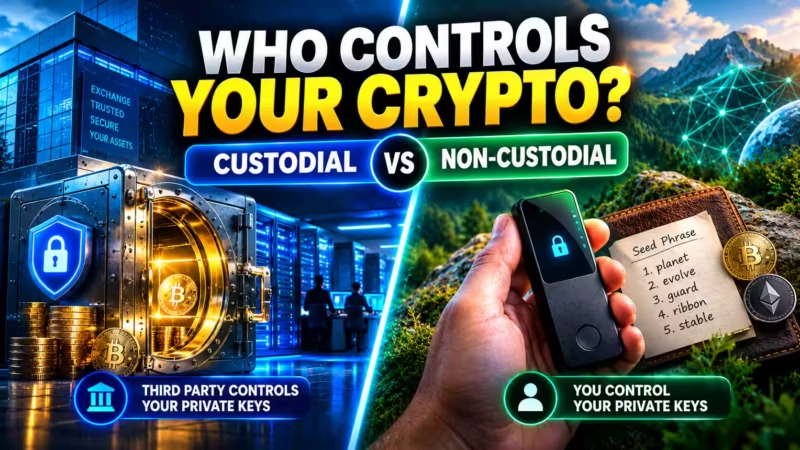
- Wallet — Software or hardware that stores the credentials used to access and control your crypto, rather than storing the coins themselves.
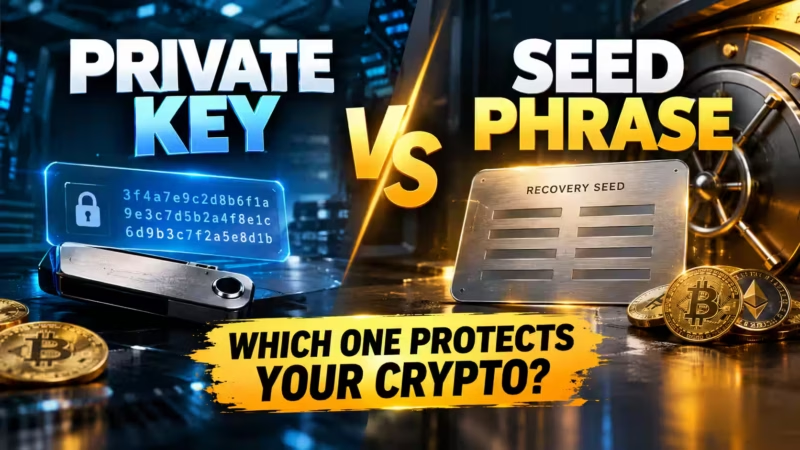
- Private key — A secret cryptographic credential that lets you authorize transactions from your wallet. Whoever controls it controls the funds.
- Seed phrase — A list of 12 to 24 words that can regenerate your private keys if your device is lost or damaged. Anyone who sees this phrase can steal everything in the wallet.
- Public address — The string of characters you share to receive crypto, similar to an account number.
- Exchange — A company (Coinbase, Kraken, Binance.US) where you buy, sell, or trade crypto using dollars.
- Gas fee — The fee paid to process a transaction on a blockchain network such as Ethereum, where costs rise and fall with network demand.
- Mining — The process of verifying transactions on proof-of-work networks like Bitcoin by solving computational puzzles.
- Staking — Locking up crypto to help verify transactions on proof-of-stake networks like Ethereum, in exchange for rewards.
- Smart contract — Code that runs automatically on a blockchain when certain conditions are met, without a middleman enforcing it.
- Digital commodity — A federal legal classification (as of March 2026) for crypto assets like Bitcoin and Ether that are not treated as securities.
- Digital security — A federal legal classification for tokenized financial instruments — think tokenized stocks or bonds — that must follow full SEC registration rules.
- Stablecoin — A crypto asset designed to hold a steady value, usually pegged to the US dollar.
- Airdrop — A free distribution of tokens to a community, usually to build early adoption.
- Confirmation — Evidence that a blockchain transaction has been included in the ledger and recognized by the network as recorded.
What Do the Basic Building-Block Terms Actually Mean, in Plain English?
Blockchain, Wallet, and Private Key
A blockchain works like a shared notebook that thousands of people hold copies of at once. Nobody can erase a page without everyone else noticing. Your wallet is the tool that lets you write in that notebook, and your private key is the signature only you can produce. Lose the key, lose access — permanently, with no customer service line to call.
Gas Fees and Smart Contracts
Gas fees exist because someone has to pay the computers verifying your transaction. When lots of people are transacting at once, that fee climbs; when the network is quiet, it drops. Smart contracts are the reason crypto can automate agreements — a smart contract might automatically release funds once a condition is met, without a bank or lawyer supervising the exchange.
Which Terms Changed Their Legal Meaning in 2026?
This is the part most glossaries skip entirely, and it’s the part that actually protects you.
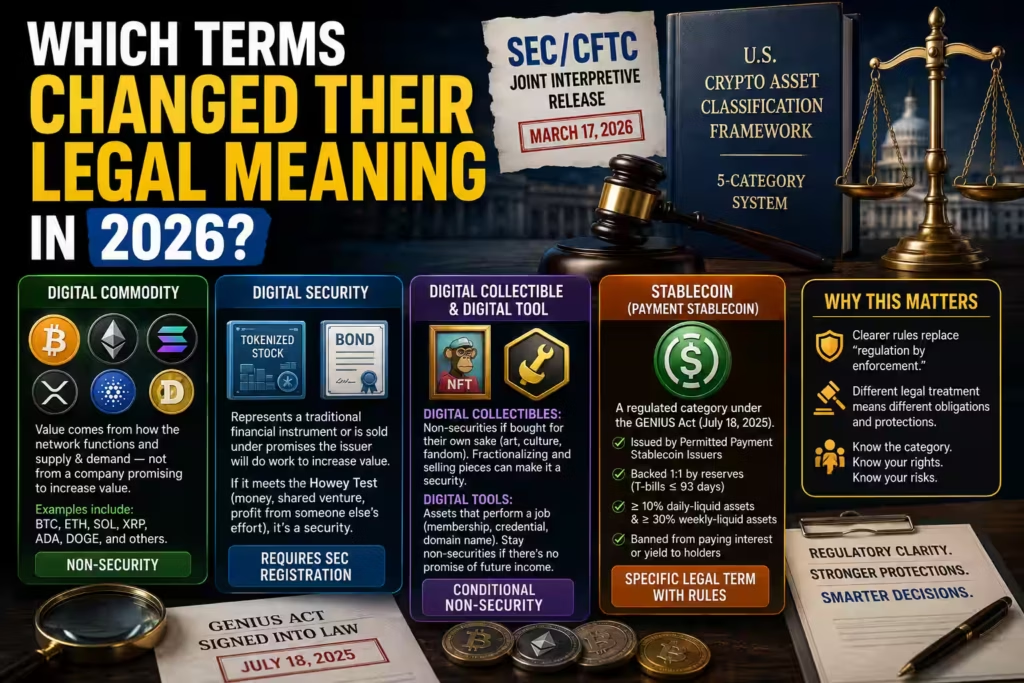
Before March 2026, the legal status of most crypto assets in the US was decided case by case, through enforcement actions rather than clear rules — a period regulators themselves now call “regulation by enforcement.” The March 17, 2026 SEC/CFTC joint interpretive release replaced that ambiguity with a five-category system. Here’s what each term now legally means.
Digital Commodity
A digital commodity is an asset whose value comes from how the network functions and from ordinary supply and demand — not from a company or team promising to make it more valuable. The guidance names Bitcoin (BTC), Ether (ETH), Solana (SOL), XRP, Cardano (ADA), Dogecoin (DOGE), and several others as examples that fall into this non-security category.
Digital Security
A digital security is a token that represents a traditional financial instrument — a tokenized stock or bond — or a token sold under specific promises that the issuer will do work to increase its value. If a purchase meets the legal test for an “investment contract” (the 1946 Howey test: money invested, in a shared venture, with profit expected from someone else’s effort), it’s treated as a security and needs full SEC registration, regardless of whether it’s called a “coin” or a “token.”
Digital Collectible and Digital Tool
Digital collectibles (NFTs, meme coins) are non-securities as long as they’re bought for their own sake — art, culture, fandom — rather than as an investment. A notable exception: fractionalizing a collectible and selling pieces of it can turn it into a security, because buyers start expecting profit from someone else managing the underlying asset. Digital tools are assets that perform a job — a membership pass, an identity credential, a domain name — and stay non-securities as long as they don’t promise future income.
Stablecoin (and Why “Payment Stablecoin” Is a Specific Legal Term Now)
Under the GENIUS Act, signed into law on July 18, 2025, a “payment stablecoin” is a specific, regulated category: a token designed to hold a steady value, issued only by a Permitted Payment Stablecoin Issuer, and backed one-to-one by reserves like Treasury bills maturing in 93 days or less. Issuers must keep at least 10% of reserves in daily-liquid assets and 30% in weekly-liquid assets, and they’re banned from paying interest or yield to holders. That yield ban is worth remembering: if a platform offers to pay you interest on a “stablecoin,” that arrangement sits in a legal gray zone the GENIUS Act was specifically written to close.
Comparison Table: How the Five Categories Actually Differ
| Category | Default Legal Status | Example Assets | Key Rule Beginners Should Know |
| Digital Commodity | Non-security (CFTC oversight) | BTC, ETH, SOL, XRP, ADA, DOGE | Value comes from network use, not a company’s promises |
| Digital Collectible | Non-security | NFTs, meme coins | Fractionalizing it can flip it into a security |
| Digital Tool | Non-security | ENS domain names, access credentials | Loses status if it starts promising future income |
| Stablecoin | Non-security if GENIUS Act compliant | GENIUS Act-compliant payment stablecoins | Yield or interest payments to holders are banned |
| Digital Security | Security (SEC oversight) | Tokenized stocks and bonds | Requires full SEC registration, same as traditional securities |
What Do You Need to Know About Wallets, Keys, and Seed Phrases Before You Store Anything?
Your seed phrase is the single most important string of words in this entire glossary. It’s the master backup for your private key — 12 to 24 plain English words that can rebuild your wallet on a new device if yours is lost, stolen, or destroyed. Anyone who sees those words can access your funds from anywhere, with no login alert and no way to freeze the account. Write it on paper, store it somewhere physical and private, and never type it into a website, no matter how official the request looks.
What Do Mining, Staking, and Airdrops Actually Cost You — or Owe You?
These three terms sit at the center of another 2026 regulatory update worth knowing.
Mining (used on proof-of-work networks like Bitcoin) and staking (used on proof-of-stake networks like Ethereum) are both classified as safe-harbor activities under the March 2026 guidance — meaning the people doing this work aren’t treated as selling you a security. But staking loses that protection under one specific condition: if a custodian exercises discretion over when or how much gets staked, or guarantees a specific reward amount, the arrangement can be reclassified as a security-like product.
That’s a meaningful distinction if you’re comparing staking services — a provider that guarantees a fixed return is taking on legal risk that a provider offering variable, market-based rewards is not.
Airdrops are free token distributions, and they stay outside securities law specifically because you didn’t pay anything to receive them — the legal test for an “investment of money” simply isn’t met. If a project ever asks you to pay, perform a task, or provide personal data to qualify for an airdrop, that condition can change its legal treatment entirely.
To see how these terms play out in a real transfer, our step-by-step guide to how cryptocurrency works follows a transaction from signing to confirmation.

Which Terms Should You Understand Before You Buy Crypto?
Before your first purchase, make sure you can explain these five terms out loud, without looking them up:
- Private key — because losing it means losing your funds permanently, with no recovery process.
- Confirmation — because a transaction isn’t truly final, and can’t be undone, until the network confirms it.
- Gas fee — because the same transaction can cost very different amounts depending on network congestion.
- Digital commodity vs. digital security — because this determines whether what you’re buying is regulated like a stock or like a currency.
- Payment stablecoin — because knowing whether a “stablecoin” is GENIUS Act-compliant tells you whether its reserves are legally required to back it 1:1.
Understanding these five terms won’t make you an expert, but it will stop you from making the two most common beginner mistakes: sending funds you can never recover, and buying an asset without knowing what legal category it actually falls into.
This article is general educational information, not financial, legal, or investment advice. Cryptocurrency regulations and asset classifications can change; consult a licensed financial or legal professional before making investment decisions.
FAQ
What crypto words should beginners know first? Blockchain, wallet, private key, seed phrase, gas fee, and confirmation cover the mechanics. Digital commodity and digital security cover the legal side, which became far more concrete after the SEC and CFTC’s March 2026 joint guidance.
What is a seed phrase in simple terms? It’s a backup list of 12 to 24 words that can restore your crypto wallet on a new device. Anyone who obtains this phrase can access your funds, so it should never be shared or stored digitally.
Is a stablecoin the same thing as a digital dollar? No. A payment stablecoin is a private company’s token, backed 1:1 by reserves like short-term Treasury bills under the GENIUS Act. It’s not issued by the government and isn’t backed by the full faith and credit of the United States.
What’s the difference between a digital commodity and a digital security? A digital commodity, like Bitcoin, derives its value from network use and supply and demand, and is treated as a non-security. A digital security is a tokenized financial instrument, or a token sold with specific promises of profit from someone else’s effort, and it requires full SEC registration.
Do you owe taxes or fees just for staking crypto? Staking itself is a safe-harbor activity under the 2026 guidance, not a security transaction, but staking rewards can still be taxable income. Consult a tax professional for guidance specific to your situation.
What is a wallet in crypto?A crypto wallet is software or hardware that stores the credentials needed to access and control your digital assets. It does not hold the coins themselves; those remain recorded on the blockchain.
What is a private key in simple terms? A private key is the secret credential that authorizes transactions from a wallet. If someone else gets it, they can move the funds, and if you lose it, you may lose access permanently.
What is a gas fee in crypto? A gas fee is the transaction-processing cost paid to a blockchain network, especially on systems like Ethereum where fees can change based on congestion and demand for block space.
Editorial Integrity
Sources & Citations
Primary documentation and reference materials on crypto terminology, wallet and key security, SEC/CFTC digital asset classifications, payment stablecoin rules, staking treatment, and airdrop legal interpretation
This article draws on official regulatory guidance, statutory stablecoin rules, blockchain documentation, and reference materials explaining how wallets, private keys, seed phrases, gas fees, staking, and transaction confirmation work. These sources support the article’s explanation of common crypto terms for beginners, the March 2026 legal category framework for digital assets, and the distinction between ordinary educational definitions and terms that now carry direct regulatory consequences.
View full sources, methodology, and editorial notes ⌄
This article was developed using primary legal and regulatory materials, official blockchain ecosystem documentation, and established reference sources used to explain crypto terminology in plain English. Preference is given to official government guidance, primary legislative materials, and first-party technical documentation where those sources directly support claims about digital commodity and digital security treatment, payment stablecoin requirements, wallet and seed phrase risk, staking treatment, and blockchain transaction finality. Because cryptocurrency regulation and asset classification can change over time, readers should verify current official guidance before making financial, legal, or investment decisions.
- Official article source page: Tech Capital Hub — Authentic Crypto Terms Explained for Beginners — used to align this editorial integrity block with the article’s actual scope, terminology, and publication context.
- Digital asset legal categories discussed in the article: U.S. Securities and Exchange Commission (SEC) — referenced for the article’s discussion of digital securities, investment contract treatment, and the legal consequences of token classification.
- Commodity-side oversight and digital commodity framing: U.S. Commodity Futures Trading Commission (CFTC) — referenced for the article’s discussion of digital commodities and the regulatory distinction between securities treatment and non-security commodity treatment.
- Wallets, keys, transaction structure, and blockchain operations: Ethereum Developer Documentation — cited for plain-English support around wallets, private keys, transaction execution, and gas-fee-related network behavior.
- Bitcoin network and proof-of-work terminology: Bitcoin.org — How Bitcoin Works — cited for beginner-level explanation of blockchain records, mining, transaction validation, and the basic mechanics behind proof-of-work systems.
- Stablecoin terminology and reserve-backed payment structure: Congress.gov — referenced for statutory context around payment stablecoin treatment and reserve-backed legal definitions discussed in the article.
- Token classification and investment contract framework: Cornell Law School — Investment Contract — cited for accessible legal reference context around the Howey test used in the article’s explanation of digital security treatment.
- General consumer education on crypto terminology and asset risk: Federal Trade Commission Consumer Advice — referenced for consumer-protection context where terminology misunderstandings can contribute to loss, fraud exposure, or unsafe wallet practices.
Our Editorial Standards
Tech Capital Hub applies Google’s E-E-A-T framework to every beginner crypto glossary and educational guide, prioritizing primary regulatory materials, official blockchain documentation, statutory text, and verifiable reference sources over hype, vague summaries, or unsupported claims about token safety, legal status, or expected returns.
View how our editorial standards apply to this article ⌄
Built Around the Terms Beginners Actually Misunderstand
This article is structured around the terms new crypto users are most likely to encounter before making a purchase, sending funds, or choosing a wallet. Instead of treating vocabulary like abstract jargon, we focus on how terms such as private key, seed phrase, gas fee, confirmation, digital commodity, and digital security affect real user decisions, mistakes, and risk exposure.
Technical Definitions Explained in Plain English Without Losing Precision
Coverage translates blockchain mechanics and legal terminology into beginner-friendly language while preserving the distinction that matters. We explain how wallets interact with blockchain records, why seed phrases function as full-access recovery credentials, how gas fees rise with network demand, and why terms like digital commodity and digital security carry different regulatory consequences even when both are casually called “crypto.”
Grounded in Official Documentation, Legal Frameworks, and Protocol Sources
Claims are anchored to source types that can be checked: official regulatory materials, statutory references, first-party blockchain documentation, and recognized legal reference frameworks. We do not rely on influencer commentary, token promotion, anonymous threads, or unsourced glossary definitions when explaining classification issues, wallet security, stablecoin treatment, staking mechanics, or transaction finality.
Consumer-Safety First, Especially Where Terminology Affects Loss Risk
Readers can lose funds permanently by misunderstanding a seed phrase, private key, address, or confirmation state, so this guide states those risks directly rather than softening them. Regulatory definitions and digital asset treatment can also change, so content is reviewed as better source material becomes available. Nothing in this article is financial, legal, or investment advice, and readers should confirm current guidance before acting on any classification or product claim.
About the Author
Marcus Delray
Fintech Analyst | Cryptocurrency Basics, Blockchain Technology & Digital Asset Regulation
Marcus Delray writes beginner-focused crypto education designed to make technical and legal terms easier to understand before readers buy, store, or transfer digital assets. He covers the definitions that matter in practice — from wallets, private keys, and seed phrases to gas fees, confirmations, staking, stablecoins, and the regulatory difference between a digital commodity and a digital security.
View full author bio, credentials, and links ⌄
Marcus Delray is an analyst and founder of Tech Capital Hub, where he covers cryptocurrency basics, blockchain mechanics, wallet custody, payment stablecoins, digital asset regulation, and the practical risks beginners face when navigating the crypto market for the first time.
In beginner crypto guides, he focuses on turning confusing vocabulary into usable knowledge. His coverage explains what terms like blockchain, wallet, private key, seed phrase, exchange, gas fee, staking, mining, airdrop, and confirmation actually mean in plain English, while also showing where legal classifications now matter in ways older glossaries often ignore. That includes the distinction between digital commodities and digital securities, how stablecoin treatment differs from other crypto assets, and why misunderstanding a wallet credential can lead to permanent loss of funds.
Rather than repeating market hype or surface-level definitions, he grounds his work in source-backed explanation using official regulatory materials, statutory references, first-party protocol documentation, and established legal frameworks so readers can understand both the mechanics and the real-world consequences behind the terms they see most often.
- Explains beginner crypto vocabulary in plain English, with emphasis on the terms most likely to affect buying, storage, and transaction safety
- Breaks down wallet custody concepts including private keys, seed phrases, public addresses, and the irreversible consequences of credential loss
- Covers how gas fees, staking, mining, confirmations, and airdrops work in practical terms rather than abstract protocol language
- Connects technical definitions with legal context, including digital commodity, digital security, payment stablecoin treatment, and current US regulatory framing
Enjoying our content?
Click below to add us as a preferred source. Google will prioritize our latest articles in your Top Stories, AI Mode, and AI Overviews.
Preferred Source on Google




2 thoughts on “Common Crypto Terms Explained for Beginners: 15 You Need Before You Buy”