Beginner Crypto Mistakes to Avoid: The Costly Errors New Users Repeat Every Cycle

Fintech Analyst | Cryptocurrency, Blockchain & Digital Assets
Who this is for: US investors who are new to cryptocurrency, want to understand the real risks before buying, and are trying to figure out the safest way to get started.
Skip the security basics and you’re not risking a bad trade — you’re risking a total, permanent loss with no bank, no chargeback, and no fraud department to call. According to the FBI’s Internet Crime Complaint Center, crypto-related complaints reached 181,565 in 2025 alone, totaling $11.366 billion in losses, with an average loss of $62,604 per complainant. That’s not market risk. That’s the cost of avoidable beginner crypto mistakes — errors that are far easier to prevent before they happen than to recover from after.
And if you want the full picture before you buy, our guide on what cryptocurrency is and how it works ties the mechanics, wallets, and risks together in one place.
Also if you need help to understand what you’re actually buying. If key terms like “seed phrase,” “gas fee,” or “private key” are unfamiliar, the Common Crypto Terms Explained for Beginners guide on Tech Capital Hub is a useful starting point.
Beginner Crypto Mistakes to Avoid: What’s the One Thing Most Guides Miss?
Most beginner articles list the same six mistakes — hype buying, weak security, panic selling — and stop there. What they skip is that one of these mistakes isn’t actually mandatory anymore.
Since 2024, US investors have had a second option beyond holding crypto directly: regulated spot Bitcoin and Ether exchange-traded products (ETPs), which trade on national exchanges like NYSE Arca and Cboe BZX. An ETP shifts the custody and security burden — the exact source of most beginner mistakes on this list — onto a regulated fund structure instead of onto you personally. That doesn’t eliminate every risk; the fund still holds volatile crypto, and you still pay expense ratios. But it does mean that “leaving funds on an exchange” and “losing a private key” simply aren’t possible mistakes to make if you hold exposure through an ETP instead of a wallet. Knowing that trade-off exists — and that it’s a real choice, not a shortcut — changes how you should think about every mistake below.
Table of Contents

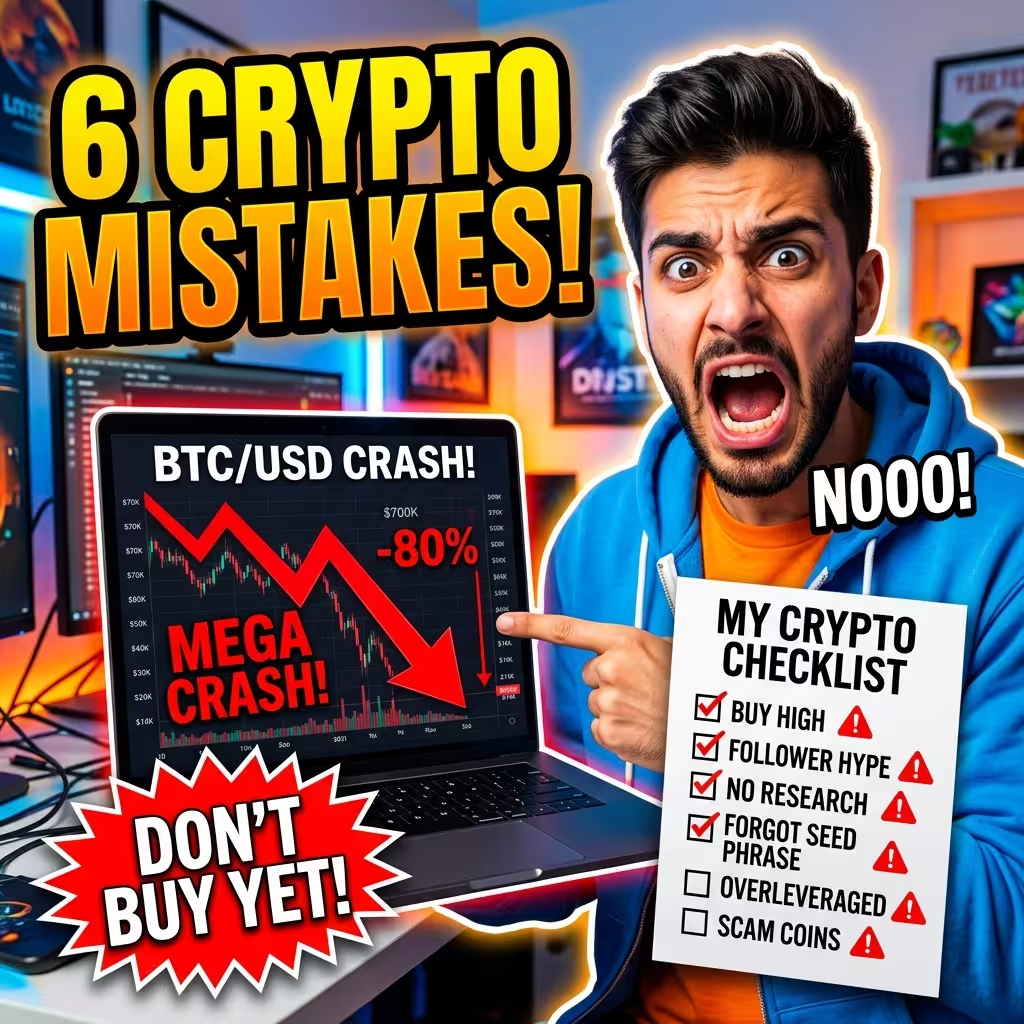
Mistake #1: Buying Based on Hype
Short answer: Buying a coin because it’s trending on social media — not because you understand what it does — is one of the most repeated and costly beginner crypto mistakes across every market cycle.
What It Is
Buying a coin because it’s trending on social media, not because you understand what it does.
Why It Happens
Viral attention creates the illusion of momentum. New investors often enter through social feeds and fast-moving narratives, and price momentum can fade long before late buyers notice — the excitement itself, not the fundamentals, is what pulls people in.
The Real Cost
In November 2021, a token called “Squid Game,” riding the Netflix show’s popularity, surged 230,000% and pulled beginners in at prices as high as $2,800 per token. The developers then executed a “rug pull,” draining liquidity and crashing the price to zero. Investors lost an estimated $3.38 million in minutes. According to industry tracking data, total crypto scam and fraud losses exceeded $4.2 billion globally in 2022 alone.
How to Avoid Hype-Driven Crypto Purchases
Before buying anything trending, ask what the project actually does and whether the price move is backed by real adoption or only speculation. Research the team — are they publicly identified, or anonymous? Check the token contract on a block explorer like Etherscan for red flags: mint functions that let developers create unlimited tokens, blacklist functions, or “honeypot” code that blocks you from selling after you buy.

Mistake #2: Ignoring Wallet and Account Security
Short answer: Skipping two-factor authentication or sharing a seed phrase with anyone are among the fastest ways for beginners to suffer an irreversible crypto loss.
What It Is
Skipping two-factor authentication, reusing passwords, or worse, sharing your seed phrase with someone who asks for it.
Why It Happens
Security setup feels like a delay standing between you and your first trade, so beginners rush past it.
The Real Cost
Leaving accounts unverified or clicking unknown links remains one of the most common ways people lose crypto in 2026. No real exchange or wallet will ever ask for your seed phrase — any message requesting it is a scam, full stop.
How to Avoid It
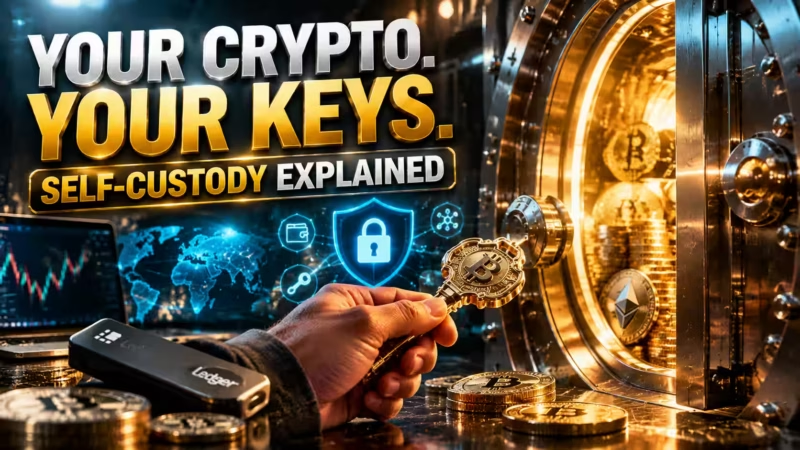
Turn on two-factor authentication everywhere it’s offered. Use a dedicated password for crypto accounts, never reused elsewhere. Write your seed phrase on paper, store it somewhere physical, and never enter it into a website, app, or message, regardless of how official it looks.
How to Secure a Crypto Account Properly
Turn on two-factor authentication everywhere it’s offered. Use a dedicated password for crypto accounts, never reused elsewhere. Write your seed phrase on paper, store it somewhere physical, and never enter it into a website, app, or message — regardless of how official it looks. If you’re unfamiliar with how wallets and seed phrases work at a mechanical level, the How Does Cryptocurrency Work for Beginners walkthrough provides a step-by-step foundation.

Mistake #3: Leaving All Your Funds on an Exchange
Short answer: Treating a crypto exchange like a bank account exposes beginners to counterparty risk — meaning exchange insolvency, hacks, or withdrawal freezes — that has nothing to do with normal market volatility.
What It Is
Treating an exchange account like a bank account and leaving your entire balance there indefinitely.
Why It Happens
It’s convenient, and beginners often assume a large, popular platform is safe by default because of its size.
The Real Cost
Exchange failures are not hypothetical. During the February 2026 market downturn, the crypto market recorded $3.2 billion in realized losses in a single day — more than the FTX collapse — as overleveraged positions cascaded into forced liquidations. Not every exchange handled that stress the same way: platforms with verifiable proof of reserves and transparent fee structures held up better than those without. If your exchange cannot prove it holds your funds one-to-one, you are carrying counterparty risk on top of ordinary market risk.
How to Reduce Exchange Custody Risk
For funds you’re not actively trading, move them to a wallet where you control the private key, or consider a regulated spot ETP where a fund custodian — not an exchange — holds the underlying asset. If you do keep funds on an exchange, choose one with verifiable proof of reserves and an insurance fund, not just marketing promises. The comparison table later in this article lays out the full risk profile across all three options.

Mistake #4: Not Understanding Fees Before You Trade
Short answer: Crypto transaction fees — including network gas fees — are not fixed. Beginners who don’t check before confirming a trade can pay significantly more than expected, especially during high network congestion.
What It Is
Trading without checking what a transaction, withdrawal, or network fee will actually cost you.
Why It Happens
Fee structures on crypto platforms are often buried, and network gas fees change constantly based on how busy the blockchain is at that moment.
The Real Cost
Fees aren’t fixed the way a bank wire fee is — they spike when the network is congested and drop when it’s quiet, and a beginner who doesn’t check first can end up paying far more than expected on a routine transfer. One documented example: an NFT collector who scheduled transactions during low-congestion windows using a gas prediction tool reduced annual gas costs by 73%, saving roughly $12,000 in 2025 — proof that timing genuinely changes what you pay.
How to Minimize Crypto Transaction Fees
Check estimated fees before confirming any transaction, and avoid transacting during periods of high network activity when possible. If you’re using an exchange, compare its withdrawal fee schedule against competitors before assuming it’s standard.

Mistake #5: Panic Selling During Normal Volatility
Short answer: Selling everything the moment prices drop — without a predetermined plan — is how beginners lock in losses that more disciplined investors avoid by simply waiting through a normal correction.
What It Is
Selling everything the moment prices drop, without checking whether the decline is a normal correction or something structurally different.
Why It Happens
Watching a portfolio lose value overnight is genuinely stressful, and the instinct to “stop the bleeding” feels rational in the moment even when it locks in a loss that a calmer investor wouldn’t have taken.
The Real Cost
Crypto can drop 10% to 20%, or in sharper downturns 30% to 40% or more, without the long-term picture necessarily changing — and beginners without a plan often sell at the worst possible moment. Historical bear markets illustrate the pattern: Bitcoin fell 74% in 2018 and 77% in 2022, and recovered to new highs within about 18 months both times. Crypto winters have historically lasted roughly 13 months, according to Bitwise CIO Matt Hougan.
How to Avoid Panic Selling
Before you buy anything, decide your reason for buying, your intended holding period, and the specific conditions that would change your view. Writing this down before volatility hits removes the decision from the moment of panic. A dollar-cost averaging approach — investing a fixed amount at regular intervals regardless of price — also reduces the psychological pressure that leads to panic selling in the first place.

Mistake #6: Chasing Meme Coins Too Early
Short answer: Meme coins are high-risk, speculative assets. Treating them as a legitimate entry point into crypto — rather than a small, discretionary bet — magnifies losses for beginners who don’t yet have a stable portfolio foundation.
What It Is
Treating meme coins as a legitimate entry point into crypto rather than a high-risk side bet.
Why It Happens
Meme coins can rise fast, and that speed is exactly what attracts beginners looking for quick gains.
The Real Cost
Meme coins can fall just as fast as they rise. Many have no real utility and depend almost entirely on social media attention, and some are structured to benefit early insiders before the price collapses on everyone who bought in afterward. Putting concentrated capital into a single coin — meme or otherwise — magnifies losses when the market swings 30% to 40% in either direction.
How to Approach Meme Coins Safely
If you want exposure to a meme coin, treat it as a small, separate allocation you can afford to lose entirely — never a core position. Diversify rather than concentrating capital in one asset, and never risk more than a small fraction of your total portfolio on a single speculative trade. Understanding the difference between crypto and traditional currencies first can help clarify why speculative coins behave the way they do; the Crypto vs Regular Money for Beginners article covers that comparison directly.
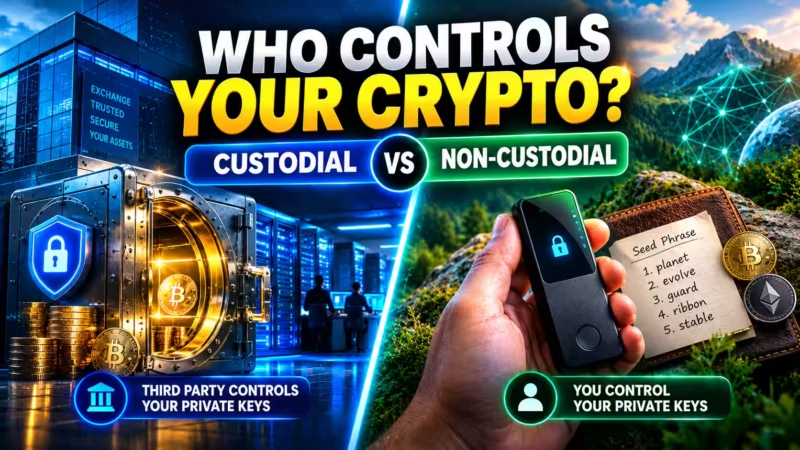
Self-Custody vs. Exchange vs. Regulated ETP: Where Does the Risk Actually Sit?
Decision framework:
- Self-custody wallets are best suited for investors who are technically confident, want full control over their holdings, and have taken time to understand seed phrase security. The risk of permanent, irreversible loss through human error is real and unrecoverable.
- Exchange accounts work best for active traders who need liquidity and are willing to accept counterparty risk in exchange for convenience — provided the exchange has verifiable proof of reserves.
- Regulated spot ETPs are better suited for investors who want crypto market exposure but prefer to avoid custody and security management entirely. They carry standard market volatility and expense ratios, but eliminate the self-custody and exchange-failure risks that cause most beginner losses.
Self-Custody vs. Exchange vs. Regulated ETP: Where Does the Risk Actually Sit?
Compare who holds your crypto, the main risk you take on, and what protection each option offers.
| Ownership Method | Who Holds the Asset | Main Risk | Regulatory Protection |
|---|---|---|---|
|
Self-custody wallet ● High responsibility | You, via your private key | Losing the seed phrase or key means permanent, irreversible loss | None — you are entirely responsible |
|
Exchange account ● Moderate risk | The exchange | Exchange insolvency, hacks, or frozen withdrawals during market stress | Varies; look for proof of reserves and insurance funds |
|
Regulated spot ETP (e.g., Bitcoin or Ether ETP) ● Lower custody risk | A regulated trust, via an authorized custodian | Standard market volatility; expense ratios | SEC-regulated wrapper with surveillance-sharing agreements and standardized disclosures |
Beginner Safety Checklist: What Should You Do Before Your First Trade?
- Decide your reason for buying, your holding period, and what would change your mind — write it down before you buy, not after prices move.
- Turn on two-factor authentication and never reuse passwords across crypto accounts.
- Store your seed phrase on paper, offline, and never type it into any website or message.
- Choose an exchange with verifiable proof of reserves if you plan to keep funds there.
- Check fees and network congestion before confirming any transaction.
- Research any trending coin’s team, contract, and liquidity before buying — don’t buy because it’s trending.
- Consider whether a regulated ETP fits your goals better than direct self-custody, especially if security and custody risk are your main concerns.
- Never invest more than you could afford to lose completely in a single asset.
This article is general educational information, not financial or investment advice. Cryptocurrency values are highly volatile and involve substantial risk of loss; consult a licensed financial professional before making investment decisions.
The Safest Path for a First-Time Crypto Investor
For most beginners, the safest starting path combines three things: a clear written plan (reason, holding period, exit conditions), a secure account setup (2FA, unique passwords, offline seed storage), and a custody method matched to your actual risk tolerance — whether that’s self-custody, a verified exchange, or a regulated ETP.
The mistakes in this article aren’t random. They cluster around two failure modes: acting on emotion without a plan, and skipping security steps because they feel inconvenient. Addressing those two things before buying anything puts a beginner meaningfully ahead of most new investors entering any given market cycle.
People Also Ask
How can I avoid common crypto mistakes as a beginner?
Set a plan before you buy — your reason, your holding period, and your exit conditions — and stick to it. Combine that with strong account security, verified exchanges, and avoiding hype-driven purchases.
What is the biggest mistake new crypto investors make?
Buying based on hype or social media trends without research is one of the most repeated mistakes across market cycles, often compounded by panic selling once the hype fades and prices correct.
What not to do when starting crypto?
Don’t share your seed phrase with anyone, don’t leave your entire balance on one exchange indefinitely, and don’t put a large portion of your portfolio into a single meme coin based on social media buzz.
Is it safer to buy crypto through an ETF instead of holding it directly?
A regulated spot Bitcoin or Ether ETP removes self-custody risks like losing a private key or an exchange collapse, since a regulated custodian holds the underlying asset. It doesn’t remove market volatility or expense ratios, so it represents a different risk profile — not a risk-free one.
Why do beginners panic sell during normal crypto volatility?
Watching a portfolio’s value drop quickly is stressful, and without a predetermined plan, many investors sell to stop the emotional discomfort rather than because the fundamentals changed — often locking in losses right before a recovery.
How do I know if a crypto exchange is safe to use?
Look for exchanges that publish verifiable proof of reserves, maintain an insurance or reserve fund, and have a transparent fee structure. Avoid platforms that can’t demonstrate one-to-one asset backing, especially during high-stress market periods.
What is a rug pull in crypto, and how do I avoid one?
A rug pull occurs when developers drain a token’s liquidity pool after attracting investor funds, crashing the price to near zero. To avoid one, check the token’s smart contract on a block explorer like Etherscan for mint functions, blacklist functions, or honeypot code before buying into any trending project.
Should a crypto beginner use dollar-cost averaging?
Dollar-cost averaging — investing a fixed amount at regular intervals regardless of price — is widely recommended for beginners because it reduces the psychological pressure of trying to time the market and lowers the average cost per unit over time.
Editorial Integrity
Sources & Citations
Primary documentation on FBI-reported crypto fraud losses, the Squid Game rug pull, historical Bitcoin bear markets, Ethereum smart contract mechanics, SEC-regulated spot Bitcoin and Ether ETPs, gas fee optimization, and the February 2026 liquidation event
Every statistic in this article traces back to a primary source. The article draws on the FBI Internet Crime Complaint Center’s 2025 annual report for crypto fraud loss figures, contemporaneous reporting on the November 2021 Squid Game token rug pull, historical Bitcoin price data for the 2018 and 2022 bear markets, Ethereum’s developer documentation and Etherscan for smart contract and gas fee mechanics, SEC filings on regulated spot Bitcoin and Ether exchange-traded products, and on-chain liquidation data from the February 2026 market downturn. These sources support how the article explains why irreversible transactions make fraud losses permanent, how hype-driven tokens collapse, why panic selling locks in losses, and how a regulated ETP shifts custody risk off the individual investor.
View full sources, methodology, and editorial notes ⌄
This article was developed using official government crime-loss reporting, primary regulatory filings, protocol-level technical documentation, and verifiable on-chain and market price data. Preference is given to official FBI and SEC publications, first-party protocol documentation, and block explorer records where those directly support claims about fraud losses, ETP structure, smart contract risk, fee behavior, and price history. Because fraud statistics, network fees, ETP availability, and market conditions change over time, readers should verify current official guidance before making any investment decision. This article is educational information, not financial advice.
- FBI-reported crypto fraud losses in 2025: 2025 IC3 Annual Report — FBI Internet Crime Complaint Center (PDF) — cited for the 181,565 crypto-related complaints, $11.366 billion in total losses, and $62,604 average loss per complainant used to illustrate why irreversible blockchain transactions make fraud permanent.
- The Squid Game token rug pull (November 2021): BBC News — Squid Game crypto token collapses in apparent scam — cited for the token’s surge and subsequent crash to zero after developers drained liquidity, illustrating how hype buying exposes beginners to rug pulls and estimated investor losses.
- Historical Bitcoin bear market drawdowns and recoveries: Bitcoin Price History — CoinGecko — cited for the roughly 74% drawdown in 2018 and 77% drawdown in 2022, and the recovery to new highs within about 18 months in each cycle, supporting the case against panic selling during normal volatility.
- Ethereum gas fee mechanics and smart contract behavior: Gas and Fees — Ethereum Developer Documentation — cited for how gas fees are priced by real-time demand for block space, why fees spike during network congestion, and why checking estimated fees before confirming a transaction prevents overpaying on routine transfers.
- Verifying token contracts before buying: Etherscan — Ethereum Block Explorer — cited for how beginners can inspect a token contract for red flags such as mint functions, blacklist functions, and honeypot code that blocks selling after purchase.
- SEC approval of spot Bitcoin exchange-traded products: SEC — Statement on the Approval of Spot Bitcoin Exchange-Traded Products (January 2024) — cited for the regulated spot Bitcoin ETPs that trade on national exchanges such as NYSE Arca and Cboe BZX, shifting custody and security risk from the individual investor onto a regulated fund structure.
- SEC approval of spot Ether exchange-traded products: SEC — Order Approving Spot Ether Exchange-Traded Products (2024, PDF) — cited for the regulated spot Ether ETPs that give US investors exposure without holding a private key, supporting the self-custody versus exchange versus ETP risk comparison.
- Gas fee optimization through transaction timing: Etherscan Gas Tracker — cited for how scheduling transactions during low-congestion windows reduces gas costs, supporting the documented example of an NFT collector cutting annual gas spend by 73%.
- February 2026 market liquidation event: CoinMarketCap — Crypto Market Charts and Liquidation Data — cited for the single-day realized losses during the February 2026 downturn, when overleveraged positions cascaded into forced liquidations, illustrating the counterparty and market risk of leaving funds on an exchange.
Our Editorial Standards
Tech Capital Hub applies Google’s E-E-A-T framework to every beginner crypto safety guide, prioritizing official crime-loss reporting, primary regulatory filings, and protocol documentation over price speculation, promotional content, or unsupported claims. Every statistic in this article traces back to a primary source: the FBI IC3 2025 Internet Crime Report, SEC spot Bitcoin and Ether ETP approval orders, official Ethereum developer documentation, Etherscan contract records, CoinGecko price history, and BBC reporting on the Squid Game token collapse.
View how our editorial standards apply to this article ⌄
Grounded in the Mistakes Beginners Actually Make
This article follows what a new investor encounters in practice, not in theory. We walk through the moment security setup feels like a delay and gets skipped, the convenience that leaves a full balance sitting on an exchange, the overnight drop that triggers panic selling, and the trending token that pulls buyers in on hype alone. Each scenario reflects a real decision point a beginner faces, with the concrete cost it carries.
Custody Risk, Rug Pulls, and the Reversibility Gap
Coverage explains the distinctions that determine whether a beginner keeps their money. We break down how a rug pull drains liquidity and crashes a token to zero, how self-custody, exchange accounts, and regulated ETPs carry different risk profiles, why gas fees spike during network congestion and hit small transfers hardest, why a lost private key means permanent loss with no recovery, and why concentrating capital in one meme coin magnifies every swing.
FBI IC3, SEC Filings, and Primary Protocol Documentation
Claims are anchored to primary material: the FBI IC3 2025 Internet Crime Report citing 181,565 crypto complaints and $11.366 billion in losses, the SEC approval orders for spot Bitcoin and Ether exchange-traded products trading on NYSE Arca and Cboe BZX, official Ethereum developer documentation on transactions and gas, Etherscan records for verifying token contracts, CoinGecko price history for the 2018 and 2022 bear markets, and BBC reporting on the November 2021 Squid Game rug pull. We do not treat promotional content, social commentary, or unverified figures as sufficient support for statements about fraud, losses, custody, or fees.
Transparent, Reviewable, and Consumer-Safety First
Crypto transactions are irreversible once confirmed, fraud losses are permanent, and a lost private key cannot be recovered — so we state these risks plainly rather than softening them. Fraud figures, network fees, ETP availability, and market conditions change, so this guide is reviewed and updated as stronger source material becomes available. Nothing here is financial or investment advice. Corrections or source challenges can be submitted directly to our editorial team at editorial@techcapitalhub.com.
About the Author
Marcus Delray
Fintech Analyst | Crypto Security, Beginner Investing & Digital Asset Risk
Marcus Delray writes about the mistakes that cost new crypto investors the most money. He covers the practical decisions a beginner faces first: why hype buying exposes you to rug pulls, how weak wallet security hands over your funds, why leaving a full balance on an exchange carries counterparty risk, how gas fees spike without warning, why panic selling locks in losses, and why concentrating capital in a single meme coin magnifies every swing.
View full author bio, credentials, and links ⌄
Marcus Delray is an analyst and founder of Tech Capital Hub, where he covers crypto security, beginner investing mistakes, wallet and key custody, exchange risk, and the US regulatory environment that shapes how everyday users buy and hold digital assets.
On beginner safety, he focuses on where new investors actually lose money. A lost seed phrase — the recovery key for a self-custody wallet — means permanent loss, because no bank, chargeback, or fraud department can reverse a confirmed blockchain transaction. A rug pull drains a token’s liquidity and crashes the price to zero, which is how hype-driven buyers get wiped out in minutes. He explains the tradeoff between three ownership methods: self-custody puts full responsibility on you, an exchange account carries insolvency and hack risk, and a regulated spot ETP shifts custody onto a fund custodian while still exposing you to market volatility and expense ratios.
Rather than repeating price headlines, he grounds his coverage in source-backed explanation. He shows why gas fees are priced by real-time network demand and spike during congestion, why panic selling during a normal 30% to 40% correction locks in avoidable losses, and how historical bear markets — Bitcoin’s 74% drop in 2018 and 77% drop in 2022, each followed by recovery within about 18 months — put short-term volatility in context. His analysis draws on FBI IC3 loss data, SEC ETP filings, Ethereum developer documentation, and block explorer records so readers understand where the real risks and safeguards sit.
- Explains rug pull mechanics — how developers drain liquidity and crash a token to zero — and how to check a contract on a block explorer before buying
- Details seed phrase and key custody safety, including why a lost private key means permanent loss and why no legitimate platform ever asks for your recovery phrase
- Breaks down the risk tradeoffs across self-custody, exchange accounts, and regulated spot Bitcoin and Ether ETPs, including what each structure protects against and what it does not
- Grounds volatility guidance in historical bear market data, including Bitcoin’s 74% drawdown in 2018 and 77% drawdown in 2022 and the roughly 18-month recoveries that followed
- Anchors fraud risk in primary sources: the FBI IC3 2025 report citing 181,565 crypto complaints, $11.366 billion in losses, and a $62,604 average loss per complainant
Enjoying our content?
Click below to add us as a preferred source. Google will prioritize our latest articles in your Top Stories, AI Mode, and AI Overviews.
Preferred Source on Google



4 thoughts on “Beginner Crypto Mistakes to Avoid: The Costly Errors New Users Repeat Every Cycle”