
Understanding Crypto Fees: Gas, Trading, and Withdrawal Costs Explained


Fintech Analyst · Founder of Tech Capital Hub
Marcus has spent more than a decade researching blockchain and financial technology. This is the ultimate easy guide to crypto fees! He breaks down every cost you’ll actually pay — trading fees, gas fees, hidden spreads, and withdrawal markups — then shows you the simple habits that slash them: picking cheaper Layer 2 networks, timing off-peak transfers, and matching the right network to each asset. Every fee-conscious beginner will love it!
Crypto fees are any cost taken out of a transaction beyond the amount you’re actually sending or trading, and there are three main types: trading fees, network (gas) fees, and spreads. Knowing how each one works is the easiest way to stop overpaying! This guide breaks down every fee you’ll meet, why gas fees dropped so dramatically, how the biggest exchanges really charge you, and the simple habits that keep more money in your wallet.
Here’s a surprising anchor: Ethereum mainnet gas fees fell roughly 93% between their 2024 peak and early 2026, driven by a sequence of network upgrades and the migration of everyday activity onto Layer 2 networks. That single number tells you something most fee guides skip — the fee you pay depends less on “crypto being expensive” and more on which network and which interface you happen to be using.
Crypto Fees in 30 Seconds
- Trading fee → paid to the exchange when you buy or sell. Usually the smallest and most visible cost.
- Gas (network) fee → paid to the blockchain to process your transaction. Varies by network and time of day.
- Spread → a hidden markup baked into the price you’re quoted. The cost most likely to surprise you.
- Withdrawal fee → charged to move funds off a platform. Often marked up above the real network cost.
- Biggest win: match the network to the asset and use advanced trading interfaces over one-tap “instant buy” buttons.
What Are Crypto Fees, Really?
A crypto fee is any cost deducted from a transaction beyond the amount you’re sending or trading. There are three of them, and they come from three different places: a trading fee goes to the exchange, a network fee or gas fee goes to the blockchain itself, and a spread is a hidden markup built into the price you’re quoted. Most beginners only notice the first one, which is exactly why the other two catch people off guard.
If you’re still learning how that cost stack appears in a real purchase flow, our guide on how to buy cryptocurrency for beginners walks through where these fees show up from the moment you fund an account to the moment you place your first order.
Here’s the short version before the detail: trading fees are usually the smallest and most visible cost. Gas fees vary wildly by network and time of day, but have dropped dramatically on Ethereum since 2024. Spreads are the cost most likely to surprise you, because “zero-fee” marketing rarely mentions them.
Table of Contents

What Are the Three Types of Crypto Fees You’ll Actually Pay?
You’ll pay three core fees on most transactions — a trading fee, a gas fee, and a spread — plus a withdrawal fee when you move funds off a platform. Here’s how each one works.
Trading Fees (Maker vs. Taker)
A trading fee is what an exchange charges to execute your buy or sell order. Most centralized exchanges use a maker-taker model: a maker order adds a new order to the book and isn’t filled instantly, while a taker order fills immediately against an existing order. Makers typically pay less because they add liquidity to the market; takers pay more because they remove it.
Rates vary a lot by platform. As of publication, MEXC Global lists 0.00% maker and 0.10% taker. Binance charges a flat 0.10% on both sides, with a 25% discount if you hold its BNB token. Coinbase’s advanced trading interface runs higher than the others — which is part of why Coinbase is positioned as a beginner-friendly, higher-trust platform rather than a low-cost one.
Network (Gas) Fees
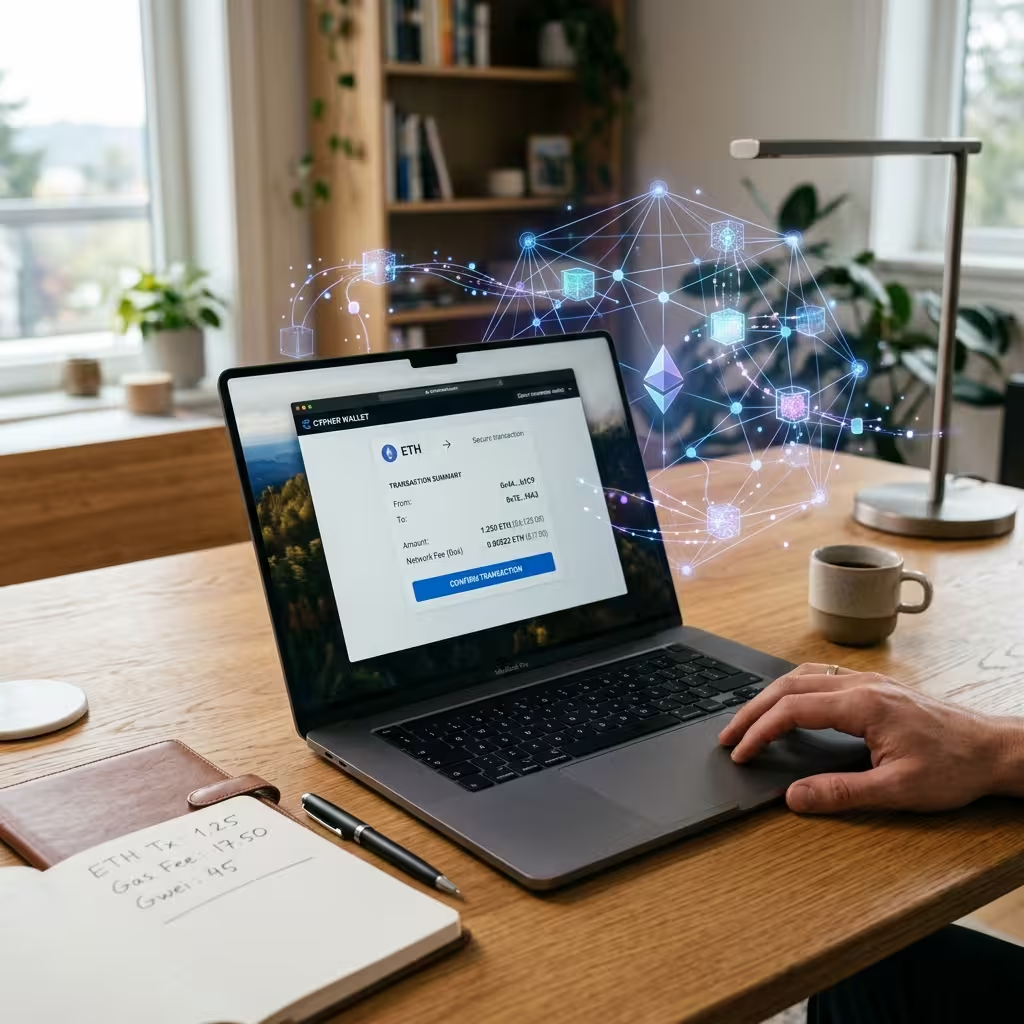
A gas fee is what you pay the network itself to process a transaction — it goes to validators, not the exchange or wallet you’re using. On Ethereum, gas fees are built from three pieces defined by the EIP-1559 fee market:
- Base fee: the protocol-set minimum price for inclusion, which gets burned (permanently removed from circulation) rather than paid to anyone.
- Priority fee (tip): an optional extra payment to the validator, which acts like express postage to get your transaction picked up faster.
- Max fee: the absolute ceiling you’re willing to pay, which protects you from a sudden fee spike.
Gas fees swing constantly based on how busy the network is. A simple ETH transfer might cost around $0.04 on the Ethereum mainnet during typical mid-2026 conditions, while a DEX token swap involving more computation can run $5 to $15 during busier periods. If you’re new to how transactions get confirmed in the first place, our who confirms crypto transactions guide explains the role validators play.

Spreads and Withdrawal Markups
The spread is the gap between the actual market price and the price you’re quoted — and it’s the fee most beginners never see coming. Zero-fee or “instant buy” marketing frequently hides a 1% to 3% spread inside the quoted price. On a $10,000 trade, that’s $100 to $300 you never see itemized anywhere.
Withdrawal fees work similarly. Exchanges often add a markup on top of the actual network cost. Bitstamp, for example, has charged roughly 20 USDT for an ERC-20 withdrawal, while OKX may charge as little as $0.01 for a USDT withdrawal routed over Solana. Coinbase, by contrast, offers free withdrawals for BTC, ETH, and USDC across several networks — including Ethereum, Solana, Base, and Arbitrum — which makes it one of the cheapest platforms to move funds out of, even though its trading fees run higher.
In short: the advertised trading fee is only one piece. The spread and the withdrawal fee often matter more.
Why Do Gas Fees Change So Much?
Gas fees rise and fall with network congestion, the same way a toll road gets more expensive during rush hour. When more people transact at once, they bid against each other with higher priority fees to get included in the next block, and the base fee rises to match demand.
Timing matters more than people expect. Fees are typically 40% to 60% lower during off-peak windows — weekends and roughly 2:00 AM to 6:00 AM UTC — simply because fewer people are competing for block space at those hours. If your transaction isn’t urgent, waiting for a quiet window is a free discount.
The type of transaction matters too. A basic ETH transfer uses about 21,000 gas units, while a DEX token swap can use 150,000 or more, and a DeFi stake or deposit can run 300,000 gas units or higher. More computational work means a higher fee, regardless of what time you send it.
Why Did Ethereum Gas Fees Drop So Much in 2026?
Ethereum gas fees dropped because a sequence of protocol upgrades rebuilt how the network handles data, moving everyday activity onto cheaper Layer 2 networks. This is the part most fee explainers miss entirely, and it’s why “crypto fees are expensive” is now an outdated assumption for a huge share of everyday transactions.
- Dencun (March 2024) introduced “blobs” through EIP-4844, creating a separate, cheaper data lane specifically for Layer 2 networks. This alone cut L2 posting costs by an estimated 50% to 90%.
- Pectra (May 2025) roughly doubled blob capacity and introduced transaction batching, which further stabilized per-transaction costs.
- Fusaka (December 2025) rolled out Peer Data Availability Sampling (PeerDAS), distributing blob data across more nodes and expanding blob capacity further, toward full “danksharding” in later upgrades.
The practical result: Layer 2 networks like Base and Arbitrum now offer fee reductions of 90% to 99% compared to using the Ethereum mainnet directly. A simple transfer that might cost around $0.04 on mainnet can run about $0.02 on Base, and an NFT mint or DeFi deposit that costs $4 to $25 on mainnet can drop to well under a dollar on a Layer 2 network.
If you’re still paying mainnet gas fees for routine transfers or swaps in 2026, you’re very likely using the wrong network for the job — not accepting a necessary cost of using crypto.
There’s a second layer to this shift that most beginners never hear about: the mainnet is also less congested than it used to be. Gas utilization has dropped to the point where more than 60% of Ethereum blocks use less than half of the available gas limit, and the block gas limit itself was raised from 45 million to 60 million units, adding roughly a third more room per block. Less competition for space, combined with cheaper Layer 2 data posting, is why the 93% mainnet fee drop happened — it isn’t a temporary dip, it’s the result of the network being built to handle far more activity than it’s currently carrying.
How Do Exchanges Actually Charge You (Beyond the Advertised Rate)?
The real cost of trading on any platform is a stack of at least four separate charges: the trading fee, the network fee, the spread, and any withdrawal fee. A platform that wins on one of these can easily lose on another, which is why “cheapest exchange” is more complicated than a maker-taker comparison suggests.
Exchange Fee Comparison (Illustrative)
The table below is illustrative only. Rates and policies change frequently, and every figure should be confirmed on the exchange’s official fee page before you trade.
Crypto Fees · Side-by-Side
Exchange Fee Comparison (Illustrative)
Hover any row to compare the full cost stack. The greenest cells flag the best value in each column!
Swipe sideways to see every column →
| Exchange | Maker Fee | Taker Fee | Typical Spread | Notable Withdrawal Detail |
|---|---|---|---|---|
| MEXC Global | 0.00% Lowest Maker | 0.10% | ~0.08% | ~$12 flat fee for ETH withdrawals |
| Binance | 0.10% | 0.10% | ~0.01% Tightest Spread | 25% fee discount when paying with BNB |
| OKX | 0.08% | 0.10% | ~0.02% | As low as $0.01 for USDT via Solana Cheapest Route |
| Bybit | 0.10% | 0.10% | Not separately listed | Strong derivatives fee structure |
| Coinbase | 0.40% Advanced | 0.60% Advanced | ~0.01% (Advanced) | Free USDC/BTC/ETH withdrawals on multiple networks Free Moves |
How to read this table
The cheapest exchange depends on your total cost, not just the maker/taker fee! A platform can win on trading fees and still lose once you add a wide spread and a flat withdrawal charge. Always add up all four costs — trading fee, gas fee, spread, and withdrawal fee — for the exact asset and network you’re using.
MEXC has the lowest advertised maker fee, but its spread runs roughly eight times wider than Binance’s. Coinbase carries the highest trading fees here, yet its free multi-network withdrawals make it one of the cheapest platforms to move funds off of. The full stack tells the real story!
Notice the trade-off: MEXC has the lowest advertised maker fee, but its spread is roughly eight times wider than Binance’s, and its flat withdrawal fee can outweigh the fee savings on a mid-size transfer. Coinbase has the highest trading fees on this list by a wide margin, but its free multi-network withdrawals make it one of the cheapest platforms to move funds off of. Neither the lowest fee nor the biggest brand name tells you the actual cost — the full stack does.
One more detail that catches beginners specifically: Coinbase’s “Simple” or “Instant Buy” interface carries a noticeably wider spread than its Advanced Trade interface, even though both run on the same exchange. For newer users, this is one of the biggest hidden costs in a first crypto purchase, because the easiest-looking interface is often the one with the widest built-in markup.
Choosing the advanced order type over the one-tap buy button is often the single biggest fee reduction available to a retail user, with no change in platform required.
What’s the Cheapest Way to Move Money Between Exchanges and Wallets?
The cheapest way to move funds is to match the network to the asset, because the price gap between networks for the same asset can be enormous. Network choice matters as much as exchange choice.
- For Bitcoin, the Lightning Network reduces routing costs to a small fraction of a cent for small transfers, compared to on-chain fees that can run several dollars during busy periods.
- For Ethereum transfers, routing through Base or Arbitrum instead of the mainnet directly typically cuts costs by 90% or more.
- For stablecoins like USDT, Solana and Tron (TRC-20) generally offer the cheapest routes, often a dollar or less, while moving the same stablecoin over the Ethereum mainnet can cost significantly more depending on congestion.
- For USDC specifically, Coinbase’s free multi-network withdrawal (covering Ethereum, Solana, Base, Polygon, and Arbitrum) makes it close to a zero-cost option for that one asset.
The practical takeaway: before you withdraw or transfer anything, check which network options your exchange or wallet offers. Picking the wrong network for the same asset can mean paying ten or twenty times more than necessary for an identical transfer. If you’re still choosing where to store your coins, start with our crypto wallet guide and seed phrase guide.
This is also where transaction timing intersects with technical mechanics. Every Ethereum transaction needs a “max fee” set high enough to cover both the base fee and your chosen priority fee. Setting that ceiling too low doesn’t just slow things down — it can leave a transaction stuck in the mempool indefinitely, unconfirmed until you either wait for congestion to drop or pay to replace it with a higher-fee version. Wallets like MetaMask let you check live fee trackers before confirming, so you’re not guessing at the right number.
Simple Ways to Pay Less on Every Transaction
These easy habits consistently lower your total cost, no matter which exchange or wallet you use:
- Use the advanced trading interface, not the one-tap buy button. The spread difference alone is often larger than any maker-taker fee savings you’d get from switching exchanges entirely.
- Time non-urgent transactions for off-peak hours. Weekends and the 2:00 AM to 6:00 AM UTC window typically bring 40% to 60% lower gas fees on Ethereum.
- Move routine transfers to a Layer 2 network. Base, Arbitrum, and similar networks offer 90%+ savings over the Ethereum mainnet for the same basic actions.
- Match the network to the asset. Use Lightning for small Bitcoin transfers, and Solana or Tron for stablecoin moves, rather than defaulting to whatever network an app suggests first.
- Hold a native exchange token if you trade often. Discounts of 20% to 25% on trading fees, as offered through tokens like BNB or OKB, add up quickly for anyone trading regularly.
- Check withdrawal fees before you pick an exchange for a specific asset. A platform with slightly higher trading fees but free or cheap withdrawals, like Coinbase for USDC, can beat a “low-fee” competitor once you actually move the funds out.
New to all of this? Our [how to buy crypto] walkthrough shows where these fees appear during your very first purchase.
How We Evaluated These Fee Examples
The figures in this article reflect published fee schedules, official network documentation, and typical on-chain conditions observed at the time of writing in 2026. Trading fees and withdrawal details are drawn from each exchange’s public fee pages. Gas fee ranges reflect typical mainnet and Layer 2 conditions rather than guaranteed prices, since actual gas costs shift minute to minute with network congestion. Spread estimates are approximate and vary by asset, trade size, and market conditions. Every number here is meant as a realistic illustration, not a fixed quote.
Freshness note: Fee schedules, spreads, and gas costs change constantly. Exchanges update their pricing, networks upgrade, and congestion varies by the hour. Always verify current rates directly on your chosen exchange’s official fee page or a live gas tracker before you trade or transfer.
People Also Ask
Why are crypto fees sometimes so much higher than other times?
Fees rise and fall with network congestion. When more people transact at once, they bid against each other with higher priority fees, pushing the overall cost up until demand eases.
What’s the difference between a gas fee and a trading fee?
A trading fee is charged by the exchange for executing your buy or sell order. A gas fee is paid to the blockchain network itself to process and confirm the transaction, and it exists regardless of which exchange or wallet you use.
Are “zero-fee” trading platforms actually free?
Rarely in the way the marketing implies. Many zero-commission platforms make up the difference through a wider spread — often 1% to 3% built into the quoted price — which doesn’t show up as a separate line item but still costs you money.
Why did Ethereum fees drop so much recently?
A series of protocol upgrades — Dencun in March 2024, Pectra in May 2025, and Fusaka in December 2025 — restructured how the network handles data for Layer 2 rollups, cutting L2 transaction costs by 90% to 99% compared to the mainnet.
Is it cheaper to trade on a decentralized exchange or a centralized one?
It depends on the trade size and network conditions. Centralized exchanges have clearer, published fee schedules, while decentralized exchange costs combine a trading fee, a gas fee, and the effects of network congestion, which can make total costs less predictable.
How can I tell if I’m paying a hidden spread?
Compare the price shown in your exchange’s “Simple” or “Instant Buy” flow to the live market price on its advanced trading screen for the same asset at the same moment. A meaningful gap between the two is the spread you’re paying.
The Bottom Line
Crypto fees aren’t one cost — they’re a stack of four: trading fees, gas fees, spreads, and withdrawal fees. The best part is how much control you have over all of them! Use an advanced trading interface instead of a one-tap buy button, move routine transfers to a Layer 2 network, match the network to the asset, and time non-urgent transactions for quiet hours. Do those four things and you’ll consistently pay less than someone who just accepts the first fee they’re shown.
Your simplest next step: before your next transfer, check which networks your exchange supports and compare them. That single habit can save you ten or twenty times the cost of an identical transaction!
General information only. This article does not constitute financial or investment advice. Fee rates and network costs change frequently — verify current rates directly with your chosen exchange or network before trading.
Cryptocurrency · Editorial Integrity
Sources & Citations
The best public data and official documentation behind this easy guide to crypto fees — covering trading fees, maker/taker rates, Ethereum gas mechanics, hidden spreads, withdrawal markups, Layer 2 network savings, and the biggest exchange fee comparisons!
Every claim in this simple, step-by-step guide is backed by official documentation and published fee data! Gas fee mechanics reference the Ethereum EIP-1559 and EIP-4844 specifications, Layer 2 savings draw on named Base and Arbitrum documentation, and trading and withdrawal figures follow published Binance, Coinbase, and OKX fee schedules. Wallet and network guidance follows official MetaMask and Ethereum.org documentation. Because exchange fees, spreads, and gas costs change fast, always check the latest data before you act on it.
View full sources, methodology, and editorial notes
This easy beginner guide was written using official protocol specifications, primary exchange fee disclosures, named Layer 2 network documentation, and official wallet resources. We give preference to primary fee pages, dated protocol releases, and named platforms where they directly support a claim about trading fees, gas mechanics, spreads, withdrawal routes, or Layer 2 savings. A few points are described in general terms because gas costs and spreads shift minute to minute with network congestion. This article is educational information, not financial or investment advice.
- Ethereum gas fee mechanics (EIP-1559): EIP-1559 — Fee Market Change for ETH 1.0 Chain — cited for how the base fee, priority fee (tip), and max fee combine to price each transaction.
- Proto-danksharding and blobs (EIP-4844): EIP-4844 — Shard Blob Transactions — cited for the “blob” data lane introduced in Dencun that cut Layer 2 posting costs.
- Ethereum network upgrades and scaling: Ethereum.org — Roadmap (Dencun and Danksharding) — cited for the sequence of upgrades behind the drop in mainnet gas fees and the move toward danksharding.
- Layer 2 fee reductions on Base: Base — Official Documentation — cited for the low per-transaction costs on Base compared with the Ethereum mainnet.
- Layer 2 fee reductions on Arbitrum: Arbitrum — Official Documentation — cited for how routing transfers through Arbitrum can cut costs by 90% or more versus mainnet.
- Binance trading fee schedule: Binance — Fee Schedule — cited for the flat 0.10% maker/taker rate and the BNB fee discount.
- Coinbase pricing and Advanced Trade fees: Coinbase — Advanced Trade Fees — cited for the higher Advanced Trade rates and the wider spread on the “Simple” buy flow.
- OKX withdrawal and trading fees: OKX — Fee Schedule — cited for the low maker/taker rates and the sub-cent USDT withdrawal routed over Solana.
- Wallet fee estimation and max fee settings: MetaMask — Support and Gas Fee Guidance — cited for using live fee trackers and setting a max fee high enough to avoid stuck transactions.
- Bitcoin Lightning Network transfers: Lightning Network — Official Resource — cited for how Lightning reduces small Bitcoin transfer costs to a fraction of a cent versus on-chain fees.
- Consumer guidance on crypto costs and risk: Consumer Financial Protection Bureau — Cryptocurrency — cited as a consumer-protection reference on fees, hidden costs, and the risks of digital-asset transactions.
Understanding Crypto Fees · Editorial Standards
Our Editorial Standards
Tech Capital Hub applies Google’s E-E-A-T framework to every crypto fees explainer, favoring clear, plain-English explanations, public fee schedules, and official documentation over hype or unsupported claims. This guide anchors specific points to primary references — the Ethereum EIP-1559 and EIP-4844 specifications for gas mechanics, Ethereum.org for the network upgrades behind falling fees, Base and Arbitrum docs for Layer 2 savings, and published Binance, Coinbase, and OKX fee pages for trading and withdrawal costs. From hidden spreads to network choice, every claim is grounded in a source you can check yourself. Because gas costs, spreads, and exchange fees change fast, figures are presented as illustrative and should be verified before you trade.
View how our editorial standards apply to this article
Written to Help You Avoid Unnecessary Crypto Costs
This guide meets readers right where the money leaks happen. We walk through the real cost stack most beginners miss — the hidden spread inside a one-tap buy button, the withdrawal markup added on top of network cost, and the mainnet gas fee you pay when a Layer 2 network would do the same job for pennies. Everyday framing anchors each point, like why waiting for an off-peak window is a free discount, so the lessons stick and your next transaction costs less.
Gas Fees, Spreads, and Network Choice in Plain English
Coverage breaks down the choices that save you real money. We clarify how Ethereum’s base fee, priority fee, and max fee combine under EIP-1559, why makers pay less than takers, how a 1% to 3% spread hides inside “zero-fee” quotes, and when Base, Arbitrum, Solana, or Lightning is the cheaper route for a given asset. Every term — spread, maker, taker, gas unit, blob, mempool — is defined in clear, simple language before it’s ever used.
Official Documentation and Published Fee Data
Specific claims are anchored to primary sources. Gas mechanics reference the Ethereum EIP-1559 and EIP-4844 specifications, network-upgrade context draws on Ethereum.org, and Layer 2 savings follow named Base and Arbitrum documentation. Trading, spread, and withdrawal figures reference published Binance, Coinbase, and OKX fee schedules, while wallet guidance follows official MetaMask resources. We avoid promotional content and unverified numbers as support for any point.
Honest About Fees and Changing Conditions
We state the trade-offs as plainly as the tips: the lowest advertised trading fee can lose to a wide spread or a flat withdrawal charge once you move funds out. Fee figures and the comparison table are illustrative only, because gas costs and spreads shift minute to minute with network congestion. This guide is reviewed and updated over time, and nothing here is financial or investment advice. Corrections or source challenges can be sent to editorial@techcapitalhub.com.
Understanding Crypto Fees · About the Author
Marcus Delray
Fintech Analyst · Founder of Tech Capital Hub
Marcus Delray is a fintech analyst and the founder of Tech Capital Hub. In this clear, easy guide to crypto fees, he breaks down every cost you actually pay — trading fees, gas fees, hidden spreads, and withdrawal markups — then shows you the simple habits that shrink them. From choosing cheaper Layer 2 networks to timing off-peak transfers and matching the right network to each asset, it’s a practical roadmap that helps you keep more of your money on every transaction.
View full author bio, credentials, and links
Marcus Delray has spent over a decade researching financial technology. He built Tech Capital Hub to turn that research into easy, useful guides for everyday readers — from total beginners to people who already follow the market. He covers cryptocurrency, blockchain, DeFi, AI in finance, and business accounting tools, with a consistent focus on turning dense topics into clear, actionable steps.
This guide is his simple, plain-English answer to how crypto fees really work! Marcus walks readers through the full cost stack most beginners miss — the trading fee an exchange charges, the network (gas) fee that goes to validators, the hidden spread baked into “zero-fee” quotes, and the withdrawal markup added on top of network cost. He explains how Ethereum’s base fee, priority fee, and max fee combine under EIP-1559, why makers pay less than takers, and how a 1% to 3% spread can quietly cost you far more than any advertised rate.
He also shows why Layer 2 networks like Base and Arbitrum cut costs by 90% or more versus the Ethereum mainnet, when Solana, Tron, or the Lightning Network is the cheaper route for a given asset, and how timing transactions for off-peak windows saves real money. Every claim is grounded in official protocol specifications, published exchange fee schedules, and network documentation. All articles are educational information, not financial or investment advice.
- Explains crypto fees in plain, jargon-free language — trading fees, gas fees, spreads, and withdrawal markups, all defined before they’re used
- Breaks down Ethereum gas mechanics under EIP-1559, including base fee, priority fee, and max fee, plus why fees dropped after Dencun, Pectra, and Fusaka
- Compares real exchange costs across Binance, Coinbase, OKX, MEXC, and Bybit — maker/taker rates, spreads, and withdrawal details as a full cost stack
- Shows the cheapest ways to move funds, from Layer 2 networks like Base and Arbitrum to Solana, Tron, and the Lightning Network for the right asset
- Grounds coverage in official documentation — Ethereum EIPs, Ethereum.org, and published exchange fee pages — with clear educational framing and no financial advice
Enjoying our content?
Click below to add us as a preferred source. Google will prioritize our latest articles in your Top Stories, AI Mode, and AI Overviews.
Preferred Source on Google






2 thoughts on “Understanding Crypto Fees: Gas, Trading, and Withdrawal Costs Explained”