What Is a Smart Contract? A Plain-English Guide With Real DeFi Examples

Fintech Analyst · Founder of Tech Capital Hub
Marcus has spent more than a decade researching blockchain, smart contracts, and decentralized finance. In this guide, he explains what smart contracts are in plain terms, how they work behind DeFi apps, where they show up in lending, swapping, and governance, and what limits beginners should understand before trusting code with real money.
You click “Swap” on a DeFi app. Your wallet pops up. You hit confirm, and seconds later new tokens land in your account. No company approved the trade, and no one at a desk checked it.
A smart contract did all of that. A smart contract is a program stored on a blockchain that runs automatically when preset conditions are met.
Most explanations of what a smart contract is stop at a vending machine analogy or jump straight into code. This guide covers the middle ground. You’ll learn how smart contracts work, what happens when you click a button in a DeFi app, where they show up in real products, and the limits most guides skip. For the wider picture of how decentralized finance fits together, start with our DeFi beginner’s guide. This article focuses on the engine underneath it.
This article is educational information only. It isn’t financial or legal advice.
Table of Contents

What Is a Smart Contract?
Quick answer: A smart contract is self-executing code stored on a blockchain. It runs automatically when its preset conditions are met. Once deployed, it follows its code exactly. No bank, company, or person approves each transaction, and anyone can check what the code does.
A smart contract isn’t a document. It’s code that lives at a specific address on a blockchain. Ethereum.org’s developer documentation describes it as a collection of code (its functions) and data (its state) stored at that address.
That code can hold funds, enforce rules, and respond to transactions. It can’t act on its own, though. A user or another contract has to call it first. Think of it as a machine that waits until someone presses a button.
Where Did the Term “Smart Contract” Come From?
Computer scientist Nick Szabo coined the term “smart contract” in the 1990s. His classic example was the vending machine. Insert the right coins, pick a snack, and the machine delivers it without a cashier. He expanded the idea in his essay Formalizing and Securing Relationships on Public Networks.
The idea stayed mostly theoretical until Ethereum launched in 2015. Ethereum was the first major public blockchain built to run general-purpose code. That turned blockchain smart contracts from a concept into working financial tools.
Why Smart Contracts Aren’t Smart or Legal Contracts
Here’s the idea that clears up most confusion. A smart contract is neither smart nor a contract in the usual sense.
- It isn’t smart. It has no judgment and no AI. It does exactly what it was written to do, mistakes included.
- It isn’t a contract by default. It’s not a legal agreement unless a separate legal document says so. It’s closer to an automated rulebook.
A better mental model: a public, unstoppable if-then machine that can hold money. Every benefit and every limit in this guide flows from that one idea.

How Do Smart Contracts Work?
Smart contracts work by checking conditions and then carrying out actions. If the conditions are met, the action runs. If they aren’t, nothing happens, and the transaction fails.
Smart Contract Logic in Plain English
Developers write smart contracts in programming languages. The most popular on Ethereum is Solidity, a language built specifically for smart contracts. Vyper is a smaller, Python-style alternative.
You don’t need to read either language to understand the logic. Here’s a simple lending rule in plain English:
IF a user deposits 1 ETH as collateral
AND the ETH price from the price feed is above a set level
THEN let them borrow up to a fixed share of its value

IF the collateral value falls below the safety line
THEN let anyone repay part of the loan
AND claim some collateral at a discount
That’s the whole idea. Conditions go in, actions come out. The code just spells it out precisely enough for a computer.
The Four Stages of a Smart Contract’s Lifecycle
Every smart contract moves through the same four stages:
- Write. Developers write the rules in a language like Solidity or Vyper.
- Deploy. They compile the code and publish it to the blockchain at a permanent address.
- Interact. Users and other contracts send transactions to that address.
- Execute. The Ethereum Virtual Machine (EVM) runs the code on every node in the network, and all nodes agree on the same result.
Many teams hire outside reviewers before launch. If you want to judge that work yourself, our guide on how to audit a smart contract walks you through it without any coding.
Why Smart Contracts Need Gas
Every action on a smart contract costs a small fee called gas. You pay it to the network, not to the app. Gas does two jobs. It pays for the computing work, and it stops people from flooding the network with endless requests.
Fees rise when the network is busy and vary by chain. Our breakdown of gas fees and other crypto costs shows how to avoid overpaying. For the technical side, see Ethereum.org’s guide to gas.
Why Smart Contracts Are Deterministic and Public
Two traits make smart contracts trustworthy in a specific way:
- Deterministic. The same input always produces the same output on every computer in the network.
- Public. Anyone can read verified contract code and its full transaction history on a block explorer like Etherscan.
Picture a recipe printed on a restaurant wall. Every chef must follow it exactly, and every diner can read it. That’s a smart contract on a public blockchain. The blockchain ledger records each result permanently, so no one can quietly change what happened.
In short: You don’t have to trust a person to follow the rules. You trust code that you, or someone you rely on, can inspect.
What Happens When You Use a Smart Contract in a DeFi App?
When you use a DeFi app, three separate layers work together: a front end, a wallet, and a smart contract. They feel like one product, but each plays a different role. Seeing them apart is the fastest way to understand how smart contracts work in practice.
The Tech Capital Hub Three-Layer Model
The Tech Capital Hub Three-Layer Model
When you use a DeFi app, three separate layers work together: a front end, a wallet, and a smart contract. They feel like one product, but each plays a different role.
Front end
The website or app with buttons and screens
The team hosting it
app.uniswap.org
Wallet
The tool that signs and sends your transaction
You, if it’s non-custodial
MetaMask
Smart contract
The code that actually moves the tokens
Its code, and sometimes governance
Uniswap’s pool contracts
Here’s the key insight. If a website goes down, the contract usually keeps running. Anyone can build a different front end that talks to the same contract. The website is just a window.
This is why decentralized applications, or dapps, look like normal apps on the surface. A dapp is the full package: a front end plus one or more smart contracts doing the real work. Ethereum.org’s dapps overview shows how wide that ecosystem has become.
The wallet layer matters too. If wallets are new to you, start with what a crypto wallet is and how it works. DeFi also requires a wallet where you hold the keys. Our guide to custodial vs non-custodial wallets explains why exchange accounts can’t connect directly to these contracts.
Step by Step: How a Token Swap Runs Through a Smart Contract
Here’s what happens when you swap 100 USDC for ETH on a decentralized exchange:
- You enter the trade. You type “Swap 100 USDC for ETH” on the website.
- The website builds a transaction. It packages your request and sends it to your wallet. The website can’t move your funds on its own.
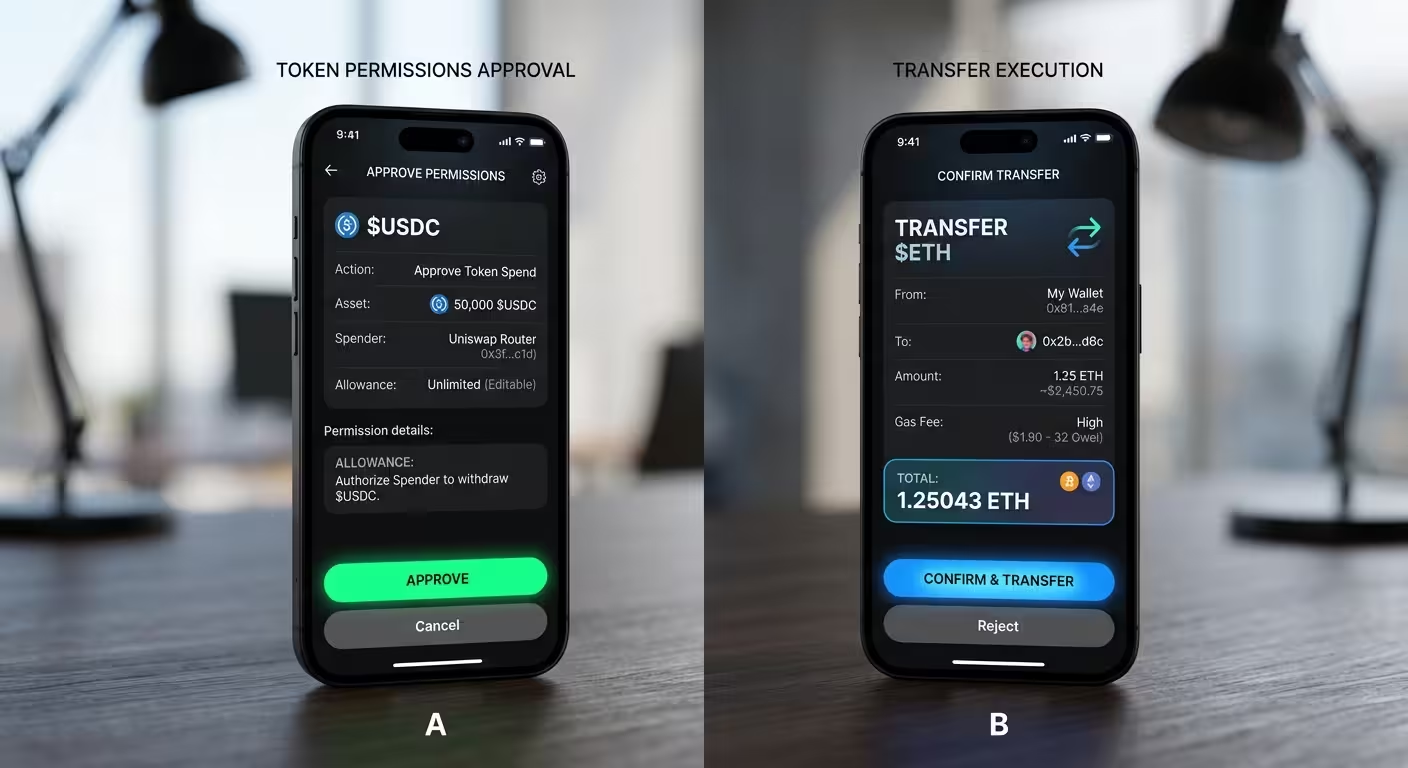
- Your wallet shows what you’re signing. This often comes in two steps: first an approval, then the swap.
- You confirm. Your wallet signs the transaction and broadcasts it to the network with a gas fee.
- The contract checks its conditions. Do you have enough USDC? Is the price still within your slippage limit, the maximum price change you’ll accept?
- The contract executes. It takes your USDC, sends ETH from its pool, and updates its records.
- The result goes on-chain. The trade is permanent and visible to anyone on a block explorer.
Notice who did what. The website suggested. You approved. The contract decided and executed. No company stood in the middle. Uniswap’s protocol documentation covers how its pools price these trades.
Token Approval vs. Token Transfer
A token approval gives a contract permission to move a specific token from your wallet. It doesn’t move anything yet. The actual swap or transfer is a separate step.
This matters because approvals can stay active long after you’re done. Read every wallet prompt before you confirm, and know which one you’re signing.

Smart Contract Examples in DeFi
Smart contracts power almost every DeFi activity, from loans to trades to voting. Each example below shows the same if-then machine applied to a different job.
How Smart Contracts Run DeFi Lending
Lending protocols like Aave use smart contracts in place of a loan officer. You deposit collateral, borrow against it, and the code tracks your position around the clock. Aave’s beginner documentation describes a non-custodial protocol where borrowers must supply collateral worth more than their loan.
Hypothetical scenario: Maria deposits $1,500 in ETH and borrows $900 in stablecoins. ETH then drops 30%. Her collateral is now worth about $1,050, and her position crosses the protocol’s safety line. The contract lets a liquidator repay part of her loan and claim some of her ETH at a discount. Nobody emails her. There’s no grace period.
For the full mechanics of collateral, interest rates, and health factors, read our guide on how DeFi lending works.
How Smart Contracts Power Token Swaps
A decentralized exchange contract holds two tokens in a shared pool. It prices trades with a math formula instead of matching buyers and sellers in an order book. People who deposit tokens into the pool earn a share of the trading fees.
How Smart Contracts Mint and Burn Stablecoins
Many tokens, including stablecoins, follow the ERC-20 standard, a shared rulebook for how tokens behave on Ethereum. Some stablecoins use smart contracts to create new tokens when collateral comes in and destroy them when it goes out. The contract keeps supply tied to the rules it was given.
How Smart Contracts Handle Governance Votes
Many protocols let token holders vote on changes. If a vote passes and a waiting period ends, the contract applies the change automatically. Staff don’t flip a switch. Voters do, through code.
How Smart Contracts Track Tokenized Real-World Assets
Smart contracts can record ownership of tokenized Treasury funds or real estate. They can also restrict who is allowed to hold those tokens, which matters for regulated products. Our roundup of real-world asset tokenization examples shows which products are already live.
What Is Smart Contract Composability?
Composability means one smart contract can call another, like open building blocks. A yield vault might deposit into a lending pool, which relies on a price feed, which another app also uses. Ethereum.org’s composability guide explains the concept in more depth.
This explains two things. A single transaction can touch several contracts at once. And one weak piece can affect everything stacked on top of it.
The If-Then Pattern Across DeFi
The If-Then Pattern Across DeFi
Different DeFi products look complex on the surface, but underneath they all follow the same logic: if a condition is met, the smart contract executes the next step automatically.
Borrowing
Enough collateral is deposited
Release the loan
No
Liquidation
Collateral falls below the threshold
Sell collateral to repay debt
No, anyone can trigger it
Swapping
Price stays within the slippage limit
Exchange the tokens
No
Governance
Vote passes and the time delay ends
Apply the parameter change
Voters, not staff
Smart Contracts vs. Traditional Contracts
A traditional contract relies on people and courts. A smart contract relies on code and a network. That single difference changes speed, flexibility, and what happens when something goes wrong.
Smart Contracts vs. Traditional Contracts
A traditional contract relies on people and courts. A smart contract relies on code and a network. That one difference changes speed, flexibility, and what happens when something goes wrong.
Written in
Legal language
Code
Enforced by
Courts, lawyers, institutions
The blockchain network
Handles gray areas
Yes, through human judgment
No, only explicit rules
Speed
Days to weeks
Seconds to minutes
Changes
Amended by agreement
Hard or impossible once deployed
Visible to
The parties involved
Anyone
If something goes wrong
Dispute resolution
The code’s outcome usually stands
Are Smart Contracts Legally Binding?
Sometimes. It depends on the jurisdiction and whether a legal agreement exists alongside the code. The CFTC’s primer on smart contracts notes that a smart contract may or may not be legally enforceable, depending on the facts. In England and Wales, the Law Commission’s smart contracts project concluded that existing law can generally accommodate them.
Most everyday DeFi interactions run on code, not signed legal terms. That’s why bank-style protections don’t apply. The FDIC confirms that crypto assets are not insured deposits, and Investor.gov’s crypto guidance is worth reading before you commit funds.
Smart Contract Myths vs. Reality
Most beginner confusion comes from a handful of common myths. Here’s how each one compares with how smart contracts actually behave.
Smart Contract Myths vs. Reality
Most beginner confusion comes from a few repeated myths. This side-by-side breakdown makes the difference instantly clear.
“Smart contracts are intelligent.”
“Smart contracts can never be changed.”
“The website is the smart contract.”
“Smart contracts know real-world prices.”
“Code is law, so outcomes are always fair.”
“If it’s on the blockchain, it’s safe.”
They follow fixed instructions with zero judgment.
Many use upgradeable designs controlled by admins or governance. Immutability is a design choice, not a guarantee.
The website is just a window into the contract. They’re separate layers.
They can’t see outside the blockchain. They depend on oracles for external data.
Code is literal. It enforces bugs and edge cases as faithfully as intended rules.
The blockchain records results accurately. That says nothing about whether the rules are good.
What Are the Benefits of Smart Contracts?
The main benefits of smart contracts are automation, transparency, and open access. They come from the same source as the limits: rigid, public, automatic code.
- Automation. There’s no approval queue. A contract runs at 3 a.m. on a holiday just as it does on a Tuesday.
- Transparency. The rules are public. You can see how a lending pool calculates interest instead of trusting fine print.
- Neutral access. Anyone with a wallet gets the same terms. The code doesn’t care about your zip code or credit score.
- Fewer middlemen. When code handles matching and settlement, fewer intermediaries take a cut.
- Composability. Builders combine existing contracts into new products instead of starting from scratch.
These traits explain much of how centralized and decentralized finance differ. A centralized platform runs on company policy. A DeFi protocol runs on published code.

What Are the Limits of Smart Contracts?
Smart contracts have design limits that good intentions can’t remove. They can’t see outside data, can’t tell intent from instructions, and can be hard to fix. Knowing these limits makes every DeFi product easier to evaluate.
Smart Contracts Can’t See Outside Data Without Oracles
A smart contract doesn’t know the price of ETH, the weather, or an election result. It only knows what’s already on the blockchain. Tools called oracles bring outside data in. Ethereum.org explains oracles as the bridge between off-chain information and on-chain code. Networks like Chainlink supply many of the price feeds DeFi relies on.
Think of a judge locked in a room who only knows what’s slipped under the door. If the note is wrong, the ruling is wrong.
Smart Contracts Execute Mistakes as Faithfully as Rules
Code can’t tell the difference between what a developer meant and what a developer wrote. If the instructions contain a flaw, the contract carries out the flaw.
Not every flaw turns into a loss, though. A 2020 USENIX Security study of 23,327 flagged Ethereum contracts found that fewer than 2% had actually been exploited. Most funds sat in a small number of contracts that weren’t exploitable in practice. The lesson is nuance, not comfort. A flaw on paper and a loss in real life are different things.
Smart Contracts Are Hard to Fix After Deployment
An immutable contract can’t be patched. An upgradeable one often requires a governance vote and a time delay before changes take effect. Both are trade-offs. Immutability builds trust that no one can change the rules. Upgradeability adds flexibility, but it also gives someone control.
Smart Contracts Can’t Handle Context or Nuance
Hardship, honest mistakes, and context mean nothing to code. Send tokens to a mistyped address, and they’re usually gone for good. There’s no customer service line inside a smart contract.
Smart Contracts Still Depend on People
Developers write the code. Governance voters change it. Oracle providers feed it data. Front-end teams host the interface. Even a well-written contract runs inside a system of humans.
“Trustless” really means “trust shifted,” not “trust removed.”
Contracts also change over time through upgrades and new integrations. That’s why a single review is only a snapshot, a point we explore in why one smart contract audit is no longer enough.

Real Cases Where Code Did Exactly What It Said
Real incidents show how smart contracts behave under pressure. In each case below, the code didn’t “break” in the usual sense. It did exactly what it said. The question was whether what it said matched what everyone expected.
The DAO (2016): When “Code Is Law” Met Its Social Limits
The DAO was an early investment fund built as a smart contract on Ethereum. In June 2016, an attacker used a flaw in its withdrawal logic to drain roughly a third of its funds. The contract followed its code exactly.
The bigger story came next. The Ethereum community had to choose between accepting the outcome and changing the blockchain itself. Most chose a hard fork to reverse the damage, and the original chain continued as Ethereum Classic. Ethereum.org’s history page documents the split.
The lesson: “Code is law” works until enough people decide it shouldn’t. Immutability turned out to have social limits.
Black Thursday (2020): Working as Designed Isn’t Working Well
In March 2020, crypto prices crashed sharply in a single day. The Ethereum network clogged, and gas prices spiked. Some of MakerDAO’s collateral auctions ran with very little competition, and some collateral sold far below market value.
The contracts ran the auctions exactly as designed. They had no rule for “the market is chaotic, so wait.” The protocol later changed its auction design through governance.
The lesson: Smart contracts don’t adapt to unusual conditions unless someone wrote that logic in advance.
The Everyday Liquidation: When Smart Contracts Work Quietly
Go back to Maria’s loan. Her collateral fell, the contract allowed a liquidation, a liquidator repaid part of her debt, and lenders stayed whole. No drama, no headline.
The lesson: Most smart contract activity is routine, and it works. Headlines skew toward failures because failures are news.
Common Beginner Mistakes With Smart Contracts
Most smart contract mishaps come from small misunderstandings, not sophisticated attacks. These are the ones that catch newcomers most often.
- Thinking the website and the contract are the same. Fix: Bookmark official URLs. Remember the contract runs independently of any site.
- Signing prompts without reading them. Fix: Check whether you’re approving, swapping, or transferring before you confirm.
- Granting unlimited token approvals by default. Fix: Approve only the amount you need for the transaction.
- Sending tokens directly to a contract address. Fix: Many contracts can’t return them. Always use the app’s intended function.
- Assuming “decentralized” means no one has control. Fix: Check whether admin keys or upgrade controls exist.
- Treating an “audited” badge as a guarantee. Fix: Learn how to evaluate a protocol’s security review before trusting the label.
- Ignoring gas costs on small transactions. Fix: Compare fees across networks before you move a small amount.
- Losing control of the wallet that talks to the contract. Fix: Learn the difference between a private key and a seed phrase, then follow our guide to storing your seed phrase safely.
Why Smart Contracts Matter in DeFi
Smart contracts are what make DeFi possible. They replace the trusted middleman with rules anyone can verify. Without them, DeFi would just be crypto sitting in a wallet.
That shift also changes your role. When code holds the money and enforces the rules, you take on more responsibility for your own keys and decisions. Our guide to self-custody in crypto explains what that looks like day to day.
Institutions now use the same programmable logic for tokenized funds and settlement. Some teams also pair smart contracts with AI systems that decide when to act, a trend we cover in how AI and blockchain work together in finance. The foundation is still the same if-then machine.
Quick Recap: Smart Contracts in 60 Seconds
- A smart contract is self-executing code on a blockchain that runs when conditions are met.
- It’s neither intelligent nor automatically a legal contract.
- Developers usually write it in Solidity or Vyper, and the EVM runs it.
- You reach it through a front end and a wallet. Those are three separate layers.
- It powers lending, swaps, stablecoins, governance, and tokenized assets.
- It can’t see outside data without oracles.
- It enforces mistakes as faithfully as intended rules.
- Its benefits and limits share one source: rigid, public, automatic code.
People Also Ask
What is a smart contract in simple terms?
A smart contract is a program on a blockchain that follows if-then rules automatically. If the conditions are met, it carries out the action, such as releasing a loan or swapping tokens. No person approves each step. The code is public, so anyone can check what it does.
What is a smart contract in crypto?
In crypto, a smart contract is the code behind most apps you use. When you swap tokens on a decentralized exchange, a contract checks your balance and price limit, takes your tokens, and sends new ones back. It handles the trade from start to finish without a company in the middle.
What are smart contracts used for?
Smart contracts are used for lending and borrowing, token swaps, stablecoins, governance votes, and tokenized real-world assets. They also run NFTs, payments, and multi-signature wallets. Any process that follows clear if-then rules can potentially run as a smart contract.
What is an example of a smart contract?
A DeFi lending pool is a common example. You deposit ETH as collateral, and the contract lets you borrow stablecoins up to a set limit. If your collateral value falls too far, the same contract allows a liquidation automatically. No loan officer is involved at any step.
Who invented smart contracts?
Computer scientist Nick Szabo coined the term “smart contract” in the 1990s. Ethereum, launched in 2015, made the idea practical at scale. It was the first major blockchain designed to run general-purpose smart contract code.
What programming language are smart contracts written in?
Most Ethereum smart contracts are written in Solidity. Vyper is a smaller alternative with Python-like syntax. Both compile to bytecode that the Ethereum Virtual Machine runs. Other networks differ. Solana programs, for example, are usually written in Rust.
Are smart contracts safe?
Smart contracts are as safe as their code, design, and data sources. Established protocols with public reviews and long track records carry less risk, but no contract is risk-free. DeFi deposits also lack FDIC insurance, so start small and use only funds you can afford to lose.
Is a smart contract the same as a blockchain?
No. The blockchain is the network and its shared blockchain ledger. A smart contract is a program that runs on that network. One blockchain can host thousands of separate smart contracts, each with its own address and rules.
Can a smart contract be changed after it’s deployed?
It depends on the design. Immutable contracts can’t be changed at all. Upgradeable contracts let admins or governance voters swap in new code, often after a waiting period. Check which type a protocol uses before you deposit funds.
Are smart contracts legally binding?
Sometimes. It depends on the jurisdiction and whether a separate legal agreement exists. Most DeFi interactions run on code alone, without signed legal terms or bank-style protections. This isn’t legal advice, so consult a licensed attorney for specific situations.
Do smart contracts only work on Ethereum?
No. Many blockchains support smart contracts, including Solana and Layer 2 networks built on Ethereum. Ethereum popularized them in 2015 and still hosts a large share of DeFi activity.
What happens if a smart contract has a mistake?
The contract keeps following its code, mistake included. If the design allows upgrades, the team or governance may be able to replace it. Immutable contracts can’t be fixed at all, which is why reviewing a protocol before you deposit matters.
What is the difference between a smart contract and a dapp?
A dapp, or decentralized application, is the full product you use, including its website or app. Smart contracts are the back-end logic that does the real work. One dapp can rely on several contracts, and one contract can serve many dapps.
The Bottom Line
Smart contracts aren’t smart, and they usually aren’t contracts. They’re rule-following machines that hold money and act the moment their conditions are met. Once you see them that way, every DeFi product gets easier to understand.
You can also ask better questions. What are the rules? Who can change them? What data do they rely on?
Your next step: Pick one DeFi app you’ve heard of and look up its main contract on a block explorer. You’ll see the same public, permanent record this guide described. Then set up a secure wallet with our guide to crypto wallets for beginners before you interact with any contract.
Smart Contracts · Editorial Integrity
Sources & Citations
Official documentation, public records, and regulator guidance behind this guide to smart contracts. It covers how smart contracts work, smart contract languages, DeFi examples, oracles, gas fees, legal context, and core risks.
Every major claim in this guide is grounded in official blockchain documentation, protocol references, public regulator material, and selected research. Smart contract definitions, execution, and composability rely on Ethereum.org and Solidity documentation. DeFi examples draw on Aave and Uniswap documentation. Legal and consumer-protection context follows public guidance from the CFTC, FDIC, and Investor.gov. Because smart contract platforms, protocol rules, and regulation change quickly, readers should verify the latest details at the source before acting on any technical, financial, or legal decision.
View full sources, methodology, and editorial notes
This beginner guide was written using primary sources wherever possible. We relied on official blockchain documentation, smart contract language references, protocol documentation from major DeFi platforms, public legal and regulator guidance, and selected public research where it clarified risk or historical context. We give preference to sources that explain how smart contracts, tokens, and blockchain systems actually work over promotional material or social posts. Real-world examples in the article are used to explain mechanics, not to provide investment, legal, or developer advice. Because contract designs, governance controls, and legal interpretations evolve over time, some descriptions reflect broad principles rather than permanent rules. This article is educational information only and not financial or legal advice.
- What a smart contract is and how it works: Ethereum.org — Introduction to Smart Contracts — cited for the plain-language definition of smart contracts as code and data stored at a blockchain address, plus their role in executing rules automatically.
- Official Ethereum smart contract explainer: Ethereum.org — Smart Contracts — cited for a simpler user-facing explanation of self-executing code and how smart contracts remove certain intermediaries.
- Smart contract language documentation: Solidity Documentation — cited for the role of Solidity as the most widely used language for Ethereum smart contract development.
- A second smart contract language used on Ethereum: Vyper Documentation — cited to support the mention of Vyper as a Python-style alternative to Solidity.
- How the Ethereum Virtual Machine executes code: Ethereum.org — Ethereum Virtual Machine (EVM) — cited for how smart contract bytecode runs consistently across the network.
- Gas fees and transaction execution costs: Ethereum.org — Gas and Fees — cited for how gas pays for computation and why fees rise during network congestion.
- How smart contracts connect to outside data: Ethereum.org — Oracles — cited for the explanation that smart contracts cannot access off-chain data directly and therefore depend on oracle systems.
- Example of price data delivered on-chain: Chainlink — Data Feeds Documentation — cited for how decentralized price feeds deliver external market data to smart contracts.
- How smart contracts combine with one another: Ethereum.org — Smart Contract Composability — cited for the idea that contracts can call other contracts like open building blocks.
- How decentralized applications work: Ethereum.org — Decentralized Applications (dapps) — cited for the distinction between a dapp’s front end and its smart contract back end.
- How DeFi lending protocols use smart contracts: Aave — Aave 101 — cited for how non-custodial lending and borrowing protocols use overcollateralized smart contract logic.
- How token swaps and protocols work on Uniswap: Uniswap Documentation — Protocol Overview — cited for how smart contracts power swaps and liquidity pools on decentralized exchanges.
- Historical background on Ethereum and Ethereum Classic: Ethereum.org — History — cited for the DAO fork context and the split between Ethereum and Ethereum Classic.
- Original concept behind smart contracts: Nick Szabo — Formalizing and Securing Relationships on Public Networks — cited for the origin of the term “smart contract” and the vending machine analogy.
- Research on vulnerabilities versus real-world exploitation: USENIX Security / arXiv — Smart Contract Vulnerabilities: Vulnerable Does Not Imply Exploited — cited for the distinction between theoretically vulnerable contracts and those actually exploited in practice.
- Legal and regulatory framing of smart contracts: CFTC — A Primer on Smart Contracts — cited for the point that smart contracts may or may not be legally enforceable depending on facts and context.
- How contract law can accommodate smart contracts: Law Commission of England and Wales — Smart Contracts Project — cited for the view that existing legal frameworks can generally accommodate smart contracts.
- No deposit insurance for crypto assets: FDIC — Financial Products That Are Insured and Not Insured — cited to confirm that crypto assets are not insured deposits.
- Consumer-facing crypto risk guidance: Investor.gov — What Should I Know Before I Buy Crypto — cited for general consumer risk and due diligence guidance around crypto assets.
Smart Contracts · Editorial Standards
Our Editorial Standards
Tech Capital Hub applies Google’s E-E-A-T framework to every beginner crypto guide. We favor plain-English explanations, official documentation, public records, and verifiable technical references over hype or unsupported claims. In this guide, official blockchain and smart contract documentation explains what smart contracts are, how they execute, and where their limits begin. Protocol documentation from platforms like Aave and Uniswap supports our DeFi examples. Ethereum.org, Solidity documentation, and related technical resources shape our coverage of smart contract logic, gas fees, oracles, dapps, and composability. Public regulator guidance informs our notes on legal context, investor protection, and crypto risk. Because smart contract platforms, governance rules, and legal interpretations evolve quickly, we treat examples as educational rather than permanent or universal.
View how our editorial standards apply to this article
Built Around a Real User Action
This guide starts where most readers actually meet a smart contract: clicking a button in a DeFi app. Instead of leading with theory, it explains what happens when someone swaps tokens, approves a transaction, or borrows against crypto collateral. The three-layer model, the step-by-step swap walkthrough, and the beginner mistake section are designed to mirror the real decisions users face when code moves money on-chain.
Technical Concepts in Plain English
Coverage focuses on the ideas that matter most for understanding smart contracts without assuming a developer background. We explain self-executing code, the Ethereum Virtual Machine, Solidity and Vyper, token approvals, gas fees, oracles, composability, governance, and smart contract risk in clear language. The goal is not to impress advanced developers. It is to make complex infrastructure understandable for beginners and investors evaluating how DeFi actually works.
Official Docs and Public Guidance Where They Matter
Specific claims are anchored to primary sources wherever possible. Core definitions and execution mechanics rely on Ethereum.org and Solidity documentation. DeFi examples use official protocol references from Aave and Uniswap. Legal and consumer-protection context follows public material from bodies such as the CFTC, FDIC, and Investor.gov. We avoid treating social posts, promotional content, or unsourced claims as authoritative support for technical or legal points.
Honest About Limits, Bugs, and Responsibility
We state the benefits and limits of smart contracts with equal weight. Smart contracts can automate money movement, but they can also enforce bugs, rely on flawed outside data, and leave little room for human judgment once deployed. We note that crypto assets are not insured deposits, that audits are not guarantees, and that legal treatment can vary by jurisdiction. This guide is reviewed and updated over time. Nothing here is financial, legal, or investment advice. Corrections or source challenges can be sent to editorial@techcapitalhub.com.
Smart Contracts · About the Author
Marcus Delray
Fintech Analyst · Founder of Tech Capital Hub
Marcus Delray is a fintech analyst and the founder of Tech Capital Hub. In this guide, he explains what smart contracts are in plain terms, how they work behind DeFi apps, and where their biggest benefits and risks show up in the real world. His focus is on clarity, practical understanding, and beginner-safe context, not jargon or hype.
View full author bio, credentials, and links
Marcus Delray has spent over a decade researching financial technology, blockchain infrastructure, and decentralized finance. He built Tech Capital Hub to make that research useful for everyday readers, from total beginners to people who already follow the market. He covers cryptocurrency, blockchain, DeFi, AI in finance, and business accounting tools, with a steady focus on turning dense topics into clear, actionable guides.
For this guide, Marcus focuses on the question most beginners ask first: what is a smart contract, and what actually happens when you click a button in a crypto app? He explains self-executing code, token approvals, gas fees, oracles, composability, and governance using plain-English examples instead of developer jargon. The article walks through how a smart contract powers a token swap, how it differs from a traditional contract, and why “code is law” is only part of the story.
He also covers the limits many simplified explainers skip, including buggy code, upgrade risk, oracle dependence, and the fact that blockchain transparency does not guarantee safety. The three-layer model, myths-vs.-reality table, and beginner mistake section are designed to turn abstract blockchain concepts into practical mental models readers can actually use. All articles are educational information, not financial, legal, or investment advice.
- Explains smart contracts in plain, jargon-light language for beginners, investors, and curious readers
- Breaks down how front ends, wallets, and smart contracts work together in real DeFi interactions
- Clarifies core concepts like gas fees, token approvals, oracles, composability, and governance without assuming coding knowledge
- Highlights real risks, including buggy code, upgrade controls, false assumptions about decentralization, and lack of deposit insurance
- Grounds every major concept in official documentation, protocol references, and public regulator guidance rather than hype or social-post consensus
Enjoying our content?
Click below to add us as a preferred source. Google will prioritize our latest articles in your Top Stories, AI Mode, and AI Overviews.
Preferred Source on Google