
How to Read a Crypto Exchange: Order Types and Charts for Total Beginners

Fintech Analyst · Founder of Tech Capital Hub
Marcus covers cryptocurrency, blockchain, DeFi, and financial technology in plain English for everyday readers. In this guide, he explains how to read a crypto exchange screen, compare market and limit orders, understand maker and taker fees, and use charts, order books, and trading pairs without getting overwhelmed.
- Crypto Exchanges
- Order Types
- Trading Pairs
- Order Books
- Candlestick Charts
- Maker & Taker Fees
A crypto exchange is a platform where you buy and sell cryptocurrencies by placing orders against other traders. Learning how to read a crypto exchange comes down to four elements: the trading pair, the order type, the order book, and the price chart. Once you know what each one tells you, the screen stops looking like a wall of numbers.
Most beginners think market and limit orders differ only in speed. They don’t. The real difference is liquidity. You either take a price that already exists, or you offer a new price and wait. That one idea affects your fees, your fill price, and your risk. If you’re brand new to trading, start with our What Is DeFi? A Beginner’s Guide to Decentralized Finance in 2026, then come back here to learn the screen itself.
Key Takeaways
- Every exchange screen answers four questions: what you’re trading, how you’re trading it, what others will pay, and where the price has been.
- Market orders cost more. They take liquidity and pay higher taker fees. Limit orders that rest on the book pay lower maker fees.
- A limit order isn’t always a maker order. If your limit price crosses the best available price, it fills instantly and pays the taker fee.
- BTC/USD and BTC/USDT are different trades. One is priced in dollars, the other in a privately issued stablecoin.
- A green candle isn’t a buy signal. Chart patterns need volume confirmation, and most published reliability statistics come from stock markets, not crypto.
Table of Contents

What Do All Those Numbers on a Crypto Exchange Mean?
The numbers on a crypto exchange answer four questions. The trading pair shows what you’re buying and what you’re paying with. The order type controls speed or price. The order book lists current buy and sell offers. The chart shows past prices. Almost every other number on the screen supports one of these four ideas.
You don’t need to understand every number at once. You only need to know which number answers which question. A crypto exchange shows the same core information a stock brokerage does. The labels just look different. Once you internalize that, the screen starts to make sense.
What Does Each Part of the Exchange Screen Show?
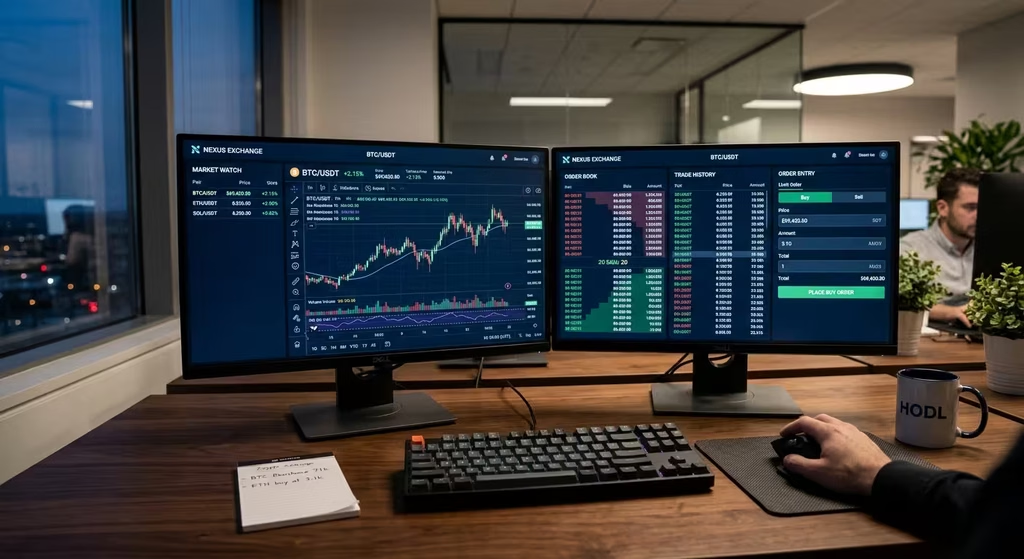
A typical crypto exchange screen layout has five panels: the trading pair selector, the price chart, the order book, the order entry panel, and the recent trades panel. Coinbase Advanced, Kraken Pro, and most similar platforms arrange them in roughly the same way, so learning one layout prepares you for nearly all of them.
Each panel on the exchange screen has one job:
- Trading pair selector. It usually sits at the top. It shows what you’re trading, such as BTC/USD or ETH/USD.
- Price chart. It takes up the most space. It shows past price movement, usually as candlesticks.
- Order book. It usually sits on the right. It lists buy and sell orders waiting to fill.
- Order entry panel. It sits near the order book. You pick your order type and enter your trade here.
- Recent trades panel. It often sits below the order book. It shows a live feed of completed trades. The order book shows what people want to trade. The recent trades panel shows what actually traded.
Coinbase and Kraken both offer two views. The simple view hides the order book and order types behind one “Buy” button. The advanced view shows the full layout above. The simple view is convenient, but it also hides a fee difference. That difference is covered in the fee section below.
Don’t try to master every panel on day one. For your first few trades, you’ll mainly use the order entry panel and the price chart. The order book and recent trades panel become more useful once you start placing limit orders.

How Do You Read a Trading Pair Like BTC/USD or BTC/USDT?
A trading pair uses a base asset / quote asset format. The base asset is what you buy or sell. The quote asset is what you pay with. In BTC/USD, Bitcoin is the base asset, and the U.S. dollar is the quote asset. A price of 100,000 means one Bitcoin costs $100,000. Order size and trade volume usually appear in the base asset (BTC). The price appears in the quote asset (USD).
The base asset / quote asset structure works the same for every pair:
Trading Pairs Explained
Base Asset vs. Quote Asset
The first asset is what you buy or sell. The second is what you pay with.
| Pair | Base assetWhat you buy or sell | Quote assetWhat you pay with | Where it’s common |
|---|---|---|---|
| BTC/USD | Bitcoin Priced per 1 BTC | U.S. dollar Fiat currency | U.S. platforms like Coinbase and Kraken |
| BTC/USDC | Bitcoin Priced per 1 BTC | USD Coin Stablecoin | U.S. and global platforms |
| BTC/USDT | Bitcoin Priced per 1 BTC | Tether Stablecoin | Mostly offshore and global platforms |
| ETH/USD | Ether Priced per 1 ETH | U.S. dollar Fiat currency | U.S. platforms |
U.S. readers: Coinbase and Kraken mainly list USD and USDC pairs. The BTC/USDT trading pair is far more common on global exchanges. Which pairs you see depends on where you live and which platform you use.
Why BTC/USDT Isn’t the Same Trade as BTC/USD
A stablecoin is a crypto token designed to hold a steady value, usually $1. USDT and USDC both aim to track the dollar. Neither one is actual cash, and neither is a bank deposit.
The SEC’s April 2025 staff statement on stablecoins clarifies that dollar-backed stablecoins depend entirely on the reserves their issuers hold. Separately, the FDIC’s guidance on crypto assets and deposit insurance confirms that stablecoins are not bank deposits and are not FDIC insured. The two points come from two different regulators, and both matter.
The dollar peg can slip. In May 2022, during the TerraUSD collapse, USDT briefly fell to about $0.95. In March 2023, USDC dropped to roughly $0.87 after Silicon Valley Bank failed, because part of its reserves sat at that bank. Both coins recovered, but each event showed that “stable” doesn’t mean “guaranteed.”
In July 2025, the U.S. passed the GENIUS Act, which set federal reserve and disclosure requirements for payment stablecoins. The law introduced accountability that didn’t exist before, but stablecoins are still not bank deposits. Verify the current implementation status before treating any stablecoin as cash.
BTC/USD and BTC/USDT prices can differ for this reason. BTC/USD is priced in dollars. BTC/USDT is priced in a token that only aims to equal a dollar. Small gaps are normal. A large or lasting gap often signals doubt about the stablecoin, not a real change in Bitcoin’s value.
If your exchange offers both a USD pair and a stablecoin pair, trading against USD removes that layer of stablecoin risk. To understand how decentralized alternatives to centralized exchanges work, see our guide to CeFi vs DeFi: Key Differences Between Centralized and Decentralized Finance.

What’s the Difference Between Market Orders and Limit Orders?
A market order buys or sells right away at the best available price. A limit order only fills at a price you set or better. Market orders “take” existing liquidity and usually pay higher taker fees. Limit orders that rest on the order book “make” liquidity and usually pay lower maker fees.
Two terms come up in every conversation about order types:
- Taker: A trader whose order fills immediately against an existing order, removing liquidity from the order book.
- Maker: A trader whose order rests on the order book and waits, adding liquidity that others can trade against.
- Slippage: The difference between the price you expected and the price your order actually filled at.
How a Market Order Works
A market order fills against the best offers already in the order book. The trader placing it is the taker. The risk is slippage. In a fast or thin market, the price can move between your click and your fill. You might pay more than the price you saw a second earlier.
How a Limit Order Works
A limit order sets your exact price. It only fills if the market reaches that price, so it may never fill at all. If it waits on the book, the trader placing it is the maker. Exchanges reward makers with lower fees because their resting orders add liquidity and make the market easier for everyone else to trade in.
The Marketable Limit Order Trap
Placing a buy limit above the ask is a common beginner mistake. If your limit price crosses the current best offer, the order fills immediately and is charged as a taker. For example, if the lowest ask is $100,000 and you place a buy limit at $100,200, you’ll fill right away and pay the taker fee — not the maker rate.
Traders often set a high buy limit “to make sure it fills” and unknowingly lose the fee discount. Coinbase Advanced and Kraken Pro both offer a post-only setting that prevents this. It cancels your order if it would fill as a taker, so you always get the maker rate when using limit orders.
Market Order vs. Limit Order at a Glance
Order Types Explained
Market Order vs. Limit Order at a Glance
One takes the price that exists now. The other sets a price and waits.
| Feature | Market orderTakes existing liquidity | Limit orderAdds liquidity when it rests |
|---|---|---|
| Execution | Immediate Fills at the best available price | Only at your price or better Waits until the market reaches it |
| Fee category | Taker fee Usually the higher rate Taker | Maker if it rests on the book Taker if it fills instantly MakerOr taker |
| Main risk | Slippage Worst in fast or thin markets | May never fill The price may not reach your level |
| Best for | Urgent trades In high-liquidity assets like BTC or ETH | Price-sensitive trades Patient entries and lower fees |
| Stock-market equivalent | Market order Same concept | Limit order Same concept |
Time-in-force is a separate setting. It controls how long your order stays active, not what kind of order it is. “Good ’til Canceled” (GTC) keeps an order open until it fills or you cancel it. Other common options include Day, Immediate or Cancel (IOC), and Fill or Kill (FOK). The SEC’s investor guide to types of orders covers these terms in stock-market language. They work the same way on most crypto exchanges.
How Much Do Maker and Taker Fees Actually Cost?
Maker and taker fees are percentage charges an exchange applies to each trade. Takers pay more than makers on almost every platform. On a $1,000 Bitcoin purchase, the gap between the two is a few dollars. Across dozens of trades, those dollars add up. A limit order is one of the easiest ways to reduce trading costs without switching platforms.
The worked example below uses Kraken Pro’s entry-tier rates as an illustration. Always verify the current rates on the official Kraken fee schedule and the Coinbase Advanced fee page before you trade, since fee tiers change as your 30-day volume grows.
Scenario: Buying 0.01 BTC at $100,000 ($1,000 order) — illustrative rates
Trading Fees Explained
What a $1,000 Bitcoin Buy Really Costs
Same trade, two order types. The fee gap is small once and big over time.
| Cost item | Limit orderMaker rate, ~0.25% | Market orderTaker rate, ~0.40% |
|---|---|---|
| Fill price | $100,000 Fills at your set price No slippage | $100,030 average Includes $30-per-BTC slippage, or $0.30 on this 0.01 BTC order Slippage |
| Cost of 0.01 BTC | $1,000.00 0.01 × $100,000 | $1,000.30 0.01 × $100,030 |
| Fee | $2.50 ~0.25% of $1,000 Maker | $4.00 ~0.40% of $1,000 Taker |
| Total cost | $1,002.50 Lower cost | $1,004.30 +$1.80 more |
The limit order saved $1.80 on one trade. Over 50 trades a year, that’s about $90. Slippage was small here because Bitcoin is highly liquid. In a thinner market, it can be much larger.
Simplified “Buy” screens usually cost more than either column above, often through a higher fee combined with a built-in spread.

What Are Stop-Loss and Stop-Limit Orders?
A stop-loss order sells automatically when the price falls to a level you choose, called the stop price. A stop-limit order also triggers at a stop price, but then places a limit order instead of a market order. Both help you cap losses without watching the screen all day. Each one has a different trade-off.
Stop-Loss (Stop-Market) Orders
A stop-loss turns into a market order once the stop price triggers. It will almost always fill. The catch is the fill price. In a sudden crash, the price can drop past your stop before your order executes. You might sell well below the level you set.
Stop-Limit Orders
A stop-limit order has two prices: a stop price and a limit price. When the market hits the stop, the exchange places a limit order at your limit price. You control the worst price you’ll accept. But if the market drops past your limit too fast, the order won’t fill, and you’re still holding the asset.
Order Types Explained
Stop-Loss vs Stop-Limit Orders
Same trigger price. Very different outcomes.
| Feature | Stop-lossStop-market order | Stop-limitStop price + limit price |
|---|---|---|
| Triggers at | Stop price The level you choose in advance Same trigger | Stop price The level you choose in advance Same trigger |
| Becomes | Market order Sells at the best available price | Limit order Sells only at your limit price or better |
| Fill guaranteed? | Almost always You exit the position Almost always | No The price can skip past your limit Not guaranteed |
| Price guaranteed? | No Fill price depends on the market Not guaranteed | Yes, at your limit or better You set the worst price you’ll accept Price floor |
| Main risk | Selling far below your stop in a crash Slippage when prices gap down Slippage | No fill in a fast drop You may still hold the asset Stuck position |
Take-profit orders work the opposite way. They sell automatically when the price rises to your target. Many exchanges let you attach a stop-loss and a take-profit to the same position at the same time.
The CFTC’s customer advisory on virtual currency trading risks warns that crypto prices can swing sharply in short periods. Stop orders reduce that risk, but they can’t eliminate it.
Which Order Type Should You Use?
Order Types Explained
Which Order Type Should You Use?
Start with your goal. The right order type follows from it.
| Your goalWhat you want to happen | Best order typeThe tool for the job | How it worksFill and fee behavior | Watch out forThe main trade-off |
|---|---|---|---|
| Buy now, price doesn’t matter | Market order Entry | Fills right away At the best available price Taker fee | Slippage Worse in fast or thin markets Higher cost |
| Buy at a specific price, can wait | Limit order (post-only) Entry Beginner default | Fills at your price or better Post-only cancels it if it would fill as a taker Maker fee | May never fill The price may not reach your level No fill |
| Cap a loss while away from the screen | Stop-loss Loss protection | Becomes a market order Triggers at your stop price, then sells Fills almost always | Selling below your stop Prices can gap past it in a crash Slippage |
| Cap a loss with a price floor | Stop-limit Loss protection | Becomes a limit order Sells only at your limit price or better Price floor | No fill in a fast drop You may still hold the asset Stuck position |
| Lock in a profit automatically | Take-profit Exit | Sells when the price rises Triggers at the target you set Pairs with a stop-loss | Exiting too early You give up gains above your target Capped upside |
As a beginner, a limit order with post-only enabled is the right default for most buys. Use a market order only when speed matters more than price. Add a stop-loss if you can’t monitor the position.
How Do You Read an Order Book?
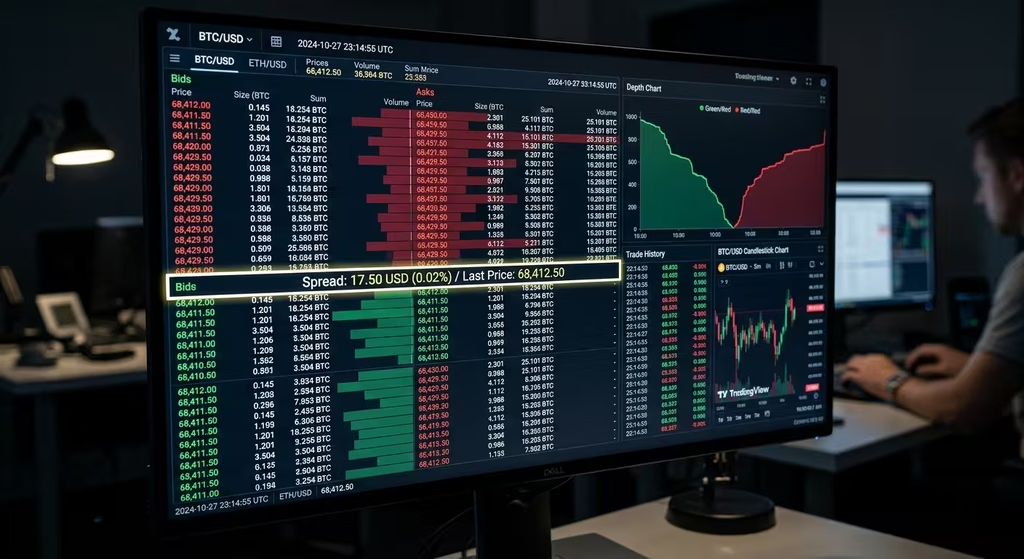
An order book is a live list of buy orders (bids) and sell orders (asks), each with a price and a quantity. To read a crypto exchange order book as a beginner, focus on two things: the bid-ask spread and the order book depth near the current price. Together, they tell you how much a market order will cost right now.
The order book updates constantly as traders place, cancel, and fill orders. You don’t need to read every row.
The Bid-Ask Spread
The bid-ask spread is the gap between the highest price a buyer will pay and the lowest price a seller will accept. The bid-ask spread is the smallest cost of trading right now. A tight spread signals an active, liquid market. A wide spread means thinner trading and a higher hidden cost for market orders.
You can measure the spread as a percentage:
Spread % = (lowest ask − highest bid) ÷ lowest ask × 100
If the highest bid is $99,990 and the lowest ask is $100,000, the spread is $10, or 0.01%. On a small altcoin, the spread might be 0.5% or more — 50 times wider — and you pay it on every market order.
Order Book Depth
Order book depth is the total volume of orders stacked near the current price. A thick stack means the market can absorb a decent-sized trade without moving much. A thin stack means even a modest order can push the price. That is the mechanical reason large trades sometimes fill at worse prices than expected.
What a Depth Chart Shows
A depth chart turns the order book into a visual. Bids form a green “wall” on the left. Asks form a red “wall” on the right. The gap in the middle is the spread. Steep, tall walls near the center mean deep liquidity. Shallow slopes mean your order could move the price noticeably.
A quick glance at the spread and depth tells you whether a market order makes sense right now, or whether a limit order is the safer call.
How Do You Read Crypto Charts?
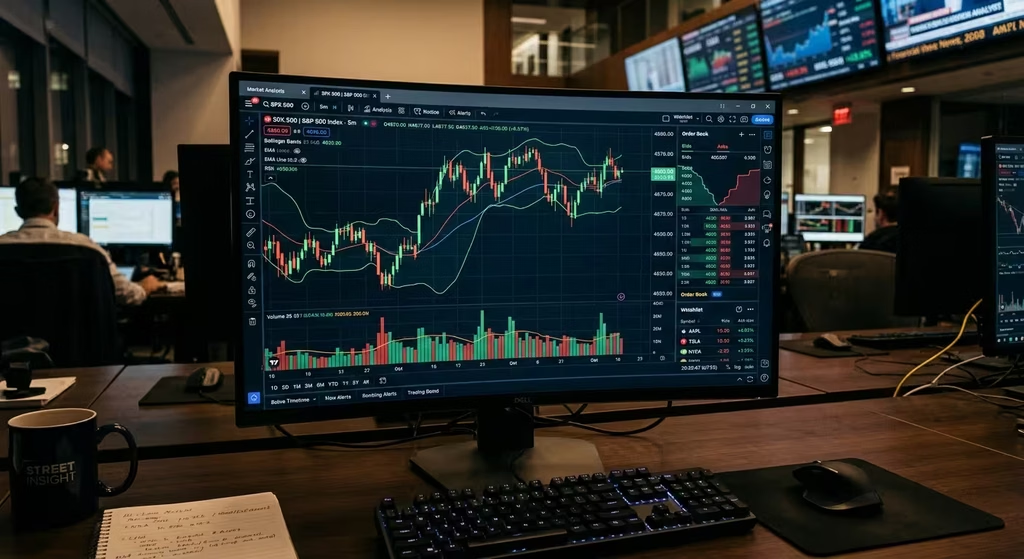
To read crypto charts, start with candlesticks. Each candlestick packs four prices into one shape — the open, the close, the high, and the low — for a single time period. Green means the price closed higher than it opened. Red means it closed lower. Candlestick chart reading only becomes reliable when you confirm patterns with trading volume.
The Parts of a Candlestick
- Color. Green means the close was above the open. Red means the close was below it.
- Body. The thick part spans the opening and closing prices.
- Wicks. The thin lines above and below the body show the highest and lowest prices reached during the period, even if the price didn’t stay there.
Each candle covers whatever timeframe you pick: one minute, one hour, one day, or longer. Beginners usually do best with the daily or 4-hour chart. Very short timeframes, like the 1-minute chart, produce a lot of random noise that’s easy to misread. To understand how smart contracts automate trades on decentralized platforms, see our guide to What Is a Smart Contract? A Plain-English Guide With Real DeFi Examples.
Common Crypto Chart Patterns for Beginners
A few single-candle patterns show up often enough to recognize:
- Hammer. A small body near the top with a long lower wick, usually after a decline. Traders read it as a possible bullish reversal. To identify a hammer, look for a lower wick at least twice the length of the body.
- Shooting star. A small body near the bottom with a long upper wick, usually after a rally. Traders read it as a possible bearish reversal.
- Doji. The open and close are nearly identical, so the body looks like a thin line. It signals indecision.
Larger multi-candle patterns include the head and shoulders (a possible top) and the double bottom (a possible floor). To spot a double bottom, look for two lows at roughly the same level with a peak between them. The pattern only confirms when the price breaks above that middle peak.
A Note on Pattern Reliability
Many reliability statistics for chart patterns trace back to research by Thomas Bulkowski, whose pattern performance studies measured thousands of patterns. That data comes mostly from U.S. stock markets, not crypto. Crypto trades 24/7, swings harder, and has thinner markets for most coins. Treat those statistics as a rough guide, not a promise.
Why Volume Confirmation Matters
Volume confirmation is the habit of checking whether trading volume supports a price move. A breakout on low volume is often a fakeout. A common rule of thumb among technical traders is that a valid breakout should show volume well above its recent average. Some traders use 25% to 30% above the 20-day average as a starting threshold. It’s a guideline, not a guarantee.
The volume bars sit at the bottom of the chart. Check them before you trust any pattern. Most beginner guides skip this step entirely and just name the shapes.
How Should You Place Your First Practice Order?
The safest way to learn is to use an amount so small that mistakes don’t matter. Pick a liquid pair, check the spread, place a small limit order, then compare it with a small market order. Reviewing the trade confirmation tells you the real fee and whether you traded as a maker or a taker.
Follow these steps for your first practice trade on a crypto exchange:
- Pick a highly liquid pair. BTC/USD or ETH/USD are good starting points on U.S. platforms. Deep order books and tight spreads make learning easier. Thin, low-volume pairs are confusing for beginners.
- Check the spread. Look at the gap between the highest bid and lowest ask. It shows what a market order will cost you right now.
- Place a small limit order. Set a buy slightly below the current price, or a sell slightly above it. Turn on post-only if your exchange offers it. Watch whether it fills or sits on the book.
- Cancel it and place a small market order. Compare your fill price with the price you saw a moment earlier. That gap is slippage, made concrete.
- Review the trade confirmation. It shows the exact fee charged and whether you were categorized as a maker or a taker.
Some platforms offer demo or paper trading, which lets you run through these steps with no money at risk. Check your platform’s settings before your first live order. Before you deposit funds, make sure you know how to store your coins safely — see our guide to What Does Self-Custody Mean in Crypto? A Plain-English Guide to Owning Your Keys. If you’re still choosing a platform, compare how centralized exchanges differ from decentralized alternatives in our guide to CeFi vs DeFi: Key Differences Between Centralized and Decentralized Finance.
Crypto Exchange Glossary
- Trading pair: Two assets traded against each other, such as BTC/USD.
- Base asset: The asset you’re buying or selling in a trading pair, listed first.
- Quote asset: The asset used to price the base asset, listed second.
- Order book: A live list of all open buy and sell orders for a trading pair.
- Bid-ask spread: The gap between the highest bid price and the lowest ask price.
- Order book depth: The total volume of orders waiting near the current price.
- Liquidity: How easily you can buy or sell an asset without moving its price.
- Maker: A trader whose order rests on the order book and adds liquidity.
- Taker: A trader whose order fills immediately against an existing order and removes liquidity.
- Slippage: The difference between the expected price of a trade and its actual fill price.
- Time-in-force: A setting that controls how long an order stays active (GTC, Day, IOC, FOK).
- Stablecoin: A crypto token designed to hold a steady value, usually one U.S. dollar.
People Also Ask
What’s the difference between a market order and a limit order in crypto?
A market order buys or sells immediately at the best available price. A limit order only fills at a price you set or better. Limit orders can take longer to fill, or may never fill at all. When a limit order rests on the order book, it usually qualifies for lower maker fees.
Which order type should a beginner use?
Use a limit order with post-only enabled for most buys. It typically costs less and prevents accidental taker fees. Use a market order only when speed matters more than price. Add a stop-loss if you can’t watch the position closely.
What are maker and taker fees on a crypto exchange?
Maker and taker fees are trading charges based on how your order fills. Makers add resting orders to the book and pay a lower rate. Takers fill against existing orders and pay a higher rate. On most exchanges, the taker rate is noticeably higher than the maker rate.
What is a stop-loss order?
A stop-loss order automatically sells your crypto when the price drops to a level you choose. Once triggered, it becomes a market order, so it almost always fills. In a fast crash, though, it can fill well below your stop price.
What is the spread in a crypto order book?
The spread is the gap between the highest price a buyer will pay and the lowest price a seller will accept at that moment. A tight spread means a liquid, easy-to-trade market. A wide spread means a higher cost for market orders.
What does a depth chart show?
A depth chart is a visual version of the order book. It shows total buy orders as a green curve and total sell orders as a red curve. Tall, steep walls near the current price mean deep liquidity. Shallow curves mean even modest orders can move the price.
What timeframe should beginners use on a candlestick chart?
Most beginners do best with the daily or 4-hour chart. These timeframes filter out much of the random noise found on 1-minute or 5-minute charts. Shorter timeframes make sense later, once you understand how patterns and volume work together.
Why is my trade priced in USDT instead of USD?
Many global exchanges default to USDT pairs because they often carry deep liquidity. USDT aims to track the dollar but is a separate digital asset with its own risks, including losing its peg. U.S. platforms like Coinbase and Kraken mainly offer USD and USDC pairs instead.
How does slippage affect crypto market orders?
Slippage makes your market order fill at a different price than you saw on screen. It happens when the price moves between your click and your fill, or when the order book is too thin to absorb your order at one price. Liquid pairs and smaller orders reduce slippage.
Does a green candle mean I should buy?
No. A green candle means the price closed higher than it opened during that period. It describes what already happened. It doesn’t predict what comes next. Reliable signals require a recognized pattern, a confirmed breakout, and above-average trading volume — not just the color of one candle.
Do I have to use the advanced trading screen as a beginner?
Not right away. The simple “Buy” screen works fine while you learn the basics. It usually costs more than placing a limit order on the advanced screen, so switching once you feel comfortable can save money on every trade.
How we researched this guide: We reviewed official fee schedules published by Coinbase and Kraken, regulatory guidance from the SEC and CFTC, the FDIC’s position on crypto and deposit insurance, and Thomas Bulkowski’s published chart-pattern research. We also consulted the GENIUS Act legislative text for the stablecoin section.
Crypto Exchange Basics · Editorial Integrity
Sources & Citations
Primary regulatory, exchange, and market-education sources behind this guide to reading a crypto exchange. It covers trading pairs, market and limit orders, stop orders, maker and taker fees, order books, stablecoin risk, and candlestick chart basics.
Every key claim in this guide is grounded in primary regulatory guidance, official exchange documentation, and established market-education sources. Stablecoin risk and deposit-insurance distinctions rely on SEC and FDIC materials. Order-type definitions draw on Investor.gov and official exchange fee documentation. Risk disclosures reference the CFTC. Chart-pattern context relies on widely cited technical-analysis research, with clear notes where stock-market evidence does not translate perfectly to crypto. Because exchange fees, stablecoin rules, and platform features can change, always verify the latest details with the original source before trading.
View full sources, methodology, and editorial notes
This guide was written using primary sources wherever possible. We gave preference to official regulator guidance, exchange fee documentation, government investor-education materials, and primary legislative text. These sources were used to explain how market, limit, stop-loss, and stop-limit orders work; how maker and taker fees affect cost; how stablecoin risk differs from holding U.S. dollars in a bank account; and why chart-pattern claims should be treated cautiously in crypto markets. References to fees, stablecoin regulation, and exchange features reflect the source material available at the time of review. This article is educational information, not financial or investment advice.
- How dollar-backed stablecoins are framed by the SEC: SEC — Statement on Stablecoins — cited for the SEC’s explanation of reserve-backed stablecoins and the distinction between payment use and investment expectations.
- Why stablecoins are not bank deposits or FDIC insured: FDIC — Crypto Assets and Deposit Insurance Guidance — cited for the federal deposit-insurance distinction between bank deposits and crypto-related assets, including stablecoins.
- How investor order types work in plain English: Investor.gov — Types of Orders — cited for market orders, limit orders, and time-in-force concepts such as GTC, IOC, and FOK in investor-facing language.
- Official warning on the risks of virtual currency trading: CFTC — Customer Advisory on Virtual Currency Trading Risks — cited for the volatility, execution, and loss-risk disclosures relevant to stop orders and first-time crypto trading.
- Official Kraken trading fee documentation: Kraken — Fee Schedule — cited for maker and taker fee structure examples and for illustrating how trading volume affects fee tiers.
- Official Coinbase Advanced fee documentation: Coinbase — Advanced Trade Fees — cited for current fee-page comparisons and for showing how advanced trading interfaces differ from simplified buy flows.
- Primary research often cited for chart-pattern performance: ThePatternSite.com — Thomas Bulkowski Pattern Research — cited for the historical pattern-performance data often referenced in technical analysis, with the article noting that most of this evidence comes from equities, not crypto markets.
- Federal stablecoin legislation referenced in the article: Congress.gov — Federal Legislative Text and Status — cited for reviewing the GENIUS Act context referenced in the stablecoin section. Verify the latest implementation details directly from the final enacted text and current agency guidance.
Crypto Exchange Basics · Editorial Standards
Our Editorial Standards
Tech Capital Hub applies Google’s E-E-A-T framework to every cryptocurrency and blockchain guide. We prioritize plain-English explanations, official regulatory guidance, exchange documentation, and clearly attributed research over hype, trading folklore, or recycled unsourced claims. In this article, SEC and FDIC materials support the stablecoin and deposit-insurance discussion. Investor.gov and official exchange fee pages support the explanation of order types, time-in-force settings, and maker-taker costs. CFTC guidance informs the risk disclosures around volatility and execution. For chart patterns, we cite established technical-analysis research while clearly stating where stock-market evidence does not perfectly translate to crypto. Because exchange fees, platform features, and regulatory frameworks can change, examples and dates are reviewed over time rather than treated as permanent.
View how our editorial standards apply to this article
Built Around the Real Beginner Experience
This article is structured around the moment new traders actually struggle: opening a crypto exchange and not knowing what the screen is showing them. Instead of jumping straight into jargon, the guide walks through the exact elements beginners face first, including trading pairs, order books, market and limit orders, stop orders, charts, spreads, and fees. The goal is not to impress advanced traders. It is to help first-time readers make sense of a live trading screen and avoid expensive beginner mistakes.
Complex Market Mechanics in Plain English
Coverage focuses on the mechanics that directly affect cost, execution, and risk. We explain the difference between market orders, limit orders, stop-loss orders, and stop-limit orders, how maker and taker fees work, why slippage happens, and what the bid-ask spread and order book depth reveal about liquidity. Technical terms are defined once, examples are kept practical, and chart concepts are tied to what a beginner can actually use.
Primary Sources Where Accuracy Matters Most
Specific claims are anchored to primary or official sources. SEC and FDIC materials support the distinction between reserve-backed stablecoins and insured bank deposits. Investor.gov supports order-type and time-in-force definitions in investor-facing language. Official Kraken and Coinbase Advanced fee pages support the fee discussion. CFTC advisories support the volatility and loss-risk disclosures. When the article references chart-pattern research, it names the source and explains the limits of applying stock-market data to crypto markets.
Clear About Risk, Limits, and Reviewability
We state the limits of crypto education as clearly as the mechanics. A limit order can reduce fees, but it may never fill. A stop-loss can cap downside, but it cannot guarantee the exit price in a fast market. Stablecoins can improve liquidity, but they are not the same as cash in a bank account. Fee schedules, exchange settings, and regulatory rules can change, so examples are reviewable and should be checked against the original source before a reader places a trade. Nothing in this guide is financial, legal, or tax advice.
Crypto Exchange Basics · About the Author
Marcus Delray
Fintech Analyst · Founder of Tech Capital Hub
Marcus Delray is a fintech analyst and the founder of Tech Capital Hub. In this guide, he explains how a crypto exchange works in plain English. He covers trading pairs, market and limit orders, maker and taker fees, order books, chart basics, and beginner trading risks so readers can understand the screen before placing their first trade.
View full author bio, credentials, and links
Marcus Delray has spent more than a decade researching financial technology, blockchain systems, digital assets, and AI in finance. He built Tech Capital Hub to make complex fintech and crypto topics useful for everyday readers, operators, and finance professionals. His work covers cryptocurrency basics, DeFi infrastructure, digital custody, market mechanics, and business finance tools, with a focus on turning technical concepts into practical, readable guides.
For this guide, Marcus focuses on a question many beginners face the first time they open an exchange: what do all these numbers, panels, and order types actually mean? He explains how trading pairs work, why market and limit orders behave differently, how maker and taker fees affect cost, what the bid-ask spread and order book reveal about liquidity, and why chart patterns need context before they become useful. Because this topic touches financial risk, market behavior, and changing platform rules, the article is grounded in primary sources such as SEC guidance, FDIC materials, CFTC advisories, Investor.gov documentation, official exchange fee pages, and cited chart-pattern research. All articles are educational information, not financial or investment advice.
- Explains crypto exchange basics in plain, jargon-light language grounded in real beginner questions
- Breaks down trading pairs, order types, maker and taker fees, order books, and slippage with practical examples
- Clarifies stablecoin risk, custody differences, and exchange-related tradeoffs using primary regulatory and industry sources
- Covers DeFi, blockchain infrastructure, and crypto market mechanics with a focus on accuracy over hype
- Prioritizes value-first education designed to help readers understand risk before they place a trade
Enjoying our content?
Click below to add us as a preferred source. Google will prioritize our latest articles in your Top Stories, AI Mode, and AI Overviews.
Preferred Source on Google