
KYC vs KYB vs AML: How the Three Fit Together in Compliance

Fintech Analyst · Founder of Tech Capital Hub
Marcus covers AML, KYC, KYB, fintech compliance, and financial crime controls in plain English for operators, compliance teams, founders, and curious readers. In this guide, he explains how KYC and KYB fit inside an AML program, how CIP, CDD, beneficial ownership, and enhanced due diligence map to US rules, what sponsor banks expect from fintechs, and where onboarding and monitoring programs most often break down.
- KYC
- KYB
- AML Compliance
- Beneficial Ownership
- Customer Due Diligence
- Sponsor Bank Oversight
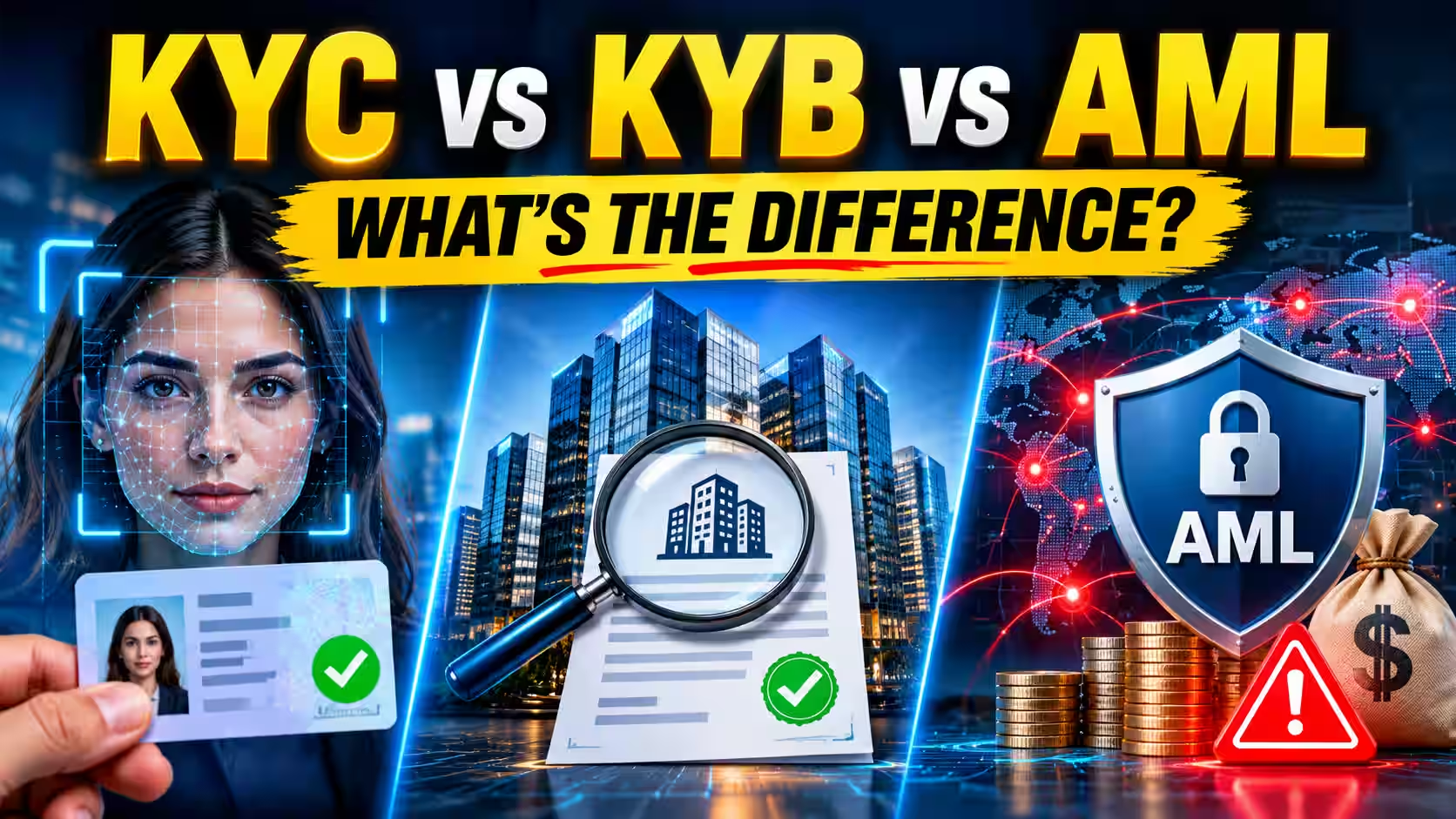
In the KYC vs KYB vs AML comparison, the three terms aren’t peers. KYC and KYB are customer due diligence steps inside an anti-money laundering (AML) program, not alternatives to it:
- KYC (know your customer) verifies and understands individual customers.
- KYB (know your business) does the same for businesses and the people who own or control them.
- AML is the full program that uses that customer knowledge to monitor activity, investigate it, and report suspicion.
Many sources treat the three terms as peers, which causes confusion. Vendor pages, job postings, and conference agendas all do it, but US rules organize them differently. “KYB” doesn’t appear anywhere in the Bank Secrecy Act regulations. The work it describes comes from two specific rules: the Customer Identification Program (CIP) rule and FinCEN’s Customer Due Diligence (CDD) Rule.
That distinction has practical consequences. A policy that says “we perform KYB” tells an examiner or sponsor bank very little. A policy that maps each step to CIP, CDD, and beneficial ownership requirements tells them a great deal. Weak onboarding data also becomes weak monitoring, because the profile you build at account opening becomes the baseline for every later alert. That handoff is the core idea behind how AI transaction monitoring works, and it runs through every section below.
This guide covers:
- What each term means and which US rules sit behind it
- How to handle beneficial ownership, trusts, and enhanced due diligence
- What sponsor banks expect from fintechs
- Where these programs most often fail
Key takeaways
- KYC and KYB sit inside AML. They feed the program. They don’t compete with it.
- KYB is industry shorthand. In US rules, it means CIP and CDD obligations for legal entity customers, including beneficial ownership.
- Onboarding drives monitoring. The customer risk rating and expected activity set the baseline for transaction monitoring.
- Refreshes are risk-based. FinCEN has said there’s no categorical requirement to update customer information on a fixed schedule.
KYC vs KYB vs AML at a Glance
Each term answers a different question:
- KYC asks: “Who is this person, and what should we expect from them?”
- KYB asks the same questions about a business, then adds: “Who really owns and controls it?”
- AML is the program that acts on those answers for every customer, every day.
Compliance Framework · At a Glance
KYC vs KYB vs AML at a Glance
These three terms are closely related, but they do different jobs. KYC focuses on individuals, KYB focuses on businesses and ownership, and AML is the wider compliance program that uses both.
- 🧍 KYC: individual customer due diligence
- 🏢 KYB: business and beneficial owner due diligence
- 🛡️ AML: broader anti-money laundering program
Category
What is being compared
|
KYC
Know your customer
|
KYB
Know your business
|
AML
Anti-money laundering
|
|---|---|---|---|
| Category 01 What it is | Individual verification and understanding Verifying and understanding individual customers. | Business verification and ownership review Verifying businesses and identifying who owns or controls them. | Full compliance program The program to detect, prevent, and report financial crime. |
| Category 02 Who it covers | Individuals Personal customers opening or maintaining accounts. | Legal entities and owners Legal entity customers and their beneficial owners. | All customers and activity All customers, accounts, transactions, and related monitoring activity. |
| Category 03 US rule basis ★ Key distinction | CIP and CDD requirements CIP rule and broader customer due diligence program requirements. | CIP plus beneficial ownership rules CIP rule and the CDD Rule for beneficial ownership. | Bank Secrecy Act framework Bank Secrecy Act and AML program rules. |
| Category 04 When it happens | Starts at onboarding Happens at onboarding and continues on an ongoing basis. | Starts at onboarding Happens at onboarding and continues on an ongoing basis. | Runs continuously Ongoing across the full customer lifecycle. |
| Category 05 Main output | Identity and risk profile Verified identity and a customer risk profile. | Entity and ownership profile Verified entity, identified beneficial owners, and risk profile. | Monitoring and reporting Monitoring, investigations, suspicious activity reports, and governance. |
| Category 06 Relationship Input Input Umbrella | Part of AML KYC is a component inside the wider AML program. | Part of AML KYB is also a component inside the wider AML program. | Umbrella program AML is the broader framework that uses KYC and KYB as inputs. |
Bottom line: KYC and KYB are not alternatives to AML. They are the onboarding and due diligence layers that feed the wider AML program.
If you want to explain the difference simply, use this framing: KYC checks the person, KYB checks the business and its owners, and AML is the system that monitors, investigates, and reports risk across both.
The nesting works like this:
- The AML/CFT program is the outer layer. Banks must maintain one under the Bank Secrecy Act (BSA).
- Customer due diligence sits inside it as a required program element.
- CIP is the identity floor within that due diligence.
- KYC is the industry name for that work on individuals. KYB is the name for it on businesses.
- Ongoing monitoring tests whether real activity matches what onboarding predicted.
KYC vs AML in one line: KYC is an input, and AML is the system that acts on it. Put another way, the difference between KYC and AML is the difference between knowing your customer and knowing what to do when their activity stops making sense.
Table of Contents

What Is KYC?
KYC, short for know your customer, is the process of verifying who an individual customer is and understanding why they want the account. In US banking rules, it covers two things: the customer identification program and customer due diligence.
In casual use, “KYC check” often means identity verification alone. That’s too narrow. Confirming an ID document answers only half the question. A program that stops there can’t explain whether later activity is normal. Weak identity checks also open the door to impersonation and account-takeover schemes that undermine both onboarding integrity and downstream monitoring.
Customer Identification Program: The Minimum Floor
The customer identification program comes from Section 326 of the USA PATRIOT Act. For banks, the rule sits at 31 CFR 1020.220. Before opening an account for an individual, a bank must collect at least the following:
- Name
- Date of birth
- Address: a residential or business street address
- Identification number: a taxpayer identification number for US persons. For non-US persons, this can be a taxpayer identification number, a passport number and country of issuance, an alien identification card number, or the number of another government-issued document.
Banks then verify identity within a reasonable time, either before or after the account opens. They can use either of two methods, or both:
- Documentary methods, such as a driver’s license or passport
- Non-documentary methods, such as checks against consumer reporting agencies or public databases
Many institutions now add automated document verification and database matching to this step.
A compliant CIP also includes:
- Risk-based verification procedures, including what happens when identity can’t be verified
- Recordkeeping for identifying information and verification methods
- Comparison against any government lists designated for CIP purposes
- Adequate notice to customers that the bank is requesting information to verify their identity
In defined circumstances, the CIP rule also lets a bank rely on another regulated financial institution’s CIP, subject to conditions in the rule.
Watch the 2025 change: In June 2025, FinCEN granted exemptive relief allowing banks to obtain a customer’s taxpayer identification number from a reliable third-party source instead of directly from the customer, under stated conditions. Confirm the current terms of that relief before changing your procedures.
CIP verifies identity, but it doesn’t assess risk. Assessing risk is the job of customer due diligence.

Customer Due Diligence: Understanding the Relationship
Customer due diligence goes beyond identity. It asks what the bank should expect from this relationship and how much risk the relationship carries.
CDD builds a customer risk profile from factors such as:
- The nature and purpose of the account
- Expected activity, including volumes, transaction types, and counterparties
- Products and channels used
- Geography
- Occupation or type of business
From that profile, the bank assigns a customer risk rating. The rating decides how much scrutiny applies, on a range from standard diligence to enhanced due diligence.
The simple test: CIP answers “Is this person who they say they are?” CDD answers “What should we expect from this relationship?” A working KYC process needs both.
Hypothetical scenario: A customer opens a personal account with a valid driver’s license and passes CIP. The bank never records expected activity. Six months later, large incoming wires arrive from several unrelated senders. The monitoring team has no baseline, so it can’t tell whether the activity is unusual. The bank verified the customer’s identity, but it never actually knew the customer.

What Is KYB (Know Your Business)?
KYB, or know your business, is the industry term for verifying a business customer’s identity, legitimacy, and purpose, and identifying the people who own or control it. In US banking, KYB isn’t a separate rule — it’s the name practitioners use for CIP and CDD obligations applied to legal entity customers.
That scope covers three things:
- That the entity exists
- That it’s legitimate
- What it’s for
How KYB Maps to US Regulations
Many policies, vendor pitches, and sponsor-bank questionnaires go wrong at this mapping. They use industry terms that examiners don’t test against. The FFIEC BSA/AML Examination Manual organizes its procedures around regulatory concepts, not marketing labels.
Regulatory Mapping · Industry Terms vs US Rules
How KYB Maps to US Regulations
You hear terms like KYB, UBO, and perpetual KYC in vendor pitches and sponsor-bank questionnaires all the time. Examiners, though, test against the rules behind those labels. This table helps compliance teams and fintech founders see what each term really means, where it lives in US rules, and how to use it in your policy.
- 🏷️ Industry term: the label people use
- ⚖️ Regulatory equivalent: what examiners test
- 📍 Where it lives: the rule to cite
- ✅ In practice: what it means for your policy
Industry Term
The everyday label
|
US Regulatory Equivalent
What the rules call it
|
Where It Lives
Rule or source to cite
|
In Practice
What it means for you
|
|---|---|---|---|
| Term 01 KYC Know your customer Individuals | CIP plus customer due diligence Confirms who the person is, then builds a profile of what the account should look like. | 31 CFR 1020.220 Customer Identification Program 31 CFR 1020.210 CDD program requirements | Cite both CIP and CDD An ID check alone covers only half the job. Without expected activity on file, your monitoring team has no baseline to work from. |
| Term 02 KYB Know your business Legal entities ★ Key mapping | CIP and CDD for legal entity customers, including beneficial ownership Not a separate rule. It’s the same obligation family, applied to businesses and the people behind them. | 31 CFR 1020.220 Customer Identification Program 31 CFR 1010.230 CDD Rule: beneficial ownership | Verify the entity, then each owner KYB includes KYC. After confirming the business is real, you verify every beneficial owner at a KYC level. Not in BSA rule text |
| Term 03 UBO Ultimate beneficial owner Ownership | Beneficial owner under the ownership and control prongs Anyone owning 25% or more, directly or indirectly, plus one person with significant control. | 31 CFR 1010.230 CDD Rule: beneficial ownership | Trace past the first holding company The rule never says “ultimate,” but “directly or indirectly” means you multiply stakes through each layer. Expect one to five owners per entity. |
| Term 04 Perpetual KYC Continuous profile updates Process model | Risk-based ongoing CDD and customer information updates Keeps customer profiles current as ownership, activity, or risk changes over time. | CDD program requirements FinCEN guidance | Treat it as a choice, not a mandate FinCEN says there’s no categorical requirement to update on a fixed schedule. Event-driven reviews meet the rule, and perpetual KYC is one way to run them. |
| Term 05 EDD Enhanced due diligence Higher risk | Required due diligence for certain accounts, or risk-based enhanced measures Mandatory for specific account types, and a judgment call for everything else. | 31 CFR 1010.610 Foreign correspondent accounts 31 CFR 1010.620 Private banking for non-US persons Institution policy | Separate required from risk-based Section 312 accounts need EDD by rule. For other triggers, document why EDD started, what you found, and what you decided. |
Bottom line: Industry labels are useful shorthand for talking with vendors, partners, and your own team. But examiners and sponsor banks test your program against regulatory concepts, not marketing terms.
That’s why a policy section titled “Our KYB process” should cite CIP and the CDD Rule rather than replace them. If you map each label back to its rule, you get a policy that’s easier to explain, audit, and defend. Confirm the current status of any CDD Rule revision before you finalize your wording.
The KYC vs KYB distinction comes down to customer type. The obligations come from the same family, applied to individuals on one side and legal entities on the other. KYB adds one layer KYC doesn’t need: identifying the people behind the entity, then verifying each of them at a KYC level.
Practical recommendation: Write policies in regulatory language and use industry terms only as labels. A section titled “Our KYB process” should cite CIP and the CDD Rule, not replace them.

What KYB Verification Covers
KYB verification works best when it’s organized around three questions.
1. Is the entity real?
- Legal name and any trade names
- Business registration and formation documents, such as articles of incorporation or articles of organization, filed with the relevant secretary of state
- A certificate of good standing from the state of formation
- An employer identification number (EIN) issued by the IRS
- Principal place of business or another physical address
2. What does it do?
- Nature of the business and industry risk
- Expected activity, counterparties, and geographies
- Licensing, where the business type requires it
3. Who is behind it?
- Beneficial owners under the ownership and control prongs
- CIP-level identification of each beneficial owner: name, date of birth, address, and identification number
No single federal checklist dictates which documents a bank must collect for every entity type. Institutions set those lists through risk-based policy, so a sole proprietorship and a multi-layer holding structure shouldn’t get the same treatment.
Where KYB shows up outside bank account opening
Several businesses run KYB even though the CDD Rule doesn’t apply to them directly. Each has a different legal driver:
- Merchant onboarding: Payment processors often perform KYB because their acquiring banks and card network rules require it.
- Marketplace sellers: Online marketplaces may verify sellers under a separate law, such as the federal INFORM Consumers Act for high-volume third-party sellers.
- B2B payments and embedded finance: The obligation often traces back to a partner bank’s program.
Knowing which rule drives your KYB process tells you what you must collect.

Beneficial Ownership: The Ownership and Control Prongs
FinCEN’s CDD Rule has required covered financial institutions to identify and verify the beneficial owners of legal entity customers since May 11, 2018. It defines beneficial owners through two prongs:
- Ownership prong: Each individual who directly or indirectly owns 25% or more of the equity interests of the legal entity customer.
- Control prong: One individual with significant responsibility to control, manage, or direct the entity. This controlling person is often an executive officer or senior manager, such as a CEO, CFO, COO, managing member, general partner, president, or treasurer.
Because the control prong always applies, every legal entity customer has at least one beneficial owner. It can have no more than five: up to four ownership-prong individuals plus one controlling person. One person can satisfy both prongs.
Two nuances matter in practice:
- Lower thresholds are allowed. As a matter of risk-based policy, a bank can collect owners below 25% for higher-risk customers.
- Identity vs status. The rule requires banks to verify the identity of each beneficial owner. Banks may generally rely on the customer’s representation of who the beneficial owners are, unless they know of facts that reasonably call that information into question. Red flags still require follow-up.
“Ultimate beneficial owner” is the global term for tracing ownership through intermediate companies to the natural persons at the end. The CDD Rule doesn’t use the word “ultimate,” but its “directly or indirectly” language requires the same tracing. Internationally, the concept comes from the FATF Recommendations on transparency of legal persons and arrangements (Recommendations 24 and 25).
Hypothetical layered-ownership calculation
An operating LLC opens a business account. Its corporate structure looks like this:
- HoldCo LLC owns 60% of the operating LLC.
- Person A owns 40% of HoldCo, and Person B owns 60% of HoldCo.
- Person C owns the remaining 40% of the operating LLC directly.
To find each person’s indirect ownership, multiply their stake through each layer:
Beneficial Ownership · Worked Example
Hypothetical Layered-Ownership Calculation
When a business sits under a holding company, you can’t just read ownership off the top layer. To find each person’s indirect ownership, multiply their stake through every layer between them and the customer. This example shows onboarding analysts and fintech compliance teams how one operating LLC produces two clear beneficial owners and one borderline case.
- 🏢 HoldCo LLC: owns 60% of the operating LLC
- 👤 Person A: owns 40% of HoldCo
- 👤 Person B: owns 60% of HoldCo
- 👤 Person C: owns 40% of the operating LLC directly
Formula
Stake in HoldCo × HoldCo's stake in the customer = Effective ownership
Owner
Who holds the stake
|
Calculation
Stake through each layer
|
Effective Ownership
Measured against 25%
|
Ownership Prong?
Meets the threshold
|
|---|---|---|---|
| Owner 01 Person A Indirect owner through HoldCo Indirect ★ Borderline | 40% × 60% 40% of HoldCo, multiplied by HoldCo’s 60% stake in the operating LLC. | 24% | ✕ No No (just under 25%) One point short of the rule’s threshold. ⚠ Review the split |
| Owner 02 Person B Indirect owner through HoldCo Indirect | 60% × 60% 60% of HoldCo, multiplied by HoldCo’s 60% stake in the operating LLC. | 36% | ✓ Yes Yes Identify and verify at a KYC level. |
| Owner 03 Person C Direct owner of the operating LLC Direct | Direct No intermediate layer, so there’s nothing to multiply. | 40% | ✓ Yes Yes Identify and verify at a KYC level. |
Bottom line: Falling below 25% doesn’t always mean you can skip someone. Under a risk-based policy, you can still collect and verify Person A, especially for higher-risk businesses.
Watch for splits that land just under the threshold, like 24%. If the structure looks designed to keep someone off your records, that’s a good reason to dig deeper. You still need to identify one controlling person too, which could be Person B, Person C, or a separate manager.
Person A falls one point short. A risk-based policy might still collect Person A, especially if the business is higher risk or the ownership split looks engineered to land just under the threshold. The bank also identifies one controlling person. That could be Person B, Person C, or a separate manager.
Trusts, Exclusions, and Layered Ownership
Most trusts aren’t legal entity customers under the CDD Rule, but when a trust owns 25% or more of a legal entity customer, the trustee is the beneficial owner under the ownership prong. That nuance is central to trust company compliance work and is where most general KYB guidance stops being useful.
Trusts as customers: The CDD Rule defines “legal entity customer” to include corporations, LLCs, and other entities created by filing a public document with a secretary of state or similar office. It also covers general partnerships and similar foreign entities. The exception for trusts is a statutory trust created by such a filing. Banks still identify and verify trust account holders under CIP and apply risk-based CDD.
Trusts as owners: When a trust owns 25% or more of a legal entity customer, the CDD Rule treats the trustee as the beneficial owner under the ownership prong.
Beyond the rule: For higher-risk trust relationships, many institutions also look at grantors, beneficiaries, and protectors. This is a risk-based practice, not a CDD Rule requirement, so document it as policy.
Exclusions: The rule excludes several categories from the legal entity customer definition. These include many regulated financial institutions, companies listed on US stock exchanges, and government entities. The rule also exempts certain account types. Check the rule text for the full lists rather than relying on summaries.
Hypothetical scenario: A family trust owns 40% of a commercial real estate LLC that opens an operating account. The bank identifies the trustee as a beneficial owner under the ownership prong and verifies the trustee’s identity. The LLC also receives large distributions from overseas sources. Because of that, the bank’s policy calls for identifying the trust’s grantor and reviewing source of wealth.
Shell company risk: Layered ownership isn’t suspicious by itself, because legitimate businesses use holding companies all the time. The concern is a pattern like one of these:
- A shell company with no real operations
- A nominee owner standing in for someone else
- A structure with no clear business reason
These patterns call for deeper tracing and often for enhanced due diligence.
CDD Rule Beneficial Ownership vs BOI Reporting
Many readers confuse the CDD Rule with the Corporate Transparency Act’s beneficial ownership information (BOI) reporting. They’re separate regimes with different obligations.
Beneficial Ownership · Two Separate Regimes
CDD Rule Beneficial Ownership vs BOI Reporting
Both rules ask about beneficial owners, so it’s easy to assume they’re the same thing. They aren’t. The CDD Rule puts the duty on banks when a business opens an account, while BOI reporting under the Corporate Transparency Act put the duty on companies to report to FinCEN.
This side-by-side view helps bank compliance teams and fintech onboarding leads see who owes what, when it applies, and where each regime stands today.
- 🏦 CDD Rule: the bank collects from its customer
- 🏛️ BOI reporting: the company reports to FinCEN
- 🔑 Key point: different obligations, different owners
Category
What is being compared
|
CDD Rule
Bank-side due diligence
|
CTA BOI Reporting
Company-side filing
|
|---|---|---|
| Category 01 Who has the obligation The party responsible for compliance | Covered financial institutions Banks and other covered institutions must identify and verify the beneficial owners of their legal entity customers. Bank duty | Reporting companies The business itself carries the filing duty, so the obligation sits outside the bank entirely. Company duty |
| Category 02 Who receives the information Where the ownership data ends up | The bank The customer hands ownership details to the bank, which keeps them on file and uses them for risk rating and monitoring. Customer Bank | FinCEN The company reports directly to the federal government, not to its bank or any other private party. Company FinCEN |
| Category 03 Trigger The event that starts the obligation | Opening a new account for a legal entity customer Every time a business opens a new account, the bank collects and verifies beneficial ownership during onboarding. | Company formation or registration The duty starts when a company is created or registered to do business, whether or not it ever opens a bank account. |
| Category 04 Status Where each regime stands today ★ Watch for changes | In effect In effect for banks Banks still collect and verify beneficial ownership for legal entity customers at account opening. Still required | Narrowed Narrowed in March 2025 As of March 2025, an interim final rule narrowed BOI reporting by exempting domestic companies and US persons. ⚠ Subject to change |
Bottom line: The changes to BOI reporting didn’t remove banks’ obligations under the CDD Rule. If you onboard business customers, you still need to identify and verify their beneficial owners at account opening.
This area has shifted several times, and the Anti-Money Laundering Act of 2020 directed FinCEN to revise the CDD Rule to align with the CTA. That’s why you should confirm the current status of both BOI reporting and any CDD Rule revision before you finalize your policy wording.

When Is Enhanced Due Diligence Required?
Regulation requires enhanced due diligence for certain correspondent and private banking accounts. Beyond those accounts, EDD applies when a customer’s risk profile calls for more scrutiny than standard customer due diligence provides.
Required EDD: Correspondent and Private Banking Accounts
Section 312 of the USA PATRIOT Act sets specific due diligence requirements for two account types:
- Correspondent accounts for foreign financial institutions (31 CFR 1010.610)
- Private banking accounts for non-US persons (31 CFR 1010.620), defined in part by a minimum aggregate deposit of $1 million
For private banking accounts held by or for senior foreign political figures, the rule requires enhanced scrutiny. The goal is to detect transactions that may involve the proceeds of foreign corruption.
Risk-Based EDD Triggers
Outside Section 312, EDD is a risk-based decision. Common triggers include:
- Politically exposed persons, particularly foreign officials in higher-risk relationships
- High-risk jurisdictions and significant cross-border activity
- Cash-intensive businesses
- Complex or opaque corporate structures
- Adverse media screening results tied to financial crime
- Sanctions screening near-matches that need resolution
- Activity that doesn’t fit the customer risk profile
Two federal statements shape how banks apply these triggers:
- August 2020 joint statement on PEPs: The agencies said the CDD Rule doesn’t create a requirement to screen for politically exposed persons, and that PEP status alone doesn’t make a customer high risk. Banks should apply a risk-based approach.
- July 2022 joint statement on the risk-based approach: The agencies stressed that no customer type presents a single, uniform level of risk. Banks should assess individual relationships rather than refuse whole categories of customers.
OFAC is a separate track. OFAC sanctions compliance applies to all US persons, not only BSA-covered institutions. OFAC can impose civil penalties on a strict liability basis, which means violations can carry liability regardless of intent. Sanctions screening runs alongside KYC and KYB, but it rests on a different legal framework.
What EDD Adds in Practice
EDD isn’t one procedure. It’s a set of measures scaled to the risk. Typical additions include:
- Source of funds for specific transactions and source of wealth for the customer overall
- Deeper ownership tracing through each layer
- Senior management approval to open or keep the relationship
- More frequent reviews and tighter monitoring thresholds
- Site visits, reference checks, or independent research where warranted
- A documented record of why EDD was triggered, what was found, and what was decided
Hypothetical scenario: A bank identifies a private banking client as a senior foreign political figure, so Section 312 requires enhanced scrutiny. The bank documents the client’s source of wealth, gets senior approval, and sets a shorter review cycle. Every step goes into the file, because examiners will look for the reasoning, not just the outcome.
Where Simplified Due Diligence Fits
“Simplified due diligence” is a FATF concept. US rules don’t define it as a separate tier. In practice, US banks scale diligence to risk, so lower-risk customers may get a lighter-touch review within the bank’s documented risk-based approach. CIP and the core CDD elements still apply to every customer.
The table below compares the three levels of diligence:
Due Diligence Levels · Scaled to Risk
Where Simplified Due Diligence Fits
You may see “simplified due diligence” in global AML guidance and wonder where it sits in a US program. It’s a FATF concept, and US rules don’t define it as a separate tier. In practice, you scale diligence to risk, while CIP and the core CDD elements still apply to every customer.
This view helps bank compliance teams and fintech onboarding leads see what each level answers, who it covers, what data it needs, and when it happens.
- 🪪 CIP: the identity floor
- 📋 CDD: the risk profile for every customer
- 🔍 EDD: deeper scrutiny for higher risk
Where SDD fits Not a fourth column. It’s a lighter-touch CDD review for lower-risk customers, documented in your risk-based approach.
Category
What is being compared
|
CIP
Customer identification program
|
CDD
Customer due diligence
|
EDD
Enhanced due diligence
|
|---|---|---|---|
| Category 01 Question answered The core job of each level ★ Start here | Who is this customer? Confirms the person or entity is who they claim to be before the account goes live. | What should we expect? Sets the baseline your monitoring team uses to spot activity that doesn’t fit. | Do we understand the higher risk? Digs into where the money comes from and who really controls the relationship. |
| Category 02 Applies to Who falls under each level | Customers opening accounts Every new account holder goes through it, with no lower-risk shortcut. Always applies | All customers Depth can scale with risk, so lower-risk customers may get a lighter review. Scales to risk | Higher-risk customers and specific account types Required for certain accounts by rule, and a risk-based call for everyone else. Risk-triggered |
| Category 03 Typical data What you collect and record | Name Date of birth Address ID number The minimum identity details you need on file. | Purpose Expected activity Risk rating Beneficial owners The details that turn an identity into a usable risk profile. | Source of funds and wealth Deeper ownership tracing Approvals Extra evidence that shows you understand the added risk. |
| Category 04 Timing When each level happens | At account opening, verified within a reasonable time You collect details up front, then verify them before or shortly after the account opens. | Onboarding and ongoing The profile starts at onboarding and gets updated as events and monitoring call for it. | When triggered, then ongoing Starts when a risk trigger appears, then continues with closer reviews over time. |
Bottom line: Lower-risk customers may get a lighter-touch review, as long as your documented risk-based approach explains why. That flexibility can save your team real time on routine accounts.
Just don’t describe it as an exemption from CIP or CDD. Every customer still needs verified identity and a core risk profile. If you label the lighter review as scaled CDD in your policy, it stays easy to explain to examiners and sponsor banks.

How KYC and KYB Fit Inside an AML Program
AML is the full program, and KYC and KYB supply the customer knowledge it depends on. Ongoing monitoring then tests whether actual activity matches what onboarding predicted.
Where CDD Sits Among the Program Pillars
A bank’s BSA/AML program has traditionally rested on four pillars:
- A system of internal controls
- Independent testing
- A designated BSA compliance officer
- Ongoing training
The CDD Rule formally added a fifth element to the AML program requirements for banks at 31 CFR 1020.210: appropriate risk-based procedures for ongoing customer due diligence. In practice, those procedures cover four core CDD elements:
- Identifying and verifying customers
- Identifying and verifying beneficial owners of legal entity customers
- Understanding the nature and purpose of customer relationships to build a customer risk profile
- Conducting ongoing monitoring to identify and report suspicious transactions, and updating customer information on a risk basis
The Anti-Money Laundering Act of 2020 pushed US policy toward programs judged on effectiveness rather than paperwork. For CDD, that raises the bar. Collecting information isn’t enough, because the program must actually use it.

From Customer Risk Rating to Transaction Monitoring
The customer risk rating is the link between onboarding and monitoring. Three connections make it work:
- The customer risk rating sets the monitoring segment. A high-risk rating may mean tighter thresholds, extra scenarios, or more frequent review.
- Expected activity becomes the baseline. Monitoring compares real transactions with what the customer said they would do.
- Beneficial ownership data powers network analysis. Without it, monitoring can’t link related businesses, shared owners, or circular fund flows.
For a deeper look at how monitoring systems use onboarding attributes, see AI transaction monitoring for AML programs.
Hypothetical scenario: A landscaping company opens a business account. It declares about $40,000 a month in domestic deposits from residential and commercial clients. Within weeks, it starts receiving frequent international wires from companies with no apparent link to landscaping. The mismatch against its risk profile triggers an alert. The investigator then:
- Reviews the customer file
- Contacts the customer
- Opens an event-driven due diligence review
If the explanation doesn’t hold up, the case may lead to a suspicious activity report filed with FinCEN.
That alert exists only because onboarding captured expected activity. Without a documented baseline, the wires would have nothing to be measured against.
Ongoing Customer Due Diligence and Refresh Triggers
How often should KYC be refreshed? On a risk basis. In its August 2020 CDD FAQs, FinCEN said the rules don’t impose a categorical requirement to update customer information on a continuous or periodic schedule. Instead, updates should be event-driven and arise from normal monitoring.
Many banks still set periodic review cycles by risk tier, such as annual reviews for high-risk customers. That’s a reasonable internal policy. However, it isn’t a regulatory mandate, and it shouldn’t be described as one.
Common event triggers include:
- Changes in ownership, control, or business activity
- Monitoring alerts or a SAR filing
- Adverse media or sanctions screening hits
- New products, channels, or geographies
- Activity that departs from the customer risk profile
Institutions typically choose among three refresh approaches, or combine them:
Ongoing CDD · Refresh Models
Ongoing Customer Due Diligence and Refresh Triggers
Customer profiles go stale faster than most teams expect, and you can’t review every account every month. FinCEN has said there’s no categorical requirement to update customer information on a fixed schedule. That’s why most institutions pick one of these three refresh models, or combine them.
This side-by-side view helps bank compliance teams and fintech onboarding leads see how each model works, where it shines, and where it can leave gaps.
- 🗓️ Periodic: reviews on a set calendar
- ⚡ Event-driven: reviews when something changes
- 🔄 Perpetual KYC: profiles update as data arrives
FinCEN’s position Updates should be risk-based and event-driven, arising from normal monitoring, not tied to a mandatory calendar.
Approach
The refresh model
|
How It Works
What starts a review
|
Strength
What you gain
|
Weakness
What to watch for
|
|---|---|---|---|
| Approach 01 Periodic by risk tier Calendar-based reviews Internal policy | Scheduled reviews, more often for higher risk You set a cycle for each risk tier, such as annual reviews for high-risk customers and longer gaps for lower-risk ones. | Predictable and easy to audit Your team can plan workloads ahead, and testers can quickly check whether reviews happened on time. | Misses changes between cycles A new owner or a sudden shift in activity can sit unnoticed for months until the next scheduled review. ⚠ Blind gaps |
| Approach 02 Event-driven Trigger-based reviews Risk-based ★ Closest to FinCEN guidance | Defined events trigger reviews Ownership changes, monitoring alerts, screening hits, or new products start a review as soon as they happen. | Responds to real risk Your reviewers spend time on customers whose situation actually changed, not on routine accounts that look the same. Focused effort | Depends on reliable triggers If a trigger is poorly defined or the data feeding it is weak, important changes never prompt a review. |
| Approach 03 Perpetual KYC Continuous profile updates Process model | Continuous data feeds update profiles Registry, screening, and transaction data flow in on an ongoing basis, and profiles refresh as new details arrive. | Keeps profiles current Your monitoring team works from up-to-date customer data, so alerts carry better context from day one. | Heavy data and governance demands It only works with reliable data sources and a person who reviews the changes it flags. ⚠ Not a requirement |
Bottom line: Periodic review cycles can be a reasonable internal policy, especially for high-risk customers. Just don’t describe them as a regulatory mandate in your procedures or sponsor-bank materials.
In practice, event triggers often drive the most effective refresh programs. Common ones include:
- 🏢 Ownership or control changes
- 🚨 Monitoring alerts or a SAR filing
- 🛑 Sanctions or adverse media hits
- 🌍 New products, channels, or geographies
If you pair a light periodic schedule with clear event triggers, you get a refresh program that’s easy to audit and still catches real changes.
Perpetual KYC is a process model, not a requirement. It works only if the data feeding it is reliable and someone reviews the changes it flags.

KYC Requirements for Fintechs in Sponsor-Bank Programs
Most US fintechs that offer accounts do so through a sponsor bank. The bank holds the deposits and remains responsible for BSA compliance. The fintech often runs onboarding, but it does so under the bank’s program and oversight.
Who Owns CIP When a Fintech Onboards Bank Customers
When account holders are bank customers, the bank’s CIP and CDD obligations apply to them. The fintech typically collects information and performs verification under contract, acting as the bank’s service provider. The obligation itself stays with the bank.
A fintech that is itself a regulated entity, such as a registered money services business, is in a different position. Those firms carry their own AML program obligations and may also operate under a partner bank’s expectations.
Recordkeeping matters as much as verification. Synapse was a middleware provider connecting fintech apps to partner banks. Its 2024 bankruptcy left many end users unable to access funds while the parties worked to reconcile records. The lesson for compliance teams is basic but easy to miss: a bank must be able to identify its customers and their balances, even when a third party runs the front end.
What Sponsor Banks Review Before and After Launch
Sponsor banks have tightened oversight after a series of public enforcement actions:
- Blue Ridge Bank: The OCC entered into a formal agreement with the bank in 2022 and issued a consent order in 2024. Both are searchable through the OCC enforcement actions database.
- Evolve Bank & Trust: The Federal Reserve announced an enforcement action against Evolve in 2024.
Both cases involved concerns about BSA/AML risk management in fintech partnerships.
Two federal documents set the broader expectations:
- The 2023 interagency guidance on third-party risk management
- The July 2024 joint statement on bank arrangements with third parties to deliver deposit products
Before and after launch, expect a sponsor bank to review:
- Written KYC and KYB policies mapped to the bank’s own program
- The customer risk rating methodology
- The beneficial ownership collection workflow for business accounts
- EDD triggers and escalation paths
- Sanctions screening and adverse media processes
- How customer data flows to the bank’s transaction monitoring
- QA sampling, testing results, and the bank’s audit rights
- Complaint handling and issue escalation
Hypothetical scenario: A B2B payments startup prepares for its sponsor-bank review. Its policy says “all business customers complete KYB.” The bank asks three questions:
- How does the startup identify controlling persons?
- What does it do when ownership runs through an offshore holding company?
- How does it document beneficial ownership verification?
The policy doesn’t answer any of them. So the startup rewrites it in CIP and CDD Rule terms, adds a layered-ownership procedure, and maps each step to the bank’s program. That version is far better positioned to pass.
If you’re a founder: Translate your onboarding flow into regulatory language before the review, not during it.

Where KYC and KYB Programs Break Down
Most failures don’t happen in the obvious places. They happen at the handoffs, where data is collected but never used, or verified once and never revisited. Each failure creates a specific blind spot downstream:
Program Gaps · Handoff Failures
Where KYC and KYB Programs Break Down
You can collect every document on your checklist and still end up with a program that misses real risk. Most compliance failures don’t happen in one isolated step. They happen in the handoffs between onboarding, ownership analysis, and monitoring, where data gets collected but never passed along or put to use.
This table helps bank compliance teams and fintech onboarding leads spot each breakdown point, see what it causes downstream, and find a practical way to tighten it.
- 👀 What it looks like: the warning sign in your process
- 💥 What it causes: the risk it creates downstream
- 🔧 How to tighten it: the practical fix
Where gaps open Onboarding Ownership analysis Monitoring
Breakdown Point
Where the program fails
|
What It Looks Like
The sign in your process
|
What It Causes
The downstream risk
|
How to Tighten It
The practical fix
|
|---|---|---|---|
| Breakdown 01 Weak business verification Entity checks stop at paperwork Onboarding | Relying only on formation docs without confirming operating status or legitimacy Articles of incorporation prove a company was formed. They don’t show that it’s active, real, or doing what it claims. | Shell or dormant entities get onboarded Companies with no real operations can open accounts and move money under a clean-looking file. ⚠ Shell risk | Confirm the business is real and active Layer independent checks on top of formation documents before you approve the account. ✓ Registry checks ✓ Website and activity validation ✓ Sanctions screening |
| Breakdown 02 Missed beneficial owners Ownership tracing ends too early Ownership ★ Exam focus | Stopping at the first holding company or misreading indirect ownership The file names a parent entity but never multiplies stakes through each layer to reach the people at the end. | True controllers stay hidden Investigators work from an incomplete picture, and indirect owners above 25% never get verified. ⚠ Hidden owners | Trace ownership through layers and document the math Show each calculation in the file, so reviewers and examiners can follow how you reached every owner. ✓ Layer-by-layer tracing ✓ Calculations on file |
| Breakdown 03 No clear expected activity Identity without a profile Risk profile | Collecting IDs but not building a usable business profile Identity checks pass, but nobody records what the account is for or how money should move through it. | Monitoring has no baseline for what is normal When unusual wires show up, your team can’t tell whether they fit the customer or signal a problem. ⚠ No baseline | Build a profile monitoring can actually use Capture the details that turn a verified identity into a clear picture of normal activity. ✓ Purpose ✓ Customer type ✓ Geographies ✓ Volumes ✓ Payment flows |
| Breakdown 04 Triggerless refresh Files wait for a manual review Ongoing review | Customer files go stale until a manual review happens Profiles set at onboarding stay frozen, even after the business, its owners, or its activity changes. | Ownership, risk, and behavior changes are missed High-risk customers can sit in low-risk segments for months, with thresholds that no longer fit them. ⚠ Stale profiles | Define event-based refresh triggers and ownership update requirements Spell out which events start a review, and require customers to report ownership changes as they happen. ✓ Event triggers ✓ Ownership update rules |
| Breakdown 05 Compliance stack fragmentation Tools that don’t talk to each other Data flow | KYC, KYB, sanctions, and monitoring tools do not share context Each system holds its own slice of the customer, and analysts copy details between screens by hand. | Risk signals stay siloed and investigations slow down Related entities and shared owners go unlinked, and every alert starts from scratch. ⚠ Siloed signals | Centralize customer context or connect systems Make sure alerts inherit due diligence data, so investigators see the full customer picture from the first click. ✓ Shared customer record ✓ Alerts carry CDD data |
Bottom line: A strong KYC and KYB program isn’t just good document collection. It creates usable context that your monitoring team and ongoing reviews can rely on every day.
That’s why the fixes above focus on process, data flow, and documentation rather than new paperwork. If you start with the gaps that leave the biggest monitoring blind spots, you get a program that’s easier to run, explain, and defend.
The last failure deserves particular attention. Synthetic identity theft blends real and invented data to build profiles that pass standard identity verification. These profiles then age into trusted customers before anyone notices the pattern.
Hypothetical scenario: A business lists its office manager as the controlling person. Months later, adverse media screening ties an undisclosed individual to the company’s operations and to an unrelated fraud case. The bank’s file never captured the real decision-maker. As a result, every alert reviewed in the meantime was missing context.
Fixing these gaps is usually a matter of process, data flow, and documentation — not new software. Start with the failures that leave the largest monitoring blind spots: missing expected activity, frozen risk ratings, and siloed KYB data.
Where Automation and AI Help, and Where They Don’t
Automation can make KYC and KYB faster and more consistent. It can’t own the judgment calls.
Where automation helps:
- Document verification: extracting and checking data from IDs and formation documents
- Entity resolution: linking records that belong to the same person or business across systems
- Ownership graph mapping: tracing layered corporate structures
- Screening: running sanctions screening and adverse media screening automatically
- Trigger detection: spotting events that should start a due diligence review
Graph methods are especially useful for ownership and network analysis. For a technical view, see how graph neural networks detect money laundering across linked accounts and entities.
What automation doesn’t replace:
- The risk judgment behind EDD decisions
- Assessing whether a listed controlling person truly controls the business
- Accountability for the program, which stays with the institution
Risks to manage:
- Manipulated documents and deepfakes that defeat automated checks
- Risk scores that investigators can’t explain or defend in an exam
- Over-reliance on automated pass or fail results, which encourages staff to stop asking questions
Every automated decision should leave an audit trail. That record should show what data was used, what the tool concluded, and what a person decided. Examiners reviewing your program against the FFIEC BSA/AML Examination Manual will expect to follow that chain.
People Also Ask
Is KYC part of AML?
Yes. KYC is a core component of an AML program. It supplies the customer knowledge that monitoring, investigations, and reporting depend on. For US banks, customer due diligence became a formal AML program element through the CDD Rule’s amendments to 31 CFR 1020.210.
Does KYB replace KYC for business customers?
No. KYB includes KYC. A bank verifies the entity, then identifies and verifies each beneficial owner at a KYC level. Skipping the individual checks leaves the people behind the business unverified.
What documents are needed for KYB?
There’s no single federal checklist. Banks typically collect formation documents such as articles of incorporation, a certificate of good standing, an employer identification number, a business address, and CIP-level identification for each beneficial owner. Exact requirements are set through each institution’s risk-based policy, so a sole proprietorship and a layered holding structure should not be treated the same way.
Who counts as a beneficial owner under US rules?
Each individual who directly or indirectly owns 25% or more of the equity interests of a legal entity customer, plus one individual with significant control over the entity. Because the control prong always applies, every legal entity customer has at least one beneficial owner.
Is beneficial ownership under the CDD Rule the same as BOI reporting?
No. The CDD Rule obligates covered financial institutions to collect beneficial ownership information from their legal entity customers. The Corporate Transparency Act’s BOI reporting obligated companies to report to FinCEN. As of March 2025, an interim final rule narrowed BOI reporting by exempting domestic companies and US persons. That change did not affect banks’ obligations under the CDD Rule.
Do banks have to prove that named beneficial owners really own the business?
Not usually. Banks must verify each beneficial owner’s identity, but they may generally rely on the customer’s representation of who the owners are. That reliance ends when the bank knows of facts that reasonably call the information into question, such as conflicting public records or adverse media.
What happens if a business won’t provide beneficial ownership information?
The bank follows its risk-based procedures. These commonly include declining to open the account, restricting or closing an existing account, and considering whether a SAR is warranted. The policy should spell out each option before the situation arises.
Who performs KYC in embedded finance products?
Usually the fintech or platform performs the work. The partner bank owns the obligation when end users are bank customers. The contract, the bank’s oversight, and the data flowing back to the bank all need to reflect that.
Does a SAR filing trigger a KYC refresh?
It commonly does. FinCEN expects event-driven updates that arise from monitoring, so a SAR filing is a natural trigger to revisit the customer risk profile and rating.
The Bottom Line
The KYC vs KYB vs AML question has a clean answer. AML is the program. KYC and KYB are how that program learns who it’s dealing with — whether the customer is a person or a business and the people behind it.
The harder lesson is that most failures happen at the handoffs:
- Identity gets verified, but purpose isn’t captured.
- Owners get named, but red flags go unexamined.
- Risk ratings get assigned, but never reach monitoring.
Your next steps:
- Bank and trust compliance teams: Confirm that every customer risk rating maps to a monitoring segment. Make sure your refresh triggers, trust treatment, and EDD decisions are documented in regulatory terms, not just industry labels.
- Fintech founders and onboarding leads: Rewrite your onboarding policy in CIP and CDD Rule terms before your next sponsor-bank review. Then test it against a layered-ownership case.
- Everyone: Check the current status of BOI reporting, any CDD Rule revision, and the June 2025 CIP exemptive relief before finalizing policy language.
Onboarding data matters most after the account opens. To see how that data drives detection, read our guide on how AI transaction monitoring works.
KYC vs KYB vs AML · Editorial Integrity
Sources & Citations
The official rules, supervisory materials, agency guidance, and internal explainers behind this guide to KYC, KYB, AML programs, beneficial ownership, customer due diligence, enhanced due diligence, and sponsor-bank expectations.
We built this guide to answer a recurring practical question: what is the actual difference between KYC, KYB, and AML in U.S. compliance work, and how do those pieces fit together in real onboarding and monitoring programs? The article draws on official rules, public agency guidance, examination manuals, and related internal explainers to show how customer identification, customer due diligence, beneficial ownership collection, refresh triggers, and enhanced due diligence work in context.
Where the article explains regulatory structure, it leans on the Bank Secrecy Act regulations, the CIP rule, FinCEN’s Customer Due Diligence Rule, the FFIEC BSA/AML Examination Manual, eCFR provisions for correspondent and private banking due diligence, and related FinCEN guidance. Where it discusses operational handoffs, sponsor-bank reviews, and downstream monitoring implications, it also draws on Tech Capital Hub’s related explainers on AI transaction monitoring, graph-based AML detection, and synthetic identity risk. This article is general educational information and does not constitute legal, financial, or tax advice.
View full sources, methodology, and editorial notes
This is a practical explainer for operators, compliance teams, fintech founders, and curious readers who want a plain-English understanding of how KYC, KYB, and AML fit together under U.S. rules. We prioritized official regulations, agency guidance, examination materials, and internal explainers only where they directly supported the topic.
The article was written to clarify a few points that are often blurred in vendor pages and generic compliance summaries: that KYC and KYB are components inside an AML program rather than alternatives to it; that KYB is industry shorthand rather than a standalone U.S. rule; that beneficial ownership must be understood through both ownership and control prongs; and that onboarding quality directly affects monitoring quality later.
Examples marked hypothetical are teaching examples, not live institution data. Internal links are included to help readers connect onboarding, ownership, identity, and monitoring concepts across related guides. Readers should still confirm current legal obligations with counsel, their primary regulator, and the latest official publications before finalizing policy language.
- Primary article reference: Tech Capital Hub — KYC vs KYB vs AML: How the Three Fit Together in Compliance — the article this sources block supports, including the cited rule references and topic framing.
- Bank Secrecy Act regulations: eCFR — 31 CFR Chapter X — cited for the broader BSA regulatory framework surrounding AML program obligations.
- Customer Identification Program rule: eCFR — 31 CFR 1020.220 — cited for CIP requirements for banks, including required identifying information and verification procedures.
- AML program rule for banks: eCFR — 31 CFR 1020.210 — cited for AML program requirements, including the CDD-related program element.
- Beneficial ownership / CDD rule: eCFR — 31 CFR 1010.230 — cited for beneficial ownership identification and verification requirements for legal entity customers.
- FinCEN CDD rule overview: FinCEN — Customer Due Diligence Requirements for Financial Institutions — cited for FinCEN’s rule summary and background on the CDD framework.
- FFIEC examination manual: FFIEC BSA/AML Examination Manual — cited for examination structure and supervisory expectations in AML compliance programs.
- Correspondent account due diligence: eCFR — 31 CFR 1010.610 — cited for due diligence requirements tied to correspondent accounts for foreign financial institutions.
- Private banking due diligence: eCFR — 31 CFR 1010.620 — cited for due diligence and enhanced scrutiny requirements for private banking accounts for non-U.S. persons.
- BOI reporting reference: FinCEN — Beneficial Ownership Information Reporting — cited to distinguish CTA BOI reporting from the CDD Rule’s bank-facing beneficial ownership obligations.
- FinCEN CDD FAQs: FinCEN — Customer Due Diligence FAQs — cited for the risk-based approach to updating customer information and refresh expectations.
- Interagency statement on model risk for BSA/AML systems: Interagency Statement on Model Risk Management for Bank Systems Supporting BSA/AML Compliance — included because the article connects onboarding quality to downstream monitoring and monitoring-system governance.
- Interagency third-party risk guidance: Federal Reserve — Interagency Guidance on Third-Party Relationships: Risk Management — cited for sponsor-bank and fintech oversight expectations in third-party arrangements.
- Joint statement on deposit arrangements with third parties: FDIC — Joint Statement on Banks’ Arrangements With Third Parties to Deliver Bank Deposit Products and Services — cited for current expectations around bank-fintech deposit product arrangements.
- Internal explainer on transaction monitoring: Tech Capital Hub — AI Transaction Monitoring for AML: How It Works, Where It Fails, and What Examiners Expect — cited where the article explains how onboarding data becomes the baseline for later monitoring.
- Internal explainer on graph-based AML detection: Tech Capital Hub — How Graph Neural Networks Detect Money Laundering — cited for network analysis and linked-entity detection concepts related to beneficial ownership and monitoring.
- Internal explainer on synthetic identity risk: Tech Capital Hub — Synthetic Identity Theft — cited for identity-quality weaknesses that can undermine KYC and downstream AML effectiveness.
KYC vs KYB vs AML · Editorial Standards
Our Editorial Standards
Tech Capital Hub applies Google’s E-E-A-T framework to every guide on AML, KYC, KYB, fintech compliance, and financial crime controls, including this one on how KYC, KYB, and AML fit together. We prioritize clear explanations, vendor-neutral analysis, official guidance, and practical regulatory context over buzzwords, oversimplified checklists, or vague compliance claims.
In this article, we explain how KYC and KYB function inside a broader AML program, how CIP, CDD, beneficial ownership, enhanced due diligence, and ongoing monitoring connect in practice, and where sponsor-bank expectations create additional pressure on fintech onboarding processes. Where regulatory precision matters, we anchor claims to official rules, supervisory manuals, interagency guidance, and public agency materials.
We also state limits clearly: examples marked hypothetical are teaching examples, legal obligations vary by institution and jurisdiction, and no article can substitute for institution-specific legal or compliance review. This guide is reviewed over time as U.S. rules, agency guidance, and industry expectations evolve.
View how our editorial standards apply to this article
Built Around Real Onboarding and Compliance Questions
We structured this guide around the questions compliance teams, fintech operators, founders, and readers actually ask in practice. What is the difference between KYC, KYB, and AML? Is KYB a legal term or just industry shorthand? When do beneficial ownership checks apply? What changes when the customer is a business instead of an individual? What does a sponsor bank expect to see before approving an onboarding program?
We also focus on the questions that arise after onboarding: how expected activity shapes transaction monitoring, why weak ownership data creates blind spots later, when customer files should be refreshed, and where enhanced due diligence becomes necessary. The result is a practical explainer built around real operating and policy questions, not just abstract definitions.
Regulatory and Operational Concepts Explained in Plain English
This article translates core compliance concepts into accessible language without removing the details that matter. That includes CIP, customer due diligence, beneficial ownership under the ownership and control prongs, enhanced due diligence, event-driven refreshes, sanctions overlap, and sponsor-bank oversight.
We also explain how industry shorthand maps to actual U.S. regulatory structure, why KYC and KYB are components inside an AML program rather than parallel alternatives, and how onboarding quality affects downstream monitoring quality. Readers do not need a deep legal or banking background to follow the logic, because each concept is introduced in business and operational terms before regulatory language is layered in.
Official Rules and Supervisory Materials Where Precision Matters
We support specific claims with official or authoritative sources where accuracy matters most. That includes the Bank Secrecy Act regulatory framework, the CIP rule, FinCEN’s Customer Due Diligence Rule, eCFR sections on beneficial ownership and enhanced due diligence, the FFIEC BSA/AML Examination Manual, and public agency guidance referenced throughout the article.
We also use internal Tech Capital Hub explainers where they add useful context, including related articles on AI transaction monitoring, synthetic identity theft, graph-based AML detection, and financial crime systems that depend on strong onboarding data.
Vendor-Neutral, Transparent, and Clear About Limits
This article is written as a vendor-neutral guide. No company paid for placement, and examples are used to explain compliance design, policy trade-offs, and program weaknesses rather than to promote any product or workflow as universally best. We also state limits directly: hypothetical scenarios are teaching devices, public references do not replace institution-specific legal review, and agency expectations can change over time.
Where KYC, KYB, and AML overlap with legal obligations, account-opening controls, or reporting decisions, we signal clearly that institutions should confirm current requirements with counsel, compliance leadership, and their primary regulator. This article is educational information, not legal, financial, or tax advice.
KYC vs KYB vs AML · About the Author
Marcus Delray
Fintech Analyst · Founder of Tech Capital Hub
Marcus Delray is a fintech analyst and the founder of Tech Capital Hub. In this guide, he explains how KYC and KYB fit inside a broader AML program, how CIP and customer due diligence work in practice, how beneficial ownership and enhanced due diligence apply to business accounts, and why onboarding quality directly affects downstream monitoring, sponsor-bank reviews, and compliance risk.
View full author bio, credentials, and links
Marcus Delray has spent more than a decade researching financial technology and explaining how digital systems change the way money moves, risk gets measured, compliance gets executed, and customer decisions are made. He built Tech Capital Hub to make complex fintech topics practical for operators, investors, founders, and curious readers who want clear, useful explanations instead of jargon-heavy summaries.
For this guide, Marcus focuses on the questions that matter most once people move past the surface-level compliance labels. What is the difference between KYC, KYB, and AML? Which parts come from actual U.S. rules and which are industry shorthand? How do beneficial ownership requirements work in practice? When does enhanced due diligence apply, and what do sponsor banks expect from fintech onboarding programs?
He breaks down customer identification, customer due diligence, beneficial ownership, trust treatment, refresh triggers, sponsor-bank oversight, and compliance handoffs in plain English. Rather than treating onboarding as a one-time checkbox, he shows how weak customer data, poor ownership tracing, or unclear expected activity can create downstream problems in monitoring, investigations, and audit readiness. All articles are educational information, not legal, financial, or tax advice.
- Explains KYC, KYB, CIP, CDD, beneficial ownership, and EDD concepts in plain English for fintech and compliance readers
- Covers how onboarding controls connect to sponsor-bank oversight, transaction monitoring, and broader AML program effectiveness
- Clarifies where industry shorthand differs from formal U.S. regulatory language and examiner expectations
- Breaks down layered ownership, control persons, refresh triggers, and customer risk profiling without oversimplifying the trade-offs
- Connects compliance design decisions to real operating outcomes, including monitoring blind spots, escalation burden, and policy weaknesses
Enjoying our content?
Click below to add us as a preferred source. Google will prioritize our latest articles in your Top Stories, AI Mode, and AI Overviews.
Preferred Source on Google