How Wall Street Uses AI Sentiment Analysis to Trade News — And How You Can Too

Fintech Analyst · Founder of Tech Capital Hub
Marcus has spent more than a decade researching financial technology, AI in finance, and market infrastructure. In this guide, he breaks down how AI market sentiment analysis shapes trading decisions, where the tools help, where they fail, and what retail investors should watch before following machine-driven market moves.
February 23, 2026. A normal Monday on Wall Street. Then IBM stock dropped 13% in a few hours. No earnings miss. No scandal. No product recall. Just a press release from a startup claiming it built a tool to replace old banking software. Within minutes, AI systems across Wall Street read that release, decided IBM was in trouble, and fired off sell orders. $30 billion in market value gone before most traders knew what happened.
That’s AI market sentiment analysis in action — software that uses natural language processing to read news, earnings calls, social posts, and filings, then scores whether the mood around a stock is positive, negative, or neutral. It’s not a lab experiment anymore. It’s the thing that moves real money, fast. And here’s the best part: you don’t need a hedge fund budget to use it. Some tools cost $25 a month. Others are free. The catch? You need to know how they work — and, more importantly, when they get it wrong. Because they get it wrong a lot.
This is one piece of a much bigger shift. If you want the full picture of how AI is changing the way retail investors trade, our AI stock trading guide maps it all out.
Key Takeaways
- AI market sentiment analysis uses NLP to read financial text and social chatter, then classifies the tone as bullish, bearish, or neutral.
- Hedge funds like Man Group, Point72, and Bridgewater already run big money on these signals — and they react to news before humans can blink.
- Retail investors can access powerful tools cheaply: FinGPT (free/open-source), Danelfin (free tier), and Quiver Quantitative ($25/month).
- Sentiment tools are fast, not always right. During April 2025’s “Liberation Day” selloff, calm retail investors beat the panicking algorithms.
- The biggest risk is AI herding — many systems reading the same news and selling at once, which regulators now flag as a systemic danger.
- Treat sentiment signals like a smart second opinion, not a boss. The tools find information faster; they don’t replace your thinking.
What Is AI Market Sentiment Analysis?
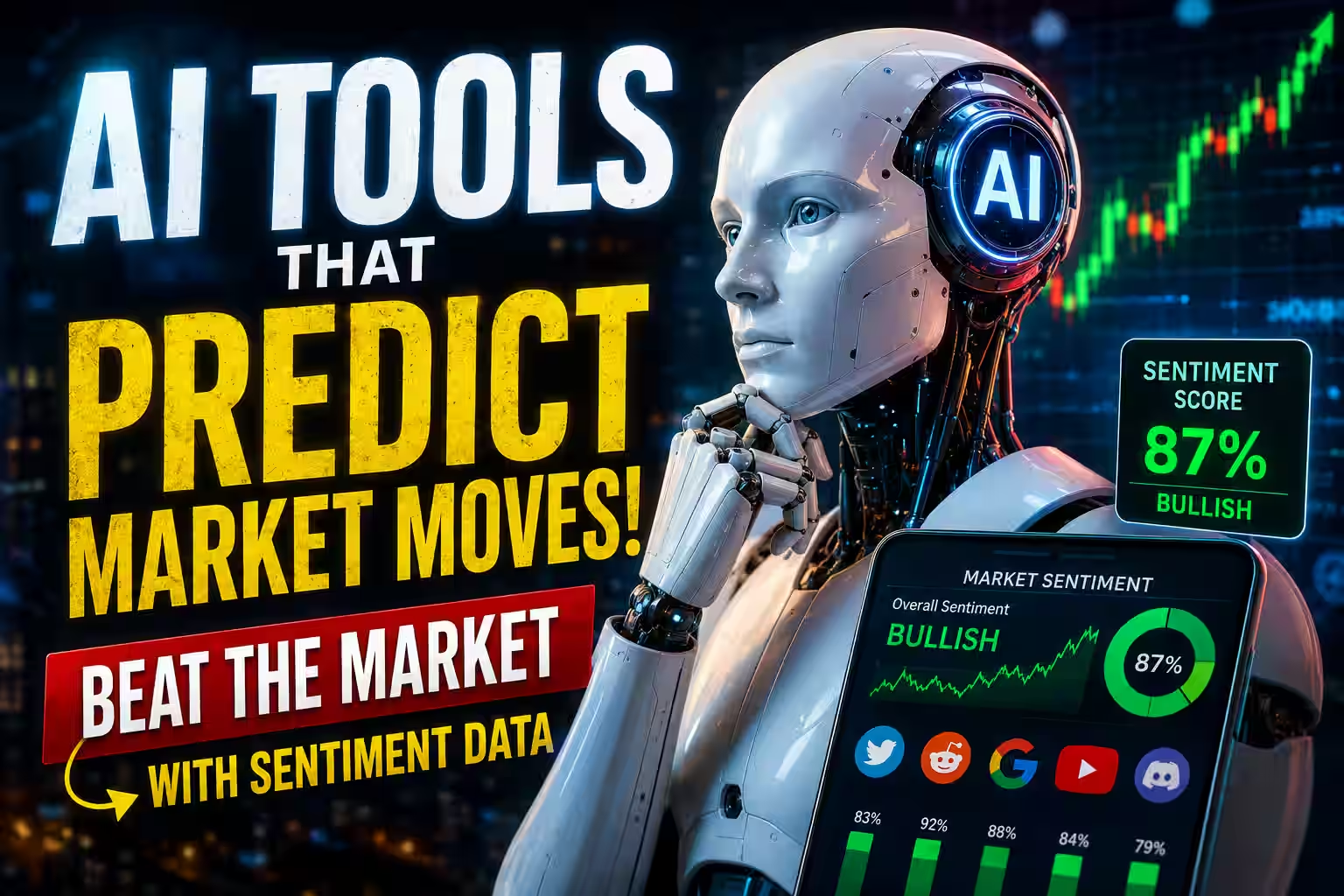
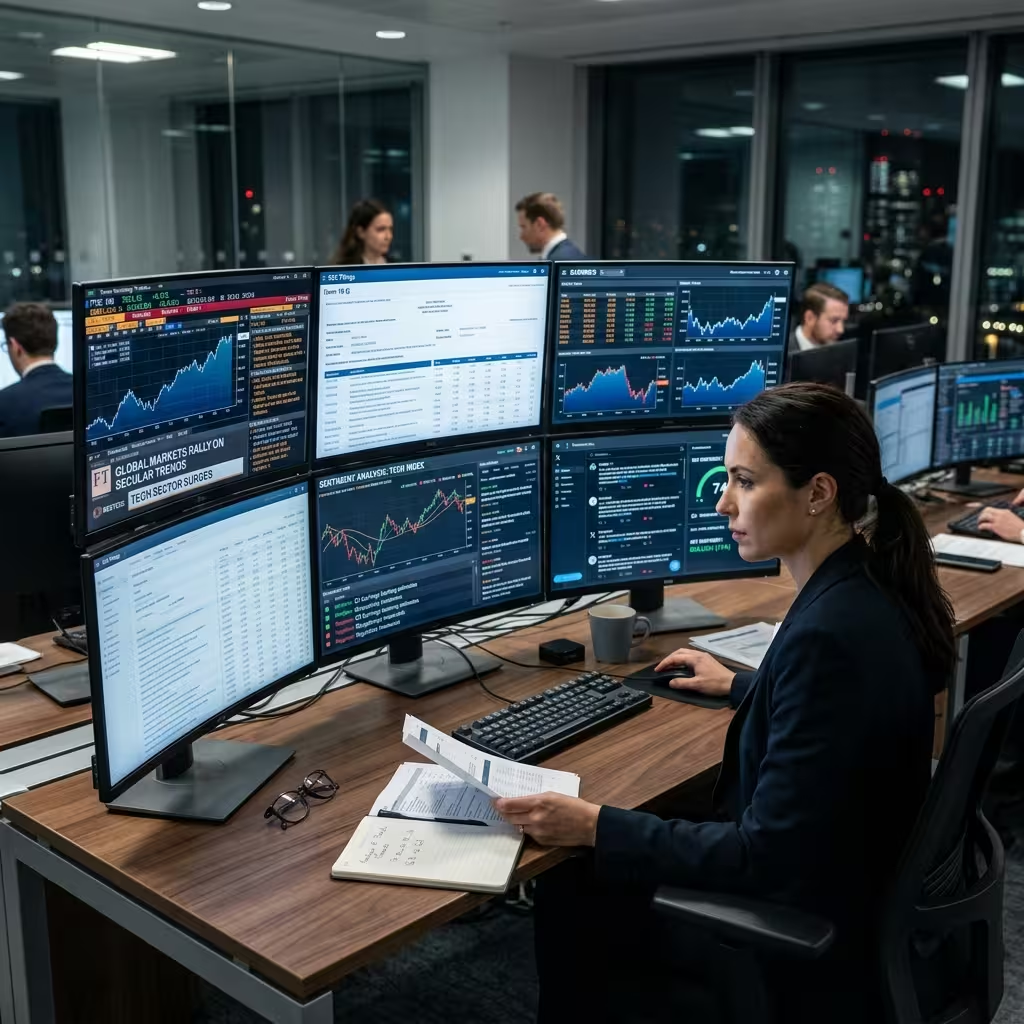
AI market sentiment analysis is the use of natural language processing to read financial text — news stories, earnings calls, tweets, Reddit posts, and SEC filings — and determine whether the tone is positive, negative, or neutral. Those sentiment scores then feed into trading models that adjust positions, flag risks, and spot momentum shifts.
Strip away the jargon and it’s pretty simple. These tools read text — news stories, earnings calls, tweets, Reddit posts, SEC filings — and figure out whether the tone is positive, negative, or somewhere in between. They use something called Natural Language Processing. NLP for short. It’s the same tech behind ChatGPT, just pointed at financial data instead of your homework.
Old-school versions of this just counted words. See the word “great”? That’s positive. See “terrible”? Negative. Done. The problem with that? Sarcasm. A customer who writes “Great, another delay” isn’t happy. A CEO who calls results “fine” might be hiding bad numbers.
Modern systems catch that stuff. They read whole sentences. They check what a person said last quarter and compare it to now. Some even measure the tone of someone’s voice during a phone call.
And the scale is wild. 60 to 73% of all stock trades in the U.S. are now run by algorithms. Nearly half of those algorithms use sentiment data in some way. So when AI decides a piece of news is bad? The selling starts before a human even reads the headline.
That’s power. It’s also a problem. We’ll get to the problem part later.
Table of Contents
How Wall Street Uses AI Sentiment Analysis
Let me paint the picture of what’s happening inside the biggest firms. This isn’t theory. These are real systems running right now with real money behind them.
Man Group manages $214 billion. In July 2025, it launched AlphaGPT, an AI that comes up with its own trading ideas, writes code to test them, and runs the tests — all on its own. No human clicks “go.” The firm’s portfolio manager says it has already created dozens of live trading signals. Half the people at Man Group now use their internal AI tool daily.
Point72 built a separate AI-only strategy called Turion. It beat the firm’s main fund in 2025.
Bridgewater — the world’s biggest hedge fund — launched a $2 billion fund run mostly by machine learning. The CEO said it produces returns that have nothing to do with what the human traders find.
What These Systems Actually Read
So what are these machines looking at? Three things, mostly.
- They scan documents. Earnings calls, SEC filings, press releases. They pull out every topic that matters.
- They compare quarter to quarter. If a CEO’s language shifts from “strong competitive position” to “challenging market conditions,” that gets flagged fast.
- They keep a running narrative map. Not just for one company — for entire sectors, tracked over months and years.
That’s how IBM got crushed in an afternoon. The AI didn’t just read one headline. It matched that headline against years of IBM calling itself an “AI winner.” When the story flipped, the machines moved first.
Can AI Sentiment Analysis Predict Stock Prices?
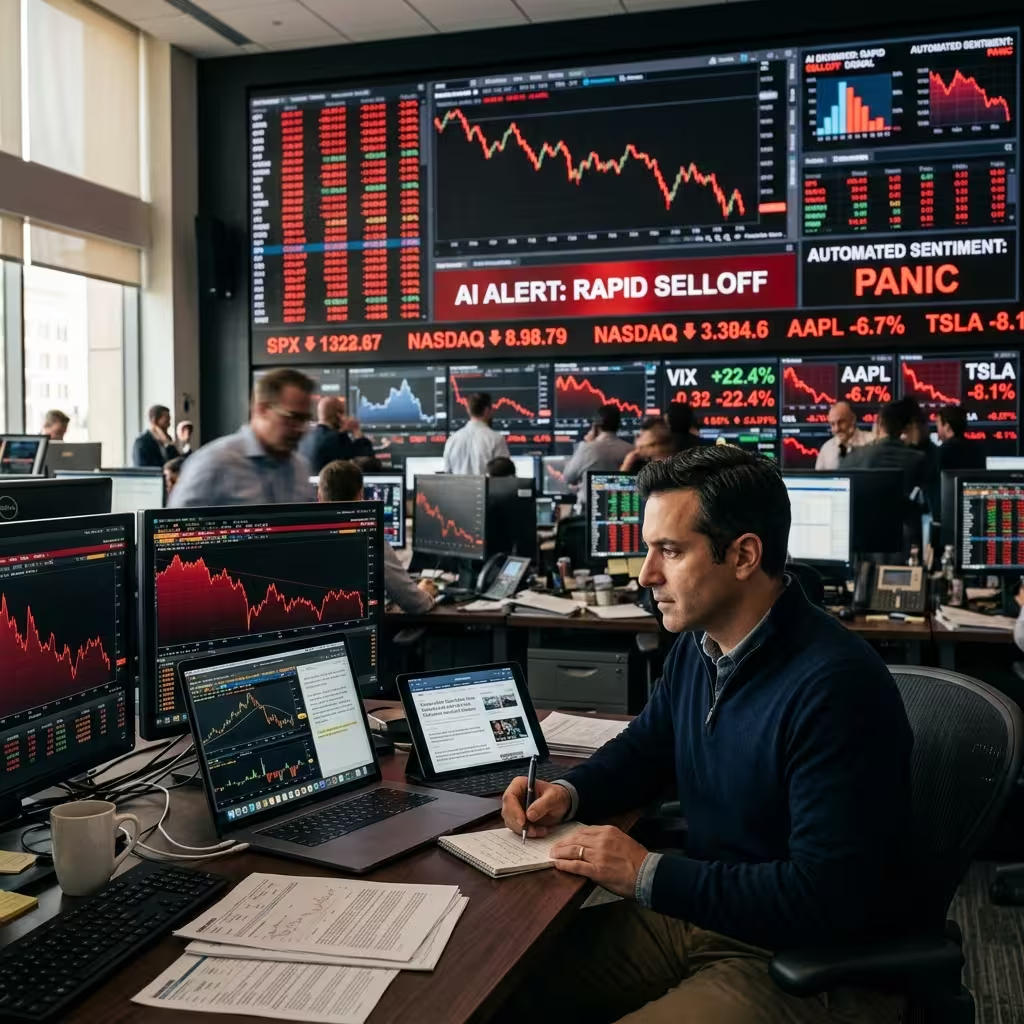
Sometimes — but “first” is not the same as “right.” AI sentiment tools are excellent at detecting how the market is reacting to news in real time. They’re far less reliable at judging whether that reaction is correct, especially when human context matters. Here are three real events from the past year that show both sides.
IBM Lost $30 Billion Over a Press Release
You already know this one. But here’s the part that matters for you. While the algorithms dumped IBM, regular investors on Reddit and Stocktwits called it a buying opportunity. Analyst price targets sat around $327 — about 50% above where the stock landed after the crash. The machines saw a threat. Humans saw an overreaction. Who was right? We still don’t know. That’s the point. The AI moved first, and moving first isn’t the same as being right.
Software Stocks Lost $800 Billion in a Week
Days before IBM’s crash, the whole software sector was already falling apart. The fear had a name: “seat compression.” The idea is simple — if AI bots can do the work of five people, companies won’t need five software subscriptions. They’ll need one.
That fear wiped out $800 billion from software stocks in about five days. Atlassian dropped 73% over the year. Salesforce fell 14% in a single week. And it wasn’t one fund making the call. Dozens of AI systems at different firms read the same “seat compression” story and sold at the same time. Nobody coordinated it. The machines just thought alike.
Regular Investors Beat the Algorithms During “Liberation Day”
April 2025. Trump announced huge new tariffs. The S&P 500 dropped $6.6 trillion in five days. Wall Street’s AI systems went full panic mode, with institutional sentiment hitting an extreme bearish 25th percentile.
But retail investors? The regular people on Reddit stayed calm. Bullish, even. On April 3 alone, individual investors bought $4.7 billion in stocks — the biggest single-day retail buy ever recorded. And they were right. Trump paused the tariffs a week later, and the S&P had its biggest one-day jump since 2008.
Retail beat the machines. Not with better data or faster systems. With better judgment about a political situation the algorithms couldn’t model. Remember that. It matters.
Best AI Market Sentiment Analysis Tools for Investors
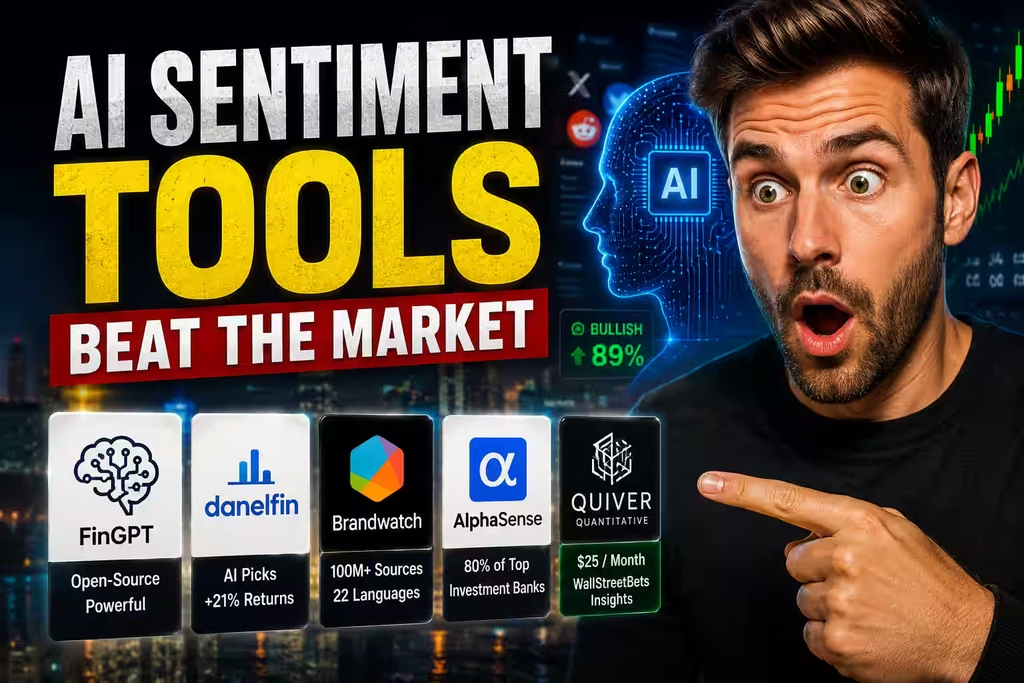
Enough about what the big guys do. What can you actually get your hands on? Here are the standouts, from free and technical to enterprise-grade.
FinGPT is where I’d start if you’re technical. It’s open-source, built by researchers at Columbia and NYU Shanghai, and available on GitHub. You can fine-tune it on your own computer for about $300 with a decent graphics card. It scores 87.6% on financial sentiment tests, and you can update it weekly. That’s a huge deal. BloombergGPT — the one the big banks use — cost somewhere between $2.67 million and $10 million to build, and they can’t afford to retrain it. So it’s stuck knowing what 2023 looked like. FinGPT knows what last Tuesday looked like. For $300.
Danelfin is friendlier for non-coders. It scores stocks using over 10,000 data points — technical signals, fundamentals, and sentiment — and has a free tier. Its AI-scored stocks beat the market by over 21% annually, according to their published track record. For a full review of Danelfin alongside seven other pickers, see our best AI stock screeners guide.
Brandwatch is the heavy hitter for social media tracking. It watches over 100 million sources in 22 languages. Price tag runs from about $800 to $15,000 a month. Not cheap, but if you’re managing real money, it’s what institutional desks reach for.
AlphaSense is used by 80% of the top investment banks for earnings call analysis. Enterprise pricing. If you can get access, it cuts research time roughly in half.
Quiver Quantitative costs $25 a month and tracks what WallStreetBets is talking about across 6,000 stocks. You can plug it straight into QuantConnect for automated trading. For a retail investor, this might be the best bang for your buck right now.
| Tool | Best for | Price | Strengths | Watch-outs |
|---|---|---|---|---|
| FinGPT | Technical DIY investors | ~$300 to fine-tune (open-source) | Weekly updates, strong financial sentiment performance, flexible for custom workflows | Requires coding skills and capable hardware |
| Danelfin | Non-coders | Free tier / paid plans | Easy to use, combines technicals, fundamentals, and sentiment into simple scores | Scores should support judgment, not replace it |
| Quiver Quantitative | Retail sentiment and Reddit tracking | $25/month | Tracks retail chatter across thousands of tickers, useful for spotting sentiment shifts | Social data can be noisy, reactive, or manipulated |
| Brandwatch | Social listening at scale | $800–$15,000/month | Large source coverage, multilingual tracking, enterprise-grade monitoring | Too expensive for most individual investors |
| AlphaSense | Earnings-call and document research | Enterprise pricing | Powerful transcript and filing search, widely used by institutions | Pricing and access are geared toward professional teams |
Here’s my honest take. The expensive tools are better — of course they are. But “better” doesn’t always mean “profitable.” The Liberation Day trade didn’t require AlphaSense or Brandwatch. It required common sense and the guts to buy when everyone else was selling. The tools help you find information faster. They don’t replace thinking.
A Quick Word on Reddit as a Data Source
Five years ago, telling a hedge fund manager to check Reddit for stock tips would’ve earned a laugh. Nobody’s laughing now. Google pays $60 million a year for real-time Reddit data, and OpenAI pays about $70 million. Reddit is now cited by AI models three times more than Wikipedia.
And the data works for trading. A study in ACM Transactions on Social Computing found WallStreetBets buy signals match up with 49% higher trading volume. A separate Nature study found Reddit chatter predicted GameStop’s spike 15 days early. But Reddit is also full of bots, paid shills, and AI-generated garbage. Treat it like a spice, not the main course. If a two-day-old account is hyping a penny stock, that’s not a signal — it’s a trap.
The Risks of AI Herding: When Every System Sells at Once
Here’s the risk that keeps regulators up at night, and it should be on your radar too. When lots of firms use similar AI models, and those models all read the same news, they can all decide to sell at the same time. Nobody planned it. Nobody called a meeting. The machines just agreed.
The Bank of England warned about this in April 2025, saying model uniformity could create feedback loops where AI selling triggers more AI selling until the market falls off a cliff. The IMF echoed it. Flash crashes have jumped 240% in the past decade, partly because of this. The February 2026 SaaS selloff was a live example — dozens of systems flagged “seat compression” and dumped software stocks in unison, and $800 billion vanished.
So what do you do about it? Watch for the pattern. When a whole sector drops fast and hard with no single clear cause, that’s probably AI herding. Sometimes it’s right. Sometimes it’s an overreaction. Either way, pause before you follow the stampede. FINRA’s 2026 report flagged this risk. The SEC hasn’t written new AI-trading rules yet, but they’re watching.
How to Build a Low-Cost AI Sentiment Stack for Under $300
You don’t need a Bloomberg Terminal. You need three simple pieces.
- Something that reads earnings calls and filings. FinGPT works if you’re comfortable with code. If not, use a large language model’s API to paste in an earnings transcript and ask: “How did the CEO’s language about competition change versus last quarter?” That one question, applied consistently, catches what most retail investors miss.
- Something that tracks what regular people are saying. Quiver Quantitative at $25 a month covers Reddit. Danelfin’s free tier covers broader sentiment scoring. You’re hunting for gaps — moments when retail stays bullish while institutions panic, or the reverse. Those gaps contain trades. Once you’ve got signals, our guide to the best algorithmic trading platforms covers how to automate around them without coding.
- A filter for news. Google Alerts is free. Set it up for your watchlist. When a story breaks, your job isn’t to react faster than algorithms — you can’t. Your job is to decide whether the algorithm’s reaction makes sense. Was that 13% IBM drop fair, or did the machines overdo it?
Total cost: somewhere between $0 and $300 a month.
Let me be straight with you. I’ve watched people spend thousands on sentiment tools and lose money because they trusted the output without thinking. I’ve also watched people with nothing but free Google Alerts and a Reddit account make smart trades. The expensive part isn’t the tools. It’s the patience to wait while the machines panic, and the discipline to sell when they get too cheerful.
The people who do well treat these tools like a second opinion, not a boss. They ask: does this make sense given what I know about this company, this CEO, this moment? If yes, they act. If the AI is just reacting to a headline without context, they wait. That’s exactly how retail investors made money during Liberation Day — not by being faster, but by being smarter.
People Also Ask
How does AI analyze news sentiment to predict stock prices?
It reads text from news stories, earnings calls, and social media, then uses NLP to score the tone as positive, negative, or neutral. Advanced versions go deeper — Aspect-Based Sentiment Analysis can tell that a company’s revenue outlook is positive while its margin guidance is negative. Those scores feed into trading algorithms that adjust positions.
What are the best AI sentiment analysis tools for a regular investor?
FinGPT is free and open-source (about $300 to fine-tune). Danelfin has a free tier that scores stocks with AI. Quiver Quantitative costs $25 a month and tracks Reddit activity across 6,000 tickers. For deeper research, AlphaSense is what investment banks use — but the price reflects that.
Can Reddit posts actually move stock prices?
Yes. Academic studies confirm WallStreetBets buy signals match up with 49% higher trading volumes, and Reddit predicted GameStop’s spike 15 days early. But raw Reddit data is noisy, and bots and paid promoters are everywhere. Use filtering tools and cross-reference with fundamentals before acting.
What is “seat compression” and why did it crash software stocks?
Seat compression is the fear that AI agents will do the work of multiple humans, so companies will buy fewer software subscriptions. That fear drove an $800 billion selloff in software stocks in February 2026. Whether it’s justified long-term is still an open question.
What happens when multiple AI trading systems sell at the same time?
It creates a feedback loop — AI selling pushes prices down, which triggers more AI selling. The Bank of England, IMF, and FINRA have all flagged this as a systemic risk. Flash crashes have increased 240% in the past decade, partly due to this pattern. Circuit breakers pause trading at 7%, 13%, and 20% S&P 500 drops, but they don’t stop the initial stampede. If you see a fast, broad selloff with no obvious cause, take a breath before joining in.
The Bottom Line
AI market sentiment analysis is no longer a Wall Street secret. It’s a set of tools you can start using this week — often for free — to see how the market is reacting to news in real time. The big lesson from IBM, the SaaS selloff, and Liberation Day is simple: these systems are fast, but fast isn’t the same as right. Your edge as a retail investor isn’t speed. It’s judgment.
Start small. Pick one free tool, set up Google Alerts for a handful of stocks you follow, and practice asking one question: does the machine’s reaction actually make sense? Build the habit before you build the budget.
This article is for information only. It’s not financial advice. Stock prices, tool pricing, and regulations change. Talk to a licensed financial advisor before putting money anywhere. Check current pricing with vendors before buying.
AI & Stocks Trading · Editorial Integrity
Sources & Citations
Public reporting, research, regulatory commentary, and company information supporting this guide on AI market sentiment analysis, algorithmic trading, retail investor behavior, social sentiment data, and AI herding risk.
Every major claim in this guide is grounded in public reporting, primary company materials, research publications, platform documentation, or named regulatory commentary. Market examples such as the IBM selloff, software sector drawdown, and tariff-driven panic are supported by dated coverage and cited sources. Tool descriptions reference vendor or project pages where relevant. Because market prices, tool pricing, model capabilities, and regulatory positions can change quickly, readers should verify time-sensitive details before making decisions.
View full sources, methodology, and editorial notes
This guide was written using a mix of named financial reporting, official product or project pages, published research, market commentary, and regulatory analysis. Preference is given to primary or clearly attributable sources when supporting claims about market sentiment tools, hedge fund AI adoption, Reddit data value, market-wide selloffs, or systemic-risk concerns related to model uniformity. Some figures in the article describe fast-moving market conditions or pricing that may change after publication. This article is educational information only and does not constitute financial advice.
- IBM selloff and AI-driven market reaction: CNBC — IBM is the latest AI casualty; shares are tanking on Anthropic COBOL threat — cited for the article’s lead example involving IBM’s sharp selloff after AI-related competitive fears.
- Algorithmic trading share and sentiment-driven trading context: Quantified Strategies — What Percentage of Trading Is Algorithmic? — cited for background on how much U.S. market activity is driven by algorithmic systems.
- Hedge fund adoption of agentic AI and signal discovery: Hedgeweek — Man Group deploys agentic AI for quant signal discovery — cited for the AlphaGPT example and institutional adoption of AI-generated trading signals.
- Point72 and hedge fund performance context: Yahoo Finance — Here’s how big-name hedge funds performed — cited for discussion of Point72 and AI-related strategy performance context.
- Software sector selloff and seat compression fears: Wedbush / MarketMinute — Software-mageddon: the $800 billion tech selloff and the death of the SaaS model — cited for the “seat compression” narrative and the software-stock drawdown example.
- Tariff panic and broad market decline: Wikipedia — 2025 stock market crash — used as a directional background summary for the timeline and scale of the tariff-driven market decline referenced in the article.
- Retail buying behavior during the tariff selloff: CNN — Retail investors kept buying U.S. stocks — cited for the article’s discussion of record retail buying during the selloff.
- FinGPT project and open-source financial AI model reference: GitHub — AI4Finance Foundation / FinGPT — cited for the open-source tool overview and model positioning.
- Danelfin platform reference: Danelfin — Official Website — cited for product positioning, AI scoring framing, and platform overview.
- Reddit licensing value and real-time data demand: Search Engine Land — OpenAI may pay Reddit $70M for licensing deal — cited for context on the market value of Reddit’s data stream.
- Reddit citation frequency in AI systems: Columbia Journalism Review — Reddit is winning AI licensing deals — cited for the claim that Reddit is heavily referenced in AI-generated answer systems.
- Reddit business growth and platform scale: Yahoo Finance — Reddit reports fourth quarter and full year 2025 results — cited for user scale and revenue growth context.
- Academic research on WallStreetBets and market activity: ACM Transactions on Social Computing — Research on WallStreetBets trading signals — cited for research linking social signals to elevated trading activity.
- Systemic risk and AI herding concerns: Bank of England — Financial Stability in Focus, April 2025 — cited for warnings about model uniformity, feedback loops, and systemic market risk.
- Flash crash and market abuse risk commentary: Sidley — Artificial Intelligence in Financial Markets: Systemic Risk and Market Abuse Concerns — cited for discussion of growing systemic-risk concerns tied to AI in markets.
- Regulatory oversight of generative AI risks in finance: FINRA — 2026 Annual Regulatory Oversight Report: Generative AI — cited for the regulatory perspective on AI-related risk and supervision.
AI Market Sentiment Analysis · Editorial Standards
Our Editorial Standards
Tech Capital Hub applies Google’s E-E-A-T framework to every finance and AI guide by prioritizing plain-English explanations, attributable reporting, public data, and official product or research sources over hype. In this article, we explain how AI market sentiment analysis works, how hedge funds and retail investors use it, and where AI-driven market reactions can fail. Claims about major market events, tool capabilities, and regulatory concerns are framed cautiously and tied to named sources where possible, especially when discussing fast-moving topics like sentiment signals, algorithmic trading, sector-wide selloffs, and AI herding risk.
View how our editorial standards apply to this article
Written for Investors Who Want Clarity, Not Hype
This guide is structured for readers trying to understand what AI sentiment tools actually do in real markets. Instead of assuming a quant background, it starts with concrete examples — like the IBM selloff, software-stock panic, and retail buying during tariff-driven volatility — to show where machine reactions can be fast, useful, and sometimes wrong. The goal is practical understanding, not abstract theory.
Complex Market Mechanics Explained in Plain English
The article breaks down AI market sentiment analysis, natural language processing, algorithmic trading behavior, and social-signal interpretation in language non-specialists can follow. It also explains the limits clearly: models can detect how the market is reacting to news in real time, but they are less reliable at judging whether that reaction is actually correct when politics, narrative shifts, or human nuance matter.
Named Reporting, Research, and Official Sources Where They Matter
Specific claims are supported with attributable references, including financial-news coverage for market-moving events, official or project sources for tool descriptions, published research for social-sentiment behavior, and regulatory or institutional commentary for systemic-risk concerns. We prefer named reporting and primary materials where available, and we avoid presenting vendor claims or dramatic market narratives as settled fact without context.
Transparent About Uncertainty, Risk, and What AI Cannot Know
We make the trade-offs explicit: AI can move faster than people, but moving first is not the same as being right. That principle runs through the article’s treatment of tool recommendations, retail sentiment, and AI herding. Because stock prices, platform pricing, model quality, and regulatory views change over time, this content should be used as educational research rather than financial advice. Corrections or source challenges can be sent to editorial@techcapitalhub.com.
AI Market Sentiment Analysis · About the Author
Marcus Delray
Fintech Analyst · Founder of Tech Capital Hub
Marcus Delray is a fintech analyst and the founder of Tech Capital Hub. In this guide, he explains how AI market sentiment analysis works in plain terms — from how systems scan news, earnings calls, and social chatter to how those signals can move markets before most people even react. His focus is on helping readers understand where these tools are useful, where they break down, and why speed alone is not the same as judgment.
View full author bio, credentials, and links
Marcus Delray has spent over a decade researching financial technology. He built Tech Capital Hub to make that research useful for everyday readers — from total beginners to people who already follow markets closely. He covers AI in finance, fintech infrastructure, blockchain, DeFi, and business software, with a consistent focus on turning dense topics into clear, actionable guides.
For this guide, Marcus walks through one of the most important shifts in modern investing: the rise of AI market sentiment analysis. He explains how hedge funds and trading desks use AI to read headlines, earnings calls, filings, and online discussion at machine speed, then shows where that edge can turn into a weakness when many systems react the same way at once. The article uses real market examples — including AI-driven selloffs, sector-wide panic, and moments where retail investors outperformed institutional systems — to show that machine speed can be powerful but is not always right. Tool coverage is framed as research and education, not investment advice.
- Explains AI market sentiment analysis in plain language, including how models interpret news, earnings calls, filings, and social signals
- Breaks down how algorithmic trading systems can react to sentiment data faster than human traders, especially during news-driven volatility
- Shows where AI tools help investors and where they fail, particularly when context, politics, or crowd behavior matter more than speed
- Covers the growing role of Reddit, retail sentiment, and alternative data in modern market analysis
- Frames systemic-risk concerns such as AI herding and synchronized selling with educational, evidence-based context rather than hype
Enjoying our content?
Click below to add us as a preferred source. Google will prioritize our latest articles in your Top Stories, AI Mode, and AI Overviews.
Preferred Source on Google