
AI Accounts Payable Software: Scale to $10M+ Without Hiring AP Clerks
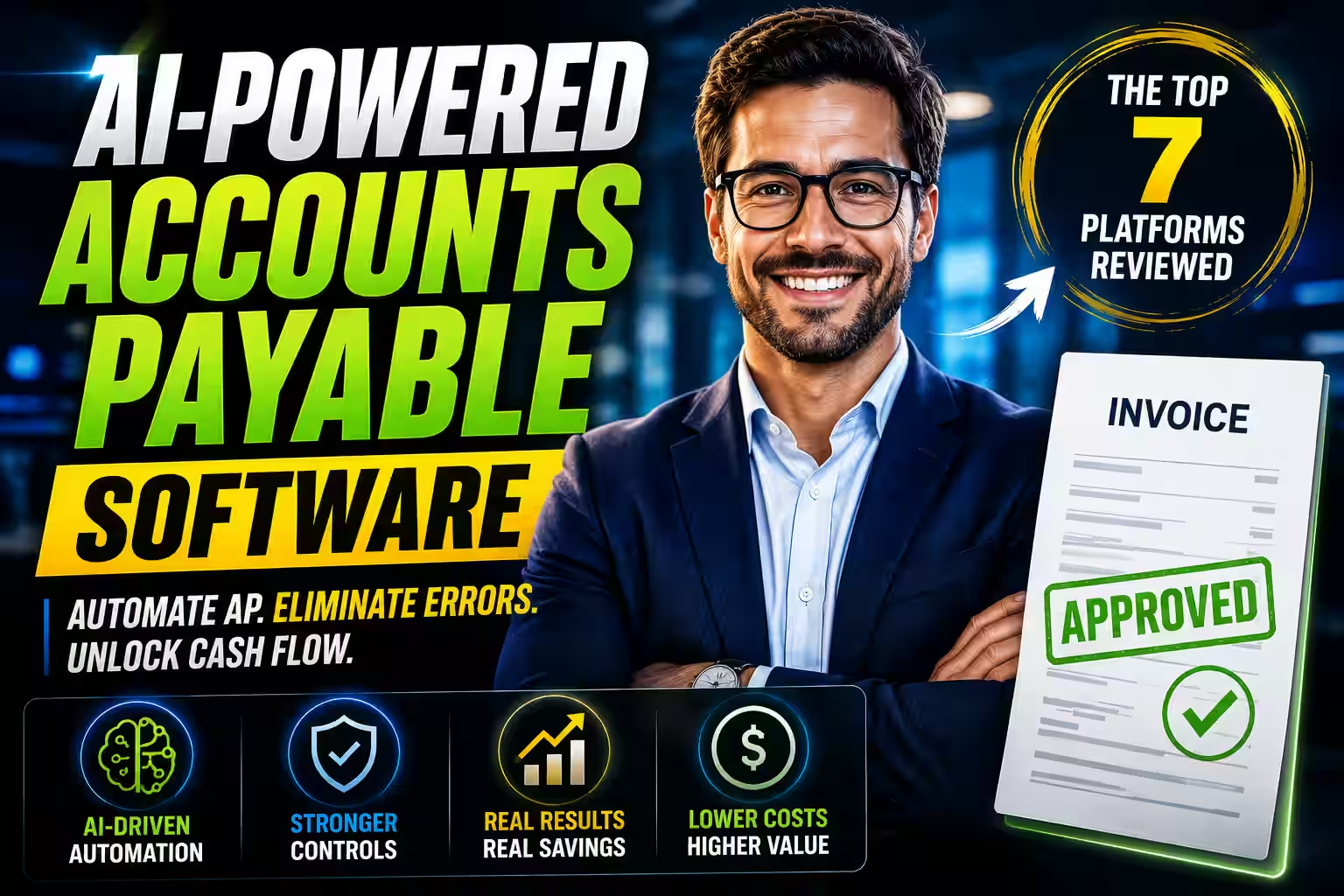
What’s the Best AI Accounts Payable Software Right Now?
There is no single best AP platform for every business.
Tipalti stands out for global and multi-entity AP, Stampli for
collaborative invoice workflows, Rillion for mid-market ERP
environments, Medius for high-volume AP, Basware for global
compliance, Xelix for AP controls, and Esker for broader
source-to-pay automation.
Best AI AP Software by Use Case
Bottom Line
Don’t choose an AP platform based on OCR accuracy alone. The strongest solution is the one that fits your ERP, invoice volume, purchasing process, approval structure, vendor base, payment requirements, and exception workflow. For many finance teams, the biggest gains come from automating the entire invoice-to-payment process rather than simply extracting invoice data.
Editorial note: Product positioning reflects Tech Capital Hub’s evaluation of the platforms covered in this guide. Features, integrations, pricing, and automation capabilities can change, so verify current specifications with the vendor before purchasing.
This guide covers all seven platforms in detail — what each one actually does, who it’s built for, how pricing is structured, and what to validate before you sign a contract.
If you’re evaluating AP tools as part of a broader finance stack refresh, see our best AI accounting software guide for a wider look at automation across bookkeeping, expense management, payables, close, and reporting.

Fintech Analyst | AI Accounts Payable, AP Automation, Invoice Processing & Accounting Technology
Key Takeaways
- Manual AP teams spend $10.89 per invoice on average; best-in-class AI-driven teams spend $2.36, according to Ardent Partners AP Metrics That Matter 2025
- Xelix estimates $53 billion in annual financial leakage from duplicate payments, overpayments, and vendor fraud across enterprise AP functions
- Gartner forecasts that 40% of enterprise teams will deploy AI agents by 2027, with AP automation among the highest-ROI applications
- Touchless processing rates of 70–85% are achievable within 6–12 months of deployment when 3-way PO matching and automated invoice approval workflow tools are properly configured
- Most tools marketed as “AI accounts payable software” are OCR platforms with rule-based logic — not genuine machine learning systems
Table of Contents

What Is AI Accounts Payable Software — and Why Most Tools Are Not Actually AI
AI accounts payable software uses machine learning models to autonomously process invoices, validate vendor data, match line items to purchase orders and receipts, and route approval decisions — with minimal human intervention after initial configuration.
That definition excludes most tools currently marketed as AI in the AP space.
OCR vs. Genuine AI: What’s the Actual Difference?
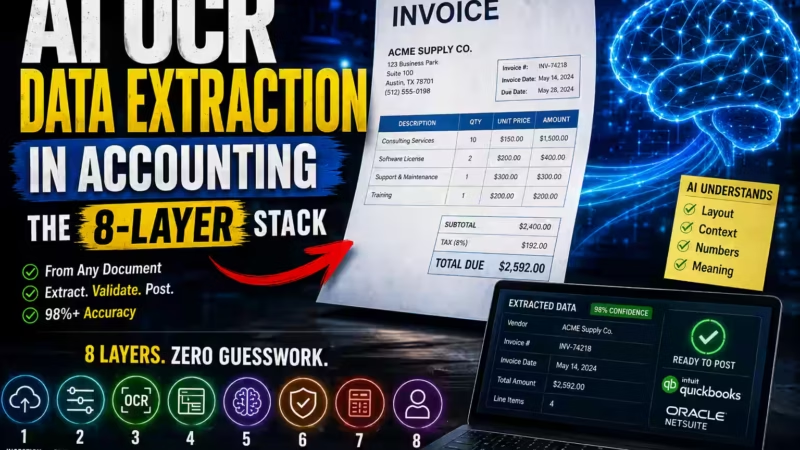
OCR (Optical Character Recognition) tools convert invoice images into structured text. They require template configuration per vendor, break when invoice layouts change, and cannot learn from historical patterns or flag contextual anomalies.
Genuine AI accounts payable software uses machine learning to understand document context without template pre-configuration. It learns your vendor patterns, flags anomalies based on behavioral history, predicts GL account coding, and improves accuracy over time as it processes more invoices. The system gets better with use — OCR does not.
The operational consequence is significant. A 500-vendor AP operation running OCR tools still requires human review on ambiguous invoices, layout exceptions, and new vendor onboarding. A machine learning-based system handles those cases autonomously after a learning period of 4–8 weeks.
Three Questions That Expose AI-Washing
Before signing any AP automation contract, ask these three questions directly:
- “Does your system learn from historical invoice patterns and improve accuracy over time, or does it apply static rules?” — Rule-based tools will hedge. Genuine AI platforms can quantify accuracy improvement timelines and provide customer benchmarks.
- “How does your platform handle line-item exception resolution when invoice data doesn’t match the PO?” — OCR tools flag and stop. ML-based systems suggest resolution paths, escalate intelligently, and log exception patterns for continuous improvement.
- “What is your documented touchless processing rate for customers at 90 days and 180 days post-deployment?” — If the vendor cannot provide customer benchmark data on touchless rates at both timepoints, the platform likely lacks autonomous decision-making capability.

How AI Account Payable Software Actually Works?
AI accounts payable software works by replacing the manual steps in the invoice-to-payment cycle with automated processes that execute without human initiation. Here’s how the flow works end to end:
- Invoice capture — The system ingests invoices from email, EDI, supplier portals, or document upload. AI extracts header and line-item data without vendor-specific templates.
- 3-way PO matching — The platform cross-references the invoice against the corresponding purchase order and goods receipt. When all three align within defined tolerances, the invoice approves automatically.
- GL account coding — The system predicts the correct general ledger account based on historical categorization patterns for that vendor and cost type.
- Duplicate detection — Before any payment is authorized, the platform screens the invoice against the full payment history database — checking invoice number, vendor ID, date, and amount.
- Approval routing — Invoices that can’t be auto-approved are routed to the correct approver based on pre-configured rules: vendor type, dollar threshold, cost center, and GL coding.
- Exception escalation — Invoices with discrepancies beyond defined tolerances are flagged, categorized, and routed to the right person rather than rejected outright.
- ERP synchronization — Approved invoices and payment data are written back to the ERP in real time, with audit trail documentation captured throughout.
- Payment execution — Depending on the platform, outgoing payments are grouped, sequenced, and executed to optimize cash flow and capture early payment discounts.
What Should AI AP Software Actually Automate?
The following capabilities separate platforms that genuinely eliminate manual AP labor from those that merely digitize it.
1. 3-Way Purchase Order Matching
3-way PO matching automatically cross-references an incoming invoice against the corresponding purchase order and goods receipt document. When all three align within defined tolerance thresholds, the invoice approves without human involvement. When discrepancies exist, the system flags the specific line-item exception rather than rejecting the entire invoice.
Best-in-class platforms execute 3-way matching in under 30 seconds per invoice. Manual matching typically takes 8–15 minutes per exception.
2. Automated Invoice Approval Workflow
An automated invoice approval workflow routes invoices to the correct approver based on pre-configured rules — vendor type, cost center, dollar threshold, and GL account coding — without AP staff manually forwarding documents. Escalation paths trigger automatically when approvals stall. Audit trail documentation captures every routing decision with timestamps.
The distinction between rule-based and AI-driven routing matters here: AI systems learn approver patterns over time and adapt routing logic when organizational structures change. Rule-based systems don’t.
3. Duplicate Payment Detection
Duplicate payment detection screens each invoice against the full payment history database before any disbursement is authorized. Screening dimensions include invoice number, vendor ID, payment date, and amount — catching duplicates that differ slightly in formatting but represent the same underlying liability. According to Xelix’s research, enterprises collectively lose over $53 billion annually to duplicate payments, overpayments, and vendor fraud.
4. Vendor Master Database Verification
Vendor master database verification cross-checks new vendor submissions and payment updates against known fraud indicators, sanctions lists, and internal policy rules before activating payment capability. Ghost vendor fraud — where fraudulent vendors are inserted into the payment system — is one of the most common AP fraud vectors. Automated verification closes that gap at onboarding rather than at audit.
5. GL Account Suggestion Engine
GL account suggestion engines predict the correct general ledger coding for each invoice line item based on historical categorization patterns for that vendor and cost type. This eliminates one of the most error-prone manual steps in AP processing. Miscoded GL entries create downstream problems at financial close, accrual calculation, and budget variance reporting.
6. IRS W-9/W-8 Form Automation and 1099 Compliance Tracking
IRS W-9/W-8 form automation collects and validates tax documentation from vendors at onboarding and re-validates annually. 1099 compliance tracking monitors cumulative payment amounts against IRS reporting thresholds and generates required filings automatically. For finance teams managing 200+ vendors, manual 1099 compliance creates significant year-end labor spikes and material penalty exposure.
7. Cross-Border FX Handling
Cross-border FX handling applies real-time exchange rate data to multi-currency vendor payments, calculates FX gain/loss for accounting purposes, and routes international payments through appropriate payment rails. For global or multi-entity AP operations, manual FX management introduces both operational friction and balance sheet risk.
8. Audit Trail Documentation and SOC 2 Compliance
Every automated decision — matching result, approval routing, exception escalation, payment authorization — must be logged in an immutable audit trail with human-readable explanations. SOC 2 Type II certification confirms that the platform’s data handling, access controls, and system operations meet independently verified security standards. Treat SOC 2 Type II as a baseline requirement, not a differentiator. Any platform that can’t provide a current report should be removed from your shortlist immediately.
Why the AP Headcount Problem Is Really a Process Design Problem?
Finance leaders scaling toward $10M and beyond typically frame AP bottlenecks as a staffing problem. Invoice volume grows. Vendor relationships multiply. Approval cycles lengthen. The instinct is to hire an AP clerk.
That instinct is expensive — and it misidentifies the actual constraint.
The real problem is process design: the absence of automated approval workflows, intelligent invoice matching, and vendor verification that can absorb volume growth without proportional headcount expansion. When each new vendor or invoice cycle requires manual touchpoints, headcount scales linearly with revenue. That math destroys AP efficiency at precisely the moment when cash flow precision matters most.
According to Ardent Partners’ AP Metrics That Matter 2025, best-in-class organizations process invoices fully automatically 73% of the time. The average organization manages touchless processing on just 42% of invoices. That 31-point gap represents the difference between a finance team that scales and one that perpetually adds headcount.
The Cost-Per-Invoice Gap Is Measurable
According to Ardent Partners, the average organization spends $10.89 per invoice on manual processing — including labor, error correction, and cycle time delays. Best-in-class organizations using intelligent invoice matching and automated approval workflows reduce that figure to $2.36 per invoice. At 5,000 monthly invoices, that differential is $42,650 per month in recoverable processing cost.
Manual AP scales linearly. Every doubling of invoice volume requires proportional staff expansion. AI accounts payable software breaks that relationship. Once an automated approval workflow is operational, processing 2,000 invoices monthly versus 10,000 monthly requires no additional headcount — only incremental software licensing.

How to Evaluate AI AP Software: 6 Criteria That Actually Matter?
1. ERP Integration Depth — Native vs. Middleware
The most overlooked evaluation criterion. Native ERP integrations write directly to your ERP records without middleware — no sync delays, no additional failure points. Middleware integrations introduce latency and create separate data management burdens. Confirm whether the vendor offers a native SuiteApp (for NetSuite) or a certified ERP connector before evaluating anything else.
2. Touchless Processing Rate at 90 and 180 Days
Ask every vendor for documented touchless processing rates from customers at 90 days and 180 days post-deployment. If they can’t provide both data points, the platform likely lacks genuine autonomous decision-making. Realistic targets are 70–85% within 6–12 months of proper configuration.
3. Line-Item vs. Header-Level Matching
Header-level matching captures basic invoice data. Line-item matching is required for accurate 3-way PO matching, GL account suggestion engine operation, and exception resolution at the individual cost level. Confirm which your vendor supports before deployment.
4. Exception Handling and Escalation Logic
How the platform handles exceptions is often more important than how it handles clean invoices. Ask specifically: does the system suggest resolution paths for line-item discrepancies, or does it simply flag and stop? AI-based platforms do the former. OCR tools do the latter.
5. Vendor Trust Tier Configuration
Can the platform segment vendors by relationship length, payment history, and contract status? Vendor trust tiers allow higher auto-approval thresholds for established suppliers and additional validation steps for new or one-time vendors. This flexibility is a meaningful differentiator between genuine AI platforms and rule-based tools.
6. SOC 2 Type II Certification and Audit Trail Export
Confirm SOC 2 Type II certification is current. Confirm that audit trail data can be exported in a format your auditors can use. These are not differentiators — they are table stakes. If a vendor can’t provide both, remove them from your list.
Best AI Accounts Payable Software: Platform Comparison
Compare the leading AP automation platforms by use case, core strength, and ERP compatibility to quickly identify the best fit for your finance team.
| # | Best Tool | Use Case / Company Type | Key Strength | ERP Fit |
|---|---|---|---|---|
| 01 | Tipalti | Global / Multi-Entity |
Cross-border FX handling and 1099 compliance Why Tipalti?
Best suited to organizations managing international
vendors, multiple currencies, tax documentation,
and global payment workflows.
|
NetSuite
Sage Intacct |
| 02 | Stampli | Audit-Heavy / Collaborative AP |
Collaborative invoice review and audit trail Why Stampli?
A strong choice when AP delays are caused by
cross-functional approvals, scattered communication,
and the need for detailed invoice-level documentation.
|
NetSuite
Sage
QuickBooks |
| 03 | Rillion | Mid-Market Multi-ERP |
NetSuite + Sage native integration depth Why Rillion?
Particularly strong for mid-market finance teams
operating across NetSuite or Sage environments that
want deep ERP-level AP automation.
|
NetSuite
Sage X3
Sage 50 |
| 04 | Medius | Logistics / Retail / CPG |
High-volume PO matching and supplier portals Why Medius?
Designed for high-volume, purchase-order-heavy AP
operations where matching speed and exception
resolution are critical.
|
SAP
D365
NetSuite |
| 05 | Basware | Enterprise Global Compliance |
E-invoicing mandates and global tax compliance Why Basware?
Best suited to enterprise AP teams dealing with
complex country-specific e-invoicing mandates,
tax rules, and global compliance requirements.
|
SAP
Oracle
NetSuite |
| 06 | Xelix | AP Control Layer / Bolt-On |
Duplicate payment detection and leakage prevention Why Xelix?
Ideal when your existing ERP already handles AP but
you need additional controls for duplicate payments,
overpayments, reconciliation, and financial leakage.
|
SAP
Oracle
NetSuite |
| 07 | Esker | Full Source-to-Pay |
End-to-end procure-to-pay automation Why Esker?
The strongest fit when your goal extends beyond AP
automation into procurement, approvals, payment
workflows, and complete source-to-pay orchestration.
|
SAP
NetSuite
Salesforce |
For a broader look at how AP automation fits within your full accounting stack, see the best AI accounting software guide at TechCapitalHub, which covers the wider landscape of AI-native financial platforms across bookkeeping, reporting, and close automation.

Best AI Accounts Payable Software: Detailed Review
Tipalti — Best for Global/Multi-Entity AP Operations
Tipalti is purpose-built for organizations running cross-border vendor payment programs. Its end-to-end AP automation platform handles supplier onboarding, IRS W-9/W-8 form automation, payment execution across 196 countries and 120 currencies, and 1099 compliance tracking — all within a single workflow.
Key differentiator: Tipalti’s tax compliance engine validates TIN data against IRS records in real time during vendor onboarding, eliminating the manual reconciliation that typically creates year-end 1099 filing backlogs.
Choose Tipalti if: Your AP operation manages international vendors across multiple currencies, entities, or tax jurisdictions, and your current process requires manual coordination across FX, compliance, and payment execution teams.
ERP integrations: NetSuite (native), Sage Intacct, QuickBooks Online, Xero. See Tipalti’s integration documentation for configuration details.
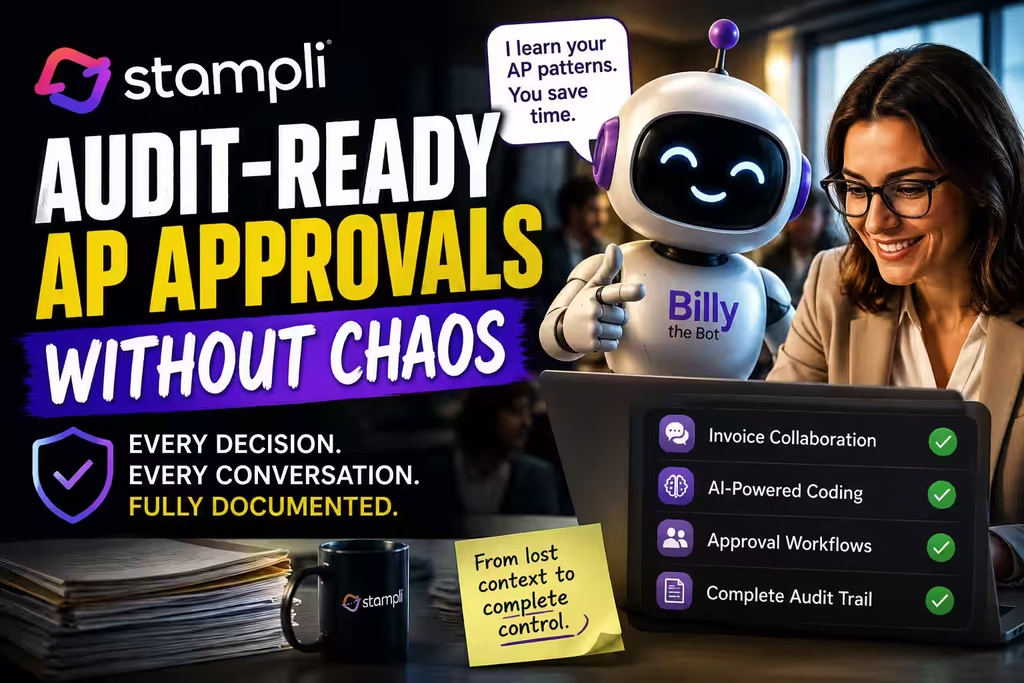
Stampli — Best for Audit-Heavy and Collaborative AP Environments
Stampli centers its platform design around invoice collaboration — placing communication, documentation, and approval workflows on the invoice itself rather than routing documents through email chains. Every conversation, decision, and approval is captured in context with the invoice record.
Key differentiator: Stampli’s Billy the Bot AI learns your organization’s AP patterns — vendor coding, approval routing, GL suggestions — without requiring manual configuration. Audit trail documentation captures the full decision history per invoice.
Choose Stampli if: Your AP approvals involve multiple stakeholders across departments, approval queues stall regularly due to lost context, or your audit exposure requires documented evidence of every invoice decision.
ERP integrations: NetSuite, Sage Intacct, QuickBooks, Microsoft Dynamics, SAP. See Stampli’s integration page for ERP-specific setup details.
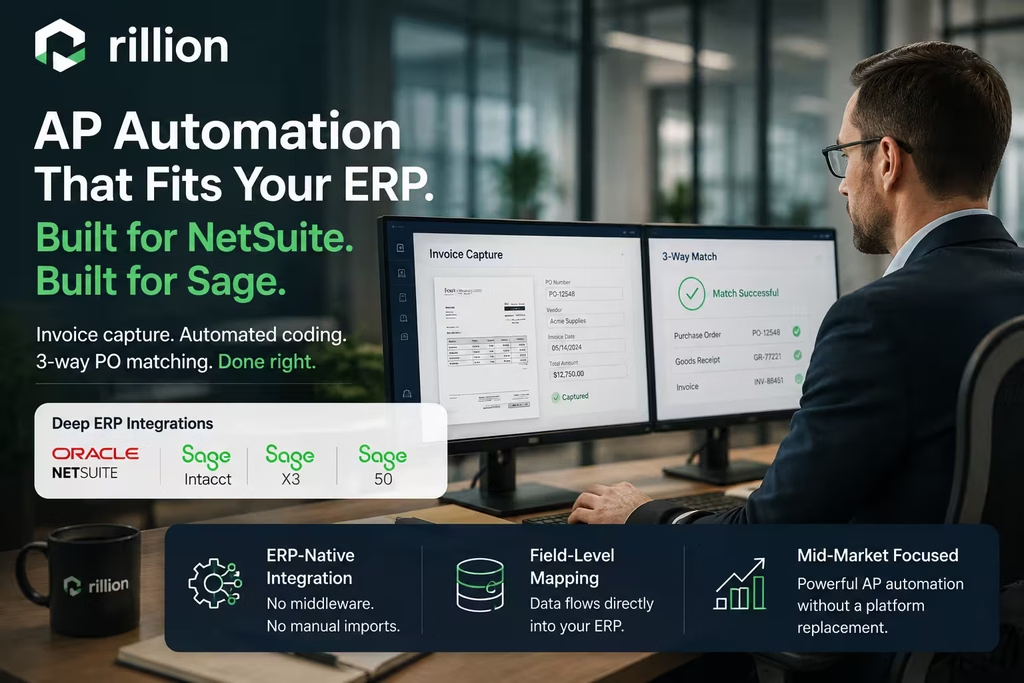
Rillion — Best for Mid-Market Multi-ERP Environments
Rillion specializes in invoice capture, automated coding, and 3-way PO matching for mid-market companies operating across multiple ERP systems. Its direct integration depth with NetSuite and Sage — including Sage Intacct, Sage X3, and Sage 50 — makes it the strongest option for finance teams that need AP automation without a full platform replacement.
Key differentiator: Rillion’s ERP-native integration architecture means AP data flows directly into existing ERP ledgers without middleware or manual import steps — a structural advantage over platforms that require separate data synchronization workflows.
Choose Rillion if: You operate on NetSuite or Sage and need AP automation that integrates at the field-mapping level rather than syncing through flat file exports. See Rillion’s NetSuite integration page and Sage integration page for specifics.
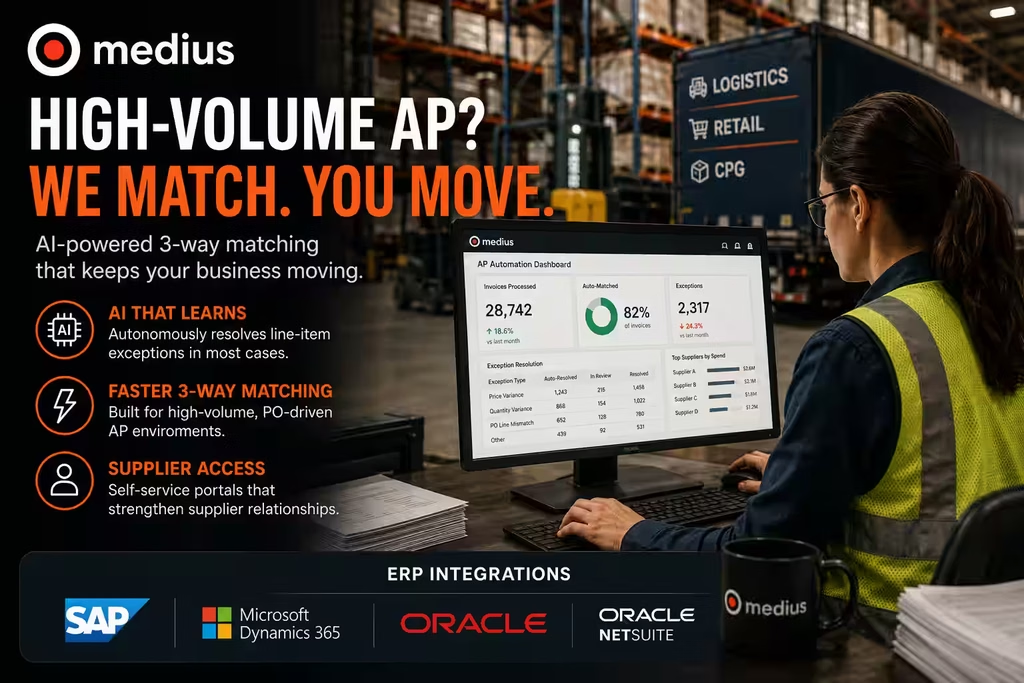
Medius — Best for Logistics, Retail, and CPG Companies
Medius is optimized for high-volume, purchase-order-driven AP environments — making it the strongest fit for logistics operators, retailers, and CPG companies where PO-matched invoices represent the majority of AP volume.
Key differentiator: Medius’s AI autonomously resolves line-item exception resolution without human review in the majority of cases, learning from historical matching decisions to reduce exception queues over time.
Choose Medius if: Your AP operation processes large volumes of PO-backed invoices where 3-way matching speed and supplier portal access are operational priorities.
ERP integrations: SAP, Microsoft Dynamics 365, Oracle, NetSuite. See Medius’s integration documentation for technical configuration requirements.

Basware — Best for Enterprise Global Compliance
Basware is the leading platform for enterprise organizations with complex global e-invoicing mandates. Basware handles country-specific electronic invoicing compliance requirements across 50+ countries — including VAT mandate compliance, country-specific invoice formats, and real-time tax authority reporting requirements that vary by jurisdiction.
Key differentiator: Basware’s global compliance infrastructure is pre-built and maintained by the platform — so finance teams in markets with mandatory e-invoicing requirements (Brazil, Italy, Mexico, and others) don’t need to build compliance workflows from scratch.
Choose Basware if: Your enterprise AP operation spans multiple countries with active or upcoming e-invoicing mandates, and compliance infrastructure — not processing speed — is your primary risk factor.
ERP integrations: SAP, Oracle, NetSuite, Microsoft Dynamics. See Basware’s integration catalog for implementation requirements.
Xelix — Best for AP Control Layer (Bolt-On)
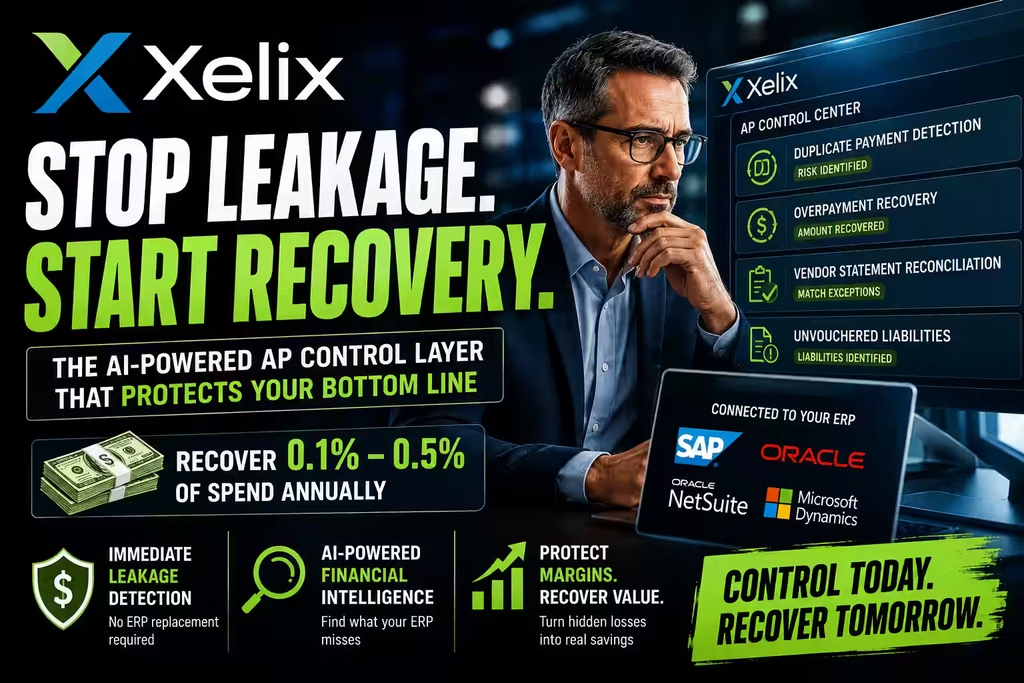
Xelix functions as an AI-powered AP controls layer that sits above your existing ERP rather than replacing it. Xelix specializes in duplicate payment detection, overpayment recovery, vendor statement reconciliation, and unvouchered liabilities tracking — the financial leakage categories that existing ERP systems routinely miss.
Key differentiator: Xelix does not require a full AP platform migration. It connects to your existing SAP, Oracle, or other ERP environment and immediately begins screening payment runs for leakage patterns. According to Xelix’s own research, enterprise AP operations recover between 0.1% and 0.5% of spend annually through Xelix-driven leakage detection.
Teams focused on duplicate payments, policy controls, and broader spend oversight should also review our guide to AI expense management software, especially if AP automation is only one part of a larger finance-control initiative.
Choose Xelix if: You need immediate duplicate payment detection and AP control improvements without the implementation timeline or organizational change management of a full platform replacement. Xelix is also the strongest option if your primary concern is recovering financial leakage from an existing AP operation rather than automating a new one.
ERP integrations: SAP, Oracle, NetSuite, Microsoft Dynamics. See Xelix’s integration documentation for ERP connection requirements.
Esker — Best for Full Source-to-Pay Automation
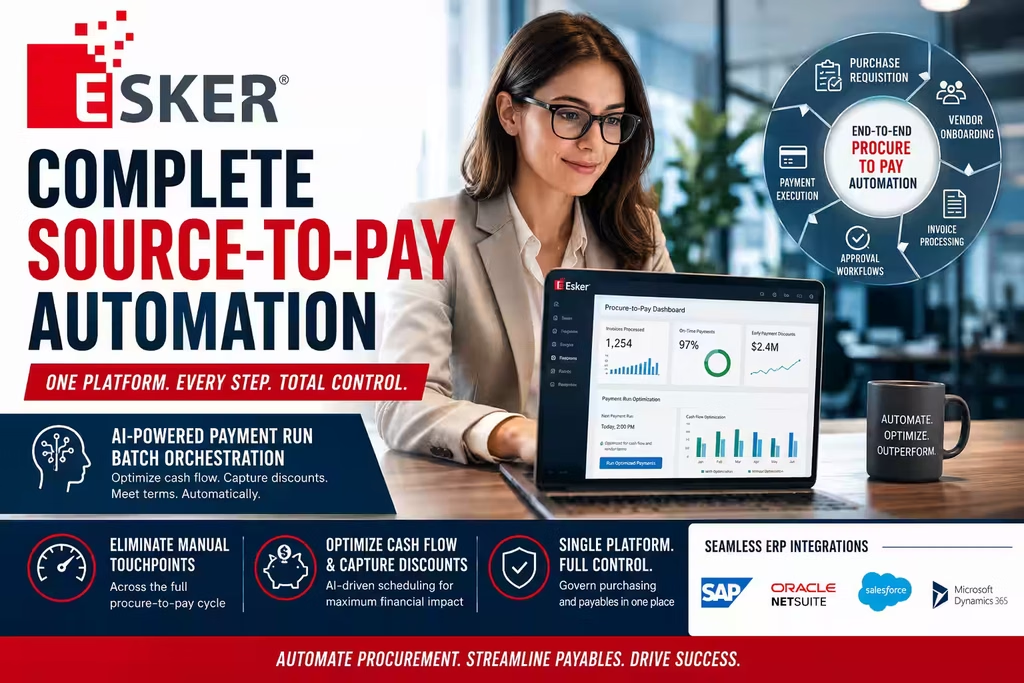
Esker delivers end-to-end procure-to-pay automation — from purchase requisition and vendor onboarding through invoice processing, approval, and payment execution. For organizations that want to eliminate manual touchpoints across the full procurement-to-payment cycle rather than automating AP in isolation, Esker provides the most complete automation coverage.
Key differentiator: Esker’s AI handles payment run batch orchestration — grouping and sequencing outgoing payments to optimize cash flow, capture early payment discounts, and meet vendor payment terms — without manual payment scheduling.
Choose Esker if: Your finance transformation goal is full procure-to-pay automation rather than AP-only automation, and you want a single platform governing both purchasing and payables workflows.
ERP integrations: SAP, NetSuite, Salesforce, Microsoft Dynamics. See Esker’s integration page for technical configuration details.

Pricing: What AI AP Software Actually Costs
Pricing for AI accounts payable platforms is not typically published openly — all seven platforms covered in this guide operate on custom or quote-based pricing models. However, several consistent pricing structures apply across the category:
Common pricing models:
- Per-invoice pricing — A fee charged per invoice processed. Common for mid-market platforms like Rillion and Stampli. Typically ranges from $0.50–$5.00 per invoice depending on volume and features.
- Subscription tiers — Fixed monthly or annual fees based on user count, invoice volume bands, or feature tiers. Tipalti and Esker commonly structure pricing this way.
- Platform fee + transaction fees — A base platform fee covering core AP automation, with variable fees for payment execution, FX transactions, and additional modules. Common for global payment-focused platforms like Tipalti.
- Bolt-on / ERP overlay pricing — Xelix operates as a bolt-on control layer; pricing is typically based on spend volume monitored or transaction count screened rather than invoices processed.
What drives cost variation:
- Invoice volume per month
- Number of entities or subsidiaries
- ERP integration complexity
- Geographic scope (domestic vs. multi-country)
- Payment execution requirements
- Compliance modules (e-invoicing, tax filing)
- Implementation and onboarding services
What to request from vendors:
- Pricing at your current invoice volume and at 2x growth
- Implementation fees (often $5,000–$50,000+ for enterprise platforms)
- Ongoing support and success tier fees
- Pricing for additional modules (e.g., payment execution, compliance)
Request pricing from Tipalti, Stampli, Rillion, Medius, Basware, Xelix, and Esker directly before shortlisting.
ERP Integrations: NetSuite, SAP, Oracle, Sage, and Beyond
Integration quality determines whether AP automation delivers its theoretical value or creates a parallel data management burden.
NetSuite Integration
For NetSuite environments, prioritize platforms with native SuiteApp integrations available in the NetSuite SuiteApp Marketplace. Native SuiteApp integrations write directly to NetSuite records without middleware. Rillion, Stampli, Tipalti, and Medius all offer native NetSuite integrations.
Before deploying any AP platform with NetSuite, confirm:
- Native SuiteApp vs. middleware integration method
- Line-item level mapping (not just header-level data)
- Multi-subsidiary and multi-entity support
- Real-time vs. batch sync (real-time is preferable for payment accuracy)
- Bidirectional vendor master synchronization with duplicate prevention
Sage Intacct, Sage X3, and Sage 50
Sage’s product family spans significantly different technical architectures, and integration depth varies considerably by platform and Sage version:
- Sage Intacct: Rillion, Tipalti, and Stampli all maintain documented Sage Intacct integrations. Sage Intacct’s own AP Automation Agent (part of Sage Copilot) handles native AP automation for teams already committed to the Sage ecosystem.
- Sage X3: Rillion’s Sage X3 integration provides direct invoice capture and approval workflow integration. Confirm GL mapping depth and multi-company support before deployment.
- Sage 50: Integration options are more limited than for Intacct and X3. Rillion supports Sage 50, but confirm current API capability and sync method directly with the vendor before procurement.
SAP, Oracle, and Microsoft Dynamics
Medius, Basware, and Xelix have the strongest documented integrations for SAP and Oracle enterprise environments. Esker is certified for SAP, NetSuite, Salesforce, and Microsoft Dynamics. For D365 environments, Medius and Stampli both offer documented integrations.
General Integration Validation Checklist
Before go-live, confirm all of the following regardless of ERP:
☐ Live sandbox test with real invoice data completed
☐ 3-way PO matching tested against purchase orders already in ERP
☐ GL account suggestion engine validated against existing chart of accounts
☐ Vendor master sync confirmed bidirectional with duplicate prevention active
☐ Audit trail documentation export tested and confirmed audit-ready
☐ SOC 2 Type II certification documentation received from vendor
☐ Payment run batch orchestration tested against existing payment schedules
☐ Exception escalation routing confirmed active and tested with synthetic exceptions

How to Implement an Autonomous Approval Matrix?
An autonomous approval matrix is the configuration framework that determines which invoices approve automatically, which require human review, and which escalate to senior approval — without manual routing decisions by AP staff.
Setting one up correctly is the single highest-leverage configuration decision in any AP automation deployment.
Step 1: Audit Your Current Approval Patterns
Pull 90 days of invoice data and categorize by vendor, dollar amount, cost center, and GL account. Identify which approval paths are genuinely judgment-dependent and which are purely procedural. Procedural approvals — recurring vendor invoices within expected ranges — are automation candidates. Judgment-dependent approvals — new vendors, unusual amounts, policy exceptions — require human retention.
Step 2: Define Dollar-Threshold Tiers
Establish three to four approval tiers based on invoice value. A common structure: auto-approve below $500 for approved recurring vendors; manager approval for $500–$5,000; director approval for $5,000–$25,000; CFO approval above $25,000. Set these thresholds conservatively at deployment — tighten or loosen based on actual exception rates at 60 days.
Step 3: Configure Vendor Trust Tiers
Not all vendors carry equal payment risk. Segment vendors into trust tiers based on relationship length, payment history, and contract status. Tier 1 (established vendors with 12+ months clean payment history) can carry higher auto-approval thresholds. New vendors and one-time suppliers should require additional validation steps regardless of invoice amount.
Step 4: Map GL Account Coding to Auto-Approval Eligibility
Certain GL account categories — utilities, recurring SaaS subscriptions, standard office supplies — have predictable invoice patterns and low fraud risk. These coding categories can carry higher auto-approval thresholds. Capital expenditures, professional services, and non-recurring vendor payments warrant human review regardless of amount.
Step 5: Define Exception Escalation Paths
Configure automatic escalation triggers: invoices held in queue beyond 48 hours route to the approver’s manager; invoices with 3-way matching discrepancies exceeding a defined tolerance route to the AP manager rather than auto-rejecting. Clear escalation paths prevent approval bottlenecks that defeat the purpose of automation.
Step 6: Establish Audit Trail Documentation Requirements
Every automated approval decision must log: the matching result, the approval rule applied, the timestamp, and the approver identity (or “autonomous approval” designation). Configure your platform to capture this data in a format that supports audit trail documentation export — either natively or through ERP multi-field mapping.
Step 7: Run a 30-Day Parallel Review Before Going Fully Autonomous
During the first 30 days post-configuration, run automated approvals alongside manual review. Compare automated decisions against what manual review would have produced. Identify systematic mismatches and adjust threshold rules accordingly. This parallel period is the most valuable configuration investment you can make — it catches policy misalignments before they become real financial exposures.

Can AI AP Software Completely Eliminate Manual Invoice Entry?
No — but it can eliminate manual entry for 70–85% of invoices within 6–12 months of proper deployment. The remaining 15–30% requires human involvement for reasons that are structural, not technological.
Where AI Eliminates Manual Entry
- Recurring vendor invoices: Once a vendor’s invoice pattern is established, AI processes subsequent invoices autonomously with no human touchpoints.
- PO-matched invoices within tolerance: When 3-way PO matching confirms alignment within defined thresholds, the invoice approves and queues for payment without manual review.
- GL account coding: GL account suggestion engines handle coding for established vendor relationships automatically.
- Duplicate screening: Duplicate payment detection runs pre-payment without human initiation.
Where Manual Intervention Remains Appropriate
- First-time vendor invoices: New vendors require validation through vendor master database verification and, where applicable, IRS W-9/W-8 form collection before payment eligibility is established.
- Line-item exceptions above tolerance thresholds: When invoice amounts deviate from PO values beyond defined tolerance, human review is appropriate. The AI flags and escalates; the resolution decision requires human judgment.
- Unvouchered liabilities: Services received but not yet invoiced require human accrual judgment.
- Policy exceptions and credits: Non-standard payment terms, partial credits, and vendor disputes require human judgment regardless of automation capability.
The variance between 70% and 85% touchless processing is almost entirely determined by configuration quality — specifically, how well the approval matrix tiers and vendor trust levels are defined at deployment.

How to Choose the Right AI AP Platform
The right platform depends on five variables. Work through each before shortlisting:
1. Invoice volume and growth trajectory
Platforms like Medius and Basware are designed for high-volume environments. Stampli and Rillion work well at mid-market scale. Your projected 24-month invoice volume matters as much as your current volume.
2. ERP environment
This is the most decisive constraint. For NetSuite, Rillion, Stampli, and Tipalti offer the deepest native integrations. For SAP, Oracle, or D365, Medius, Basware, and Xelix have stronger track records. Confirm integration method — native vs. middleware — before shortlisting.
3. Geographic footprint and compliance complexity
Single-country domestic AP operations have very different requirements than multi-country operations with active e-invoicing mandates. Tipalti and Basware are built for the latter. Most other platforms serve domestic or simpler multi-currency needs.
4. AP-only vs. procure-to-pay
If your goal is to automate invoice processing, most platforms in this guide qualify. If you want to extend automation upstream into purchasing and procurement, Esker is the only platform here that covers the full source-to-pay cycle.
5. Full replacement vs. bolt-on controls
If you’re replacing your current AP process entirely, evaluate Tipalti, Stampli, Rillion, Medius, Basware, or Esker. If your existing ERP handles AP adequately but you’re losing money to duplicate payments and financial leakage, Xelix is the fastest path to recovery without a full platform migration.
If your evaluation also includes employee spend controls, reimbursements, and real-time spend visibility, review our AI expense management software guide as a companion resource.
Final Verdict
There is no single best AI accounts payable platform. But there are clear answers for most use cases.
Tipalti is the strongest option for global and multi-entity AP where FX, 1099 compliance, and international payment execution are core requirements.
Stampli is the best choice when collaborative invoice approvals and audit trail documentation matter as much as automation throughput.
Rillion delivers the most practical AP automation for mid-market finance teams on NetSuite or Sage that want deep ERP integration without rebuilding their entire AP process.
Medius is the right call for high-volume, PO-heavy environments — particularly logistics, retail, and CPG operations — where exception resolution speed and matching throughput are the primary constraints.
Basware is built for enterprise organizations where global e-invoicing compliance is a genuine operational risk, not just a feature on a checklist.
Xelix is the fastest way to recover financial leakage from an existing AP operation without a full platform migration. If duplicate payments and overpayment recovery are your most pressing problems today, Xelix delivers results faster than any full replacement would.
Esker is the right platform when your goal extends beyond AP automation into the full procure-to-pay cycle, and you’re willing to invest in the broader organizational change that requires.
What is consistent across every high-performing AP operation is measurement discipline: cost-per-invoice, touchless processing rate, duplicate detection rate, and days payable outstanding. According to Gartner’s AI agent adoption forecast, 40% of enterprise teams will operate AI agents in core finance functions by 2027. The organizations reaching that threshold in AP automation now are building the process infrastructure — vendor master hygiene, approval matrix configuration, ERP integration depth — that determines whether AI delivers its documented efficiency gains or simply adds another system to manage.
The gap between the 42% average touchless rate and the 73% best-in-class rate is not a technology gap. It’s a process design gap. Fix the design. The headcount math takes care of itself.
Frequently Asked Questions
What is AI accounts payable software and how does it differ from standard AP automation?
AI accounts payable software uses machine learning to autonomously process invoices, execute 3-way PO matching, detect duplicates, and route approvals — improving accuracy over time as the system learns vendor patterns. Standard AP automation applies fixed rules and OCR capture without learning capability. The operational difference: AI-based platforms reach 70–85% touchless processing; rule-based platforms typically plateau at 40–55%.
What is the best AI accounts payable automation software with line-item matching?
For mid-market organizations on NetSuite or Sage, Rillion provides the strongest line-item matching depth with native ERP integration. For enterprise environments with SAP or Oracle, Medius and Basware offer the most mature line-item exception resolution capabilities. Stampli is the strongest option when collaborative invoice review and audit trail documentation are equal priorities alongside matching accuracy.
How do I integrate automated AP software with NetSuite and Sage?
Integration quality depends on whether the platform uses a native ERP integration or middleware. For NetSuite, prioritize platforms with native SuiteApp certifications — Rillion, Stampli, and Tipalti all qualify. For Sage, confirm which Sage product you’re running (Intacct, X3, or Sage 50) before evaluating, as integration depth varies significantly. Validate ERP multi-field mapping at the line-item level, bidirectional vendor master sync, and real-time (not batch) data sync before deployment.
Can AI accounts payable tools completely eliminate manual invoice entry?
No — but AI accounts payable software can eliminate manual entry for 70–85% of invoices within 6–12 months when properly configured. Manual review remains appropriate for first-time vendor invoices, line-item exceptions above tolerance thresholds, unvouchered liabilities, and policy exception cases. The 15–30% requiring human intervention represents judgment-dependent decisions that automation should surface and route efficiently — not attempt to eliminate entirely.
What are the top automated bill pay software options for growing mid-market companies?
For growing mid-market companies, the strongest options are Tipalti (global vendor payments and compliance), Stampli (collaborative AP with strong audit trail documentation), and Rillion (deep NetSuite and Sage integration). Xelix is the best bolt-on addition if duplicate payment detection and financial leakage recovery are immediate priorities without a full platform migration.
How does duplicate payment detection work in AI accounts payable platforms?
Duplicate payment detection screens each invoice against the full historical payment database before disbursement — checking invoice number, vendor ID, payment date, and amount across multiple dimensional variations. AI-based duplicate detection catches near-duplicates where invoice numbers or amounts differ slightly but represent the same underlying liability. Xelix specializes in this function as a standalone AP control layer. According to Xelix’s financial leakage research, enterprises recover 0.1–0.5% of total spend annually through systematic duplicate detection.
What is procure-to-pay automation and how does it differ from AP-only automation?
Procure-to-pay automation covers the full cycle from purchase requisition and vendor onboarding through invoice processing, approval, and payment execution. AP-only automation starts at invoice receipt. The distinction matters because AP automation deployed without upstream procurement workflow integration creates process islands — purchase orders and receiving documentation still require manual steps before AP automation can execute. Esker delivers the most complete procure-to-pay automation platform of the tools covered in this guide.
Methodology and Editorial Standards
This article evaluates AI-powered accounts payable platforms based on the capabilities most relevant to modern finance teams: invoice capture and processing, purchase-order matching, duplicate detection, vendor verification, GL coding, approval automation, payment controls, audit trails, compliance, and ERP connectivity.
Sources and evaluation approach:
- Finance operations benchmarking: APQC and Ardent Partners — used for AP process benchmarking, including cost-per-invoice and touchless processing comparisons
- Platform reviews: Official vendor documentation, product pages, and integration materials from Tipalti, Stampli, Rillion, Medius, Basware, Xelix, and Esker
- AI adoption forecasting: Gartner — AI agent adoption in enterprise finance functions
- Financial leakage data: Xelix — duplicate payment and overpayment leakage estimates
Product capabilities, integrations, pricing, and compliance requirements can change over time. Verify current specifications directly with the relevant vendor before making a purchasing or implementation decision.
Editorial Integrity
Sources & Methodology
Official AP automation product documentation, vendor materials, ERP integration documentation, finance operations benchmarks, and primary sources relevant to AI-powered accounts payable automation
This guide evaluates seven AI accounts payable platforms — Tipalti, Stampli, Rillion, Medius, Basware, Xelix, and Esker — using primary vendor documentation, official product and integration pages, and independent finance operations research. The analysis covers invoice processing, 3-way matching, duplicate-payment detection, autonomous approvals, vendor verification, ERP integration, compliance, and financial controls.
View full sources, methodology, and editorial notes ⌄
Each platform was assessed on what it actually does for a finance team, not on the presence of an “AI” label. We looked at invoice capture, purchase-order matching, duplicate detection, vendor controls, GL coding, approval automation, payment workflows, audit trails, compliance, and ERP connectivity. Preference is given to primary sources — official vendor documentation and integration pages — supported by recognized finance operations benchmarks. Product capabilities, integrations, pricing, benchmarks, and compliance requirements change over time, so verify current details with the relevant vendor before making a purchasing or implementation decision.
- Finance operations benchmarking: APQC — used for accounts-payable process benchmarking, including invoice-processing efficiency and cost comparisons between manual and automated operations.
- AP cost and touchless processing benchmarks: Ardent Partners — referenced for cost-per-invoice figures and touchless processing rates from the AP Metrics That Matter 2025 research.
- AI agent adoption forecasting: Gartner — cited for its forecast on AI agent adoption across core enterprise finance functions through 2027.
- Financial leakage and duplicate-payment data: Xelix — referenced for estimates on duplicate payments, overpayments, and vendor-fraud leakage across enterprise AP functions.
- Global AP and payment automation: Tipalti — reviewed for global accounts-payable workflows, supplier payments, multi-entity operations, cross-border payments, and tax-related workflows.
- Collaborative AP automation: Stampli — reviewed for invoice collaboration, approval workflows, AP communication, and audit-oriented invoice management.
- Mid-market ERP integration: Rillion — reviewed for AP automation and integration depth across NetSuite, Sage, and other supported ERP environments.
- High-volume invoice processing: Medius — reviewed for purchase-order matching, invoice automation, supplier workflows, and high-volume AP environments.
- Enterprise global compliance: Basware — reviewed for enterprise AP automation, global e-invoicing requirements, compliance workflows, supplier invoicing, and ERP connectivity.
- AP control and leakage detection: Xelix — reviewed for duplicate-payment detection, overpayment recovery, vendor statement reconciliation, AP controls, and ERP-connected leakage detection.
- Source-to-pay automation: Esker — reviewed for end-to-end procure-to-pay automation, invoice processing, approval workflows, payment orchestration, and ERP integration.
- ERP integration verification: Official vendor integration documentation was used where available to assess compatibility with ERP environments, including SAP, Oracle, NetSuite, Microsoft Dynamics, Sage, and other supported systems.
- AI AP capability assessment: Platforms were evaluated on practical automation capabilities rather than marketing claims — including autonomous matching, exception handling, approval routing, duplicate detection, GL coding, vendor controls, and auditability.
Our Editorial Standards
Tech Capital Hub applies Google’s E-E-A-T principles to our AI accounts payable software research, comparisons, and buying guides. We prioritize official vendor documentation, ERP integration materials, technical documentation, independent research, industry benchmarks, and workflow-specific evidence over generic software claims, unsupported accuracy percentages, or promotional ROI promises.
View how our editorial standards apply to this article ⌄
Built Around Real-World Accounts Payable Workflows
This guide evaluates AI AP software from the perspective of actual finance operations: invoice capture, purchase-order matching, three-way matching, approval routing, exception handling, vendor onboarding, duplicate-payment detection, GL coding, tax-document collection, payment processing, and audit preparation. We focus on where automation can remove repetitive work while recognizing the situations that still require human review and financial controls.
Evaluating AI Beyond Basic Invoice OCR
Our analysis distinguishes genuine AI-driven AP automation from basic OCR and rule-based invoice capture. We examine capabilities such as intelligent invoice matching, approval decisioning, duplicate detection, vendor master controls, GL account suggestions, exception resolution, workflow orchestration, and ERP synchronization. We also consider implementation factors such as approval thresholds, vendor trust levels, historical data quality, and the level of human oversight required.
Primary Vendor Documentation and Independent AP Research
Product capabilities and integration claims are evaluated against primary sources wherever available, including official documentation from vendors such as Tipalti, Stampli, Rillion, Medius, Basware, Xelix, and Esker. We also reference established AP research and industry benchmarks, including Ardent Partners and other relevant sources, when discussing invoice-processing costs, touchless processing, automation maturity, and financial leakage. Vendor marketing claims are treated as claims rather than independent proof of performance.
Transparent Comparisons, Practical Tradeoffs, and Buyer-Safe Guidance
We do not assume that one AP platform is best for every organization. Recommendations are matched to factors such as company size, invoice volume, ERP environment, global payment requirements, compliance complexity, PO usage, approval workflows, and the need for bolt-on controls versus full source-to-pay automation. Published benchmarks and vendor-reported performance figures should be validated against your own invoice population, workflows, ERP configuration, and implementation requirements before making a purchasing decision.
About the Author
Marcus Delray
Fintech Analyst | AI Accounts Payable, AP Automation, Finance Software & Accounting Technology
Marcus Delray writes about AI-powered accounts payable software, finance automation, and accounting technology for businesses evaluating ways to reduce manual invoice processing, strengthen financial controls, and modernize procure-to-pay operations. His coverage focuses on what matters beyond the marketing claims: invoice capture, three-way matching, approval workflows, duplicate detection, exception handling, ERP integration, payment controls, implementation complexity, and the level of human oversight required.
View full author bio, credentials, and links ⌄
Marcus Delray is a fintech analyst and founder of Tech Capital Hub, where he covers AI accounts payable software, AP automation, finance platforms, accounting technology, and the systems changing how businesses manage invoice-to-pay operations. His work examines AP technology from an operational perspective — looking at how software captures invoices, extracts financial data, matches invoices against purchase orders and receipts, routes approvals, identifies exceptions, detects duplicate payments, and connects accounting data with ERP and financial systems.
In accounts payable software research, Marcus focuses on the capabilities that can materially affect finance-team productivity and control. This includes intelligent invoice processing, purchase-order and non-PO invoice workflows, three-way matching, automated approval routing, vendor management, duplicate detection, GL coding, payment workflows, exception queues, audit trails, and ERP integrations.
He also evaluates where AI adds meaningful value compared with conventional OCR, rules-based automation, and basic invoice capture. The goal is to distinguish software that simply digitizes invoices from platforms capable of supporting broader AP workflows and reducing the amount of repetitive work handled manually by accounting teams.
Rather than relying solely on vendor marketing, his analysis uses official product documentation, technical materials, integration references, industry research, benchmark data, and other source material to explain product capabilities, limitations, implementation considerations, and the tradeoffs buyers should evaluate before selecting an AP automation platform.
- Analyzes AI-powered accounts payable platforms across invoice capture, matching, approvals, exceptions, payments, and financial controls
- Explains the practical differences between OCR, intelligent document processing, AI invoice automation, and broader AP workflow automation
- Evaluates AP software based on automation depth, three-way matching, duplicate detection, ERP integration, approval workflows, and exception handling
- Examines implementation considerations including invoice volume, PO versus non-PO workflows, ERP compatibility, approval structures, and human review requirements
- Grounds software analysis in official vendor documentation, technical references, industry research, benchmarks, and workflow-specific evidence
Enjoying our content?
Click below to add us as a preferred source. Google will prioritize our latest articles in your Top Stories, AI Mode, and AI Overviews.
Preferred Source on Google
One thought on “AI Accounts Payable Software: Scale to $10M+ Without Hiring AP Clerks”