AI and Blockchain in Finance: How They Work Together

Fintech Analyst · Founder of Tech Capital Hub
Marcus has spent more than a decade researching blockchain, digital assets, and financial technology. In this guide, he explains how AI and blockchain work together in finance, where the convergence is already live, where it is still emerging, and what risks, governance, and compliance issues matter most.
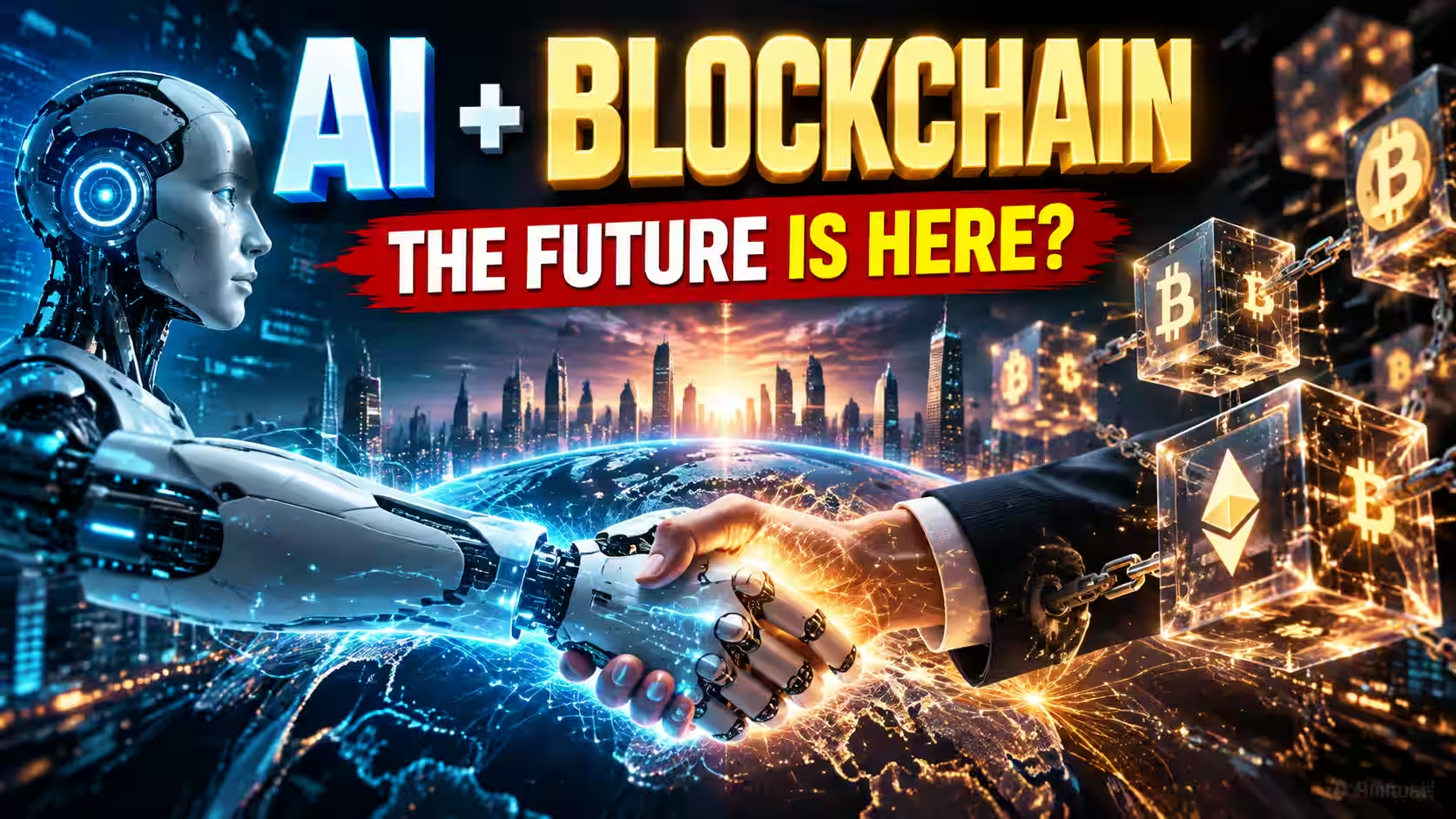
AI and blockchain technology work together in finance by splitting one job into two parts. AI reads data and decides what should happen. Blockchain records that decision and executes it through smart contracts that anyone can audit. One layer supplies judgment. The other supplies proof.
This pairing already runs real systems. It powers automated DeFi strategies, scans smart contracts for bugs, traces stolen funds across wallets, and supports tokenized Treasury funds. It also creates new risks, from deepfake fraud to AI agents acting with too much freedom.
This guide covers:
- The three-layer model behind the convergence
- One transaction, followed from start to finish
- What is live now, what is emerging, and what remains a risk
- The governance and compliance rules that apply
- A checklist for evaluating any AI-powered protocol
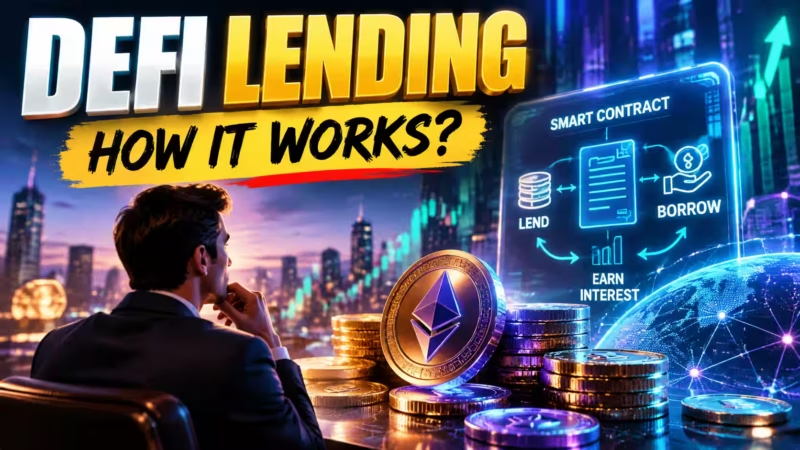
If decentralized finance is new to you, start with our beginner’s guide to decentralized finance (DeFi). Then come back here for the AI layer.
Key Takeaways
- Think in three layers: data in, decisions in the middle, settlement at the end. AI owns decisions. Blockchain owns settlement.
- The strongest use cases are defensive. Fraud detection, contract auditing, and risk scoring have more proven value than AI trading bots.
- Tokenization is the bridge to traditional finance. Tokenized Treasury and money market funds already hold institutional capital.
- The biggest threat is human, not technical. Many of the largest recent crypto losses came from compromised access and social engineering, not broken code.
- AI does not make blockchain trustless. Models can be wrong, biased, or manipulated, so human oversight still matters.
- Existing rules apply. U.S. regulators judge the activity, not the technology behind it.
- Treat market forecasts as directional. Headline projections vary widely by methodology.
Table of Contents

What Does “AI and Blockchain in Finance” Mean?
AI and blockchain in finance means combining two technologies that solve different problems. Blockchain answers one question: Can we trust this record? AI answers another: What should happen next?
Most explanations blur the two into one buzzword. They work better as separate layers, and each one fixes a weakness in the other.
Layer 1: Data
Every financial decision starts with inputs. On-chain data includes wallet activity, liquidity pool balances, and transaction history. Off-chain data includes market prices, credit signals, and identity checks.
Blockchain adds a major advantage here. Public ledgers create a permanent, shared record. Anyone can analyze the same data, which gives AI models a consistent source to learn from.
Layer 2: Decisions
This is AI’s job. Models spot patterns, score risk, and choose actions. A model might decide that a loan is close to liquidation, that a wallet looks linked to a known hack, or that a portfolio has drifted from its target.
Humans cannot watch thousands of variables around the clock. Machines can, and they never wait for a meeting.
Layer 3: Settlement
Blockchain executes the outcome. Smart contracts are programs that run automatically when set conditions are met. They move funds, update balances, and log every step.
No clearinghouse holds the trade for days. No clerk needs to approve it. Strangers can transact without trusting each other because the code enforces the terms.
The core idea: AI without blockchain produces decisions you must take on faith. Blockchain without AI produces rigid rules that cannot adapt. Together, they deliver adaptive decisions with a verifiable trail.

Why Blockchain Alone Fell Short
The original pitch was bold. Remove the middleman. Let math do what banks do. Give ordinary people the same tools as institutions.
It was a good idea with real problems in execution.
Human Coordination Became the Bottleneck
Decentralized systems still depended on people. Decisions moved at the speed of forum threads and Discord debates. Participation stayed low.
DAOs, or decentralized autonomous organizations, promised to democratize governance. Large token holders had time to read proposals and vote. Everyone else had jobs and families. Power concentrated anyway, just under a new label.
Fraud Shifted From Code to People
Chainalysis reported that more than $2.17 billion was stolen from crypto services in the first half of 2025. That figure already exceeded the total for all of 2024. The Bybit breach alone accounted for roughly $1.5 billion, and it stemmed from compromised infrastructure rather than broken cryptography.
Security teams call this the “all-green” problem. The attacker does not crack your password. They manipulate you with a cloned voice, a deepfake video call, or a fake support agent. Every system check passes. The transfer looks legitimate. The money disappears.
A stronger password cannot fix that. This is the gap AI stepped into.
Following One Transaction Through the Stack
Here is how the three layers interact in a single DeFi lending scenario.
- A borrower deposits collateral. Maria locks $10,000 in ETH into a lending protocol and borrows $6,000 in stablecoins. The smart contract records her position on-chain.
- AI monitors the position. A risk model tracks ETH’s price, volatility, and liquidity across exchanges. It also watches for oracle manipulation, an attack in which bad actors distort the price feed a protocol relies on.
- The model flags danger. ETH drops 12% in an hour. The model calculates that Maria’s position will hit the liquidation threshold within minutes if the slide continues.
- An automated response fires. Depending on the setup, an AI-driven tool alerts Maria, adds collateral from a linked vault, or partially repays the loan.
- Blockchain settles and records. The smart contract executes the action. The transaction, timestamp, and outcome sit on-chain for anyone to verify.
What this shows: AI handled speed and judgment. Blockchain handled execution and proof. Neither could do the full job alone.

Where AI and Blockchain Deliver Value Today
The hype centers on futuristic AI agents. The proven value sits in more practical places.
Smart Contract Security
Code bugs have drained billions from DeFi protocols. Machine learning tools now scan contracts for known vulnerability patterns before launch. They flag reentrancy risks, access-control flaws, and logic errors faster than manual review alone.
Our breakdown of Why One Smart Contract Audit Is No Longer Enough covers the technology in depth. To vet a protocol yourself, use our guide on how to audit a smart contract without being a developer.
Fraud Detection and Anti-Money Laundering
Stolen funds rarely sit still. Attackers split them across hundreds of wallets, swap them across chains, and route them through mixers. Rule-based systems struggle to follow that trail.
Graph-based AI maps relationships between wallets instead of checking each one in isolation. It spots laundering patterns, such as peel chains and circular flows, that simple rules miss. Learn how graph neural networks detect money laundering.
Portfolio Management
AI models track correlations, volatility, and on-chain flows to rebalance holdings automatically. They enforce risk limits without emotional decisions. They also struggle in sudden shocks that fall outside their training data. Our guide to AI crypto portfolio management explains where these tools help and where they fall short.
Tokenized Real-World Assets
Tokenization turns ownership of traditional assets, such as Treasury bills, fund shares, or gold, into blockchain tokens. Major asset managers have already moved real products on-chain. BlackRock’s BUIDL fund launched on Ethereum in 2024, and Franklin Templeton runs a tokenized government money market fund.
AI adds value on top through pricing, risk monitoring, and compliance screening. Explore the full landscape in our guide to tokenization of real world assets, then see concrete deployments in real world asset tokenization examples.
Corporate Treasury Automation
The same agent-based logic is spreading into corporate finance. Treasury teams now use AI agents that watch bank feeds, categorize transactions, and flag cash risks without waiting for a prompt. As tokenized cash and stablecoin rails mature, these agents will increasingly operate across both bank and blockchain systems. Our analysis of agentic AI in treasury management shows how this works under real governance controls.
Governance Experiments
Ethereum co-founder Vitalik Buterin has written about the promise and challenges of crypto and AI applications, including AI agents acting as participants in on-chain systems. One extension is AI-assisted voting: you train a personal agent on your values, and it votes on DAO proposals for you. Parts of this stack exist. The full model remains experimental.

Identity and Fraud: Verifying Humans and Machines
Perfect code means nothing if you cannot confirm who, or what, sits on the other side of a transaction. Identity has become the weakest link in digital finance.
Synthetic Identities and Deepfakes
Modern fraudsters build fake people from real parts. They combine a stolen Social Security number, an AI-generated face, and a cloned voice. The result can pass a basic document scan and selfie check.
The damage is real. In 2024, engineering firm Arup confirmed it lost about $25 million after an employee joined a video call with deepfaked executives. FinCEN has since alerted financial institutions to fraud schemes that use deepfake media. Our guide to how banks detect synthetic identity theft covers the warning signs.
Behavioral Biometrics
AI offers a stronger defense than static checks. Behavioral biometrics analyze how you interact with a device, including typing rhythm, swipe pressure, and the brief pause before you approve a large transfer.
The system stops asking, “Is the password right?” It asks, “Does this session behave like the real user?” That catches account takeovers even when credentials are valid. Read more in our explainer on behavioral biometrics in banking fraud prevention.
Identity for AI Agents
AI agents now hold wallets and transact on their own. Builders are developing frameworks that give agents verifiable on-chain identities, defined permissions, and spending limits across networks such as Ethereum, Solana, and the XRP Ledger.
The question has shifted from “Who are you?” to “What are you trying to do, and does it match everything you have done before?” If an agent misbehaves, investigators should be able to trace who deployed it and what it was allowed to do.
Privacy Through Zero-Knowledge Proofs
Identity checks create tension. Regulators want verification. Users want privacy. Zero-knowledge proofs resolve that tension. They let you prove a fact, such as “this user passed KYC,” without revealing the personal data behind it.
That capability is a key reason institutions can consider DeFi without exposing customer records on a public ledger.
The Infrastructure Underneath
AI can only act as fast as the settlement layer allows. Autonomous agents make many small, fast decisions, so they need cheap and reliable settlement.
Ethereum
Ethereum’s official roadmap focuses on capacity, cost, and long-term security.
- Glamsterdam is a planned upgrade built around block-level access lists. Think of a single-lane road opening to four lanes. Transactions that do not conflict can process in parallel.
- Gas limits have climbed steadily, and core developers have discussed targets well beyond 100 million. More capacity per block means lower pressure on fees. Our explainer on crypto gas and transaction fees shows why that matters for users.
- Hegotá, a later upgrade, ties into longer-horizon work such as quantum-resistant cryptography. Settlement layers that may hold trillions must plan a decade or more ahead.
Solana
Solana prioritizes throughput and fast finality. Its developer documentation covers the core architecture.
- Alpenglow is a consensus redesign aimed at faster, more predictable finality.
- Firedancer, an independent validator client built by Jump Crypto, adds client diversity. A bug in one codebase is less likely to halt the network.
- Application Controlled Execution (ACE) is a proposal that would let apps set their own transaction-ordering rules. The goal is to limit MEV (maximal extractable value), the front-running and sandwich attacks that quietly drain ordinary traders.
Why this matters: Faster, more resilient chains make agent-driven finance practical rather than theoretical.
Live Now, Emerging, and Still a Risk
Not everything in this space carries the same certainty. Here is a clear breakdown.
Live Now, Emerging, and Still a Risk
Filter the table by category or keep all three columns visible for side-by-side comparison.
| Live Now | Emerging | Still a Risk |
|---|---|---|
| AI-assisted smart contract audits Machine learning tools already scan contracts for known vulnerability patterns before launch. | AI agents voting in DAO governance AI agents representing user preferences in governance are being explored, but broad use remains limited. | Deepfake-enabled social engineering Attackers use cloned voices and synthetic video to trigger legitimate-looking transfers. |
| Graph-based tracing of stolen crypto Blockchain analytics platforms already use graph-based AI to follow stolen funds across wallets and bridges. | Verifiable identities for AI agents Builders are developing frameworks that give autonomous agents identities and permission scopes. | Synthetic identities passing basic KYC Fraudsters combine stolen personal data with AI-generated media to pass weak onboarding checks. |
| Tokenized Treasury and money market funds Real-world assets like Treasury exposure and fund structures are already operating on-chain. | Parallel execution on Ethereum Planned infrastructure changes aim to process non-conflicting transactions more efficiently. | Oracle manipulation feeding bad data to AI AI models can trigger flawed actions if upstream price feeds or inputs are manipulated. |
| Behavioral biometrics in fraud detection AI already monitors typing rhythm, swipe patterns, and device interaction to catch takeovers. | App-controlled ordering on Solana Execution controls aim to reduce harmful MEV patterns through better sequencing logic. | Over-reliance on unaudited AI models A poorly tested model with execution power can make bad decisions at machine speed. |
| Automated DeFi portfolio rebalancing AI-driven systems actively rebalance crypto and DeFi portfolios using on-chain and market signals. | Quantum-resistant signature schemes Long-horizon infrastructure work is exploring stronger future cryptographic defenses. | Industrialized scam operations Fraud operations now use scripts, workflow specialization, and AI-assisted deception at scale. |
| Zero-knowledge compliance proofs Privacy-preserving proofs are already being used to verify compliance-related facts without exposing raw data. | Agent-to-agent payments at scale Autonomous agents sending value directly is advancing quickly, but it is not yet mainstream. | Attackers using the same AI tools Defenders and attackers increasingly draw from the same AI stack, narrowing the technical gap. |
Apply the same discipline to market numbers. Some analyses estimate that 2024 stablecoin transfer volume rivaled or exceeded major card networks. Adjusted figures that strip out bot activity and exchange shuffling are far lower. Projections for the Web3 market and AI-agent economic activity also vary widely. Read them as directional signals, not guarantees.

What Most Coverage Gets Wrong
The biggest risk in this convergence is not technical. Protocols keep getting stronger. What lags is human understanding, and bad actors exploit that gap aggressively.
Fraud Has Industrialized
The FBI’s Internet Crime Complaint Center reported more than $9.3 billion in cryptocurrency-related losses in its 2024 annual report, with investment fraud leading the categories. The United Nations Office on Drugs and Crime has documented scam compounds that combine human trafficking with AI-assisted deception, often running in round-the-clock shifts.
Many of these schemes start with scripted relationship-building. Our guide on how AI spots romance scammer scripts shows how detection tools fight back.
Four Misconceptions to Drop
- “AI makes DeFi safe.” AI reduces some risks and adds others. A flawed model with execution power can cause damage at machine speed.
- “Blockchain data is always accurate.” Blockchain proves a transaction happened. It does not prove the inputs were true. A manipulated price feed still settles irreversibly.
- “AI agents act alone, so no one is responsible.” Someone deploys every agent. Regulators expect that party to answer for it.
- “Forecasts prove the trend.” Big numbers attract attention. Methodology determines whether they mean anything.
The Same Tools Work for Both Sides
The AI that powers autonomous trading also powers autonomous fraud. Fraudsters use generative models for phishing scripts, fake identities, and voice cloning. Defenders use similar models to catch them. The advantage goes to whoever deploys faster, with better data and tighter controls.
What this means: Continuous behavioral monitoring matters more than any single checkpoint. Security must run through the whole session, not just the login screen.

Governance, Security, and Compliance
Autonomous systems that move money attract regulatory scrutiny, and they should. Strong governance does not slow innovation. It makes innovation durable.
Who Regulates What
U.S. regulators generally apply existing rules to the activity, regardless of the technology behind it.
- The Securities and Exchange Commission (SEC) determines when a token or tokenized product counts as a security and which disclosures apply.
- The Commodity Futures Trading Commission (CFTC) oversees digital-asset derivatives and commodity markets.
- FINRA’s crypto asset guidance covers broker-dealer obligations. FINRA has also stressed that firms must supervise AI tools with the same rigor they apply to human activity.
- FinCEN sets anti-money-laundering expectations for money services businesses that touch digital assets.
- The U.S. Department of the Treasury shapes policy on AI risk in financial services, sanctions, and illicit finance.
- The GENIUS Act, signed in 2025, created a federal framework for payment stablecoins, including reserve and disclosure requirements.
AI Risk Management
The NIST AI Risk Management Framework gives teams a shared structure built on four functions: govern, map, measure, and manage. Financial firms use it to document how models work, where they can fail, and who oversees them.
Six Governance Principles for AI on the Blockchain
- Set hard limits. Cap what any agent can spend, borrow, or move without human approval.
- Keep humans on high-stakes calls. Large transfers, credit decisions, and governance votes need sign-off.
- Log every decision. Record inputs, model versions, thresholds, and outcomes so auditors can reconstruct events.
- Audit twice. Review both the smart contract and the AI model before launch and after every major update.
- Watch for drift. Models degrade as markets change. Monitor performance continuously.
- Plan for failure. Build pause functions and incident response plans before you need them.
How to Evaluate an AI-Powered Protocol
Run through this checklist before you trust any protocol or platform with capital.
- Audit history: Has a reputable firm audited the smart contracts? Are the reports public?
- AI transparency: Does the team explain what the AI does, what data it uses, and what it controls?
- Permission limits: Can the AI move funds on its own? If so, how much?
- Oracle design: Where do price feeds come from? Does the protocol use multiple sources?
- Custody: Who controls the keys? Our comparison of custodial vs. non-custodial wallets explains the trade-offs.
- Incident record: How did the team respond to past exploits or outages?
- Regulatory posture: Does the project address securities, AML, and sanctions obligations?
A protocol that cannot answer these questions clearly deserves extra caution.
What This Means for You
Trust is shifting from institutions to infrastructure. People once trusted a bank for its reputation, its branches, and the FDIC sticker on the door. Now the question is whether you trust a protocol, a smart contract, or an AI agent. Unlike a reputation, those can be verified on-chain, in real time.
For investors: AI already runs inside many DeFi protocols. Find out how each one uses it, check its audit history, and understand who holds your keys. Treat bold projections as context, never as a buy signal.
For finance professionals: Build fluency in on-chain analytics, tokenized assets, and zero-knowledge compliance now. Map your institution’s exposure to deepfake and synthetic-identity attacks. Early skill compounds.
For operators and builders: Design governance in from day one. Use AI-assisted audits, but never skip a human security review. Give agents verifiable identities, narrow permissions, and full decision logs.
Your next step: Pick one protocol you use or plan to use. Run it through the evaluation checklist above this week. The answers will tell you more than any market forecast.
People Also Ask about AI and Blockchain Technology
How do AI and blockchain work together in finance?
AI analyzes data and makes decisions. Blockchain records those decisions and executes them through smart contracts. The result is a financial system that adapts quickly and leaves a verifiable audit trail.
What are real examples of AI and blockchain in finance?
Live examples include AI-assisted smart contract audits, graph-based tracing of stolen crypto, automated DeFi portfolio rebalancing, risk monitoring for lending protocols, and analytics on tokenized Treasury funds.
What is AI in DeFi?
AI in DeFi refers to machine learning used inside decentralized finance protocols. It manages liquidity, rebalances portfolios, audits code, and flags risky positions. Some people call this space DeFAI.
Can AI detect crypto fraud?
Yes. AI analyzes transaction patterns, wallet relationships, and user behavior in real time. It flags suspicious activity, traces laundering paths across many wallets, and catches account takeovers even when credentials are valid.
What are zero-knowledge proofs, and why do they matter in finance?
A zero-knowledge proof lets you prove a fact without revealing the underlying data. A protocol can confirm you passed compliance checks without seeing your personal information. That bridges privacy and regulation.
How does tokenization connect to AI?
Tokenization puts real-world assets such as Treasury bills and fund shares on a blockchain. AI then helps price those assets, monitor risk, screen for compliance, and automate portfolio decisions.
Are AI agents in finance regulated?
Yes, through existing rules. U.S. regulators apply securities, commodities, AML, and broker-dealer rules to the activity an agent performs. The firm that deploys the agent remains responsible for its actions.
Are DAOs working in 2026?
Some are. Better-run DAOs address low participation with AI-assisted voting and prediction markets that filter weak proposals. Many still struggle with concentrated voting power, so results vary widely.
Is AI-powered DeFi safe for everyday investors?
It carries real risk. Smart contracts can fail, AI models can misjudge markets, and scams target retail users heavily. Check audit history, understand custody, and never invest more than you can afford to lose.
Disclaimer
This article is for informational and educational purposes only. It is not financial, legal, or investment advice. Crypto assets and DeFi carry significant risk, including the potential for total loss. Do your own research and consult a licensed financial advisor before making investment decisions.
Cryptocurrency · Editorial Integrity
Sources & Citations
Public documentation, regulatory guidance, and current reporting behind this guide on how AI and blockchain work together in finance — including DeFi, tokenization, fraud detection, smart contracts, identity, and infrastructure.
Every major claim in this guide is grounded in public documentation, official regulatory material, protocol documentation, and current industry reporting. Technical sections draw on Ethereum and Solana documentation, identity and compliance sections reference official public guidance, and market structure examples are framed using named real-world deployments and current reporting. Because blockchain infrastructure, AI capabilities, regulation, and tokenization activity evolve quickly, readers should verify the latest details before acting on any operational, financial, or compliance decision.
View full sources, methodology, and editorial notes
This guide was written using official protocol documentation, public regulatory guidance, cybersecurity and illicit-finance reporting, and current infrastructure materials from leading blockchain ecosystems. Preference is given to primary sources, official developer documentation, regulatory publications, and named institutional or analytics references where they directly support a claim. Some market figures and deployment examples are described in general terms where conditions change quickly. This article is educational information, not financial, legal, or investment advice.
- How smart contracts work on Ethereum: Ethereum.org — Smart Contracts — cited as an official explainer on how programmable on-chain execution works and why smart contracts matter to AI-plus-blockchain systems.
- Ethereum roadmap and scaling direction: Ethereum.org — Roadmap — cited for network evolution, capacity improvements, and the broader infrastructure context relevant to agent-driven or automated finance.
- Zero-knowledge proofs and privacy-preserving verification: Ethereum.org — Zero-Knowledge Proofs — cited to support the explanation of privacy-preserving compliance and verification in blockchain-based financial systems.
- Solana technical infrastructure: Solana Documentation — cited for the infrastructure discussion around throughput, finality, and application-layer execution design.
- AI risk governance framework: NIST — AI Risk Management Framework — cited for the governance model used to explain how financial teams should assess and supervise AI systems.
- Illicit finance and blockchain investigations: Chainalysis — cited as a named blockchain analytics source supporting the discussion of tracing stolen funds, fraud patterns, and crypto-related enforcement context.
- Anti-money-laundering and deepfake-related financial crime alerts: FinCEN — cited for U.S. AML expectations and public warnings relevant to synthetic identity, suspicious activity, and emerging fraud techniques.
- U.S. securities regulation context: U.S. Securities and Exchange Commission — cited for the regulatory discussion around digital assets, tokenized products, and disclosure or securities considerations.
- U.S. commodities and derivatives oversight: U.S. Commodity Futures Trading Commission — cited for regulatory context related to crypto markets, commodity treatment, and derivatives oversight.
- Broker-dealer and crypto asset compliance guidance: FINRA — Crypto Assets — cited for broker-dealer supervision and compliance obligations relevant to AI-assisted or blockchain-linked financial activity.
- U.S. Treasury policy and illicit-finance context: U.S. Department of the Treasury — cited for sanctions, illicit-finance policy, and broader public policy context affecting digital asset markets.
- Market structure and fraud loss reporting: FBI Internet Crime Complaint Center (IC3) — cited as a public reporting source for crypto-related fraud and cybercrime loss trends discussed in the article.
AI and Blockchain in Finance · Editorial Standards
Our Editorial Standards
Tech Capital Hub applies Google’s E-E-A-T framework to every fintech and crypto guide by favoring clear explanations, public documentation, official source material, and named examples over hype or unsupported claims. This article explains how AI and blockchain work together in finance using plain language first, then anchors specific points to official protocol documentation, public regulatory context, cybersecurity guidance, and real-world infrastructure examples. Where technology, compliance, or tokenization trends are still evolving, we describe the landscape carefully rather than overstate certainty.
View how our editorial standards apply to this article
Complex Infrastructure Explained in Plain English
This guide is structured for readers who understand finance at a high level but may be newer to blockchain infrastructure, tokenization, or AI operations. It starts with the practical split between what AI does and what blockchain does, then shows where those systems intersect in fraud detection, smart contracts, identity, trading, and compliance. The goal is not to impress with jargon. It is to help readers understand how the stack actually works.
Focused on Real Financial Use Cases, Not Buzzwords
Coverage centers on applied use cases rather than abstract claims. The article explains how AI supports detection, decisioning, and automation, while blockchain handles execution, settlement, auditability, and programmable rules. It also distinguishes between what is already live, what is still emerging, and what remains risky. That framing helps readers separate operational reality from speculative marketing language.
Built on Official Docs, Public Guidance, and Named Sources
Specific claims are grounded in official protocol documentation, public regulatory material, and named industry references where they directly support a point. Smart contract and zero-knowledge discussions rely on public blockchain documentation. Governance, compliance, and AI risk sections reflect official frameworks and public agency guidance. Fraud, tracing, and market structure context draw from established public reporting and recognized analytics sources.
Clear About Limits, Risks, and Unresolved Questions
This article does not present AI-plus-blockchain systems as frictionless or risk free. It highlights unresolved issues including oracle risk, synthetic identity fraud, over-reliance on unaudited AI models, regulatory uncertainty, and the fact that attackers use the same AI tools as defenders. Because market conditions, infrastructure, and policy can shift quickly, this guide is educational information only and should not be treated as financial, legal, or investment advice.
AI and Blockchain in Finance · About the Author
Marcus Delray
Fintech Analyst · Founder of Tech Capital Hub
Marcus Delray is a fintech analyst and the founder of Tech Capital Hub. In this guide, he explains how AI and blockchain work together in finance in practical terms — showing where AI handles detection, prediction, and decisioning, where blockchain handles execution and recordkeeping, and where the convergence creates real opportunity as well as real risk.
View full author bio, credentials, and links
Marcus Delray has spent over a decade researching financial technology. He built Tech Capital Hub to make that research useful for everyday readers — from total beginners to professionals trying to understand where digital infrastructure is heading. He covers blockchain, DeFi, AI in finance, fintech platforms, and business software, with a focus on turning fast-moving technical subjects into clear, decision-useful explanations.
For this guide, Marcus explains the practical split between what AI does well and what blockchain does well. He shows how AI reads data, detects anomalies, scores risk, and supports automation, while blockchain provides execution rails, auditability, tamper-resistant records, and programmable settlement. He also distinguishes between what is already live in finance, what is still emerging, and what remains unresolved — including fraud, synthetic identity, oracle risk, model governance, and the reality that attackers use the same AI tools as defenders. Where legal, technical, or market conditions are still evolving, he describes the landscape carefully rather than overstate certainty. All articles are educational information, not financial, legal, or investment advice.
- Explains how AI and blockchain complement each other in finance, from fraud detection and smart contracts to tokenization and settlement
- Breaks down what is already live, what is emerging, and what remains risky across DeFi, digital identity, compliance, and market infrastructure
- Translates technical subjects like smart contracts, zero-knowledge proofs, agent-based automation, and blockchain auditability into plain language
- Highlights real trade-offs involving security, governance, model risk, synthetic identity fraud, and regulatory uncertainty
- Grounds coverage in public documentation, official guidance, and named industry references with clear educational framing and no financial advice
Enjoying our content?
Click below to add us as a preferred source. Google will prioritize our latest articles in your Top Stories, AI Mode, and AI Overviews.
Preferred Source on Google