AI Crypto Portfolio Management: A Practical Guide for 2026


Fintech Analyst · Founder of Tech Capital Hub
Marcus has spent more than a decade researching financial technology, digital assets, and AI-driven investing. In this guide, he explains how AI crypto portfolio management can help investors automate rebalancing, improve diversification, reduce emotional decision-making, and manage digital assets with a more systematic risk framework.
AI crypto portfolio management uses machine learning and automation to build, monitor, and rebalance a cryptocurrency portfolio. It bases those decisions on market data and on rules you set, such as your target mix and risk tolerance.
In practice, these tools handle the work most investors struggle to do consistently. They track allocation drift, rebalance on schedule, flag risk, and stop emotion from steering trades. They do not predict prices, and they do not remove market risk.
This guide explains how AI manages a crypto portfolio, which tool categories matter, what can go wrong, and how to start safely. It is written for beginners and intermediate investors who want clear, practical answers. For wider context on how these technologies fit together, start with our guide to AI and blockchain in finance: how they work together.
Key Takeaways
- AI crypto portfolio management automates allocation, rebalancing, and risk monitoring based on your rules.
- Automated crypto rebalancing is the most useful feature for most investors. It keeps your portfolio aligned with your plan.
- AI improves discipline and speed, not prediction. No tool can reliably forecast crypto prices.
- Real diversification now goes beyond altcoins. Tokenized treasury funds and tokenized gold add different risk profiles.
- Security basics still matter most. Use trade-only API keys, enable multi-factor authentication, and keep long-term holdings in self-custody.
- Rebalancing can trigger taxes in the US. Plan for it before you automate.
Table of Contents

What Is AI Crypto Portfolio Management?
AI crypto portfolio management is the use of algorithms to decide how much of each crypto asset you hold. It also covers when to adjust those holdings. The system follows your goals, not its own.
A useful way to think about it: you set the strategy, and the software enforces it.
What AI crypto portfolio management does
- Collects data. It pulls prices, volume, volatility, and sometimes on-chain activity.
- Measures your portfolio. It compares your current mix to your target mix.
- Applies rules or models. It decides whether to rebalance, reduce risk, or hold.
- Executes trades. It places orders through exchange connections you approve.
- Reports results. It shows performance, drift, and fees.
What it does not do
- It does not predict the future with certainty.
- It does not fix a poor strategy. It only executes it faster.
- It does not replace security, tax planning, or judgment.
Why this matters: Most portfolio damage comes from inconsistency, not a lack of information. Automation solves the consistency problem.
How Does AI Manage a Crypto Portfolio?
AI manages a crypto portfolio by running a continuous loop: measure, compare, decide, act. Each step uses data and rules. The level of “intelligence” varies widely between tools.
Rule-based automation vs. machine learning
Not every “AI” tool uses machine learning. Many popular platforms use rule-based logic. That is not a flaw. Simple rules are easy to understand and test.
- Rule-based systems follow fixed instructions. Example: “Rebalance when any asset drifts 5% from target.”
- Machine learning systems learn patterns from historical data. They may adjust weights based on volatility or correlation shifts.
- Hybrid systems combine both. Rules set the guardrails. Models adjust within them.
The research behind portfolio optimization
Modern allocation methods build on Harry Markowitz’s 1952 paper on portfolio selection. His core idea still holds: combine assets to balance expected return against risk.
Newer research applies machine learning to the same problem. One widely cited study, A Deep Reinforcement Learning Framework for the Financial Portfolio Management Problem, tested reinforcement learning on cryptocurrency portfolios. Results like these are promising. However, backtests often perform better than live trading, so treat them as evidence of potential, not proof of future returns.
Why this matters: Knowing which type of system you use helps you judge its claims. Ask every platform a simple question: “Is this rules, models, or both?”
What Is Automated Crypto Rebalancing?
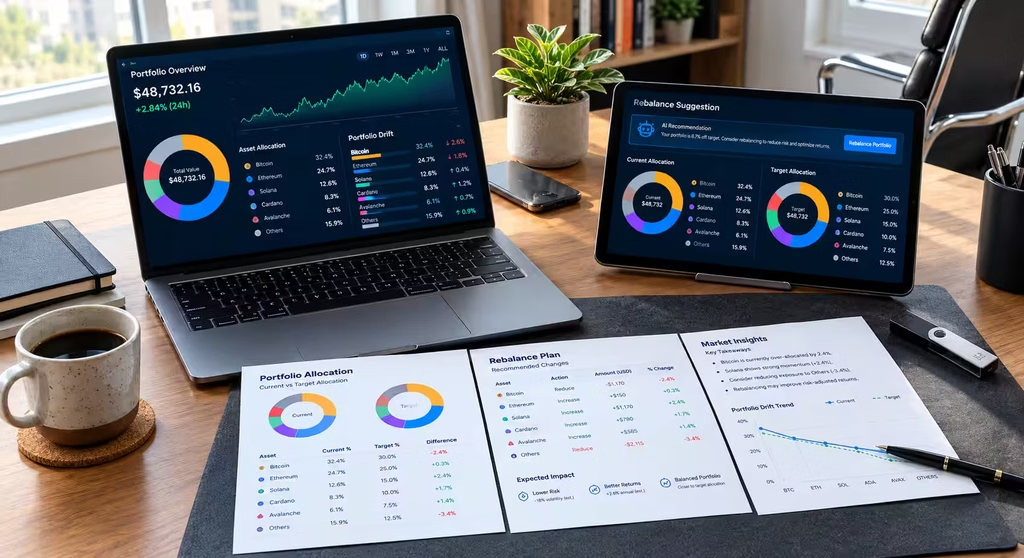
Automated crypto rebalancing is the process of selling assets that have grown too large and buying assets that have shrunk. It returns your portfolio to its target mix. Software handles it on a schedule or when drift crosses a threshold.
A simple rebalancing example
Say you start with this target:
- 50% Bitcoin
- 30% Ethereum
- 20% other assets
Bitcoin then rallies hard. It grows to 65% of your portfolio. You made no decision, but your risk changed. A sharp Bitcoin drop would now hurt far more than you planned.
A crypto portfolio rebalancing bot detects this drift. It sells some Bitcoin and buys the underweight assets. Your portfolio returns to 50/30/20.
Threshold vs. calendar rebalancing
| Method | How it works | Best for |
|---|---|---|
|
Threshold Reactive | Rebalances when an asset drifts past a set percentage | Volatile markets and active monitoring |
|
Calendar Simple | Rebalances on a fixed schedule, such as monthly | Simplicity and lower trading frequency |
|
Hybrid Balanced | Checks on a schedule but only trades if drift is large | Balancing cost control and discipline |
A 5% drift threshold is a common starting point. Tighter thresholds trade more often. That raises fees and possible tax events. Learn how trading and network costs add up in our guide to crypto trading, gas, and withdrawal fees.
Why this matters: Rebalancing enforces “sell high, buy low” without relying on willpower.
Scenario: When a rebalancing bot did its job while the investor panicked
This is a situation that comes up often in crypto investor communities. A retail investor — let’s call him David — had set up a rebalancing bot with a 60/30/10 target split across Bitcoin, Ethereum, and a small-cap altcoin basket. In early 2024, Bitcoin surged and quickly became 78% of his portfolio.
His first instinct was to turn off the bot and let Bitcoin ride. He had seen this pattern before and wanted to hold. The bot, however, had already triggered a rebalance. It trimmed the Bitcoin position and bought back into Ethereum and the altcoin basket, returning to the target split.
David was frustrated at first. Then Bitcoin pulled back sharply a few weeks later. Because the bot had reduced his Bitcoin concentration at the peak, his total drawdown was meaningfully smaller than his friends who had held without a system.
The lesson he shared in a Reddit thread: “The bot did what I planned to do in January. My emotions tried to override that in March. The bot won, and I’m glad it did.”
This is not a guarantee of how rebalancing performs. But it illustrates the core value: the system enforces a plan even when the investor does not want to.
How Does AI Crypto Allocation Work?
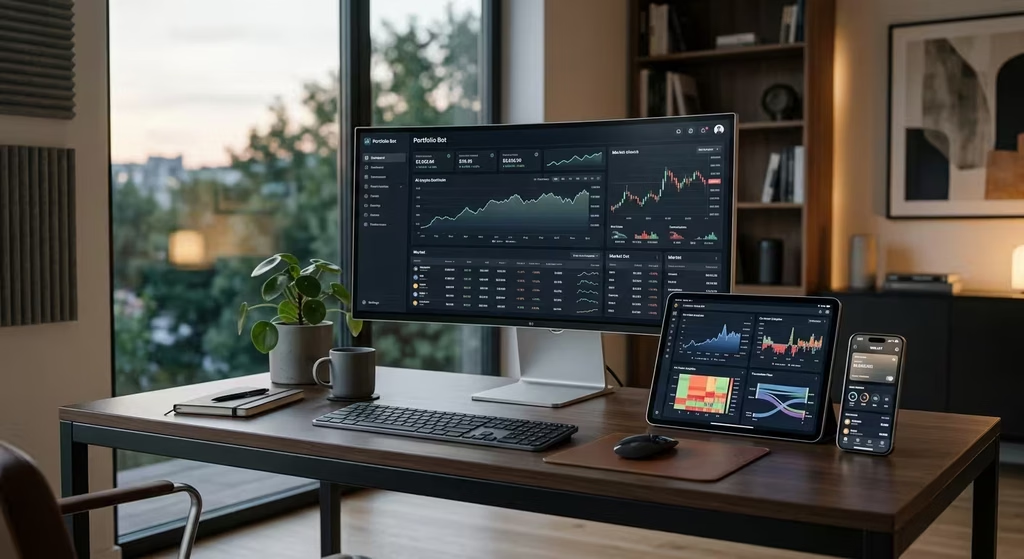
AI crypto allocation decides the ideal percentage for each asset in your portfolio. It weighs expected return, volatility, and how assets move together. The goal is a mix that fits your risk tolerance.
The main inputs
- Volatility: How much an asset’s price swings.
- Correlation: How closely assets move together.
- Liquidity: How easily you can trade without moving the price.
- Your constraints: Time horizon, risk limits, and assets you exclude.
Why correlation matters in crypto
Crypto assets often move together, especially during sell-offs. When fear spikes, correlations tend to rise. Diversification that looked solid in a calm market can weaken fast.
Good allocation systems track correlation over time. They can reduce exposure to assets that are moving in lockstep. This is a core part of crypto portfolio risk management.
Stress testing and simulations
Many allocation tools test portfolios against historical scenarios, such as past crashes and long bear markets. This shows how a mix might have behaved under pressure. It cannot show how it will behave in a crisis that has never happened.
Why this matters: Allocation sets your risk. Rebalancing only maintains it. Get allocation right first.

Why Does Crypto Portfolio Diversification Need More Than Altcoins?
Holding several cryptocurrencies is not full diversification. Most coins share the same market drivers. True crypto portfolio diversification adds assets with different risk sources.
Tokenized treasury funds
Tokenized treasury funds hold short-term US government debt and represent shares as blockchain tokens. They aim to deliver yield with lower volatility than crypto assets.
One well-known example is BlackRock’s BUIDL fund, issued through Securitize. Access is often limited to qualified or institutional investors, so check eligibility first.
Tokenized gold
Tokenized gold links each token to physical gold held in custody. Two major examples are Paxos Gold (PAXG) and Tether Gold (XAUT). Always read the issuer’s redemption terms and audit or attestation reports.
Where these assets fit
A diversified, AI-managed portfolio might combine:
- Core crypto: Bitcoin and Ethereum
- Yield and stability: Tokenized treasury funds
- Inflation hedge: Tokenized gold
- Growth exposure: A smaller slice of DeFi tokens or altcoins
This is an illustration, not a recommendation. To see which tokenized products already exist, read our roundup of real world asset tokenization examples. For the risks and regulations behind them, see our full explainer on tokenization of real world assets.
Why this matters: Diversification only works when assets respond differently to the same event.
Scenario: A beginner learns the hard way what diversification actually means
A newer investor — call her Maya — shared her experience in a popular crypto forum after a broad market correction in late 2023. She had spread her portfolio across ten different tokens: Bitcoin, Ethereum, and eight altcoins she had researched carefully. She felt diversified.
When the market dropped, all ten assets fell together. Some fell harder than Bitcoin. Her portfolio was down more than 50% at the bottom. She had exposure to ten different names but only one type of risk: crypto market sentiment.
After that experience, Maya rebuilt her portfolio using a crypto robo-advisor. She added a 15% allocation to a tokenized treasury product for yield and stability. During the next correction, her overall drawdown was smaller, and the treasury position gave her something to hold that had not lost value. It also gave her capital to redeploy when she wanted to buy into crypto at lower prices.
Her comment in the forum: “I thought ten coins was diversification. It wasn’t. It was just ten bets on the same mood.”
This distinction — between spreading across names and spreading across risk types — is one of the most common gaps between what investors think they are doing and what they are actually doing.
Which AI Crypto Portfolio Tools Matter Most?
Four tool categories cover most needs: rebalancing bots, on-chain analytics, crypto robo-advisors, and DeFi yield optimizers. Each solves a different problem. Most investors need only one or two.
Which AI Crypto Portfolio Tools Matter Most?
Compare the main tool categories used in AI crypto portfolio management. Use the search and filter controls to find the right fit by need, risk, and experience level.
| Tool category ↕ | Best for ↕ | Core function ↕ | Key risk ↕ | Ideal user ↕ |
|---|---|---|---|---|
Portfolio rebalancing bots Useful for maintaining a target allocation automatically. | Keeping a target mix | Automated buy and sell orders via exchange API | API key misuse or exchange failure | Investors with a plan |
On-chain analytics Helps investors read wallet flows and network behavior. | Market context | Tracking wallet flows and network activity | Misreading data as a price signal | Intermediate & advanced |
Crypto robo-advisors Good for hands-off portfolio building and management. | Hands-off management | Builds and manages a portfolio from a questionnaire | Limited control and platform risk | Beginners |
DeFi yield optimizers Aims to move funds between protocols for better yield. | Earning yield | Moves funds between protocols for better returns | Smart contract exploits | Experienced DeFi users |
Portfolio rebalancing bots
- 3Commas is a crypto trading automation platform. It offers bots and portfolio tools that connect to exchanges through API keys.
- Shrimpy is a portfolio management platform focused on automated rebalancing across connected exchanges.
- Coinrule is a rule-based automation tool. Users build “if this, then that” trading rules without coding.
On-chain analytics
- Nansen is an on-chain analytics platform. It labels wallets and tracks fund flows across blockchains.
- Glassnode provides on-chain metrics for Bitcoin, Ethereum, and other networks. Analysts use it to study supply, holder behavior, and exchange flows.
Crypto robo-advisors
Robo-advisors ask about your goals, time horizon, and risk tolerance. They then build and manage a portfolio for you. Crypto-specific options are still developing. To compare how traditional platforms handle fees and automation, see our review of the best robo-advisors in 2026. If you are unsure whether software or a person suits you, read AI financial advisor vs. human advisor.
DeFi yield optimizers
Yearn Finance runs automated vaults. They deploy deposits into lending and liquidity strategies to seek yield. Yield optimizers add smart contract risk on top of market risk. Learn the basics in our beginner’s guide to decentralized finance, then see how AI is making DeFi smarter and safer.
Why this matters: Choose tools by the problem you need to solve, not by popularity.
Is AI Crypto Portfolio Management Safe?
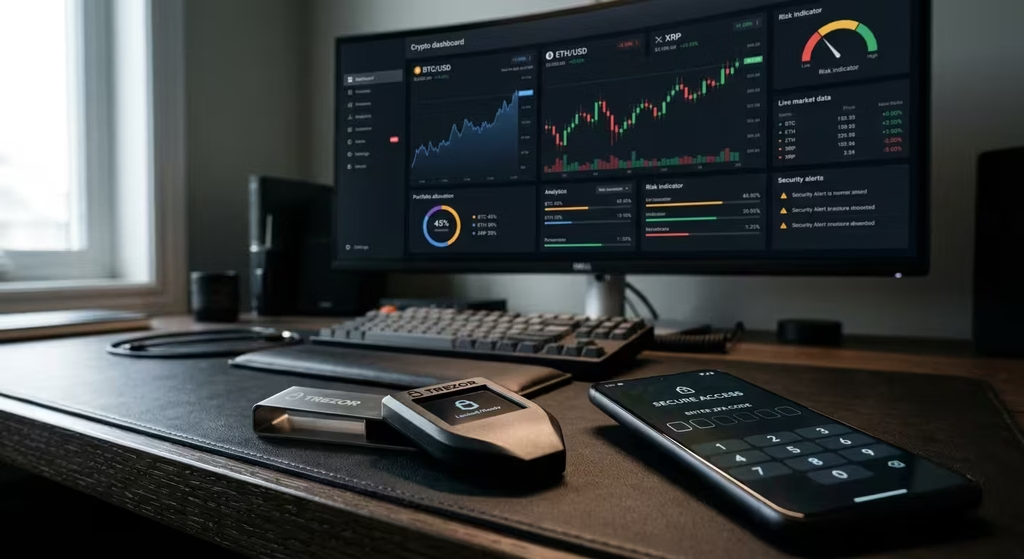
AI crypto portfolio management is as safe as the platform, the setup, and your security habits. Automation reduces emotional errors. It also adds new risks, such as API exposure and model failure.
The US Commodity Futures Trading Commission warns that AI trading bots will not turn into money machines. Scammers often use AI claims to promise unrealistic returns. Treat guaranteed profits as a red flag.
The main risks to manage
- Model risk: Models trained on past data can fail in new conditions.
- Platform risk: Exchanges and tools can be hacked, fail, or shut down.
- API risk: A leaked key can let someone trade your account.
- Smart contract risk: DeFi protocols can contain exploitable bugs. Our guide on how to audit a smart contract without being a developer shows what to check.
- Fee drag: Frequent rebalancing adds trading costs.
- Tax risk: In the US, selling crypto can trigger capital gains. Review the IRS guidance on digital asset taxation.
Essential security practices
- Use trade-only API keys. Never enable withdrawal permissions for a bot.
- Turn on multi-factor authentication. CISA explains why multi-factor authentication matters.
- Keep long-term holdings in self-custody. Learn the difference in custodial vs. non-custodial wallets.
- Protect your recovery details. Understand private keys vs. seed phrases before you store anything.
- Report fraud fast. File complaints with the FBI’s Internet Crime Complaint Center.
Why this matters: One weak password or exposed key can undo years of good portfolio decisions.
How Is AI Crypto Investing Regulated?
Crypto regulation is becoming clearer in both the US and Europe. Clearer rules can improve accountability. They do not remove investment risk.
United States
- The SEC oversees securities markets. In January 2025, it issued Staff Accounting Bulletin 122, which removed a barrier to banks holding crypto for clients.
- The GENIUS Act created a federal framework for payment stablecoins.
- The CLARITY Act addresses crypto market structure. Check Congress.gov for its current status.
- Investor.gov offers plain-English guidance on crypto asset risks.
European Union
The Markets in Crypto-Assets Regulation, known as MiCA, now applies across the EU. Read the official MiCA regulation text or the ESMA MiCA overview.
Why this matters: Use platforms that comply with the rules in your country. Compliance gives you more recourse if something goes wrong.
What Are the Pros and Cons of AI Crypto Portfolio Management?
Pros
- Removes emotion from buying and selling decisions
- Maintains discipline through automated rebalancing
- Monitors markets around the clock without your attention
- Processes more data than manual tracking allows
- Makes advanced methods accessible to individual investors
Cons
- Cannot predict prices or prevent market losses
- Adds platform and API security risk
- May increase fees and taxable events with frequent trades
- Often lacks transparency in how models make decisions
- Can create false confidence if you stop reviewing results
How Do You Get Started With AI Crypto Investing for Beginners?
Start small, set clear rules, and automate only what you understand. Use this checklist.
Step-by-step getting started checklist
- Define your goal. Long-term growth, income, or a short-term target? Your answer drives every setting.
- Set an honest risk tolerance. Ask yourself: “If my portfolio fell 35% next month, would I sell?” If yes, choose a conservative mix.
- Choose a target allocation. Write it down before you open any tool.
- Secure your accounts. Enable MFA and set up a wallet. New to wallets? Read what a crypto wallet is and how it works.
- Pick one tool category. Beginners usually start with a rebalancing bot or robo-advisor.
- Create trade-only API keys. Disable withdrawals every time.
- Set a rebalancing rule. A 5% drift threshold or a monthly schedule works for most people.
- Start with a small amount. Test the setup before you scale.
- Track fees and taxes. Log every trade for tax reporting.
- Review monthly, not daily. Daily checking brings back the emotional decisions automation is meant to remove.
People Also Ask
What is AI crypto portfolio management?
It is the use of algorithms and automation to allocate, monitor, and rebalance crypto holdings. The system follows your goals and risk settings.
Can AI manage a crypto portfolio better than a human?
AI is better at consistency, speed, and data processing. Humans are better at judgment, context, and setting goals. The strongest approach combines both.
What is a crypto portfolio rebalancing bot?
It is software that connects to your exchange and trades automatically. It keeps your portfolio at its target allocation.
Is AI crypto portfolio management good for beginners?
Yes, if you start small and use simple tools. Robo-advisors and basic rebalancing bots suit beginners best.
Does automated crypto rebalancing trigger taxes?
In the US, it often does. Each sale may create a capital gain or loss. Check IRS guidance or speak with a tax professional.
Are AI crypto trading bots legal in the US?
Using automation tools is generally legal. Choose platforms that follow US rules and avoid any service that promises guaranteed returns.
What is the difference between a rebalancing bot and a crypto robo-advisor?
A rebalancing bot connects to your exchange and adjusts your existing holdings based on rules you set. A crypto robo-advisor builds and manages the entire portfolio for you, usually starting from a short questionnaire. Bots give you more control. Robo-advisors require less setup and knowledge.
How often should you rebalance a crypto portfolio?
That depends on your threshold and trading costs. A 5% drift threshold with monthly checks is a common starting point. Rebalancing too often raises fees and potential tax events. Rebalancing too rarely lets risk drift.
What Should You Do Next?
AI crypto portfolio management works best as a discipline tool, not a prediction engine. Set a clear allocation, automate rebalancing, and protect your accounts. Then let the system enforce the plan you chose.
Your next step: write down your target allocation and risk limit today. Then explore our guide to AI and blockchain in finance: how they work together to see where these tools are heading.
Cryptocurrency · Editorial Integrity
Sources & Citations
Public reporting, market context, and platform categories behind this guide on AI crypto portfolio management — including rebalancing, allocation models, diversification, tokenized assets, DeFi yield tools, security, and regulation.
This guide draws on public market reporting, platform documentation, and current industry context to explain how AI can support crypto portfolio management in practice. We prioritize sources that help readers understand real use cases — such as rebalancing, portfolio allocation, risk monitoring, on-chain analysis, tokenized real world assets, and security controls — while avoiding exaggerated performance claims. Because market conditions, regulation, and product features change quickly, readers should always verify the latest terms, data, and platform details before acting.
View full sources, methodology, and editorial notes
This article was prepared using a mix of platform documentation, public company and market reporting, financial research references, and current regulatory context. We give preference to named platforms, primary documentation, and widely cited market sources where they directly support a point about portfolio automation, rebalancing, crypto diversification, on-chain analytics, DeFi yield management, tokenized real world assets, or security practices. Some examples in the article are illustrative rather than prescriptive. This content is educational information only and does not constitute financial, legal, or investment advice.
- Automated crypto portfolio management and rebalancing tools: platform documentation and public product materials from services such as 3Commas, Shrimpy, and CoinRule were used as reference points for how retail investors access rule-based portfolio automation and drift-based rebalancing.
- On-chain analytics and wallet-level market signals: public-facing materials and platform explanations from providers such as Nansen and Glassnode were referenced to describe how investors use blockchain data, wallet flows, and network activity for portfolio context and risk monitoring.
- DeFi yield optimization and on-chain capital movement: protocol and product information from DeFi platforms such as Yearn Finance were used to support the discussion of automated yield routing and strategy optimization within decentralized finance.
- AI portfolio allocation and model-driven investing concepts: the article draws on established portfolio management principles, machine learning forecasting frameworks, and public financial AI reporting to explain how algorithmic systems can process large data sets, test allocations, and reduce emotionally driven decisions.
- Institutional adoption and market structure shifts: public reporting around crypto market participation, exchange infrastructure, and asset management activity was used to frame the article’s discussion of how institutional capital changes volatility patterns, liquidity behavior, and portfolio construction logic.
- Tokenized real world assets and diversification: public market coverage and issuer materials related to tokenized Treasuries, tokenized gold, and other on-chain real world assets were referenced to explain why diversification in 2026 extends beyond native crypto assets alone.
- Security and fraud prevention context: the guide uses general best practices from exchange security guidance, API permission standards, and fraud-monitoring discussions across fintech and crypto platforms to support recommendations around account protection, trading-only permissions, and operational caution.
- Regulatory and compliance environment: current public discussion of U.S. and international crypto oversight, including the evolving SEC environment and Europe’s MiCA framework, was used to provide broad legal context without overstating certainty where rules or interpretations continue to develop.
AI Crypto Portfolio Management · Editorial Standards
Our Editorial Standards
Tech Capital Hub applies Google’s E-E-A-T framework to every crypto and AI investing guide, prioritizing plain-English explanations, credible market context, and practical risk framing over hype or unrealistic promises. For this article, we focus on how AI portfolio tools are actually used in practice — including automated rebalancing, allocation models, on-chain analytics, DeFi yield optimization, tokenized real world assets, and platform security. Where regulation or market structure continues to evolve, we describe the broader 2026 landscape carefully rather than overstate certainty or make performance guarantees.
View how our editorial standards apply to this article
Built Around Real Investor Problems
This guide is written for readers dealing with real crypto portfolio stress — constant price checking, portfolio drift, emotional buying and selling, and uncertainty around diversification. Instead of assuming institutional-level knowledge, the article starts with everyday investor behavior and explains how AI tools can help introduce more discipline through automation and rule-based decision-making.
AI Allocation, Rebalancing, and Risk Explained Clearly
We break down how AI portfolio management works in practical terms: monitoring allocations, tracking correlations, automating rebalancing, supporting dollar-cost averaging, and optimizing risk exposure across digital assets. Technical concepts are explained in accessible language so readers can understand what these systems do, where they help, and where human judgment still matters.
Grounded in Named Tools, Market Shifts, and Risk Context
Rather than speak in abstractions, this article references the types of tools investors actually evaluate — including rebalancing bots, on-chain analytics platforms, robo-advisors, and DeFi yield optimizers. It also places those tools in the wider 2026 environment shaped by institutional participation, tokenized real world assets, improving infrastructure, and maturing oversight, helping readers connect product features to market reality.
Clear Limits, Security Warnings, and No Hype
We are explicit that AI portfolio systems are tools, not guarantees. They do not predict markets perfectly, remove all risk, or replace basic security practices. This guide highlights limitations, emphasizes safe exchange API setup, recommends strong account security, and keeps the content educational rather than promotional. Nothing here should be interpreted as financial, legal, or investment advice.
Cryptocurrency · About the Author
Marcus Delray
Fintech Analyst · Founder of Tech Capital Hub
Marcus Delray is a fintech analyst and the founder of Tech Capital Hub. In this guide, he explains how AI crypto portfolio management helps investors reduce emotional decision-making, automate rebalancing, improve diversification, and manage digital assets more systematically. His focus is on practical portfolio strategy, risk awareness, and clear educational guidance rather than hype or price predictions.
View full author bio, credentials, and links
Marcus Delray has spent over a decade researching financial technology and digital markets. He built Tech Capital Hub to make complex topics useful for everyday readers — from beginners learning the basics to more experienced investors comparing tools, platforms, and strategies. His coverage spans AI in finance, blockchain, DeFi, and business finance systems, always with an emphasis on practical decision-making.
For this guide, Marcus focuses on how AI is changing crypto portfolio management in real world use. He explains how automated rebalancing, allocation models, correlation tracking, on-chain analytics, robo-advisors, and DeFi yield tools can help investors manage risk with more discipline. He also places these tools in the broader 2026 market context, including institutional participation, tokenized real world assets, platform security, and the evolving regulatory environment. All content is for educational purposes only and should not be treated as financial advice.
- Explains AI crypto portfolio management in plain language, with a focus on rebalancing, diversification, and risk control
- Breaks down how automated allocation tools use market data, correlation tracking, and systematic rules instead of emotion-driven decisions
- Covers practical categories of tools including rebalancing bots, on-chain analytics platforms, robo-advisors, and DeFi yield optimizers
- Connects portfolio strategy to broader 2026 shifts such as institutional capital flows, tokenized real world assets, and stronger platform oversight
- Grounds coverage in educational analysis with clear risk framing, security best practices, and no investment recommendations or financial advice
Enjoying our content?
Click below to add us as a preferred source. Google will prioritize our latest articles in your Top Stories, AI Mode, and AI Overviews.
Preferred Source on Google