Best AI Crypto Trading Bots in 2026: Honest Reviews, Strategies, and Scam Risks


Fintech Analyst · Founder of Tech Capital Hub
Marcus has spent more than a decade researching blockchain and financial technology. In this guide, he digs into AI crypto trading bots, compares AlgosOne, 3Commas, and Pionex, breaks down grid, DCA, and arbitrage strategies, and shows you how to spot the scam platforms hiding beside the real ones.
Finding the best AI crypto trading bot in 2026 is harder than it sounds — not because good platforms don’t exist, but because convincing fakes do too. This guide cuts through both. We compare the three most-reviewed platforms — AlgosOne, 3Commas, and Pionex — explain which bot strategies fit which market conditions, and flag the risks that most reviews quietly skip.
If you’re newer to automated trading and want the fundamentals first, our AI stock trading guide covers the basics in plain language.
Best AI Crypto Trading Bots at a Glance
A quick side-by-side look at how AlgosOne, 3Commas, and Pionex compare on setup, control, and cost, so you can match a platform to your experience level.
AlgosOne
- Best for:Set-and-forget retail users
- Setup:Minimal — AI runs it
- Flexibility:Low (fully automated)
- Fees:Commission on winning trades
- Demo:Yes
Standout: Visible Reserve Fund and human oversight layer.
Drawback: No visibility into individual trade logic.
3Commas
- Best for:Pros who want full control
- Setup:High — you configure it
- Flexibility:High (23+ strategy types)
- Fees:Monthly subscription
- Demo:Yes
Standout: Connects to 14+ exchanges with strong API security.
Drawback: Steep learning curve for beginners.
Pionex
- Best for:New traders on a budget
- Setup:Low to moderate
- Flexibility:Moderate (16 free bots)
- Fees:0.05% flat per trade
- Demo:No
Standout: Free pre-built bots and the lowest fees here.
Drawback: No fiat withdrawal or demo account.
| Platform | Best for | Setup | Fees | Demo |
|---|---|---|---|---|
| AlgosOne | Hands-off automation | Minimal | Commission on wins | Yes |
| 3Commas | Advanced control | High | Subscription | Yes |
| Pionex | Beginners | Low to moderate | 0.05% flat | No |
Details reflect general platform positioning and may change. Verify current fees and features on each provider before depositing.
How We Compared These AI Crypto Trading Bots
We assessed each platform against the same criteria, not against their own marketing claims:
- Strategy flexibility — how much control you have over bot logic.
- Fees — subscriptions, trading commissions, and any hidden costs.
- Exchange support — which platforms the bot connects to.
- Security — API isolation, custody model, and oversight mechanisms.
- Transparency — whether you can see and audit what the bot does.
- Demo and withdrawal options — how easily you can test before committing and exit when needed.
- Suitability — fit for beginners, active traders, or professionals managing multiple accounts.
Where platforms report performance figures, we treat those as vendor-reported claims — not independently verified results. Crypto markets are volatile, and past performance never guarantees future returns. For an overview of how regulators frame these risks, the U.S. Commodity Futures Trading Commission publishes ongoing advisories on digital assets and automated trading.
Table of Contents

Do AI Crypto Trading Bots Actually Make Money?
Yes — but the details matter.
Bots generate returns through three core methods: arbitrage (exploiting price gaps between exchanges), grid trading (buying and selling repeatedly within a price range), and dollar-cost averaging, or DCA (buying at fixed intervals regardless of price). These are real, tested approaches. Each one works best in specific market conditions — and none works in all of them.
One distinction most reviews skip: a high win rate is not the same as a high return. AlgosOne reports an 80%-plus annual trade win rate for 2023–2024, according to its own disclosures. But “win rate” counts how many trades closed in profit — not what your overall return looks like. A bot can win 85% of its trades and still produce modest gains if the losing 15% are large positions.
The honest bottom line: these platforms can work. They are not guaranteed income, and treating them that way is how traders get hurt.
AI Crypto Trading Bot Strategies in 2026: Grid, DCA, and Arbitrage Explained
Pick the wrong strategy and even a good platform drains your account. If you also trade equities and want to automate those with the same discipline, our guide to algorithmic trading platforms for retail investors covers six no-code options. This is what to understand before choosing anything.
Grid Bots: Made for Sideways Markets
A grid bot places buy orders below the current price and sell orders above it — a layered net that earns on each price bounce within a set range. Price dips, it buys. Price rises, it sells. Small gains, repeated consistently.
Pionex built its reputation on grid bots, offering them for free inside its exchange. Setup is straightforward: define your price range, and the bot handles the rest.
The limitation is trend exposure. If you set a Bitcoin range of $90,000–$110,000 and BTC moves to $130,000 and stays there, your sell orders trigger early, you end up in cash, and the rally passes you by. “Infinity Grid” variations remove the ceiling but introduce their own risk profile.
Grid bots are best suited to ranging markets — which account for a significant portion of any crypto year.

DCA Bots: Made for Volatile Markets
Dollar-cost averaging means buying a fixed amount at regular intervals regardless of price. During a sustained dip, your average entry cost falls. That’s the core mechanic, and it’s the same principle many long-term investors rely on — as Investopedia’s overview of DCA explains clearly.
Modern DCA bots improve on the basic approach with Trailing Buy — rather than buying on a fixed timer, it waits for a dip to reverse, then buys closer to the actual bottom. Trailing Sell mirrors this on the way up, holding through momentum and exiting only when price starts to pull back.
3Commas offers the most configurable DCA setup in this comparison. AlgosOne handles it automatically through its AI engine, with no manual parameters needed.
Arbitrage Bots: Best for Volatile Markets
Arbitrage means buy low here, sell high there, at the same moment. In theory, free money. At the institutional level, it is.
The reality for everyone else is more complicated.
On Ethereum, over 90% of trades route through private channels via MEV-Boost. The top two block builders run over 90% of all block auctions. As Ethereum’s developer documentation explains, the specialized bots competing for these opportunities routinely give up most of their gross profit just to get their transactions processed first.
Without institutional capital and infrastructure, individual traders can’t realistically compete. The bots competing for these trades — called Searchers — often pay over 90% of their profit just to get processed first. Without serious capital and real infrastructure, you don’t compete here.
Solana runs faster (400ms blocks). But it’s not easier. The Jito-Solana client controls 92% of all network stake. One bot — E6YoRP — owns 42% of sandwich attack volume and earns around $300,000 per day. This is not a retail market.
Flash loan arbitrage lets you borrow large sums with no collateral. You execute, repay within the same blockchain transaction block, keep the difference. No credit risk. But if the trade doesn’t earn enough to cover fees, it fails. You lose the gas cost. That’s not catastrophic — but you need precise simulation tools to run it without burning through fees on failed attempts.
New to DeFi trading? Don’t start here. Grid or DCA first.
Best AI Crypto Trading Bots Compared: AlgosOne vs. 3Commas vs. Pionex
Here’s how the three most talked-about platforms stack up across the criteria that actually shape your results — from setup effort and strategy control to fees, withdrawals, and the tradeoffs each one carries.
| Criteria | AlgosOneBest for hands-off automation | 3CommasBest for advanced control | PionexBest for beginners |
|---|---|---|---|
| How it works | Fully autonomous AI — minimal setup | You build and configure the strategy | Pre-built bots in a built-in exchange |
| Best for | Set-and-forget retail users | Pros who want full control | New traders on a budget |
| Setup required | Very low | High — ongoing management | Low to moderate |
| Strategy flexibility | Low — fully automated | High — 23+ strategy types | Moderate — 16 free bots |
| Exchange access | Proprietary engine only | 14+ exchanges (Binance, OKX, Kraken) | Aggregated liquidity |
| Fees | Commission on winning trades | Monthly subscription | 0.05% flat per trade |
| Demo available | Yes | Yes | No |
| Fiat withdrawal | Yes | Yes | No |
| Standout strength | Visible Reserve Fund + human oversight | 14+ exchanges with strong API security | Free bots and the lowest fees here |
| Key drawback | No visibility into individual trade logic | Steep learning curve for beginners | No fiat withdrawal or demo account |
Details reflect general platform positioning and may change. Verify current fees and features on each provider before depositing.

AlgosOne
Zero setup. That’s the pitch — and for many users, it delivers.
The deep learning engine reads news feeds, social sentiment, and live order books.
Understanding how AI processes news and sentiment signals is key to evaluating any automated trading system — our guide to AI market sentiment analysis tools breaks down how that layer works.
It retrains every day. No manual parameters. The AI handles allocation, timing, and when to exit.
The Reserve Fund matters here. AlgosOne puts 50% of all trading commissions into it. It covers client balances in worst-case scenarios. High-tier holders get partial trade loss reimbursement. The fund balance is visible on the dashboard in real time. That’s not a brochure claim — it’s there to look at.
The AIAO token runs on ERC-20 with a fixed 1 billion supply. Hold it and you get governance votes, dividend payouts from trading commissions, and higher account tiers. Stage 1 presale holders reportedly saw 9,880% gains by October 2025. Wild number. Also means tokenomics are their own speculative bet — separate from how the trading platform performs.
The weak spot: no visible trade logic. You see your balance, win rate, reserve coverage. You don’t see which trades the AI placed or why. For anyone who needs full audit trails — institutional mandates, compliance teams — that’s a real gap.
Pros: Zero config, 80%+ win rate, visible Reserve Fund, KYC/AML verified, human oversight layer, Trustpilot-verified
Cons: No trade transparency, token system adds complexity, contract-specific ROI — not a blanket promise
3Commas
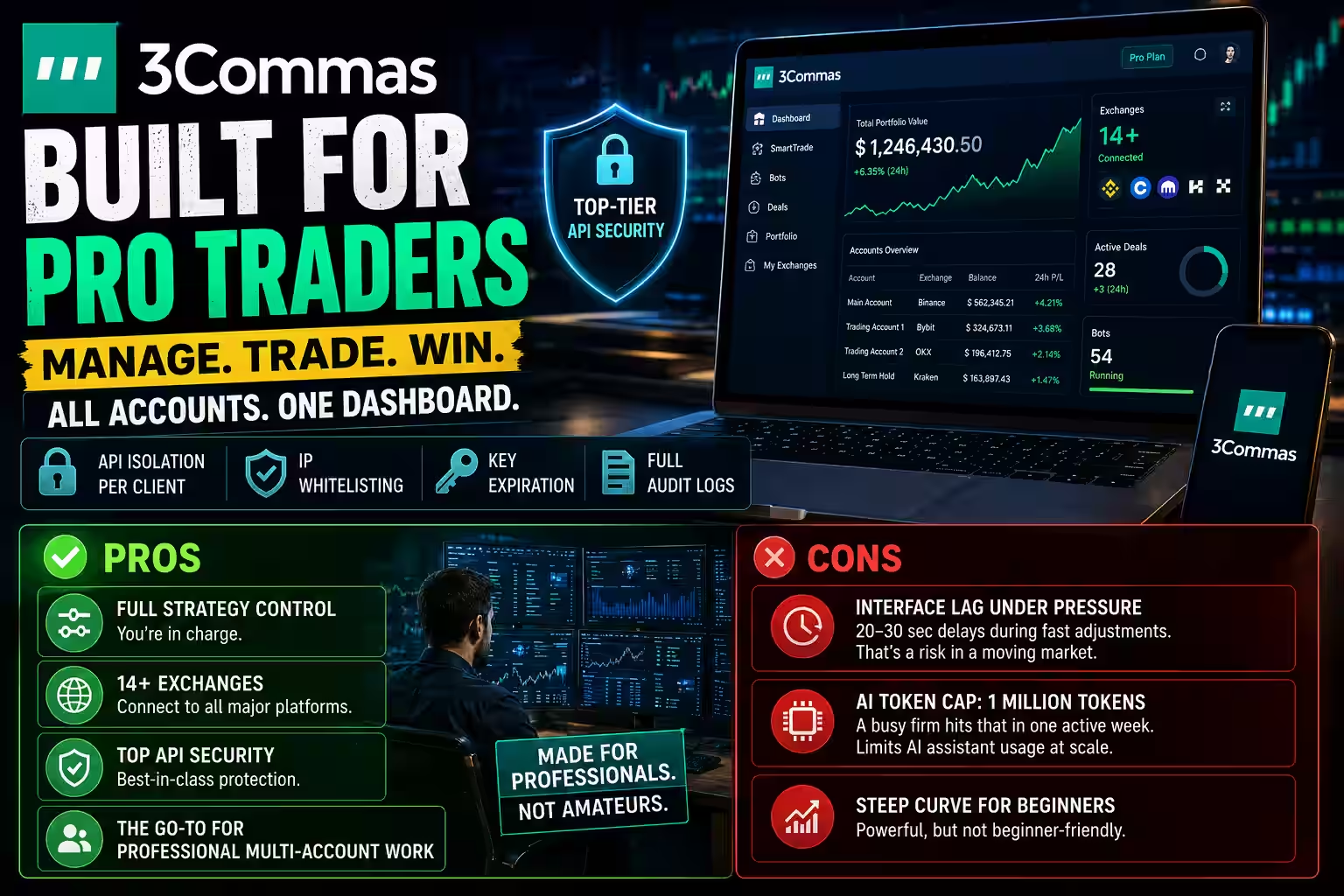
This is what professional traders use when managing multiple accounts. You connect it to 14+ exchanges via API. You clone strategies from high-performing traders. One dashboard covers all your accounts. API isolation per client, IP whitelisting, key expiration, full audit logs. Best security setup in this comparison.
Two issues worth knowing. First: input lag. On some hardware, fields show 20–30 second delays during fast manual adjustments. In a moving market, that’s a risk, not just an annoyance. Second: the AI assistant caps at 1 million tokens. A busy firm hits that in one active trading week. If you’re running 10+ accounts and using AI guidance for ongoing configuration, plan around this limit.
Pros: Full strategy control, 14+ exchanges, top API security, the go-to for professional multi-account work
Cons: Steep curve for beginners, AI token cap is a real problem at scale, interface lag under pressure

Pionex
Wins on cost. No subscription. Sixteen free bots. Flat 0.05% fee. Binance and Huobi liquidity means tight spreads on major pairs.
The downside is scale. No fiat withdrawal. No demo account. No multi-account tools. Running a personal portfolio under $10,000 and want to learn grid or DCA with no upfront cost? Pionex works. Need anything beyond that, and you’ll hit its limits fast.
Pros: Free bots, lowest fees, quick setup for beginners
Cons: No demo, no fiat withdrawal, second-tier exchange, not built for pro or institutional use

The Threat Most Reviews Don’t Mention (This One Can Wipe You Out)
Here’s the part nobody talks about.
Your biggest risk in 2026 isn’t a bad bot setting. It’s a fake platform that looks indistinguishable from a real one.
Criminal operations — many based in Cambodia — run what the FBI labels “pig butchering” schemes. The name comes from fattening livestock before slaughter. A scammer builds a relationship with you online. Takes weeks or months. Then they introduce you to a “trading platform” inside their network. Your balance grows on screen. They push you to deposit more. You try to pull your money. It’s gone. The FBI’s Internet Crime Complaint Center tracks billions in annual losses tied to these investment fraud schemes, and the numbers are still rising.
In 2026, they run it with AI at three points. Fake identities first. AI-generated profile photos that pass every reverse image search. No recycled stock photos. No trace. Then Large Language Models. One operator manages thousands of victim conversations at once. The AI reads emotional cues and adjusts tone in real time — harder when you’re excited, gentler when you hesitate. Then fake dashboards. They mirror platforms like Binance with live market data feeds. The illusion holds until you try to withdraw.
Northern California alone: romance fraud losses climbed from $22 million in 2024 to over $40 million in 2025. National figures are worse.
The Romance Scam Prevention Act cleared the US House in June 2025. Tinder’s Face Check verification reportedly cut bad actor exposure by 60%. None of it helps after you’ve sent money to a wallet.
The Federal Trade Commission consistently identifies investment scams — many crypto-related — as among the highest-loss fraud categories reported by U.S. consumers.

Run this How to Verify a Crypto Trading Platform Before You Deposit
- Video calls feel slightly off — lip sync is slightly delayed, or lighting shifts unnaturally. Possible deepfake.
- You were referred by someone online — through WhatsApp, Telegram, Instagram, or a dating app. Stop.
- Withdrawal requires a fee or “tax” — legitimate platforms never charge to access your own funds.
- No independent reviews exist — search Trustpilot, Reddit, and the BBB yourself. Don’t use links the platform provides.
- Guaranteed daily profit is promised — this is always a scam, without exception.
Before depositing on any platform, check its registration status and any investor warnings through the SEC’s investor tools portal.
Which AI Crypto Trading Bot Is Best for You in 2026?
New trader, small starting portfolio?
Start with Pionex. Run a grid bot on BTC/USDT or ETH/USDT with conservative parameters, and allocate no more than 10–20% of your capital to any single bot. Use the first 90 days to observe — don’t scale until you’ve seen the bot handle a genuine market move.
Intermediate trader managing your own portfolio?
Choose 3Commas. Use DCA bots with trailing logic on volatile assets, connect to a high-liquidity exchange like Binance or OKX, and invest in a paid plan — the free tier isn’t sufficient for active use.
Want fully automated, hands-off exposure?
Consider AlgosOne. Verify the Reserve Fund balance before depositing, understand how your account tier affects loss coverage, and don’t commit capital you might need access to before your contract term ends.
Managing client funds professionally?
3Commas is the only platform in this comparison built for that use case. Account for AI assistant usage limits — at scale, they’re an operational constraint, not a minor inconvenience.
People Also Ask
Do AI crypto trading bots actually make money?
Yes — some AI crypto trading bots do make money, but results depend on strategy, market conditions, and platform configuration. No bot performs consistently across all environments. Any platform promising guaranteed daily profits is a scam.
What are the best AI crypto trading bots for passive income in 2026?
The best AI crypto trading bots for passive income in 2026 are AlgosOne for fully automated, hands-off income, Pionex for beginners who want low-cost grid or DCA bots, and 3Commas for traders who want direct control over strategy and exchange access.
What is a grid bot, and when does it work best?
A grid bot is an automated trading tool that places layered buy orders below the current price and sell orders above it, earning a small profit each time the price bounces within a set range. It works best in sideways or choppy markets and loses effectiveness when price trends strongly outside that range.
Is flash loan arbitrage actually risk-free?
Credit risk is zero — the loan repays within the same transaction. But failed trades cost you the gas fee, and running flash loan arbitrage profitably requires specialized tools and infrastructure. It’s not a beginner strategy.
How do I identify a fake crypto trading platform?
Key red flags: guaranteed returns, referrals from people you only know online, fees charged to access your own balance, no independently discoverable reviews, and video calls where facial movements appear slightly off. Cross-check every platform on Trustpilot, Reddit, and the BBB before depositing.
What is MEV, and does it affect my bot?
MEV (Maximal Extractable Value) refers to profit generated by controlling transaction ordering on a blockchain. It makes retail arbitrage on Ethereum and Solana highly uncompetitive. On managed platforms like AlgosOne and 3Commas, this complexity is handled internally.
Can a complete beginner use an AI crypto trading bot?
Yes. AlgosOne requires minimal setup, and Pionex provides step-by-step configuration for grid and DCA bots. That said, no platform removes the need to understand what you’re putting money into. Read the documentation, run a demo for at least 30 days, and go live only when you’re confident in what the bot is doing.
The Bottom Line
The best AI crypto trading bot for you in 2026 depends on three things: your experience level, how actively you want to manage your strategy, and how much capital you’re working with.
Pionex fits beginners who want free bots and low fees. 3Commas fits experienced traders who want full control and multi-exchange access. AlgosOne fits users who want autonomous, long-term automation with a visible safety net.
Choose the strategy that matches your market conditions — grid for ranging markets, DCA for volatile ones — and never commit capital you can’t afford to have locked up or at risk.
The clearest first step: use a demo. AlgosOne and 3Commas both offer them. Run one for at least 30 days before going live. A strategy that works on paper has to hold up in a real market — and simulated trading tells you more than any platform’s marketing ever will.
AI Crypto Trading Bots · Editorial Integrity
Sources & Citations
Public data and current reporting behind this 2026 guide to AI crypto trading bots — covering platform comparisons (AlgosOne, 3Commas, Pionex), grid, DCA, and arbitrage strategies, crypto scam risks, and the fraud and regulatory landscape.
Every claim in this guide is backed by public data and current industry or research reporting. Bot mechanics and platform figures reference official documentation from AlgosOne, 3Commas, and Pionex, strategy explanations draw on protocol docs and on-chain analytics, and fraud figures follow named FBI and FTC reporting. MEV and arbitrage details use published on-chain data, and legal context follows the 2026 SEC and CFTC framework. Because platform features, network figures, and fraud numbers change fast, always check the latest data before you act on it.
View full sources, methodology, and editorial notes
This guide was written using official platform documentation, on-chain analytics, named government fraud reporting, and current regulatory releases. We give preference to primary platform docs, dated research, and named agencies where they directly support a claim about how each bot works, how grid, DCA, and arbitrage strategies perform, the scale of crypto fraud, or the legal treatment of these assets. A few points are described in general terms where exact figures shift daily. This article is educational information, not financial advice.
- How proof-of-work and blockchain settlement underpin trading: Bitcoin Whitepaper — A Peer-to-Peer Electronic Cash System — cited as the primary source for how transactions settle on-chain, context for arbitrage and execution timing.
- Ethereum consensus and transaction ordering: Ethereum.org — Consensus Mechanisms — cited as official documentation on how blocks are proposed and confirmed, supporting the discussion of MEV and arbitrage.
- AlgosOne platform mechanics and features: AlgosOne — Official Platform — cited for autonomous AI trading, the Reserve Fund, reported win rate, the AIAO token, and demo availability.
- 3Commas platform features and exchange support: 3Commas — Official Platform — cited for multi-exchange API access, strategy types, SmartTrade tooling, and API security controls.
- Pionex bots and fee structure: Pionex — Official Platform — cited for the free built-in bots, the 0.05% flat fee, aggregated liquidity, and the lack of fiat withdrawal or demo mode.
- Crypto and investment fraud statistics: FBI Internet Crime Complaint Center (IC3) — Annual Reports — cited for the scale of investment fraud losses tied to “pig butchering” and related crypto scam schemes.
- Investment scam loss data: Federal Trade Commission — Consumer Protection Data Spotlight — cited for the FTC’s identification of investment scams, many crypto-related, as a top high-loss fraud category.
- Reporting suspicious wallet addresses: Crystal Intelligence — Scam Alert Tool — cited as the wallet-reporting resource that exchanges use to flag and freeze stolen funds.
- Romance and investment fraud legislation: U.S. Congress — Romance Scam Prevention Act (2025) — cited for the June 2025 House passage referenced in the scam-risk section.
- MEV, block building, and Ethereum arbitrage: Flashbots — MEV-Boost & Block Builder Data — cited for the concentration of block auctions and searcher economics behind Ethereum arbitrage.
- Solana MEV and validator stake concentration: Jito — Solana MEV Infrastructure — cited for the Jito-Solana client’s share of network stake and Solana sandwich-attack context.
- Bitcoin network energy use: Cambridge Bitcoin Electricity Consumption Index — cited as dated research on Bitcoin’s network-wide electricity use, supporting the broader market and infrastructure context.
- Legal classification of crypto assets: Ropes & Gray — SEC and CFTC Joint Guidance on Crypto Asset Classification (March 2026) — cited for the 2026 framework that shapes how crypto platforms and their tokens are regulated.
- Regulatory interpretation (secondary): Norton Rose Fulbright — SEC and CFTC Joint Interpretation on Crypto Asset Regulation — cited as a second legal summary of the March 2026 interpretation, supporting the regulatory context.
AI Crypto Trading Bots · Editorial Standards
Our Editorial Standards
Tech Capital Hub applies Google’s E-E-A-T framework to every guide, favoring plain-English explanations, public data, and official documentation over hype or unsupported claims. This guide compares AlgosOne, 3Commas, and Pionex, breaks down grid, DCA, and arbitrage strategies, and leans on trusted references where they back a specific point — platform documentation for how each bot works, FBI and FTC reporting for the scale of crypto scam losses, and on-chain sources like Flashbots and Jito for MEV and arbitrage infrastructure. Where returns or rules are uncertain, we describe the general 2026 SEC and CFTC framework rather than overstate any promise, and we never claim guaranteed profit.
View how our editorial standards apply to this article
Guidance That Scales From Beginner to Pro
This guide meets you where you are. We map each platform to a real user profile — Pionex for someone starting under $5,000, 3Commas for hands-on traders and those managing client money, AlgosOne for set-and-forget income over 12 to 24 months. Practical framing anchors every choice, from running a grid bot on BTC/USDT to testing any strategy in a 30-day demo before real money goes in, so the advice actually fits your situation.
Strategy and Scam Detection Explained Clearly
Coverage breaks down the mechanics that matter. We explain how grid bots earn in sideways markets, how DCA with trailing buys handles volatile ones, and why arbitrage on Ethereum and Solana is expert territory shaped by MEV and block builders. We also walk through platform differences — fees, security, transparency — and lay out a step-by-step check for spotting fake platforms and “pig butchering” scams before you deposit a cent.
Official Docs and Named Data Where They Fit
Specific claims are anchored to trusted references. Platform features and reported returns draw on official AlgosOne, 3Commas, and Pionex documentation. Fraud figures reference the FBI Internet Crime Complaint Center and the FTC’s consumer data. MEV and arbitrage details use Flashbots and Jito network data, energy and market context uses the Cambridge index, and legal classification follows the 2026 SEC and CFTC joint framework. We avoid promotional claims and unverified numbers as support for any point.
Honest About Risk, Returns, and Red Flags
We state the hard truths plainly: bots make money for some people in some conditions, not all the time, and any platform promising guaranteed daily profit is a scam. We flag the risks most reviews skip — fake dashboards, withdrawal “fees,” and AI-driven fraud — and stress verifying track records yourself, never through platform-supplied links. Nothing here is financial or investment advice, and crypto trading carries real risk of loss. Corrections or source challenges can be sent to editorial@techcapitalhub.com.
AI Crypto Trading Bots · About the Author
Marcus Delray
Fintech Analyst · Founder of Tech Capital Hub
Marcus Delray is a fintech analyst and the founder of Tech Capital Hub. In this guide, he digs into AI crypto trading bots and shows you what actually works — comparing AlgosOne, 3Commas, and Pionex, breaking down grid, DCA, and arbitrage strategies, and walking through how to spot the fake platforms hiding right next to the real ones. His focus is on clarity and honest risk, not hype.
View full author bio, credentials, and links
Marcus Delray has spent over a decade researching financial technology. He built Tech Capital Hub to make that research useful for everyday readers — from total beginners to people who already trade the market. He covers AI in finance, blockchain, DeFi, and automated trading tools, with a consistent focus on turning dense topics into clear, actionable guides.
For this guide, Marcus tackles the question most people ask about automated trading: do AI crypto bots actually make money, and which ones can you trust? He compares AlgosOne, 3Commas, and Pionex on fees, security, and transparency, then breaks down how each strategy really works — grid bots that profit in sideways markets, DCA bots that ride out volatile ones, and arbitrage that sits in expert territory shaped by MEV and block builders.
He also spends real time on the risk most reviews skip: fake dashboards, withdrawal “fees,” and AI-driven “pig butchering” scams. He leans on FBI and FTC fraud data, official platform documentation, and the 2026 SEC and CFTC framework, and he is blunt that any platform promising guaranteed daily profit is a scam. Where returns or rules stay uncertain, he describes the general picture rather than overstate it. All articles are educational information, not financial advice.
- Compares AlgosOne, 3Commas, and Pionex on fees, security, and transparency — and maps each to a real user profile
- Breaks down grid, DCA, and arbitrage bot strategies in plain language, including where each one actually earns and where it fails
- Walks through a step-by-step check for spotting fake platforms and “pig butchering” scams before any deposit
- Grounds fraud claims in FBI Internet Crime Complaint Center and FTC data, with platform mechanics anchored to official documentation
- Frames every strategy against real risk of loss and the 2026 SEC and CFTC framework — no guaranteed-profit claims and no financial advice
Enjoying our content?
Click below to add us as a preferred source. Google will prioritize our latest articles in your Top Stories, AI Mode, and AI Overviews.
Preferred Source on Google