
Is Your Bank Data Safe With AI Apps? 5 Privacy Risks in 2026

Fintech Analyst · Founder of Tech Capital Hub
Marcus covers AI in finance, digital banking, fraud detection, and consumer fintech privacy. In this guide, he breaks down AI financial data privacy risks, including how finance apps access bank data, whether your information can train models, and where the biggest vendor and consent risks tend to appear.
Quick answer: Your bank data is generally safer with AI finance apps that use read-only API access instead of asking for your login credentials. The real risks aren’t the AI itself — they’re vague model-training policies, third-party vendor breaches, algorithmic errors, and a fraud pattern that tricks you into approving the transfer yourself.
AI financial data privacy is one of the biggest concerns people have when connecting a budgeting app, credit monitor, or AI-powered savings tool to a bank account. If you’ve linked one of these apps, you’ve probably wondered: what exactly is this app doing with my data? It’s a smart question to ask. Our guide to AI personal finance tools in 2026 covers how these apps are reshaping everyday money management — but that convenience comes with tradeoffs, and privacy is the one people ask about most.
This article walks through five specific questions worth asking before you link any account: how these apps actually access your data, whether they can train AI models on it, what happens when an algorithm gets a financial decision wrong, whether AI tools introduce hidden bias, and where the real breach risks live. We’ll also cover a fraud pattern that no privacy setting can stop, because it depends on manipulating you, not hacking anything.
One quick note: this article is for general informational purposes only. It isn’t financial, legal, tax, or investment advice.
Table of Contents

How Do AI Finance Apps Access Your Bank Data?
AI finance apps connect to your bank one of two ways, and the difference matters more than most people realize.
Read-only API access is the safer method. The app connects through a secure data aggregator, receives a token, and gets a live feed of your transaction data. It can see your balance and spending history, but it cannot move money, start transfers, or change account settings.
Credential sharing is the riskier method. Some older or smaller apps still ask for your actual bank username and password. Once you hand that over, the app effectively becomes you from the bank’s perspective. If that app gets breached, your real login is exposed — not just a token.
Most reputable AI finance apps route their connections through named data aggregators like Plaid, Finicity, and MX. These companies sit between your bank and the app, generating secure tokens instead of passing your credentials through directly.
| Feature | Read-Only API Access | Credential Sharing |
|---|---|---|
| Can move money? | No | Effectively, yes |
| What’s exposed in a breach? | A revocable token | Your actual bank login |
| Who’s responsible if misused? | Aggregator or app | Often unclear |
| Common providers | Plaid, Finicity, MX | Older or unvetted apps |
Choose apps that clearly state they use read-only API access. If an app’s onboarding flow asks for your bank username and password directly, treat that as a signal to look elsewhere.
Can AI Finance Apps Use Your Data to Train Models?
Some AI finance apps do use customer data to train their models, and whether that’s a problem depends entirely on what the privacy policy actually says.
“Model training” means a company is feeding user data — potentially including yours — into an AI system to improve how it functions. In practice, that can range from harmless (improving fraud detection for everyone) to genuinely concerning (building a profile from your specific transaction history that gets repurposed beyond its original use).
The problem is that privacy-policy language on this topic is often vague on purpose. Phrases like “we may use aggregated data to improve our services” can mean almost anything. Before connecting an account, look for specifics: Does the policy name what data gets used for training? Does it distinguish between anonymized data and your individually identifiable transaction history? Is there an opt-out?
Consent should never be assumed. A financial app worth trusting explains its data-use terms in plain language, not in a document written for lawyers. If a vendor can’t tell you, in one or two sentences, whether your account data trains their models, treat that as a red flag.
What Happens When an AI Finance Tool Gets a Decision Wrong?
When an AI-driven financial decision goes wrong, you’re still legally entitled to a specific, human-readable explanation — not just “the algorithm flagged it.”
AI models now power fraud detection, credit decisions, risk scoring, and personalized recommendations. Like any model, they make mistakes. The real test isn’t whether an error happens — it’s what happens next.
According to the Consumer Financial Protection Bureau (CFPB), using an algorithm to make a decision does not exempt a company from providing the specific adverse action explanations required under the Equal Credit Opportunity Act (ECOA). In other words, “the AI decided” isn’t an acceptable answer if you’re denied credit or flagged for fraud. You’re entitled to a real reason.
The CFPB has also solicited public input specifically on AI use in consumer finance — see the CFPB’s AI Request for Information for the regulatory framing behind this. If a financial institution or app gives you a generic, unexplained denial, you have the right to ask for specifics.

Can AI Financial Tools Create Hidden Bias or Discrimination?
Yes — an AI model doesn’t need to ask about your race, gender, or income directly to end up discriminating against you; it can get there through what’s known as proxy discrimination.
Proxy discrimination happens when a model relies on variables that correlate closely with protected characteristics, even when no one intended that outcome. ZIP code is the classic example. It sounds neutral, but ZIP codes often correlate strongly with race and income due to historical housing patterns. A model that weighs ZIP code heavily in a lending decision can end up replicating exactly the discrimination that anti-discrimination law was written to prevent — just filtered through a spreadsheet instead of a person.
Education level, employment history, and even behavioral signals like how quickly someone scrolls through a loan application carry similar risk. None of these factors is automatically illegal to consider, but each deserves scrutiny for what it might be standing in for.
This matters most in lending and financial access, where the stakes of a biased model are highest. If a credit or loan decision seems unfair, ask the lender directly what factors drove it — a right reinforced by the same ECOA protections mentioned above.
What Are the Biggest Bank Data Privacy and Breach Risks?
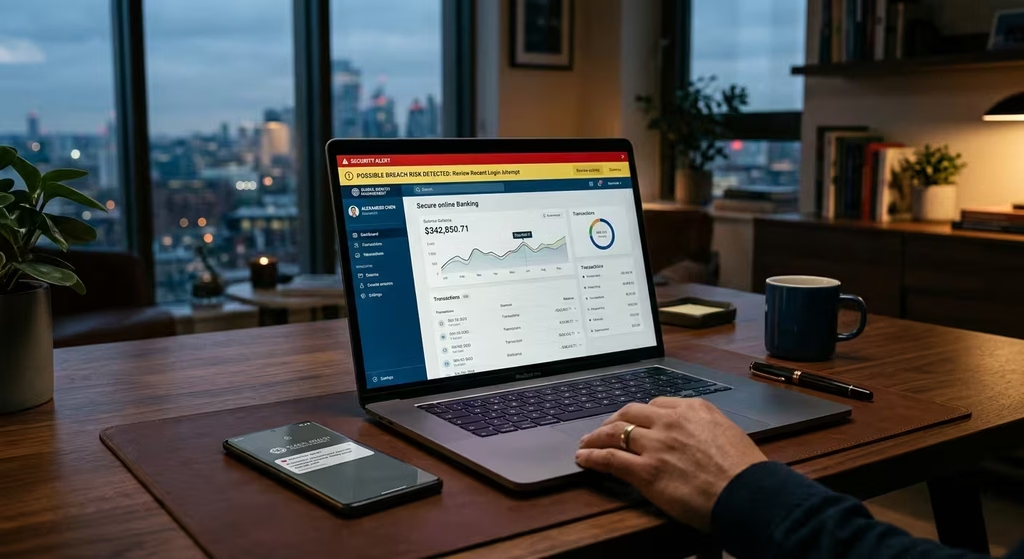
The biggest privacy risk usually isn’t your bank’s own security — it’s the third-party vendors and app integrations sitting between you and your bank.
Several real incidents in early 2026 illustrate this pattern. Breaches connected to Citizens Financial and Frost Bank, Adobe, and France Titres each involved data exposure tied to systems adjacent to the core financial institution, not the bank’s own vaults. The Vercel breach and the Venn breach, both reported in April 2026, followed a similar shape — vulnerabilities in third-party infrastructure that financial services relied on.
The common thread: third-party vendor exposure is often the actual attack surface, even when a bank’s core systems stay secure. Apps connected through OAuth permissions — the “allow this app to access your account” prompts you’ve clicked dozens of times — expand that surface further. Each connected app is another potential point of failure, which is exactly why reviewing what’s connected to your accounts matters.
Encryption type matters more than people assume, too:
| Encryption Type | What It Protects | When It Applies |
|---|---|---|
| Encryption at rest | Data sitting in storage | Only while inactive |
| Persistent encryption | Data continuously, including in use | At rest and during processing |
A financial app that only mentions “bank-level encryption” without specifying which type, and when, isn’t giving you the full picture.
Regulatory pressure is catching up to this reality. Regulation S-P now sets updated data-security requirements that extend to AI vendors, with a compliance deadline of June 3, 2026, for smaller registered investment advisers. New Nacha rules, effective March 20, 2026, tightened payment risk management requirements for institutions processing ACH transactions. Both signal that regulators increasingly treat vendor risk as inseparable from institutional risk.

How Do You Check If an AI Finance App Is Safe Before You Use It?
You can vet an AI finance app in a few minutes by running it through a short checklist before you connect any account.
- Read-only API access only — no request for your actual bank credentials.
- SOC 2 Type II certification — an independent auditor has verified the company’s security controls, not just its own marketing claims.
- A clear, specific privacy policy — one that states plainly what happens to your data, including whether it trains AI models.
- No external model training without explicit consent — you should be asked, not assumed to agree.
- Easy permission revocation — you should be able to disconnect the app from your bank in a few clicks, not a phone call.
- A visible support and contact process — if something goes wrong, there should be an actual person to reach.
If an app fails more than one of these checks, that’s reason enough to look elsewhere. For a closer look at how AI actually strengthens fraud monitoring once you’re past the login screen, see behavioral biometrics in banking and how it compares with older approaches in our breakdown of rule-based vs. AI fraud detection.

What Type of Fraud Can AI Privacy Settings Not Stop?
No privacy setting can stop authorized fraud — the kind where you approve the transfer yourself.
Every security control covered so far — encryption, read-only access, permission audits — protects against unauthorized access. None of it protects against a payment you initiate voluntarily. Authorized fraud, also called manipulation-based fraud, has become one of the fastest-growing fraud categories precisely because it sidesteps every technical control. A scammer convinces you, through urgency or impersonation, to send money yourself. Because you initiated the transfer, traditional fraud-detection systems often treat it as a normal, legitimate transaction.
Security researchers sometimes refer to a related pattern as all-green fraud — where every individual signal in a transaction looks clean and legitimate, because the account holder genuinely authorized it. Watch for unusual urgency, requests to move money to a “safe” account, or pressure to act before verifying with your bank directly. Our deep dive on how detection systems are adapting to catch this shift is covered in AI fraud detection: stop the steal.
What Are the Best Practices for Protecting Your Financial Data in the AI Era?
The most effective habit is a routine permission audit — checking which apps have access to your bank accounts every few months instead of just once at setup.
- Audit app permissions regularly. Don’t rely on a one-time setup check.
- Revoke unused access. If you stopped using an app a year ago, its connection to your bank account probably shouldn’t still be active.
- Review privacy policy updates. Companies change their terms more often than most people notice — a periodic re-read is worth ten minutes.
- Watch for vague personalization language. Phrases like “tailored insights based on your data” without further detail deserve a follow-up question, not an assumption.
- Avoid tools that ask for direct bank credentials. If read-only API access is standard across an entire app category, treat any exception as a warning sign.
What Is PII Protection in AI Financial Apps?
PII protection refers to how an app safeguards personally identifiable information — your name, Social Security number, account numbers, and similar data — from exposure, misuse, or unauthorized access. In AI financial apps specifically, this extends to how that data moves through model-training pipelines, not just how it’s stored. Strong PII protection means clear consent processes, data minimization (collecting only what’s needed), and defined limits on how long data is retained.
Where This Leaves You
None of this is a reason to avoid AI finance apps altogether. The technology genuinely helps more than it hurts, and it isn’t going anywhere — our broader look at AI in digital banking and how predictive tools are reshaping everyday savings makes that case in more detail.
The smarter move is asking better questions before you connect an account, not avoiding connection altogether. Check for read-only access. Read the privacy policy for specifics, not vibes. Know your rights around adverse decisions. And remember: the biggest fraud risk left standing isn’t a hacker — it’s a convincing enough story to get you to click “send” yourself.
People Also Ask About AI Financial Data Privacy
Is it safe to share my bank login with AI apps?
No — avoid apps that ask for your actual bank username and password. Reputable AI finance apps use read-only API access through aggregators like Plaid, Finicity, or MX, which never expose your real credentials.
How do I protect my financial data in the AI era?
Audit connected app permissions regularly, revoke access for apps you no longer use, read privacy policy updates for specifics on model training, and avoid any tool that requests direct bank credentials instead of token-based access.
What is PII protection in AI financial apps?
It’s how an app safeguards personally identifiable information like your Social Security number and account details, including limits on how that data is used in AI model training and how long it’s retained.
What encryption standard should I look for?
Look for persistent encryption, which protects data continuously, including while it’s being processed — not just encryption at rest, which only covers data while it’s sitting in storage.
Can AI apps train on my bank data?
Some can, depending on their privacy policy. Look for explicit statements about model training and consent — vague language like “aggregated data to improve services” often means broader use than it sounds.
What should I do if an AI finance app denies me credit or flags fraud unfairly?
Ask for a specific explanation. Under ECOA, and as reinforced by CFPB guidance, “the algorithm decided” is not a sufficient reason — you’re entitled to know the actual factors behind the decision.
AI Financial Data Privacy · Editorial Integrity
Sources & Citations
Primary guidance, financial privacy resources, and current reporting behind this guide on AI financial data privacy — covering bank data access, model training consent, AI-driven decisions, vendor risk, fraud detection, and consumer protection.
This article is grounded in current fintech reporting, official consumer finance and regulatory materials, and financial privacy resources relevant to AI-powered finance apps. We prioritize primary or near-primary sources where possible, especially for questions involving AI model use, consumer rights, bank-data access methods, and third-party security risk. Because app practices, breach exposure, and policy language change quickly, readers should verify current privacy terms and disclosures before connecting an account.
View full sources, methodology, and editorial notes
This guide was written using official regulatory materials, consumer protection resources, and current reporting tied directly to AI financial data privacy. We give preference to primary agency publications, official consumer resources, and named sources that clarify how financial institutions and apps use AI, process customer data, explain adverse outcomes, and manage privacy and fraud risk. This article is educational information only and does not constitute financial, legal, or investment advice.
- Consumer finance and AI guidance: CFPB and Federal Agencies — Request for Information and Comment on Financial Institutions’ Use of Artificial Intelligence — cited for regulatory context around explainability, data usage, dynamic updating, fair lending risk, and financial institutions’ AI governance.
- SEC guidance on predictive data analytics and investor harm: SEC — Conflicts of Interest Associated with the Use of Predictive Data Analytics by Broker-Dealers and Investment Advisers — cited for official regulatory discussion of AI-driven investor interactions, conflicts of interest, model opacity, and the risks of technology that can steer financial behavior.
- Official free credit-reporting resource: AnnualCreditReport.com — cited as the federally authorized source for free credit reports, relevant to readers monitoring financial exposure and suspicious activity.
- Current reporting on AI budgeting apps and bank-data access patterns: Tech Capital Hub — 7 Best AI Budgeting Apps — cited for current examples of AI finance app features, app connection methods, and consumer-facing functionality in 2026.
- Current reporting on AI fraud detection: Tech Capital Hub — Rule-Based vs AI Fraud Detection — cited for the distinction between static rule systems and adaptive AI fraud detection, including behavioral and vendor-risk implications.
- Consumer-facing article under review: Tech Capital Hub — AI Financial Data Privacy — included as the live page where these editorial source notes apply.
AI Financial Data Privacy · Editorial Standards
Our Editorial Standards
Tech Capital Hub applies Google’s E-E-A-T framework to every consumer-finance and AI guide, favoring plain-English explanations, current regulatory context, and clearly attributable sources over hype or vague claims. For this article, we focus on practical questions readers actually ask about AI financial data privacy: how finance apps access bank data, whether apps can use that data to train models, what consumer rights apply when AI-driven decisions go wrong, and where the biggest third-party privacy risks tend to sit.
View how our editorial standards apply to this article
Written Around Real Consumer Questions
This article is structured around the questions ordinary users actually ask before linking a bank account to an AI-powered budgeting, savings, or monitoring app. Instead of starting with technical jargon, we begin with practical concerns — who can access your data, what permissions matter, and what kinds of privacy or fraud risks remain even when an app looks legitimate.
AI Finance Risks Explained in Plain Language
Coverage breaks down concepts that often get buried in policy or compliance language: read-only API access versus credential sharing, model training consent, proxy discrimination, authorized fraud, and the limits of “bank-level encryption” claims. Terms are explained before they are relied on, with an emphasis on helping non-specialist readers make better decisions.
Regulatory and Consumer Sources Where They Matter
Specific claims are grounded in current regulatory and consumer-facing resources where appropriate. We rely on agency materials such as CFPB and interagency guidance for explainability, adverse-action standards, and AI governance context, and we use official consumer resources where they directly support a claim. We avoid treating generic vendor marketing claims as proof of privacy or security.
Clear About Limits, Trade-offs, and Change Over Time
We state trade-offs plainly: AI finance apps can be useful, but convenience does not eliminate vendor risk, vague consent language, or manipulation-based fraud. Because privacy policies, breach exposure, and regulatory interpretations evolve quickly, this topic is reviewed over time and framed cautiously. Nothing here is financial, legal, or investment advice. Corrections or source challenges can be sent to editorial@techcapitalhub.com.
AI Financial Data Privacy · About the Author
Marcus Delray
Fintech Analyst · Founder of Tech Capital Hub
Marcus Delray is a fintech analyst and the founder of Tech Capital Hub. In this guide, he breaks down AI financial data privacy in plain language — covering how finance apps access bank data, whether your information can train AI models, what happens when AI-driven decisions go wrong, and why third-party vendor risk often matters more than people realize. His focus is clarity, relevance, and practical consumer understanding — not hype.
View full author bio, credentials, and links
Marcus Delray has spent over a decade researching financial technology. He built Tech Capital Hub to make that research useful for everyday readers — from complete beginners to people already following digital banking, AI tools, and modern finance. His work focuses on AI in finance, fraud detection, consumer fintech privacy, and the practical trade-offs that come with app-based money management.
For this guide, Marcus addresses one of the most common questions people ask before connecting a budgeting app, credit monitor, or AI-powered savings tool to a bank account: how safe is your data, really? He explains the difference between read-only API access and credential sharing, what model-training consent actually means, why vague privacy policies are a problem, how proxy discrimination can show up in AI-driven finance decisions, and why authorized fraud can still bypass even strong privacy controls. Where regulatory or compliance expectations are discussed, he frames them carefully and avoids overstating certainty. All content is independently researched and intended as educational information, not financial, legal, or investment advice.
- Explains AI financial data privacy risks in clear, consumer-friendly language without relying on technical jargon
- Breaks down how AI finance apps access bank data, how model-training consent works, and where privacy policies often become too vague to trust
- Clarifies how AI-driven financial decisions can create issues around explainability, bias, adverse outcomes, and consumer recourse
- Highlights the role of third-party vendors, app permissions, and manipulation-based fraud in real-world fintech privacy risk
- Grounds coverage in current regulatory context, consumer protection framing, and practical decision-making guidance rather than hype or vendor claims
Enjoying our content?
Click below to add us as a preferred source. Google will prioritize our latest articles in your Top Stories, AI Mode, and AI Overviews.
Preferred Source on Google






4 thoughts on “Is Your Bank Data Safe With AI Apps? 5 Privacy Risks in 2026”