AI Financial Modeling: The 1 Structural Shift Founders Are Using to Leave Old Spreadsheets Behind

Traditional financial models break because they are static historical snapshots. True AI financial modeling builds a dynamic, predictive financial engine by linking live ledger data pipelines to automated machine learning simulations. This allows founders to run continuous multi-variable scenario testing, manage real-time runway, and secure institutional investor trust instantly.
Sarah spent three weeks on her financial model.
She hired a freelance analyst. Paid real money. Watched the spreadsheet grow into something that looked serious — rows of revenue projections, margin assumptions, a five-year P&L that filled the screen when you zoomed out.
She sent it to four Series A investors.
Three of them said some version of the same thing: “Looks a bit optimistic.”
One didn’t reply at all.
Here’s what broke Sarah’s model — and it wasn’t the numbers. Her revenue projections were reasonable. Her cost assumptions were defensible. The math checked out. What broke it was something nobody told her when she started: investors don’t just read financial models. They read the world those models assume exists. And Sarah’s model assumed a world investors didn’t believe in.
That’s the problem AI financial modeling actually solves. Not the calculations. The world-building.
Table of Contents

Investor Expectations for AI Financial Modeling Projections
Forget the numbers for a second.
When an investor opens your financial model, the first thing they’re doing — whether they know it or not — is checking if the world you’ve built matches the world they live in. Do the assumptions fit what they know about your market? Does your revenue logic match how companies in your space actually grow? Does your churn rate reflect reality or hope?
If the answer is no — if your model assumes a world they don’t recognize — they stop trusting everything else. It doesn’t matter if your formulas are correct. A technically perfect spreadsheet built on unrecognizable assumptions is just expensive fiction.
This is why the “looks optimistic” reply stings so much. It’s not a comment on your math. It’s a rejection of the world your model lives in.
Sarah’s analyst built a top-down model. He grabbed an industry TAM figure — Total Addressable Market — assumed a 2% capture rate by Year 3, and worked backward from there. That’s how most freelance analysts build startup models. It looks professional. It produces confident-sounding numbers.
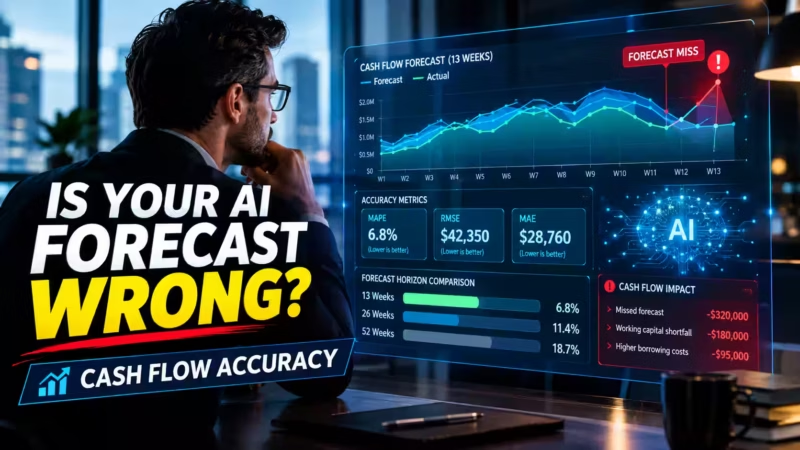
Sarah’s situation isn’t unique; most early-stage failures happen because founders can’t see cash crunches coming three months in advance.
By moving beyond manual spreadsheets, teams can implement automated AI cash flow forecasting for SaaS startups to map out real-time cash positions. This continuous insight ensures you are always managing your runway proactively rather than reacting to a sudden liquidity crisis during an active funding round.
But any experienced investor reads it and thinks: why 2%? What drives that? What’s the mechanism? And when there’s no clean answer, the whole thing collapses.
The shift that fixes this isn’t technical. It’s about starting from the right place.

Why Traditional Financial Modeling Starts in the Wrong Place
Traditional financial models are built backward.
Traditional spreadsheet modeling relies entirely on static, historical inputs. Transitioning to AI financial modeling introduces predictive financial analytics powered by machine learning forecasting.
Instead of manually updating cell blocks every month, modern systems build real-time data pipelines directly from your live ledger. This turns your model into a living document capable of executing automated, non-linear time-series analysis without human error.
You decide where you want to end up — say, $4.2M in Year 2 revenue — and then reverse-engineer assumptions to justify it. The model looks forward but the thinking goes backward. Investors who’ve seen hundreds of decks recognize this pattern immediately. It’s the financial equivalent of writing a conclusion before doing the research.
Machine learning financial models start from the other direction entirely. Instead of starting with a desired outcome, you start with your actual business mechanics — your lead sources, your conversion rates, your pricing, your churn — and let the data determine where you end up.
- Structural Fragility: One broken formula can quietly cascade errors across three financial statements.
- Information Lag: Models are often outdated the moment they are exported because they rely on historical snapshots.
- Data Silos: Qualitative context (hiring pipelines, sales CRM changes) stays locked out of standard cell blocks.
This matters in two ways. First, the output is more accurate. A 2025 Salesforce survey of CFOs found that finance leaders who shifted to AI-driven forecasting cut their scenario analysis time by 90% and reduced standard reporting from six hours to roughly twelve minutes. But those are efficiency gains.
The second benefit is the one that actually gets founders funded: the model can defend itself.
When an investor asks “how did you arrive at $4.2M in Year 2?” — a bottom-up AI model has a clean answer. Revenue equals monthly active users times conversion rate times average contract value. Here’s where each number comes from. Here’s what has to change for it to go higher or lower. Here’s the data behind it.
That’s a world investors recognize. They’ve seen it before. They can stress-test it. They can disagree with a specific assumption rather than rejecting the whole picture. And that — a disagreement about a specific input — is actually a sign of a healthy investor conversation, not a failed one.

Core Accounting Architecture for Machine Learning Financial Models
Here’s something worth saying plainly: AI tools don’t rescue broken model architecture. They accelerate whatever structure you’ve already built. So before any tool enters the picture, the underlying logic has to be sound.
Every investor-ready financial model runs on three interconnected statements. Think of them as three characters in the same story — each one has its own role, but they’re all telling the same narrative.
The Income Statement is the performance story. It runs from Revenue down through cost of goods sold, operating expenses, EBITDA, and finally Net Income. The key in 2026 is building revenue from real operational drivers — number of leads multiplied by conversion rate multiplied by deal size — rather than a growth percentage dropped in from thin air. Net Income isn’t the ending. It’s a traveler. It has to move into the other two statements or the story breaks.
The Balance Sheet is the snapshot. It holds the cumulative weight of every business decision the company has made. Assets must always equal Liabilities plus Equity — no exceptions. Net Income feeds into Retained Earnings, which sits inside Equity. When Equity rises, Assets must match it. A model that doesn’t balance isn’t a model. It’s a broken spreadsheet wearing a suit.
The Cash Flow Statement is where reality hits. A company can look profitable on paper while being nearly broke in the bank. According to market data, roughly 82% of business failures trace back to cash flow problems — not profitability problems. The CFS reconciles your accounting profit back to actual cash movement. And here’s the check that proves your model is structurally sound: the ending cash balance on the Cash Flow Statement must match the Cash line on the Balance Sheet exactly. If it doesn’t, something in the logic chain is wrong.
Depreciation is the specific place most first-time models break. It shows up as an expense on the Income Statement — which creates a tax shield by reducing taxable profit. Then it gets added back on the Cash Flow Statement because no actual cash left the building. And simultaneously it reduces the book value of PP&E on the Balance Sheet. Three separate impacts from one line item. Miss any one of them and the model is structurally unsound, even if every other number is correct.
Once this foundation is clean, AI tools can work on top of it. Not before.

What AI Financial Modeling Actually Changes
This is the part most articles get wrong — they treat AI financial modeling as a speed tool. Faster spreadsheets. Quicker scenario analysis. Less time on manual data entry.
Those benefits are real. But they’re not the point.
The real shift is in what the model can explain about itself.
Traditional DCF models — Discounted Cash Flow, the backbone of most startup valuations — require you to pick a WACC (Weighted Average Cost of Capital) and hold it constant across your entire forecast period. That’s a fiction. Your cost of capital changes as interest rates move, as your company matures, as your risk profile shifts. A fixed WACC pretends time doesn’t pass.
ML-enhanced DCF models use algorithms like Random Forest to predict revenue growth from real business drivers. Neural Networks model how risk changes over time — not in a straight line but in the non-linear, messy way real businesses actually behave. Studies comparing ML-predicted WACC against constant-WACC models show a 38% improvement in Root Mean Squared Error — meaning the ML version is measurably closer to what actually happens.
The formula looks like this:
V₀ = Σ [FCF_t^ML / (1 + WACC_t^ML)^t] + TV^ML / (1 + WACC_n^ML)^n
Every variable — free cash flow, cost of capital, terminal value — is estimated by the machine learning layer, not hand-entered by an analyst working from intuition.
But here’s what that formula means in plain language for a founder: your model now has a reasoning chain. Every number traces back to a data point or a defined business action. When an investor asks the hard question — “why this number?” — you have a clean, specific answer. Not a shrug dressed up in confident language.
That’s the world investors recognize. And fitting into that world is what gets you funded.

The Part Most Founders Skip — Monte Carlo Simulation
Traditional financial models give you one answer.
The future doesn’t work that way. The future is a distribution of possibilities — some good, most somewhere in the middle, a few genuinely bad. A model that produces one revenue number is pretending otherwise.
Monte Carlo simulation runs your model thousands of times, each time varying the input assumptions within defined ranges. What comes out isn’t a single projected figure — it’s a probability distribution. You get a P10 outcome (pessimistic — what happens 90% of the time or better), a P50 median, and a P90 upside (what requires everything to go right).
When applying AI to quantitative risk modeling, the software replaces manual sensitivity tables with continuous scenario simulation. For complex valuations like Discounted Cash Flow (DCF) or WACC calculations, automated FP&A modules can run tens of thousands of automated parallel simulations. The AI ingests both structured financial statements and unstructured data ingestion (like market sentiment reports), resulting in dynamic rolling forecasts that automatically adjust as macro market variables change.
The practical difference in an investor conversation is significant.
A founder who says “We project $4.2M by Year 2” sounds like every other founder who walked through that door. A founder who says “Our P50 scenario shows $3.8M, driven by a 4% trial-to-paid conversion rate and $85 average contract value — and here’s what has to change to reach the P90 of $5.1M” sounds like someone who actually understands their business.
One of those conversations moves forward. The other gets a polite “we’ll be in touch.”
AI-driven scenario analysis goes further than traditional Monte Carlo. It doesn’t just randomize inputs within manually defined ranges. It uses historical market data and machine learning to estimate parameter distributions more accurately — capturing correlations between variables (revenue and churn move together, not independently) and modeling tail risks that static sensitivity tables miss entirely.
This is revenue forecasting done the way institutional investors do it. For a startup founder, having access to that level of modeling — without needing a quant team — is the actual competitive advantage AI provides.
The Tools Worth Your Time in 2026
The AI tool market for finance is crowded. Most of it is noise.
Here’s what’s actually worth using, and what each one specifically does:
| Platform Name | Best Used For | Core AI Capability | Data Integration Type |
|---|---|---|---|
| Claude 3.5 Sonnet | Contextual Prompt-to-Model | Dynamic formula synthesis & macro code generation | Spreadsheet Add-in / API |
| Shortcut AI | Automated Valuation Frameworks | Text-to-model three-statement file generation | Native Spreadsheet & Cloud Export |
| Hebbia | M&A and Private Equity Diligence | Unstructured document room indexing & compliance analysis | Secure Virtual Data Room (VDR) |
| Cube Software | Enterprise FP&A Scaling | Strategic multi-variable scenario & variance analytics | Native Excel & Google Sheets Sync |
| Kensho (S&P Global) | Institutional Market Intelligence | Entity linking & advanced machine learning data analysis | Enterprise Data Pipeline / API |
| Fintool | Equity Research & Filing Sweeps | Agentic workflows for automated SEC document auditing | SEC Database & Native Excel Engine |
For AI tools that automate financial modeling in Excel, Claude in Excel stands out for one specific reason — it traces formula logic across multiple tabs. When your Assumptions sheet drives a number in your P&L three tabs away, Claude can show you that chain and flag where it breaks. For a founder who lives in Excel and doesn’t have a dedicated finance team, that’s the difference between a model that balances and one that quietly lies to you.
Hebbia is a different animal. It’s built for document-heavy work — M&A due diligence, partnership reviews, investor data rooms. If you’re raising a larger round and managing a virtual data room, Hebbia processes the entire thing and produces cited, audit-ready insights. Not summaries. Specific claims with specific sources.
Kensho belongs to risk managers and institutional investors more than early-stage founders. But if you’re building scenario analysis around macroeconomic assumptions — interest rate sensitivity, sector-specific risk factors — Kensho’s historical event modeling is the most credible tool available.

A Practical Framework: How to Build This in Five Steps
If you’re an early-stage founder building your first AI-assisted financial model, here’s the sequence that works.
Define the Drivers First
Forget top-down market shares. Pinpoint the real-world operational actions that drive your financial growth—such as cold outreach volumes, sales rep hiring timelines, or sales pipeline velocity.
Build from the Bottom Up
Map out your model step-by-step using actual costs and real conversion percentages. Build a granular foundation first so your automated algorithms have high-quality, uncorrupted variables to run projections on.
Run the Linkage Check
Verify that your income statement, balance sheet, and cash flow statement are flawlessly interconnected. A change in your operational revenue must automatically recalculate your cash balances without breaking formulas.
Create the Scenario Matrix
Construct clear, multi-variable toggles right within your model structure. You must be able to switch instantly between Base Case, Aggressive Growth, and Conservative runway preservation views with a single click.
Use AI to Test the Extremes
Deploy specialized financial algorithms to run thousands of parallel simulations. Let the machine aggressively stress-test your structure against random churn spikes, macroeconomic shifts, and delayed funding rounds.

What Investors Are Actually Looking For
Unit economics are the first lens most institutional investors apply.
Customer Acquisition Cost (CAC) — the total cost to acquire one paying customer. Lifetime Value (LTV) — total projected revenue from that customer over the relationship. And the LTV/CAC ratio, which tells the investor whether your growth is building toward sustainability or quietly burning through capital.
For early-stage SaaS, a trial-to-paid conversion benchmark in the 3–5% range is considered realistic. Below that, investors start asking hard questions about product-market fit before the financial model becomes relevant.
Two things separate founders who get funded from those who get a polite pass: cited assumptions and honest risk framing. Every projected figure should trace back to a data source or a defined business action. And your risk section should name your three or four actual risks — not generic “market risk” language — with specific mitigation plans for each.
As Marc Andreessen has said: the best founders aren’t optimists or pessimists. They’re realists with proof.
That line is worth sitting with. It’s not about being conservative or bullish. It’s about having a model that can show its work.
People Also Ask – PAA’s
What is AI financial modeling and how does it work for startups?
AI financial modeling replaces static, manually entered assumptions with data-driven parameter estimation using machine learning. Instead of picking a fixed revenue growth rate or WACC, the model learns from historical data and real business drivers to generate time-varying, more accurate forecasts. For startups, this means projections that can explain themselves to investors — not just display a number.
How do I build AI-powered financial models for startups with no technical background? Start with a clean three-statement Excel model built on bottom-up revenue drivers. Then use tools like Claude in Excel to audit formula dependencies and Shortcut to check model integrity. You don’t need to code. You need to understand what drives your business and enter those drivers accurately. The AI handles the rest.
Are machine learning financial models more accurate than traditional DCF models?
In controlled studies, ML-predicted WACC shows a 38% improvement in Root Mean Squared Error compared to constant-WACC traditional models. The accuracy gain comes from capturing non-linear relationships and time-varying market conditions that static assumptions ignore.
What AI tools automate financial modeling in Excel?
Claude in Excel, Cube, and Shortcut are the three most relevant tools for Excel-based AI financial modeling in 2026. Claude handles multi-tab formula auditing and dependency tracing. Cube enables real-time data sync and FP&A reporting. Shortcut builds and checks integrated three-statement models.
What is Monte Carlo simulation in financial modeling?
Monte Carlo simulation runs your financial model thousands of times with varied inputs to produce a probability distribution of outcomes — P10, P50, and P90 scenarios — instead of a single projection. AI-enhanced Monte Carlo uses historical data to estimate input distributions more accurately and captures correlations between variables that manual methods miss.
How does AI financial modeling help with investor readiness?
AI models produce outputs with traceable reasoning chains. Every projected number points back to a specific data source or business assumption. When investors ask how you arrived at a figure, you have a specific, defensible answer — not a shrug. That transparency is what turns a financial model from a spreadsheet into a credible investment narrative.
The Ending Sarah’s Story Deserved
Remember Sarah?
Three weeks of work. Four investor meetings. Four variations of “looks optimistic.”
Six months later, she rebuilt the model. Same business. Same market. Different approach entirely. Bottom-up drivers. Monte Carlo scenarios. Three-statement linkage that balanced to the dollar. AI-generated sensitivity analysis that could answer any assumption question in real time.
She went back to two of the same investors.
Same people. Same company. Same revenue projections, actually — the numbers didn’t change dramatically. What changed was the world the model lived in. This time it was a world they recognized. Assumptions they could stress-test. Logic they could follow. Risks she’d named before they had to ask.
One of them led her round.
That’s what AI financial modeling actually does. It doesn’t manufacture optimism. It builds a world around your numbers that investors already know how to inhabit. A world where your projections feel earned rather than hoped for.
Start with your drivers. Build bottom-up. Link your statements. Run your scenarios. And let the tools do what tools are for — so you can spend your time on what only you can do: making investors believe in the world you’re building.
This article is for informational purposes only and does not constitute financial, investment, or legal advice. Financial projections involve inherent uncertainty. Always consult a qualified financial professional before making investment decisions.
Enjoying our content?
Click below to add us as a preferred source. Google will prioritize our latest articles in your Top Stories, AI Mode, and AI Overviews.
Preferred Source on Google