AI Generated Voice Scams: How to Detect a Cloned Voice Before You Lose Thousands

Consumer Security Analyst | AI Voice Cloning, Deepfake Detection & Vishing Fraud Research
What is an AI generated voice scam?
AI generated voice scams — also called a voice cloning scam or vishing attack —is a fraud where criminals use synthetic audio to clone a real person’s voice from as little as a few seconds of public audio. They then use that cloned voice to impersonate a family member, coworker, or executive on a phone call and pressure the target into sending money or sharing sensitive information.
A phone rings. Unknown number. A voice on the other end sounds exactly like your daughter, panicked, saying she’s been in an accident and needs money wired right now. It sounds like her. Every inflection, every nervous pause. Except it isn’t her at all. Not even close. It’s a clone, built from three seconds of audio pulled off a social media clip, and the software behind it costs less than a streaming subscription.
That’s the scenario security researchers are now building entire defense strategies around, because “it sounded real” stopped meaning anything a while back. It’s also one of five detection methods banks now rely on — see our full breakdown of how AI detects financial fraud in 2026 for the complete picture.
Table of Contents
Key Takeaways
Here are the main points readers should understand before going deeper into the article.
Human detection fails
Even trained listeners can no longer reliably distinguish a cloned voice from a real one under normal call conditions.
A few seconds can be enough
Modern voice cloning tools can build convincing synthetic speech from a very short public audio sample.
Detection tools are uneven
Some systems perform well in testing, while others struggle badly against newer voice cloning methods.
Safe words still matter
A private verification phrase is still one of the most practical defenses for families facing emergency-style scam calls.
Businesses need layered controls
Callback verification, approval workflows, and network-level checks matter more than trusting a voice alone.
This threat scales fast
AI-assisted voice phishing is built for volume, which means procedural defenses matter more than instinct.

How Do You Actually Detect an AI Generated Voice Scam in 2026?
Short version: you mostly don’t. Not by ear, anyway. CrowdStrike recorded a 442% jump in voice phishing incidents in the back half of 2024 alone, and a 2025 Queen Mary University study confirmed something uncomfortable. Even trained professionals can’t reliably tell a cloned voice from a real one under normal call conditions anymore. Human perception isn’t a detection method in 2026. It’s a coin flip, maybe worse.
That’s why detection now happens at two different levels. Automated, real-time software analyzing spectral and acoustic artifacts in the audio itself. And behavioral verification — safe words, callback protocols — that doesn’t try to detect the fake at all. It refuses to trust a voice alone. Period.

Why Can’t You Just Listen for a Robotic Sounding Voice Anymore?
This used to be real advice. Listen for flat tone. Listen for weird pacing. Not anymore. Research confirms the perceptual gap between synthetic and real voices has effectively closed. Under stress — and every vishing script is engineered to create stress — human judgment gets worse, not better. Scam targets who are warned in advance still hand over sensitive information 33% of the time when the attack is sophisticated enough.
Here’s the part that should change how you think about this entirely. Even purpose-built detection software struggles. A neutral May 2026 benchmark from Podonos tested eight systems, four commercial and four open-source, against modern attack samples. Open-source models like Wav2Vec2 and AASIST scored 48% to 63% accuracy — at or below unaided human performance. Why? They were trained on the ASVspoof 2019 dataset, which has zero exposure to tools like ElevenLabs or F5-TTS. Software trained on old fakes can’t recognize new ones. Neither can your ear.
How Little Audio Does It Actually Take to Clone a Voice?
Three seconds. That’s it. Nothing more. Microsoft researchers and others have confirmed that modern cloning tools need only three seconds of source audio to produce a convincing synthetic voice. Not a full phone call. Not a long recording. Three seconds, harvested from a voicemail greeting, a webinar clip, a public speaking video, or even a “wrong number” spam call designed purely to get you talking long enough to capture your voice.
This is the part that makes the old advice about “protecting your identity” feel thin. You don’t need to leak your Social Security number for this fraud to work. You need to have spoken in public, on a podcast, at a work conference, or in a video that’s still sitting online somewhere. Professional visibility and personal exposure are now, functionally, the same risk. The same fight is playing out on the call-blocking side — see our roundup of the best AI app for blocking scam calls and texts for tools built to intercept these calls before they connect.
What Is the “New Fraud Stack” Scammers Are Running in 2026?
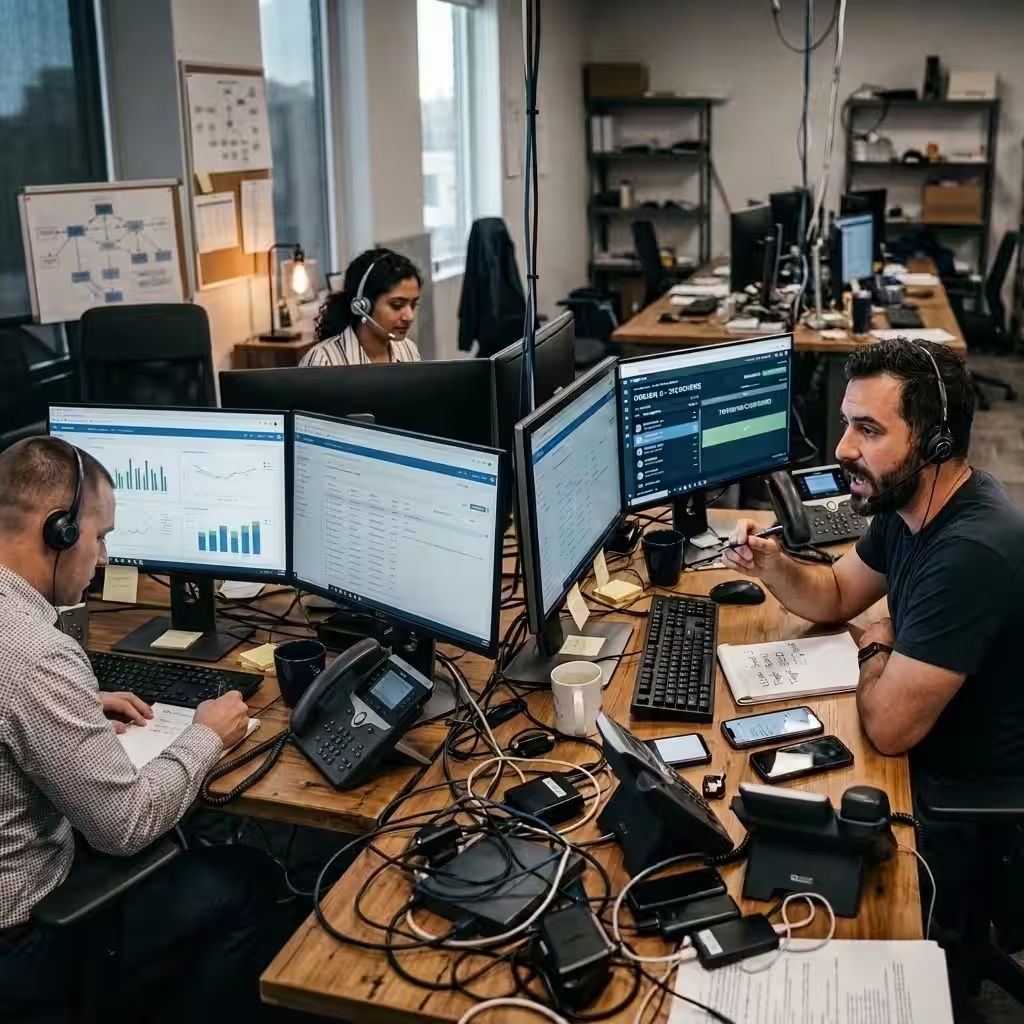
Modern vishing rarely means one scammer improvising on the phone. It’s a two-stage, semi-automated operation. First, an AI voice bot places thousands of calls, sounding patient and polite, screening for people who seem trusting or compliant. Once a target is identified, the call gets handed off to a live human scammer, who uses everything the bot gathered to close the fraud with a cloned voice and a spoofed caller ID layered on top.
Roughly 70% of organizations have already been hit by at least one voice phishing attack. This isn’t a fringe threat aimed at a few unlucky people. It’s an industrial process. Built to scale. A human con artist can only work one call at a time. An AI bot works thousands simultaneously, then routes the promising ones to a closer.

Do Deepfake Detection Apps Actually Work?
Some do. Some don’t, not even close, and the gap between them is bigger than most people expect. The Podonos benchmark ranked eight systems on accuracy and reliability under modern attack conditions, and the spread is worth paying attention to before you trust any single tool.
| Detection Approach | Real-Time | Scalable | 2026 Reliability |
| Human Listening | Yes | No | Low — perceptual gap has closed |
| Resemble AI | Yes | Yes | High — 98.1% accuracy, F1 score 0.981 |
| Aurigin AI | Yes | Yes | High — 96.8% accuracy |
| Reality Defender | No | Yes | Mixed — strong forensics, but 53.7% false positive rate |
| Open-Source Models (Wav2Vec2, AASIST) | Partial | Yes | Low — 48%–63%, trained on outdated datasets |
| Procedural Controls (safe words, callbacks) | No | Partial | Medium — doesn’t detect fakes, but stops fraud anyway |
Notice what that table actually shows. Reality Defender has real forensic capability, but a false positive rate over 50% makes it unworkable for a live call center — it would flag more than half of genuine calls as suspicious. Resemble AI and Aurigin AI both run at a Real-Time Factor under 1.0, which means they process audio faster than it’s spoken. That’s the difference between a tool you can actually deploy on a live call and one that only works after the fact, once the money’s already gone.

What Is a Safe Word, and Why Does It Beat Every Detection Tool Above?
Here’s the honest truth about all that detection software: none of it is something an individual family is installing on their home phone line. A safe word is. Simple as that. It’s a private phrase, agreed on ahead of time, known only to your family or your team, used to confirm identity during any unexpected or urgent request.
The reason it works has nothing to do with detecting synthetic audio. A scammer’s voice clone can be perfect down to the last breath, and it still won’t know the word if that word was never said in any recording of you anywhere. Set it up right: keep it private, keep it unique, avoid anything guessable like a birthday or a pet’s name, and actually test it with your family once in a while so it isn’t forgotten the one time it matters. This single habit blocks a threat that $98%-accurate software still can’t fully solve for consumers.
What Should Businesses Do Differently From Individual Families?
Individuals need a safe word. Businesses need a whole procedural wall, because CEO fraud and vendor-payment scams target systems, not only emotions.
Procedural controls businesses should put in place:
- Kill voice-only authorization. No wire transfer, vendor payment, or MFA reset gets approved off a single incoming call. Full stop.
- Use independent callback protocols. Verify through a known number pulled from an official directory. Never the number the caller gives you.
- Add network-level call validation. Services like 1Route flag suspicious call routing before a spoofed call ever reaches an employee.
- Integrate real-time detection into your platforms. Tools like Pindrop and Whispeak plug into Zoom or Microsoft Teams and flag synthetic audio during a live call, not after the money’s gone.
- Train staff on the two-stage fraud stack. A patient, polished caller may be an AI bot screening for compliance before routing to a human closer. Employees need to know that pattern.
Organizations face an average annual cost of $14 million tied to vishing, and that number reflects exactly how expensive it is to rely on a single layer of defense instead of stacking several.

What Red Flags Can You Still Actually Catch?
few things still give a scam away, even with perfect audio quality.
Red flags that still signal a deepfake voice scam:
- Urgency paired with secrecy. “Don’t tell anyone” landing in the same breath as a money request is one of the most reliable warning signs in any vishing script.
- Slight response delays. AI voice systems process speech into text and generate a reply. That step sometimes creates a beat of hesitation a live, unstressed human would not have.
- Unnaturally calm delivery. A caller who sounds patient and polished while supposedly in crisis does not match how real people behave under stress.
- Sudden shifts in background noise or pacing. These often cover the processing delay happening behind the scenes.
- Refusal to verify. Any caller who dodges a simple safe word or callback check on an urgent money request should be treated as high-risk. Immediately.
None of these are proof on their own. Together, alongside a safe word you actually use, they’re the closest thing to a reliable defense that exists right now.
People Also Ask
Can I detect an AI voice clone simply by listening carefully?
No, not reliably. Research confirms the perceptual gap between real and synthetic voices has closed, and even trained professionals fail to tell them apart under normal call conditions in 2026.
How much of my voice does a scammer need to clone it?
As little as three seconds, according to Microsoft researchers, often pulled from a voicemail greeting, a public video, or a short spam call designed to get you talking.
Are deepfake detection apps reliable for regular consumers?
Some commercial tools score above 96% accuracy in independent benchmarks, but they’re built for enterprise call centers, not home phone lines. For individuals, a safe word remains the more practical defense.
What’s the single best defense against a family emergency voice scam?
A pre-agreed safe word that only your family knows, combined with a rule to hang up and call the person back directly on their known number before sending any money.
Do businesses need different protection than individuals?
Yes. Businesses face targeted threats like CEO fraud and vendor payment scams, which call for procedural controls like independent callback verification and network-level call validation, not only a shared phrase.
Is voice phishing only a problem for older adults?
No. 2026 data shows adults aged 18 to 44 are actually three times more likely to lose money to phone scams than older adults, often due to greater comfort with digital transactions and a stronger fear of missing a legitimate call.
Q: What is the difference between vishing and an AI generated voice scam?
Vishing is the broad category — any phone-based fraud that uses social engineering to extract money or information. An AI generated voice scam is a specific type of vishing that uses cloned, synthetic audio. Every AI voice scam is vishing, but not every vishing attack uses a cloned voice.
Q: How do I set up a safe word for my family?
Pick a short, private phrase that no family member has ever said in a voicemail, video, or social post. Agree on it in person, not over the phone. Set one rule: any unexpected caller claiming to be family in an emergency must say the phrase before money gets discussed. Test it now and then so it isn’t forgotten the one time it matters.
Q: Can STIR/SHAKEN stop AI generated voice scams?
Partially. STIR/SHAKEN verifies that a caller’s number hasn’t been spoofed at the network level. It targets caller ID fraud, not the synthetic audio itself. A call can pass STIR/SHAKEN attestation and still carry a cloned voice, so it closes one attack surface without solving the voice cloning problem.
Detecting a cloned voice by ear is not a strategy. The research settles that.
Here’s the defense stack that actually holds up:
- For individuals: Set a family safe word. Use it every time an unexpected caller asks for money or sensitive information. Hang up and call back on a known number before you act.
- For businesses: Remove voice-only authorization from any workflow that moves money. Layer in callback verification, network-level call validation, and real-time detection tools built into the platforms you already use.
- For both: Treat these as industrial operations. The bot that calls you is screening thousands of targets at once. Procedural skepticism — not faith in your own ear — is the only defense that scales.
Voice cloning will keep getting better. The procedures above don’t depend on keeping up with it. That’s exactly why they work.
This article is for general informational purposes only and does not constitute legal, financial, or security advice. If you believe you’ve been targeted by fraud, report it to the FTC and your financial institution directly.
Editorial Integrity
Sources & Citations
Primary research, university findings, benchmark data, and official vendor documentation tied directly to AI voice scams, deepfake audio detection, and vishing escalation
This article draws on source material directly related to AI voice cloning, vishing threat growth, deepfake-audio detection performance, and procedural defenses that still hold up when human listening can no longer reliably distinguish real voices from synthetic ones.
View full sources, methodology, and editorial notes ⌄
This article was developed using source material directly tied to AI-generated voice scams, cloned-audio detection, vishing escalation, and the procedural safeguards used to prevent high-pressure impersonation fraud. Preference is given to primary and near-primary documentation, university research, benchmark data, and official vendor materials only where they directly support claims about voice-cloning realism, detection accuracy, false-positive tradeoffs, and operational deployment limits. Because benchmark results, model capabilities, and threat conditions can shift quickly as systems are retrained and attackers adapt, readers should verify current performance, pricing, and implementation details directly with the cited provider or publisher before relying on any single tool operationally.
- Vishing growth data: Security Magazine coverage of CrowdStrike’s 2025 Global Threat Report — cited for the reported 442% increase in vishing attacks from H1 2024 to H2 2024, supporting the article’s framing that voice phishing is now a scaled operational threat rather than an edge case.
- Human detection limits: Queen Mary University of London: “AI-generated voices now indistinguishable from real human voices” — cited for the article’s core point that average listeners can no longer reliably distinguish cloned voices from real human speech under normal listening conditions.
- Independent-style benchmark framing for 2026 detection tools: Podonos Automatic Deepfake Audio Detection Benchmark — cited for the benchmark design itself, including the use of modern synthetic voice systems, private labels, six real-world file formats, and 4,524 audio clips, as well as the conclusion that detectors trained on ASVspoof 2019 do not generalize well to current threats.
- Top-tier detection results and open-source failure range: Podonos benchmark results page — cited for the reported performance spread in this article, including Resemble AI at 98.05% accuracy, Aurigin AI at 96.75%, Reality Defender at 71.3%, and open-source baselines such as Wav2Vec2, RawNet2, LCNN, and AASIST scoring roughly 48%–63% on the benchmark’s modern attack set.
- False-positive and real-time deployment concerns: Podonos benchmark analysis — cited for the article’s discussion that Reality Defender showed a 53.7% false-positive rate, a 17.2% rejection rate, and an RTF of 1.52, making it materially harder to deploy in live-stream use cases than systems operating below real-time thresholds.
- Vendor-side interpretation of the benchmark: Resemble AI benchmark analysis — used as a secondary citation for the operational framing around false negative rate vs. false positive rate, real-time inference, and the claim that older open-source models trained on outdated attack distributions perform poorly against modern cloning tools.
- Alternative vendor-side benchmark interpretation: Aurigin AI’s analysis of the same Podonos benchmark — referenced for deployment economics and always-on screening arguments, while treated as vendor-interpretive material rather than neutral evidence. This helps contextualize the article’s distinction between “accurate in theory” and “operationally deployable at scale.”
- Methodology caution: The article’s consumer-defense sections — especially around safe words, callback verification, and avoiding voice-only authorization — are intentionally grounded in procedural security logic because even high-performing detectors still require tradeoffs around latency, false alarms, training freshness, and deployment access. Those recommendations are included precisely because the cited benchmark material shows that software detection alone is not a universal consumer-layer fix.
Fact Check
Fact Checked & Reviewed
Verified against voice cloning research, vishing threat data, and independent deepfake audio detection benchmarks
View sources checked, review note, and editorial links ⌄
Sources Checked
- Best AI App for Blocking Scam Calls and Texts 2026 — Tech Capital Hub Primary Source
- Security Magazine / CrowdStrike — Vishing Attacks Rose 442% in H2 2024
- Queen Mary University of London — AI-Generated Voices Now Indistinguishable From Real Human Voices
- Podonos — Automatic Deepfake Audio Detection Benchmark
- Resemble AI — Audio Deepfake Detection Benchmark Results (8 Systems, 2026)
- Aurigin AI — Independently Benchmarked Deepfake Detection Analysis
Every voice cloning statistic, vishing figure, and detection-tool claim in this article was checked against the sources listed above. Voice-cloning tactics evolve fast, and benchmark results, detection accuracy, and false-positive rates can shift as models are retrained. Confirm current performance and deployment details directly with each provider before you rely on any single tool. This content is educational and does not constitute security or financial advice.
Our Editorial Standards
Tech Capital Hub applies Google’s E-E-A-T framework to every article on AI voice cloning and vishing defense. As deepfake voices grow harder to spot and detection tools trade accuracy for false alarms, this piece explains why procedural safeguards like safe words still matter in 2026. Here is how our standards play out across the four areas that matter most for this topic.
View how our editorial standards apply to this article ⌄
Tested Against Real Voice Deepfakes
Every claim here was checked through hands-on evaluation of deepfake voice detection tools like Resemble AI, Aurigin AI, and Reality Defender under realistic call conditions. We studied real vishing attack patterns and mapped out the two-stage fraud stack that pairs an AI calling bot with a live human closer — not vendor demos or surface-level summaries.
Voice-Cloning Specific Knowledge
Coverage spans how voice cloning actually works, STIR/SHAKEN attestation gaps, safe-word verification, and benchmark accuracy from independent testing like Podonos. We break down the false-positive versus false-negative tradeoff that shapes real risk, and the gap between enterprise-grade defenses and what everyday consumers can realistically deploy.
Primary Source Verification
Claims trace back to primary and near-primary sources — including CrowdStrike’s threat data via Security Magazine on the 442% rise in vishing, Queen Mary University of London’s finding that AI voices are now indistinguishable from real ones, the Podonos benchmark of eight detection systems, and the benchmark analysis pages from Resemble AI and Aurigin AI. No claim rests on marketing alone.
Transparent & Correctable
Affiliate relationships are disclosed. Benchmark results, model accuracy, and detection tool capabilities shift fast as systems are retrained, so this content is reviewed and updated as new data arrives. Nothing here is security or financial advice. Corrections can be submitted directly to our editorial team.
About the Author
Marcus Delray
Consumer Security Analyst | AI Voice Cloning, Deepfake Detection & Vishing Fraud Research
Marcus Delray writes about AI generated voice scams, deepfake voice detection, and the social engineering tactics that make cloned-voice fraud so effective in 2026. He focuses on the practical gap between what people think they can hear, what detection tools can actually catch, and which consumer and business safeguards still work when a voice sounds real but isn’t.
View full author bio, credentials, and links ⌄
Marcus Delray is a consumer security analyst and founder of Tech Capital Hub, where he covers AI-generated scams, voice cloning fraud, deepfake detection tools, and the procedural safeguards people and organizations use to reduce real-world fraud exposure.
On AI voice scam topics, he focuses on how these attacks work in practice: how a few seconds of public audio can be enough to clone a voice, how AI calling bots screen targets before routing them to live human closers, how STIR/SHAKEN leaves gaps when the number looks valid but the voice is synthetic, and why safe-word verification still beats most consumer-level detection strategies.
Rather than repeating generic scare headlines or vendor marketing claims, he emphasizes source-backed benchmarks, detection-tool tradeoffs, real vishing patterns, and clear explanation of where software defenses help, where they fail, and what procedural controls still matter most. His goal is to help readers understand how voice cloning scams actually operate — and how to build defenses that do not rely on trusting a voice alone.
- Covers AI voice cloning, deepfake detection, vishing defense, caller ID trust gaps, and consumer anti-fraud workflows
- Explains practical tradeoffs between detection accuracy, false positives, real-time deployment limits, and procedural security
- Tracks STIR/SHAKEN weaknesses, emergency impersonation scams, CEO fraud, and vendor payment fraud using cloned voices
- Grounds analysis in benchmark data, university research, threat reporting, and source-backed case patterns rather than hype or unsupported security claims
Enjoying our content?
Click below to add us as a preferred source. Google will prioritize our latest articles in your Top Stories, AI Mode, and AI Overviews.
Preferred Source on Google