Why One Smart Contract Audit Is No Longer Enough in 2026

Fintech Analyst · Founder of Tech Capital Hub
Marcus has spent more than a decade researching blockchain, fintech, and digital asset risk. In this article, he explains where AI can strengthen smart contract security, why audits alone are not enough after deployment, and how continuous monitoring helps DeFi teams respond faster to live threats.
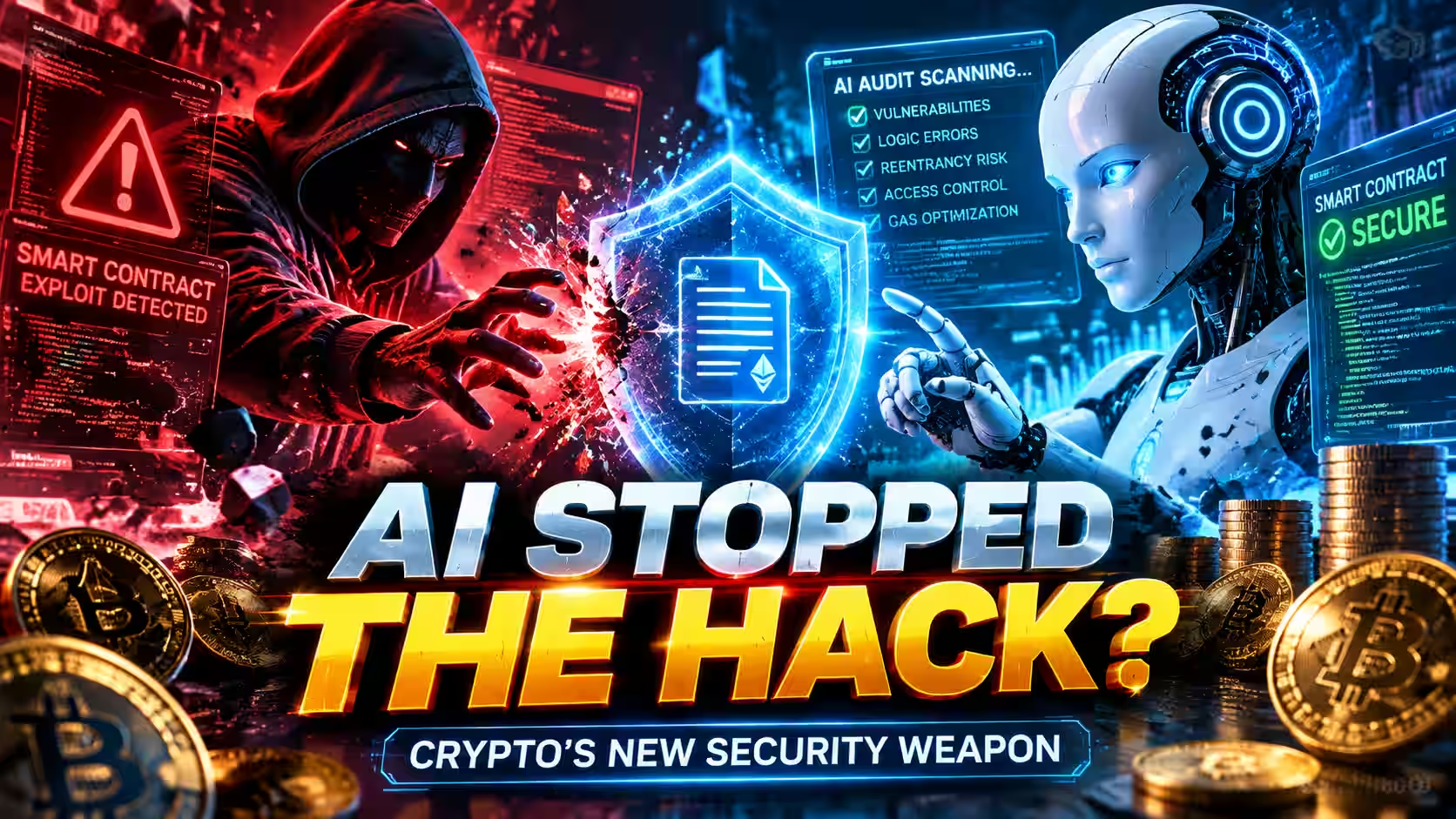
A smart contract audit is a snapshot. It shows how the code looked on the day it was reviewed. Most real-world risk appears after that day.
Protocols ship upgrades. They add integrations. Liquidity grows, and new attack paths open under live market pressure. The audit report stays the same, but the protocol keeps changing.
That gap is why serious DeFi teams now pair audits with continuous smart contract monitoring. It is also why post-deployment smart contract security has become its own discipline — separate from auditing, and just as important.
If you are new to audits, start with our pillar guide on how to read a smart contract audit. It covers severity levels, fixed versus acknowledged findings, and how to check whether the audited code matches what is live. This article picks up where that guide ends. Here, the focus is on what protects a protocol once it is running.
Quick Answer: One audit is not enough because it reviews a fixed version of code at a single point in time. After launch, upgrades, new dependencies, market conditions, and off-chain systems keep changing a protocol’s risk. Strong DeFi security in 2026 combines a pre-launch audit, continuous on-chain monitoring with automated alerts and safeguards, and human experts who review what the tools flag.
Table of Contents

What a Smart Contract Audit Still Does Well
A smart contract audit is an independent security review of deployed or pre-launch code, conducted to identify vulnerabilities before users put funds at risk.
This is not an argument against audits. A strong one is still the foundation.
A good review catches known bug classes before launch. It can surface access control flaws, reentrancy risks, broken business logic, and unsafe assumptions. It also forces a team to define scope, fix findings, and improve code quality before mainnet.
Frameworks like OWASP Smart Contract Security give developers and auditors a shared standard for testing and verification. The OWASP Smart Contract Top 10 maps the vulnerability classes that cause the most damage. Top audit firms also layer manual review with static analysis, fuzzing, and formal verification.
All of that reduces risk before launch. None of it watches the protocol after launch.
Where a One-Time Audit Falls Short
An audit answers one question: was this version of the code reasonably safe when it was reviewed?
It cannot answer the questions that matter next:
- Has the code changed since the review?
- Did a dependency or integration add new exposure?
- Is someone probing the protocol right now?
- Would the team notice an attack in time to act?
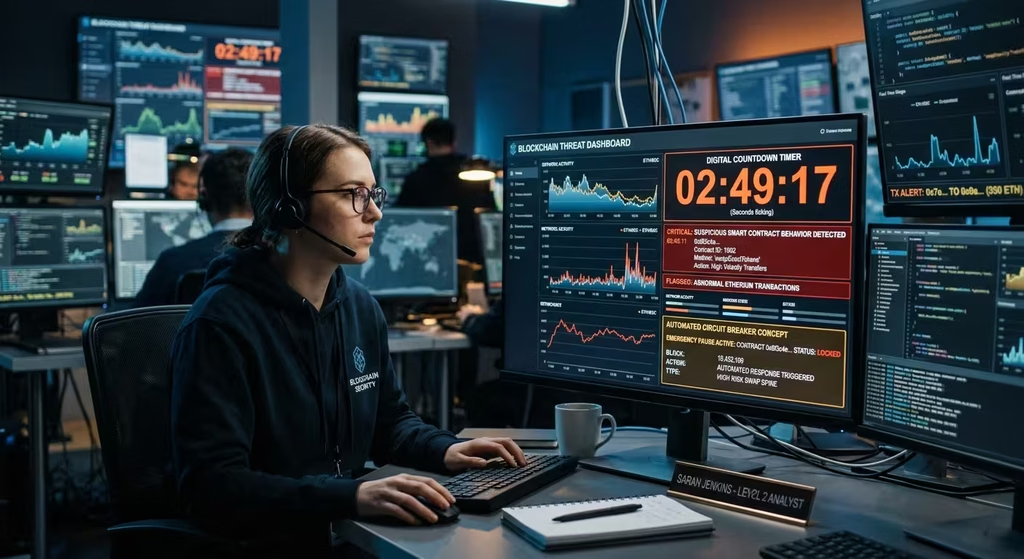
An audit does not track behavior block by block. It does not raise an alert when an admin key suddenly moves funds. It does not freeze withdrawals when a pool drains at an unusual rate.
The scope is often narrow, too. Most audits cover contract code, not the full system around it. The Bybit hack in February 2025 made this painfully clear. Attackers stole more than $1.4 billion. The weak point was the transaction signing infrastructure, not the contract logic itself. The audit never covered it.
That is the gap post-deployment smart contract security is meant to close.
Why Audited Protocols Still Get Exploited
Audited protocols get drained more often than most people expect. The causes tend to fall into four patterns.
Code Drift After the Audit
Teams keep shipping. A new feature goes live. A proxy contract gets upgraded. A small patch skips a second review. Over time, the audit describes a protocol that no longer exists.
New Integrations Widen the Attack Surface
Every new oracle, bridge, vault, or token adds a dependency. Each dependency brings its own risks. A protocol can be safe in isolation and still fail when a connected system breaks.
Market Conditions Create New Exploit Paths
Some attacks only make economic sense at certain liquidity levels or price conditions. A flash loan strategy that was unprofitable at launch may become viable months later. The code did not change. The environment did.
Off-Chain Systems Stay Exposed
Front ends, multisig setups, deployment pipelines, and key management sit outside most audit scopes. Attackers know this. They often target the softest layer, not the hardest one.

What Is Continuous Smart Contract Monitoring?
Continuous smart contract monitoring is the real-time observation of a deployed protocol’s on-chain activity, designed to detect anomalies, suspicious behavior, and exploit patterns after launch.
An audit asks: Is this code safe enough to ship?
Contract monitoring asks: What is this protocol doing right now, and does any of it look dangerous?
A strong setup watches for signals like:
- unusual withdrawal sizes or speeds
- sudden changes to admin roles or permissions
- abnormal function calls or call sequences
- bursts of transactions from new wallets
- sharp price moves in the oracles a protocol depends on
- interactions with addresses linked to past exploits
Tools such as OpenZeppelin Monitor let teams track critical events, detect anomalies, send alerts, and trigger automated responses. Forta focuses on block-by-block visibility across a protocol’s full dependency map. It can screen and stop risky transactions before or after execution.
This is the shift from passive review to active defense.
Smart Contract Audit vs Continuous Monitoring
A smart contract audit reviews code before launch. Continuous monitoring watches live behavior after deployment. They are not substitutes — each covers a different stage of risk.
Smart Contract Audit vs Continuous Monitoring
An interactive comparison of what each security layer does before launch and after deployment.
| Capability | Smart Contract Audit | Continuous Monitoring |
|---|---|---|
Reviews code before launch
Audits examine a defined codebase before deployment or before a major upgrade goes live. This is where teams catch many preventable flaws early. | Yes Designed for pre-launch review, scoped analysis, and remediation before mainnet. | No Monitoring does not replace code review. It begins after deployment. |
Watches live transactions
Monitoring tracks real-time on-chain behavior, including unusual withdrawals, permission changes, and suspicious wallet activity. | No A point-in-time review cannot observe what the protocol is doing after launch. | Yes Built for post-deployment visibility and live threat detection. |
Finds known code flaws
Audits are stronger at surfacing direct code issues. Monitoring may still detect symptoms of flawed logic after deployment. | Yes Strong at identifying access control flaws, reentrancy risks, and unsafe assumptions before launch. | Sometimes Usually detects consequences in production rather than the root flaw in code. |
Detects runtime anomalies
Runtime anomalies include unusual call patterns, sudden liquidity movement, abnormal admin actions, and exploit-like transaction behavior. | No Audits do not continuously inspect live behavior after code ships. | Yes This is one of the main reasons continuous monitoring exists. |
Covers upgrades and new integrations
Upgrades, bridges, oracles, and dependency changes create new risk. Audits can cover them only if the scope is refreshed. Monitoring sees the impact as it happens. | Limited Only if the new release or integration is reviewed again. | Yes Can flag suspicious behavior after the environment changes. |
Supports fast incident response
During an active exploit, teams need alerts, prioritization, and sometimes automated safeguards like pause controls or withdrawal caps. | Limited Useful for preparation, but not built for real-time operational response. | Yes Helps teams detect, triage, and respond faster during live incidents. |
Requires human expertise
Neither audits nor monitoring should run without human judgment. Experts are needed to review findings, validate alerts, and make escalation decisions. | High Experienced auditors are essential for architecture, threat modeling, and review quality. | High Automation helps with speed, but human review is still critical for major decisions. |
An audit is a quality gate. Smart contract monitoring is an ongoing safety system. A protocol in motion needs both.
How AI Improves Smart Contract Monitoring After Launch
“AI-powered” appears on almost every security product today. Much of it is vague. Here is where AI smart contract security adds real, measurable value after deployment.
Faster Anomaly Detection
Machine learning models learn what normal activity looks like for a given protocol. They flag behavior that breaks the pattern — a withdrawal far larger than usual, or a call sequence that has never appeared before.
Smarter Alert Triage
Busy protocols generate a lot of noise. Rule-based systems often flood teams with alerts. AI can rank alerts by risk, filter likely false positives, and push the most urgent signals to the top.
Pattern Recognition at Scale
No human team can inspect every interaction across thousands of blockchain smart contracts. AI can scan large volumes of on-chain data, link related wallets, and spot attack patterns that repeat across protocols.
Shorter Time From Signal to Action
Many DeFi exploits finish within a single transaction. Manual response is often too slow. AI-driven detection, paired with automated safeguards, can narrow that gap. A circuit breaker can pause a function or cap withdrawals while humans investigate.
Explainable Decisions
Automated actions need clear reasons. If a system freezes a withdrawal, users and teams deserve to know why. Explainable AI turns model outputs into plain-language factors that people can review and challenge. This matters for trust, and increasingly for regulation.
For AI governance, the NIST AI Risk Management Framework offers a practical structure for managing AI risk in high-impact systems. In financial services, the FCA’s guidance on AI stresses safe, responsible, and accountable adoption. Both point to the same principle: automation should come with transparency and human oversight.
What AI Cannot Do on Its Own
AI can strengthen monitoring. It cannot guarantee safety.
- It can miss novel exploit logic it has never seen before.
- It can raise false alarms if it is poorly tuned.
- It cannot judge whether a protocol’s economic design is sound.
- It cannot fix weak governance, poor key management, or bad incentives.
- Attackers use the same AI techniques to find weak spots faster.
Some marketing describes AI-powered smart contracts as if adding intelligence solves the whole problem. It does not. The real gain comes from better tooling around the contract: faster detection, sharper prioritization, and more informed decisions under pressure.
Senior security engineers still matter. They catch design flaws that no model flags. They make judgment calls under pressure. AI extends their reach. It does not replace them.
What Strong Post-Deployment Smart Contract Security Looks Like
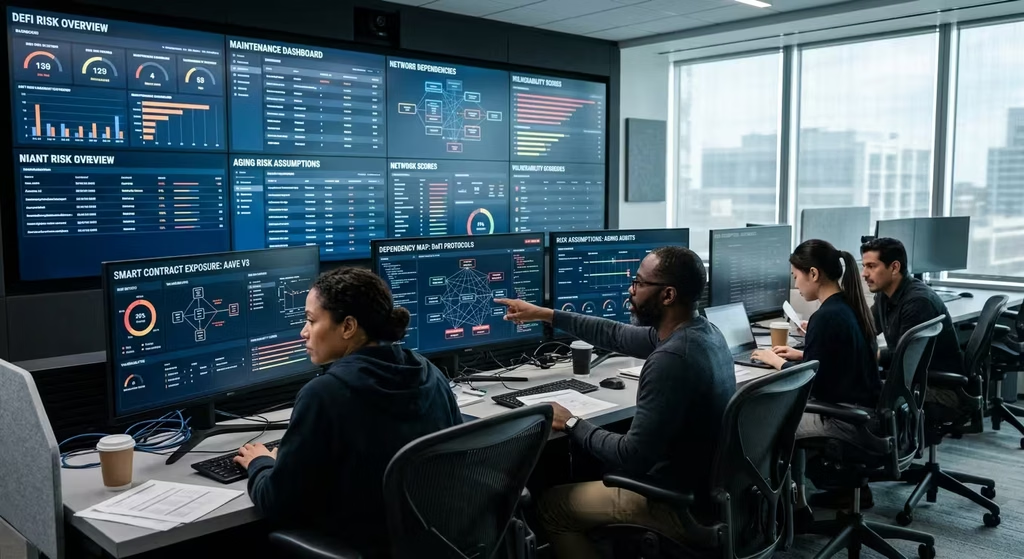
A serious contract monitor setup is more than a dashboard. It is a repeatable process built around live behavior.
Behavioral Baselines
Teams define what normal looks like. That includes typical transaction sizes, call frequency, admin activity, and wallet patterns. Anomalies only mean something when you know the baseline.
Risk-Based Alerting
Not every event deserves the same urgency. Good contract monitoring tools assign severity based on impact and context. A large withdrawal from a known treasury wallet is not the same as one from a wallet created ten minutes ago.
Automated Safeguards
Many teams link alerts to on-chain controls. These include pause functions, withdrawal limits, rate limits, and circuit breakers. Automated safeguards buy time when every second counts.
Human Escalation
Automation handles speed. People handle judgment. Clear escalation paths decide who reviews an alert, who approves a pause, and how the team communicates during an incident.
Regular Tuning
Thresholds set at launch go stale. Monitoring rules should evolve with every upgrade, new integration, and shift in liquidity.
The 2026 DeFi Security Model
The strongest DeFi security today is layered. No single control carries the full load. Here is the framework that holds up:
- Audit the code before launch. Identify and fix known vulnerabilities before deployment.
- Verify the deployed version. Confirm the live contract matches the audited code.
- Monitor live behavior continuously. Watch for anomalies, suspicious patterns, and unexpected activity.
- Add automated safeguards. Pair alerts with pause logic or withdrawal limits that act before humans can.
- Run a bug bounty. Give outside researchers a reason to report flaws. Immunefi is the largest platform for this.
- Reassess after upgrades. Every code change is a potential new risk surface.
- Keep humans in the loop. Automation filters and speeds up response. Experts make the final call.
The 2026 DeFi Security Model
A layered framework for protecting protocols before launch, after deployment, and during live incidents.
| Layer | Purpose | When It Applies |
|---|---|---|
Pre-launch audit
Reviews contract logic, permissions, integrations, and vulnerability classes before mainnet. Best used before launch and after major upgrades. | Find code flaws before deployment and reduce avoidable security debt. | Before mainnet and after major protocol changes. |
Secure deployment
Confirms the deployed contract matches the reviewed version, including verified source code, release process, and admin controls. | Verify that the live code and permissions match what was actually reviewed. | At every release, migration, or contract upgrade. |
Continuous monitoring
Tracks on-chain behavior in real time, including abnormal withdrawals, permission changes, suspicious wallets, and exploit patterns. | Detect live threats, anomalies, and risky behavior across deployed contracts. | Around the clock after deployment. |
Automated safeguards
Uses pause functions, withdrawal caps, rate limits, and circuit breakers to contain damage while the team investigates. | Limit blast radius and buy time when abnormal activity is detected. | During high-risk events and active incidents. |
Human review
Security engineers validate alerts, assess intent, review edge cases, and decide when automated actions should escalate. | Add judgment, context, and escalation control where tools alone are not enough. | Ongoing and during escalations. |
Bug bounty
Incentivizes external researchers to report vulnerabilities responsibly instead of exploiting them in the wild. | Extend coverage beyond internal teams and surface issues earlier. | Continuously, once the protocol is live. |
Periodic reassessment
Updates threat models, monitoring rules, audit scope, and incident assumptions as the protocol evolves. | Keep security controls aligned with upgrades, dependencies, and changing market conditions. | Quarterly, or after meaningful code and architecture changes. |
Each layer covers a gap the others leave open. Together, they turn security from a one-time event into an ongoing function.
Contract Monitoring Best Practices for DeFi Teams
A few habits separate strong security programs from weak ones:
- Watch privileged actions first. Admin role changes and ownership transfers are high-risk signals.
- Track large outflows. Flag unusual withdrawal sizes, speeds, and destinations.
- Monitor dependencies. Watch the oracles, bridges, and protocols you rely on, not just your own contracts.
- Define severity levels early. Decide what counts as critical before an incident starts.
- Test your response. Run drills on alerts, pauses, and team communication before you need them.
- Re-review after upgrades. Update monitoring rules and scope a fresh review when code changes.
- Run a bug bounty. Ongoing external review complements internal monitoring.
- Keep humans in the loop. Let automation filter and act fast, but have experts confirm major decisions.
These contract monitoring best practices do not require a large team. They require clarity about what normal looks like, what counts as dangerous, and who is responsible for each decision.
What Investors Should Ask Beyond the Audit Badge
You do not need to read Solidity to ask sharper questions. Before you deposit funds, ask:
- When was the last audit completed?
- What has changed in the code since then?
- Does the protocol run real-time smart contract monitoring?
- Are alerts tied to a tested response plan?
- Are there pause controls or withdrawal limits?
- Is there an active bug bounty?
- Has the team been transparent about past incidents?
A protocol with a clean audit PDF but no live visibility has a gap. That does not make it unsafe by default. It means the security posture is incomplete.
If you want to evaluate the audit itself, our companion guide explains how to verify whether an audit still matches the deployed code.
People Also Ask
Does a smart contract audit guarantee safety?
No. An audit reduces risk but does not remove it. It reviews one version of the code at one point in time. Upgrades, new integrations, market shifts, and off-chain systems can all introduce new risk after the review is complete.
What is continuous smart contract monitoring?
Continuous smart contract monitoring is the real-time tracking of a live protocol’s on-chain activity to detect anomalies, suspicious behavior, and exploit patterns after deployment. Unlike an audit, it runs around the clock and adapts as the protocol evolves.
What is the difference between an audit and continuous monitoring?
An audit is a pre-launch review of the code. Continuous monitoring watches live on-chain activity after deployment. The audit helps you ship safer code. Monitoring helps you detect and respond to threats while the protocol runs.
Can AI detect smart contract exploits in real time?
AI can flag unusual on-chain behavior quickly, often within seconds. When paired with automated safeguards like pause functions, it can help contain an attack before funds move. It is not perfect — it can miss novel exploits and still needs human review for complex decisions.
Why do audited DeFi protocols still get hacked?
Common causes include code changes after the audit, risky new integrations, market conditions that make attacks economically viable, and weak off-chain security. Many audits also have limited scope and do not cover signing systems, front ends, or external dependencies.
What should a DeFi team do after an audit?
Set up real-time smart contract monitoring, define alert thresholds, add emergency controls, run a bug bounty, and re-review the code after every major upgrade. Then test the response plan before it is ever needed.
Final Takeaway
The best protocols do not treat security as a one-time gate. They treat it as a living system.
Audits help teams ship safer code. Continuous smart contract monitoring helps protect what is actually running. AI improves detection speed, alert quality, and scale. Human experts provide the judgment no tool can replace.
If you remember one idea, make it this:
An audit checks what you planned to deploy. Continuous monitoring protects what is actually live.
That is the foundation of strong smart contract security in 2026. And for protocols serious about long-term trust, there is no shortcut around it.
Blockchain Security · Editorial Integrity
Sources & Citations
Public documentation, security frameworks, research, and industry reporting behind this guide on AI smart contract auditing, continuous monitoring, DeFi exploit detection, and post-deployment security.
Every core claim in this article is grounded in public documentation, named security frameworks, platform materials, and current reporting on blockchain security and AI governance. Smart contract security references lean on established standards and developer documentation. Monitoring and live-response sections rely on official platform materials and public research. AI oversight points draw on government and regulatory guidance where helpful. Because attack methods and monitoring capabilities evolve quickly, readers should always verify the latest documentation before making technical or operational decisions.
View full sources, methodology, and editorial notes
This guide was written using primary developer documentation, public security frameworks, reputable research, and current industry reporting. Preference is given to official standards, protocol or tooling documentation, government guidance, and named research organizations where they directly support a claim about smart contract auditing, continuous monitoring, exploit detection, post-deployment risk, or AI governance. Some operational examples are described in principle because threat patterns, tooling, and attack conditions can shift fast. This article is educational information, not legal, financial, or security advice.
- Smart contract security standards and verification practices: OWASP Smart Contract Security Project — cited as a primary reference for structured smart contract security guidance, security verification standards, testing guidance, and vulnerability classification.
- Runtime monitoring and automated on-chain alerts: OpenZeppelin Monitor Documentation — cited for how teams can monitor on-chain activity in real time, configure alerts, watch critical events, and support automated responses.
- Continuous on-chain risk visibility: Forta — cited for block-by-block monitoring, dependency visibility, alerting, and transaction screening in live blockchain environments.
- AI governance and trustworthy AI risk controls: NIST AI Risk Management Framework — cited for high-level guidance on trustworthy AI, risk management, and governance principles relevant to AI-assisted security systems.
- AI adoption and accountability in financial systems: FCA — AI in Financial Services — cited for regulatory perspective on safe, responsible, and accountable AI adoption in financial contexts.
- Post-deployment exploit context and major incident reporting: Chainalysis — Bybit Exchange Hack Analysis — cited as a named industry report illustrating how major losses can involve operational or signing-process weaknesses beyond contract logic alone.
- Responsible disclosure and smart contract bug bounties: Immunefi Bug Bounty Program Directory — cited to support the discussion of external security review, researcher incentives, and ongoing vulnerability disclosure practices.
- Companion internal explainer on audit review: Tech Capital Hub — How to Read a Smart Contract Audit — linked as the foundational internal guide for understanding audit scope, findings, and how to verify whether an audit still matches live code.
AI Smart Contract Audit · Editorial Standards
Our Editorial Standards
Tech Capital Hub applies Google’s E-E-A-T framework to every blockchain security article, with a focus on clear definitions, primary documentation, and balanced risk analysis over hype. This guide draws on public smart contract security frameworks, official monitoring documentation, named security platforms, and AI governance guidance to explain where AI can improve smart contract auditing, where continuous monitoring matters more than a one-time review, and why human oversight is still essential. Where tooling and threat patterns evolve quickly, we prefer principle-driven explanations over overstated certainty.
View how our editorial standards apply to this article
Complex Security Concepts Explained in Plain English
This article is written for readers who want to understand smart contract security without getting buried in jargon. It breaks down the difference between a point-in-time audit and continuous monitoring, explains why audited DeFi protocols can still fail after launch, and shows where AI fits into live threat detection. Practical examples and direct comparisons are used so both newcomers and experienced operators can follow the logic clearly.
AI, Audits, and Monitoring Framed With Technical Precision
Coverage is structured around the real security workflow. We distinguish code review from runtime monitoring, explain how AI can support anomaly detection and alert triage, and make clear where automation ends and human review begins. The article avoids treating AI as a magic fix and instead positions it as one layer in a broader DeFi security model that includes audits, live monitoring, safeguards, and reassessment.
Built on Official Docs, Security Standards, and Named Research
Key claims are anchored to trusted references where they matter most. Smart contract verification and testing standards draw on OWASP guidance. Live monitoring and alerting concepts reference official platform documentation from established blockchain security providers. AI governance points are supported by NIST and regulator guidance. Internal links connect readers to related foundational explainers so the article sits inside a broader, coherent topic cluster.
Balanced About Limits, Trade-Offs, and Fast-Changing Risk
We are explicit about what this article can and cannot claim. Audits reduce risk but do not guarantee safety. Monitoring improves visibility but cannot catch everything. AI can strengthen detection and prioritization, yet still produces false positives and requires human judgment. Because exploit patterns, tooling, and operating practices evolve quickly, this guide is written as educational analysis rather than legal, investment, or security advice. Corrections or source challenges can be sent to editorial@techcapitalhub.com.
Blockchain Security · About the Author
Marcus Delray
Fintech Analyst · Founder of Tech Capital Hub
Marcus Delray is a fintech analyst and the founder of Tech Capital Hub. In this article, he breaks down where AI can improve smart contract auditing, why one-time reviews are no longer enough for modern DeFi risk, and how continuous monitoring helps security teams respond faster after deployment. His approach prioritizes clarity, technical accuracy, and balanced analysis over hype.
View full author bio, credentials, and links
Marcus Delray has spent more than a decade researching financial technology, blockchain systems, digital asset risk, and the growing role of AI in complex markets. He built Tech Capital Hub to turn technical subjects into practical, readable analysis for both newcomers and experienced readers. His work focuses on blockchain, DeFi, AI in finance, and business technology, with a consistent emphasis on clarity, source quality, and real-world usefulness.
For this article, Marcus focuses on a question that matters far beyond launch-day code review: can AI actually make smart contract auditing better, and where does its value stop? He explains the difference between a point-in-time audit and continuous monitoring, outlines how AI can support anomaly detection and alert triage, and shows why live protocols still need human oversight, tested safeguards, and repeated reassessment. Rather than presenting AI as a cure-all, he frames it as one layer inside a broader security model built around audits, monitoring, and operational response. All content is educational information, not legal, financial, or security advice.
- Explains smart contract auditing, continuous monitoring, and DeFi risk in plain language without flattening the technical nuance
- Distinguishes clearly between pre-launch code review and post-deployment monitoring, helping readers understand where each security layer fits
- Examines how AI can improve anomaly detection, alert prioritization, and live threat response without overstating what automation can do
- Grounds blockchain security coverage in official documentation, named frameworks, public research, and internal topic-cluster explainers where relevant
- Applies an educational, non-promotional lens to fast-changing topics where exploit methods, tooling, and operating assumptions evolve quickly
Enjoying our content?
Click below to add us as a preferred source. Google will prioritize our latest articles in your Top Stories, AI Mode, and AI Overviews.
Preferred Source on Google