AI Stock Trading for Beginners: How It Works, Best Tools, and How to Start Safely in 2026


Fintech Analyst · Founder of Tech Capital Hub
Marcus has spent more than a decade researching financial technology and market analytics. In this guide, he explains how AI stock trading really works, reviews the tools retail investors can actually use, and breaks down the risks — from overfitting to black-box models — so you can start with a clear, realistic process.
AI stock trading uses machine learning, market data, news, and sentiment signals to spot opportunities and support your buy and sell decisions. For years, that kind of firepower was locked behind seven-figure tech budgets. Now it’s available to regular investors. This guide explains how it works, which tools you can actually use, the risks worth knowing, and how to get started the smart way in 2026.
My uncle lost $11,000 in 2019 picking stocks the old way. Research, gut feeling, a tip from a friend. Gone in three weeks.
Meanwhile, a hedge fund two miles from his house was running AI that scanned 8,000 stocks before he even had his morning coffee.
That’s the gap nobody talks about. And honestly? It’s been that way for a long time. AI stock trading was a rich man’s game — locked behind huge tech budgets and PhD-level math. Regular investors didn’t stand much of a chance.
But here’s what’s different now. Those same tools are available to anyone. Not a stripped-down version. The real thing. Let’s break down how it works and how you can use it.
Who This Guide Is For (and Who It Isn’t)
Before you dive in, a quick gut check. This saves you time.
This guide is for you if you’re:
- A beginner who wants to understand AI stock trading without the jargon
- A self-directed investor comparing AI tools before you pick one
- Someone who wants a realistic starting process, not hype
This guide is not for you if you’re:
- Looking for guaranteed returns or a “get rich” button
- Wanting a fully hands-off autopilot that thinks for you
- Chasing day-trading adrenaline over a solid process
Short version: if you want a clear head and a sane plan, keep reading. If you want magic, no tool here delivers that.
What AI Stock Trading Actually Means (No Jargon)
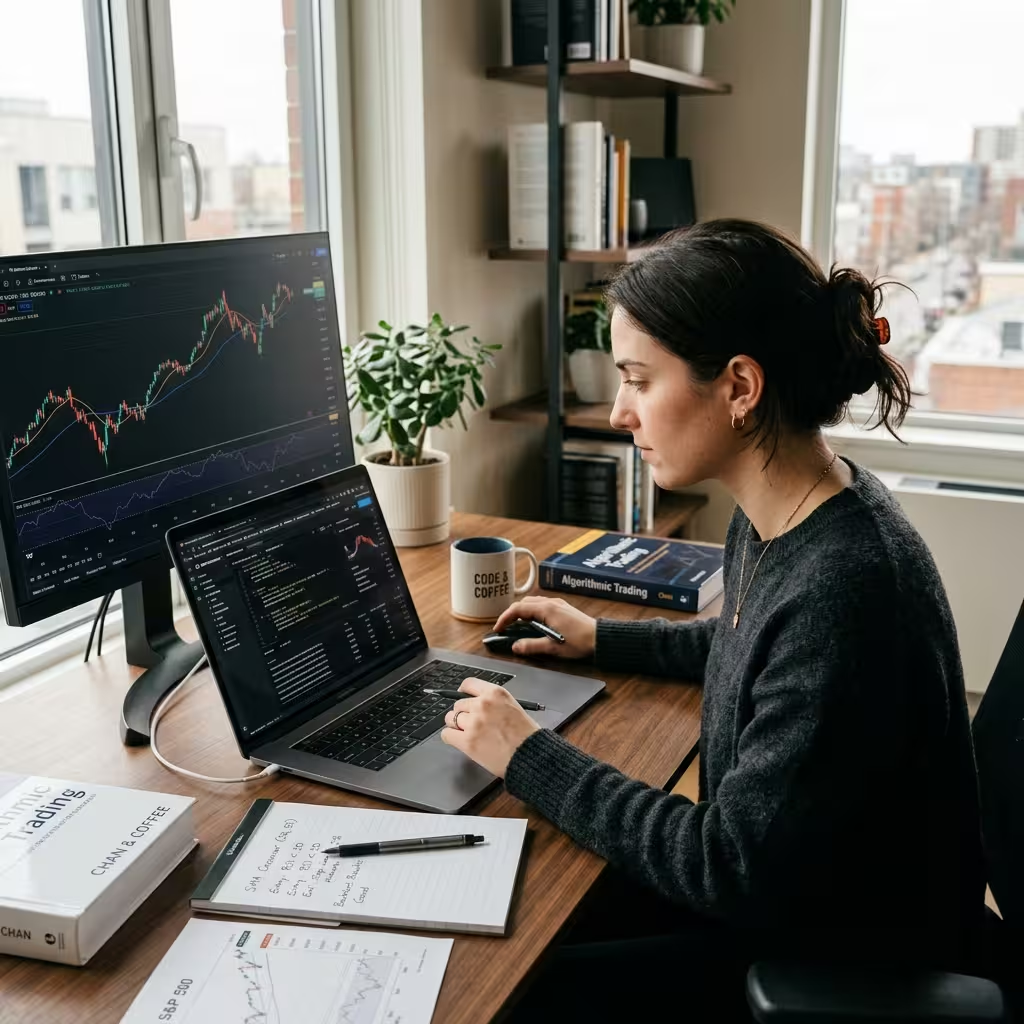
AI stock trading is when a computer program studies the market and helps you decide when to buy or sell. The program looks at prices, news, company reports, even social media posts. It spots patterns. Then it tells you what it found.
People throw this term around like everyone already knows what it means. They don’t. So let’s be real about it.
What makes it different from a basic stock screener? Machine learning.
Old programs followed rules a human typed in. “If the price drops 5%, sell.” That’s it. No thinking. Just following orders.
Machine learning tools work differently. They learn on their own. You feed them data — years and years of it — and they figure out the patterns themselves. Nobody had to program the rules. The system found them. IBM’s overview of machine learning explains this shift well: the model improves as it processes more examples.
That’s a genuinely big shift. It’s the difference between a calculator and something that actually learns.
If you want to apply this to crypto specifically, our deep dive on AI crypto trading bots and strategies covers grid, DCA, and arbitrage bots with an honest look at what actually works.
AI Stock Trading vs Stock Screeners vs Robo-Advisors
These three get mixed up constantly. They do very different jobs. Here’s the quick version.
AI Stock Trading vs Screeners vs Robo-Advisors
AI Stock Trading vs Stock Screeners vs Robo-Advisors
These three get mixed up all the time, but they do very different jobs. One suggests, one filters, and one drives. Here’s a clear side-by-side so you can match the right tool to your goal.
→ Swipe sideways to see the full table
| Compare | AI Stock Trading Tools that suggest | Stock Screeners Filters that shortlist | Robo-Advisors Platforms that drive |
|---|---|---|---|
| What it does | Uses AI models to generate signals or automate parts of a strategy. | Filters stocks using fixed rules you set. | Builds and manages a diversified portfolio for you. |
| Main goal | Give data-driven ideas while you stay in control. | Narrow thousands of stocks down to a shortlist. | Grow money passively over the long run. |
| How it works | Learns patterns from data, then scores or acts on stocks. | Applies criteria like price, P/E, or volume. | Allocates into index funds and rebalances for you. |
| Typical examples | Kavout, Danelfin, AltIndex, Capitalise.ai. | Finviz, Zacks, broker-built screeners. | Betterment, Wealthfront, robo tools at big brokers. |
| Time horizon | Short to long term, depending on your goal. | Any — it’s a research step, not a strategy. | Usually long term and hands-off. |
| What you’re evaluating | The tool: data quality, signals, transparency. | Your rules: are the filters actually useful? | The platform: fees, allocation, risk fit. |
| Control level | Medium — you decide, the AI advises. | High — you set every rule yourself. | Low — the platform runs it for you. |
| Main risk | Trusting a black box you don’t understand. Overfitting risk | Bad rules produce a misleading shortlist. Garbage in, out | Fees and a generic plan that may not fit you. Fee drag |
| Best for | Investors who want help screening and timing. | People who know their criteria and want a list. | People who want fully hands-off investing. |
| Beginner mistake to avoid | Going full autopilot before paper trading. | Stacking too many filters until nothing shows. | Ignoring fees and never checking your risk level. |
All three approaches involve real investment risk, and none of them guarantees any outcome. This comparison is for general education only and is not financial advice. Always do your own research and verify current details before you invest.
The simplest way to remember it: a screener filters, an AI tool suggests, and a robo-advisor drives. If you want to learn and stay involved, AI tools sit right in the middle — helpful, but not on autopilot.
Table of Contents

How Does AI Predict Stock Market Movements?
AI does not predict stock prices with certainty. It analyzes historical data, news, sentiment, and technical signals to estimate the probability of what usually happens next. Think odds, not fortune-telling.
Real talk — it doesn’t “predict” anything. Not exactly.
What it does is closer to what a good poker player does. They don’t know your cards. But they read the table, track the betting, and remember what happened in similar hands before. Then they make the best move given the odds.
AI does the same thing with stocks. It looks at conditions right now and asks: given everything I know from history, what usually happens next?
Here are the main tools it uses to do that:
- Sentiment analysis. The AI reads. A lot. News articles, earnings call transcripts, analyst notes, Reddit threads. It scores each one — positive, negative, or neutral. A flood of positive news before a report often signals the stock could move up. The AI catches it before most humans even open the article. For a closer look at how these tools work and which ones retail investors can afford, see our guide to AI market sentiment analysis tools.
- Predictive analytics. This one’s all about history. The system studies decades of price data and finds patterns that keep repeating. Not 100% of the time. But often enough to matter.
- Technical indicators. RSI. MACD. Bollinger Bands. Traders have used these for decades. AI takes those signals plus dozens of others and tests which combinations actually worked — not just one indicator, but all of them together, across different market conditions.
- Alternative data. This is the wild one. Some hedge funds pay for satellite photos of retail parking lots and count the cars. More cars than last quarter probably means stronger sales. Others track shipping containers or analyze how confident a CEO sounds on an earnings call — literally measuring voice tone. Some of this is now trickling down into tools regular investors can afford.
The newest systems combine all of this at once. They read a chart, process a text report, and cross-reference social data in seconds. Humans can’t match that speed. But speed isn’t everything — more on that later.
What Data AI Trading Tools Actually Use
Since data drives everything here, it helps to see it in one place. Most AI trading tools pull from some mix of these sources:
- Price and volume — the raw movement of a stock over time
- Earnings reports — revenue, profit, guidance, and surprises
- Analyst notes and ratings — professional expectations and revisions
- News coverage — headlines and articles scored for tone
- Social sentiment — Reddit, X, and forum chatter
- Technical indicators — RSI, MACD, moving averages, and more
- Alternative data — web traffic, hiring trends, satellite imagery, shipping data
Here’s the thing to remember: a tool is only as good as the data feeding it. Cleaner, broader data usually means better signals. Thin or stale data means garbage in, garbage out.

What’s Actually Working: Machine Learning in the Stock Market
Not every AI tool is worth your time. Here’s what has real results behind it.
Quantitative Trading — The OG Approach
Big quant funds have used math-heavy models since the 1980s. The methods got far more powerful over time. Modern systems use deep neural networks trained on massive datasets. We’re talking millions of variables, not just price and volume.
Two Sigma, one of the best-known quant firms in the world, has been public about something interesting. The focus is moving away from just building bigger models. Now it’s about building smarter ones — models where you understand why a call was made, not just what it predicted.
That word — interpretability — keeps coming up in serious investing circles. If your AI made a bad call, can you figure out why? If you can’t explain it, trusting it is a problem.
Backtesting: Useful but Tricky
Backtesting means running a strategy against old market data to see how it would have performed. It’s a standard step before going live. Run your idea against 10 years of prices. See how it did.
Here’s the trap most beginners fall into. A strategy looks incredible on paper — 60% annual returns, barely any losses. Then it falls apart the second you trade with real money.
Why? Because the model memorized old data instead of learning real patterns. It’s called overfitting. Smart systems test against data the model has never seen before. If it still works there, it might actually work in real life. If not, back to the drawing board.
Red Flags When Choosing an AI Trading Tool
Before you look at any platform, know what a bad one looks like. This is the fastest way to avoid getting burned.
Walk away — or at least slow down — if a tool shows any of these:
- No explanation of how signals are generated. If it’s a total black box, you can’t trust it.
- Unrealistic win-rate claims. “95% accuracy” or “guaranteed returns” is a giant red flag.
- No paper trading or demo mode. You should be able to test before you pay.
- No risk disclosures. Serious tools tell you what can go wrong.
- Vague pricing. If you can’t find clear costs, expect surprises.
- Only cherry-picked backtests. One golden period proves nothing.
- No mention of drawdowns or false signals. Every real strategy has losing streaks. Silence about them is a warning.
Quick rule: the more a tool promises and the less it explains, the faster you should close the tab.
Best AI Investment Tools for 2026 (That Real People Can Use)
Good news — you don’t need a Wall Street budget for these. Here are the platforms worth knowing about.
If you want a deeper breakdown of every major platform in this category, our guide to the best AI stock screeners for 2026 walks through eight tools with side-by-side comparisons.
Best AI Investment Tools · 2026 Comparison
Best AI Investment Tools for 2026 at a Glance
Here’s a quick side-by-side of five AI platforms built for everyday investors. Each one takes a different angle — from simple scored signals to no-code strategy building — so you can match the right tool to your goal.
→ Swipe sideways to see the full table
| Tool | Best For | Core Strength | Beginner Friendly | Pricing Model | Best Takeaway |
|---|---|---|---|---|---|
| Kavout Scored signals | Simple, at-a-glance stock signals | The Kai Score rates each stock on a 1–9 scale | High | Freemium | A clean score means you don’t need to master the math. |
| Danelfin Probability picks | Odds-based picks with clear transparency | Percentage-based likelihood a stock beats the market | High | Free / Paid | Honest when the model isn’t confident — a refreshing touch. |
| AltIndex Alternative data | Spotting early movers before the crowd | Alternative data and social sentiment tracking | Moderate | Freemium | Great for catching stocks getting hot ahead of the mainstream. |
| Tickeron Active trading | Active traders who follow technical setups | Chart-pattern scanning and breakout detection | Moderate | Paid | A strong fit if you already lean on technical analysis. |
| Capitalise.ai No-code builder | Complete beginners who don’t want to code | Turns plain-English strategies into working algorithms | High | Free / Paid | Type your idea in plain words — no math degree required. |
Features, plans, and pricing can change at any time, and availability may vary by region. This comparison is for general education only and is not financial advice. Always verify current details directly with each platform before choosing where to invest.
Quick Comparison
A quick note on how these were chosen: this list favors tools that are affordable for retail investors, transparent about their signals, and usable without a coding or math background. Features and pricing change often, so confirm current details on each vendor’s site before you commit.
- Kavout. It assigns every stock a score from 1 to 9, called the Kai Score. A neural network runs billions of data points and spits out a number. Higher score, stronger signals. It’s simple, which is actually a feature. You don’t need to understand the math. You just need to know what the score means.
- Danelfin. This one gives you a percentage: how likely is this stock to beat the market in the next 30 days? Straightforward. And it’s honest when the model isn’t confident — which is rare and refreshing.
- AltIndex. Built around alternative data and social sentiment. It tracks hiring trends, web traffic, and Reddit mentions. The goal is to find stocks heating up before the mainstream crowd notices. Good for spotting things early.
- Tickeron. Made for more active trading. The AI scans for chart patterns and flags breakouts as they form. If you’re into technical analysis, you’ll like this one.
- Capitalise.ai. Best option for beginners, no question. You type your strategy in plain English — “buy Tesla when RSI drops below 30” — and the app turns it into a working algorithm. Zero coding. Zero math degree required.

Red Flags When Choosing an AI Trading Tool
Before you look at any platform, know what a bad one looks like. This is the fastest way to avoid getting burned.
Walk away — or at least slow down — if a tool shows any of these:
- No explanation of how signals are generated. If it’s a total black box, you can’t trust it.
- Unrealistic win-rate claims. “95% accuracy” or “guaranteed returns” is a giant red flag.
- No paper trading or demo mode. You should be able to test before you pay.
- No risk disclosures. Serious tools tell you what can go wrong.
- Vague pricing. If you can’t find clear costs, expect surprises.
- Only cherry-picked backtests. One golden period proves nothing.
- No mention of drawdowns or false signals. Every real strategy has losing streaks. Silence about them is a warning.

Algorithmic Trading for Beginners: An Honest Starting Point
Here’s advice most guides skip. Don’t start complicated. Like, at all.
For a full breakdown of no-code platforms that execute these strategies automatically, see our guide to the best algorithmic trading platforms for retail investors.
- Figure out your goal first. Long-term stock ideas? Short-term signals? Risk alerts on stuff you already own? Each needs a different kind of tool. Using a day-trading platform when you want long-term picks is like using a hammer to paint a wall.
- Paper trade. Seriously. Every decent platform lets you test with fake money in real market conditions. Most beginners skip this step. Don’t. Run it for a full month before you touch real cash. You’ll notice things in week three you never saw in week one.
- Past returns aren’t future returns. A strategy that crushed it from 2016 to 2020 might have gotten wrecked in 2022 when rates jumped. Markets shift. What works in a low-rate bull market doesn’t automatically work when conditions change.
- Simpler usually wins. A basic momentum screen — finding stocks trending up with rising volume — will beat a 47-variable neural network for most retail investors. More inputs doesn’t always mean better outputs.
- Don’t go full autopilot. Use AI to narrow your list from 5,000 stocks down to 20. Then use your own brain on those 20. Full automation without understanding is how people lose real money and can’t explain why.
Your 30-Day AI Trading Starter Plan
Want a concrete way to begin? Follow this simple 30-day plan. No real money required.
- Day 1: Pick one clear goal — long-term ideas, short-term signals, or risk alerts.
- Day 2: Choose one tool. Just one. Don’t spread thin.
- Days 3–30: Paper trade it. Fake money, real conditions.
- Throughout: Track only 5–7 signals. Depth beats volume.
- Weekly: Review your wins and losses. Ask why each one happened.
- Day 30: Only then decide if small real-money testing makes sense.
The point isn’t to win in 30 days. It’s to learn how the tool thinks before your money is on the line.
Common Mistakes Beginners Make
Most early losses come from the same handful of errors. Dodge these and you’re ahead of most people:
- Trusting black-box tools blindly without understanding the signal
- Using too many indicators until the picture turns to noise
- Skipping paper trading and jumping straight to real cash
- Treating backtests like guarantees instead of rough guides
- Switching tools every week before learning any of them
- Using short-term tools for long-term goals (and vice versa)
Notice the pattern? Almost every mistake comes from moving too fast. Slow down and most of them disappear.
What AI Cannot Do
AI is powerful, but it’s not a crystal ball. Being honest about the limits protects your money.
Here’s what AI stock trading tools cannot do:
- Guarantee returns. Nothing can. Anyone claiming otherwise is selling something.
- Foresee unprecedented shocks. A pandemic or banking collapse has no clean historical pattern.
- Read messy sentiment perfectly. Sarcasm and hype fool models all the time.
- Adapt instantly when the market regime changes. It learned from the past, not the future.
- Fix bad data. Weak inputs mean weak outputs, every time.
Keep this in mind and AI becomes what it should be: a smart assistant, not a decision-maker.

Can AI Actually Outperform Human Stock Traders?
Sometimes, yes — but not always. In large, liquid U.S. stocks like Apple, Amazon, and Microsoft, AI has a genuine edge on speed and consistency. In new or unusual conditions, human judgment still adds real value. The best investors use both.
Here’s the fuller picture. AI never panics. It doesn’t check social media and change its mind. It can screen thousands of companies in the time it takes a human analyst to make coffee.
But markets aren’t just math. They’re people. Scared people. Greedy people. People who react to headlines, political news, and things that have never happened before. When something truly new hits — a pandemic, a banking collapse, an unexpected war — AI trained on old data can get blindsided. It learned from history. History doesn’t always repeat exactly.
There’s also a pattern that keeps repeating in the AI space itself. A firm spends billions building a dominant system. Then a smaller, cheaper competitor comes along, uses similar public data, and matches it — or beats it. This happened with AI model development in 2024 and 2025. It’s starting to happen with investing AI too. Building the best engine today doesn’t mean you still own the road tomorrow.
So. AI is a real edge. Not a magic trick. Not guaranteed. An edge.
Why 2026 Matters for AI Investing
Here’s the context that makes all of this more urgent.
Right now, huge sums are flowing into AI infrastructure from the biggest players — Microsoft, Amazon, Alphabet, and Meta — through 2027. Analysts at firms like Goldman Sachs and S&P Global have tied a big share of expected S&P 500 earnings growth back to AI spending. Check the latest reports for current figures, since these numbers move fast.
This isn’t hype money anymore. It’s real capital. Real earnings. Real growth.
But here’s the other side. The biggest AI stocks already have a lot of that growth priced in. Buying Nvidia at its peak expecting another 3x might not be the move.
What’s interesting is what’s been quietly overlooked. Heading into 2026, many software companies traded at low valuations compared to chip stocks. There’s a real gap there. Firms with sticky customers, strong renewal rates, and actual AI products built in — companies like Salesforce or Snowflake — might be where the next leg runs.
The market right now has a name in analyst circles: K-shaped. AI winners pulling way ahead. Everyone else falling behind. The tools in this guide are how regular investors get on the right side of that divide.
Frequently Asked Questions
How does AI predict stock market movements?
It doesn’t predict — it calculates odds. The system studies historical price data, news, sentiment, and alternative signals, then finds past patterns that match what’s happening now. From there, it estimates how things usually play out. Not guaranteed. Just better odds.
What are the best AI tools for stock market analysis in 2026?
Kavout for clean scored signals. Danelfin for probability-based picks with transparency. AltIndex for finding early movers through alternative data. Tickeron for active technical traders. Capitalise.ai if you’re brand new and don’t want to code anything.
Can AI outperform human traders consistently?
In liquid, data-rich markets, often yes — on speed and pattern recognition. In new or unusual conditions, human judgment still adds real value. The best investors combine both.
Is algorithmic trading legal for regular U.S. investors?
Yes. It’s fully legal. The retail platforms listed here are regulated and widely used. High-frequency trading at institutional scale has its own rules, but retail AI tools are fair game. For the official view on investing rules and investor protection, see the SEC’s investor resources and FINRA.
What’s the biggest risk of using AI for investing?
Overfitting to past data, model failure when conditions change, and over-relying on a black box you don’t understand. Always test first. Always know what your tool is actually measuring.
The Bottom Line
AI stock trading isn’t a shortcut. It’s not a cheat code. My uncle still lost that $11,000 — but not because he lacked the tools. He lacked a process.
The tools exist now. Free trials, paper trading, plain-English strategy builders. The gap between retail investors and big funds is smaller than it’s ever been.
What gives you the real edge isn’t the fanciest algorithm. It’s knowing what the tool is measuring, trusting the process when the market gets choppy, and not letting short-term noise wreck a long-term plan.
Pick one platform. Paper trade it for 30 days. Learn what it’s telling you. Then decide if real money makes sense.
Preparation wins. Not prediction.
This article is for information only. It’s not financial advice. Stock prices, tool pricing, and regulations change. Talk to a licensed financial advisor before putting money anywhere, and confirm current pricing with vendors before buying. All content is independently researched, and affiliate disclosures apply where relevant.
Investing · Editorial Integrity
Sources & Citations
Public data and current reporting behind this guide on AI stock trading — covering machine learning, sentiment analysis, backtesting, algorithmic trading, investing risk, and investor protection.
Every claim in this guide is backed by public data and current industry or research reporting. Machine learning concepts reference established technical documentation, tool descriptions draw on each vendor’s published materials, and market context follows named research and financial reporting. Legal and investor-protection details follow official regulator resources. Because tool features, pricing, and market conditions change fast, always confirm the latest details before you act on them.
View full sources, methodology, and editorial notes
This beginner guide was written using established technical documentation on machine learning, published vendor materials for the tools listed, named market research, and current regulator resources. We give preference to primary documentation, dated research, and official investor-protection sources where they directly support a claim about how AI analyzes markets, how tools work, the risks of backtesting and overfitting, or the legality of algorithmic trading for retail investors. Some market and valuation points are described in general terms because exact figures shift quickly. This article is educational information, not financial advice.
- How machine learning works: IBM — What Is Machine Learning? — cited as the primary source for how models learn patterns from data and improve as they process more examples, distinguishing machine learning from rule-based screeners.
- Quantitative and interpretable modeling: Two Sigma — cited for context on how leading quant firms approach data-driven investing and the growing emphasis on model interpretability.
- Legality of algorithmic trading and investor basics: SEC — Investor.gov Resources — cited as the official reference on investing rules, investor protection, and why retail use of regulated AI tools is legal.
- Investor protection and broker oversight: FINRA — Investor Resources — cited for guidance on evaluating platforms, understanding risk, and protecting yourself as a retail investor.
- Market context and AI-driven earnings outlook: Goldman Sachs — Insights — cited as named research context for how AI infrastructure spending is tied to expected market earnings growth heading into 2026.
- Market intelligence and sector data: S&P Global Market Intelligence — cited as a source for market data and analysis supporting the discussion of AI spending and sector performance.
- Scored AI signals for stocks: Kavout — cited as the vendor source for how its neural-network Kai Score summarizes signals into a 1–9 rating for each stock.
- Probability-based stock picks: Danelfin — cited as the vendor source for its AI probability scoring and transparency about model confidence.
- Alternative data and social sentiment: AltIndex — cited as the vendor source for how alternative data and social sentiment are used to flag stocks gaining early momentum.
- Chart-pattern detection for active traders: Tickeron — cited as the vendor source for AI-driven technical pattern scanning and breakout detection.
- No-code strategy building: Capitalise.ai — cited as the vendor source for turning plain-English trading instructions into automated strategies without coding.
AI Stock Trading in 2026 · Editorial Standards
Our Editorial Standards
Tech Capital Hub applies Google’s E-E-A-T framework to every beginner investing guide, favoring plain-English explanations, public data, and official resources over hype or unsupported claims. This guide relies on trusted references where they support specific points — including established machine learning documentation for how models learn from data, published vendor materials for the tools we describe, and official SEC and FINRA investor resources for rules and risk. We frame AI trading as probability, not prediction, and we flag tool limitations rather than promise returns. Because features, pricing, and market conditions change fast, we describe fast-moving figures in general terms rather than overstate certainty.
View how our editorial standards apply to this article
Written for Total Newcomers, Step by Step
This guide meets beginners where they are. We start with the simple question of what AI stock trading actually does, then walk through how these systems read data, score sentiment, and estimate the odds of what usually happens next. Everyday framing anchors the lessons — from why AI reads the table like a poker player to why you should paper trade before risking real cash — so the ideas actually stick.
Machine Learning and Backtesting Explained Without the Jargon
Coverage breaks down the concepts that matter most early on. We clarify how machine learning finds patterns in market data, how sentiment analysis and technical indicators feed a model, why backtesting can mislead, and what overfitting really means. Every term — model, signal, interpretability, backtest — is defined in plain language before it is used, so you understand why a call was made, not just what it predicted.
Public Data and Regulator Resources Where They Fit
Specific claims are anchored to trusted references. Machine learning concepts draw on established technical documentation, tool descriptions reference each vendor’s published materials, and investor-protection points cite official SEC (Investor.gov) and FINRA resources. Market context follows named research and financial reporting. We avoid promotional content and unverified numbers as support for any point, and we describe fast-moving figures in general terms.
Honest About Limits, Risk, and Updates
We state the hard truths as plainly as the mechanics: AI works with probabilities, not certainty, and past returns never guarantee future results. Simple strategies often beat complex ones, and full automation without understanding is how people lose money they can’t explain. Because tools, pricing, and markets change fast, this guide is reviewed and updated over time. Nothing here is financial or investment advice. Corrections or source challenges can be sent to editorial@techcapitalhub.com.
AI Stock Trading · About the Author
Marcus Delray
Fintech Analyst · Founder of Tech Capital Hub
Marcus Delray is a fintech analyst and the founder of Tech Capital Hub. In this guide, he explains how AI stock trading really works in plain terms — how these systems read data, score sentiment, and estimate the odds of what usually happens next. His focus is on clear, realistic understanding and honest trade-offs, not hype. This article is educational information, not financial advice.
View full author bio, credentials, and links
Marcus Delray has spent over a decade researching financial technology and market analytics. He built Tech Capital Hub to make that research useful for everyday readers — from total beginners to people who already follow the market. He covers AI in finance, machine learning, algorithmic trading, and business accounting tools, with a consistent focus on turning dense topics into clear, actionable guides.
For this guide, Marcus answers a question a lot of beginners ask but rarely get a straight answer to: can AI actually help you trade stocks, and how? He explains what machine learning does with market data, why AI reads the odds like a good poker player rather than predicting the future, and how sentiment analysis, technical indicators, and alternative data feed a model.
He walks through backtesting and why it can mislead, what overfitting really means, and why interpretability matters — being able to understand why a call was made, not just what it predicted. He lays out an honest starting point for beginners: set a goal, paper trade first, keep strategies simple, and never go full autopilot without understanding. Where market figures and tool features change quickly, he describes them in general terms rather than overstate certainty. All articles are educational information, not financial advice.
- Explains how AI stock trading works — from reading data to scoring sentiment — in plain, jargon-free language
- Breaks down machine learning, technical indicators, and alternative data, and why AI works with probabilities rather than certainty
- Clarifies what backtesting can and can’t tell you, and why overfitting trips up so many beginners
- Shares a realistic starting point for retail investors: goal-setting, paper trading, keeping strategies simple, and avoiding full automation
- Grounds coverage in machine learning documentation, published vendor materials, and official SEC and FINRA investor resources, with clear educational framing and no financial advice
Enjoying our content?
Click below to add us as a preferred source. Google will prioritize our latest articles in your Top Stories, AI Mode, and AI Overviews.
Preferred Source on Google