They Know How You Hold Your Phone: What Is Behavioral Biometrics in Banking Fraud Prevention?

Fintech Analyst | AI Fraud Detection, Identity Theft & Consumer Security
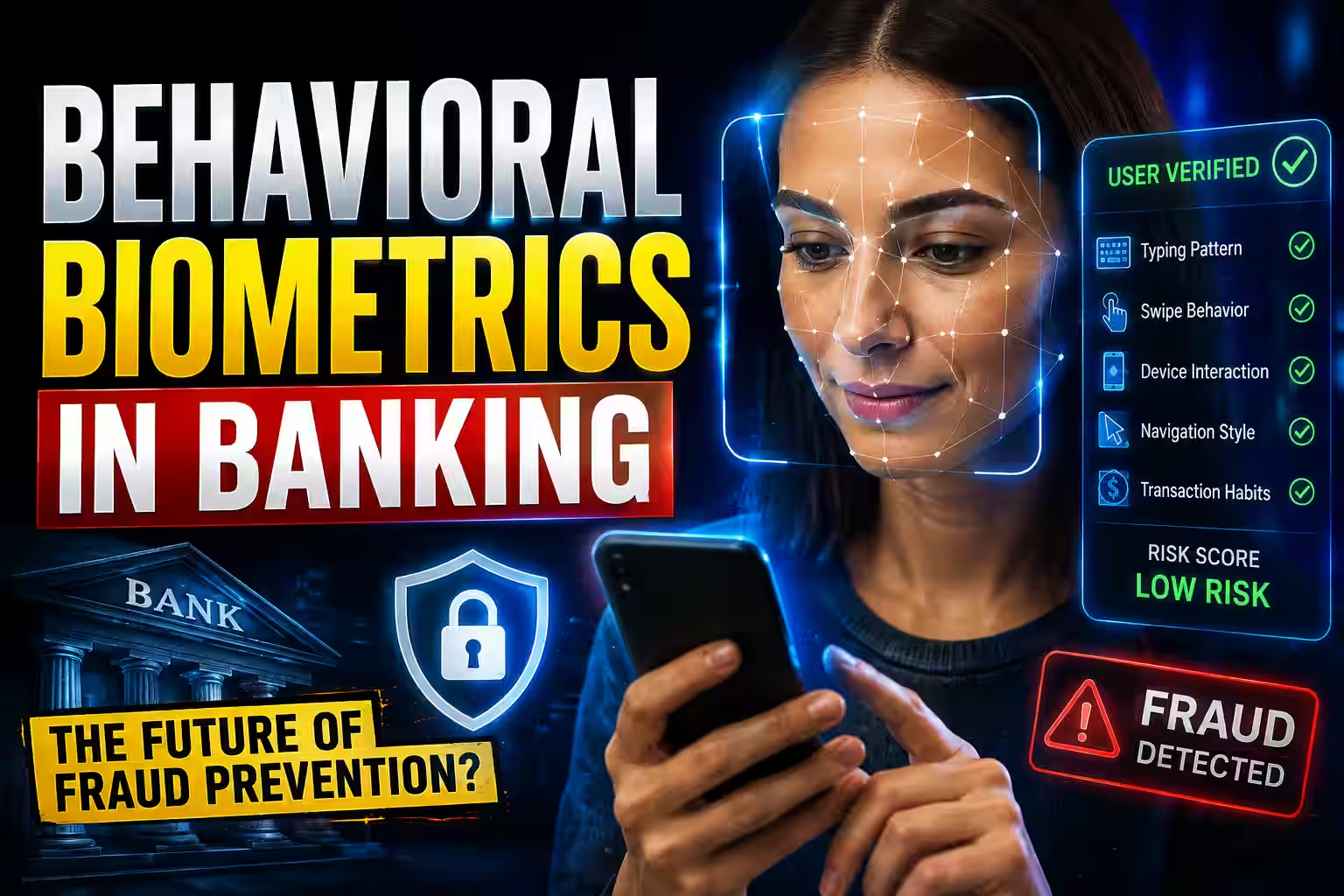
Behavioral biometrics in banking is a continuous authentication technology that analyzes how a user physically interacts with a device — including typing rhythm, mouse movement, swipe pressure, and phone grip angle — to detect fraud in real time, mid-session. Unlike a password or one-time code, it never stops checking.
Here’s a common myth: a strong password and a text code keep your bank account safe. They don’t. Once you clear the login screen, most banks stop checking who you are. That gap is where account takeover fraud lives. Behavioral biometrics closes it. It watches how you act, not just what you typed to get in.
Key Takeaways
The most important points from this article, in a format readers can scan fast or expand for more context.
Behavioral biometrics in banking strengthens fraud prevention by continuously checking how a user types, swipes, scrolls, and holds a device after login.
1 Behavioral biometrics verifies identity continuously, not just at login.
Unlike passwords or one-time codes, behavioral biometrics keeps checking a session in real time by comparing live behavior against a known baseline.
2 Banks analyze dozens of signals like typing rhythm, mouse movement, swipe pressure, and phone grip angle.
These signals are weak on their own, but together they create a harder-to-fake behavioral profile that helps spot bots, impostors, and account takeover attempts.
3 Behavioral data becomes a fraud score through a real-time machine-learning pipeline.
Typical steps include collection, cleaning, outlier removal, normalization, feature engineering, and model scoring against expected user behavior.
4 Different ML models serve different fraud goals.
SVM can offer top accuracy, Random Forest often balances speed and reliability best, and Neural Networks can detect subtler nonlinear patterns in high-risk cases.
5 This technology helps banks catch fraud that static authentication can miss, including account takeover, deepfake-enabled fraud, and synthetic identity abuse.
The real advantage is not just spotting fake faces or voices, but detecting abnormal behavior around the session, device, and transaction flow.
6 Customers cannot install behavioral biometrics themselves, but they can help it work better.
Using the same device consistently, keeping banking apps updated, and reporting unusual account behavior quickly all help banks build more accurate behavioral baselines.

Table of Contents
What Is Behavioral Biometrics in Banking Fraud Prevention?
Behavioral biometrics in banking is a security layer built on your habits. It studies your typing rhythm, your mouse path, even the angle you hold your phone at — then turns those habits into an ongoing identity check. It is not a fingerprint scan. It is not face ID either. It is quieter than both.
The system watches you type, swipe, and scroll. It compares that activity to your normal pattern, all through the session. Not just at the door.
Security researchers call this continuous authentication. It is non-intrusive — you never see it working. A normal login is one checkpoint: enter the right code once, and the system trusts you from then on. Behavioral biometrics never stops checking. If your typing rhythm shifts. If your mouse suddenly moves in flat, robotic lines. If your phone’s tilt and grip pressure don’t match your history. The system notices, right away. While you’re still connected. Not after the money is gone.

Why Isn’t a Password or One-Time Code Enough Anymore?
Because a password only proves you knew a secret once. It says nothing about who’s driving the session five minutes later. That single flaw is why AI fraud has outgrown static defenses so fast. Behavioral biometrics fraud prevention is designed for exactly this gap, helping banks detect suspicious session behavior after a user has already logged in.
Modern fraud doesn’t just steal a password. It recreates a person. Synthetic identity fraud builds fake profiles from scratch. Fraudsters mix stolen data with invented details. There’s no real victim to catch the crime early, because the “person” never existed. These fake identities build thin, believable credit histories for months. Then comes the bust-out: maxed-out credit, and the identity disappears. (See also: Synthetic Identity Theft: How Banks Detect It and How to Protect Your SSN)
Deepfakes push this further. AI can now make a criminal sound like your CEO — or look like your grandchild on a video call. In one widely reported case, an employee at a multinational engineering firm approved a $25 million transfer. The video call looked normal. Every other “person” on it, including a senior officer, was a deepfake.
None of that requires cracking your password. It just requires fooling a human — or fooling a system that stops watching after login. That is the exact gap behavioral biometrics is built to close.
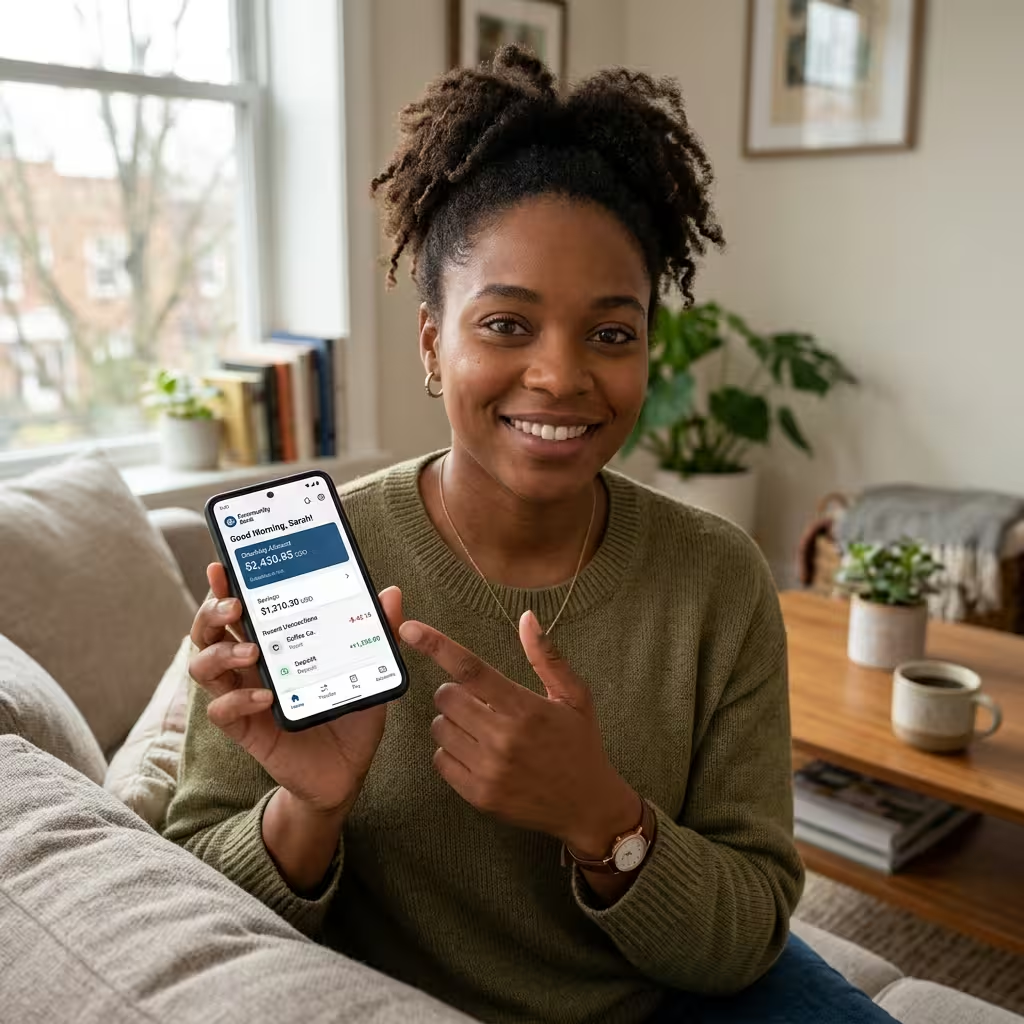
What Does “How You Hold Your Phone” Actually Mean?
Your phone already knows your physical habits better than you do. Security systems are stYour phone already knows your physical habits better than you do. Security systems are starting to use that. Every swipe, tap, and grip carries small signals that are hard to fake on command.
Researchers group these signals into three buckets:
- Keystroke dynamics — how long you hold a key down, and the timing gap between keys. Measured in milliseconds.
- Mouse movement — your typical speed, acceleration, and the curve your cursor takes. Measured in pixels per millisecond.
- Touch interaction — pressure on the screen (in Newtons), swipe duration, and grip angle on mobile devices.
Advanced fraud models track around 50 of these features at once. None of them is dramatic by itself. A slightly faster swipe. A tiny shift in key-hold time. But stacked together, they form a pattern that is hard to copy — even for a bot, and even for a criminal holding your stolen phone. A fraudster can steal your password in seconds. Copying the exact rhythm of how you’ve typed for two years? That is a different problem entirely.

How Does a Bank Turn Your Habits Into a Fraud Score?
It runs your raw behavior through a data pipeline. The pipeline cleans, standardizes, and sA bank converts raw behavioral signals into a real-time fraud score by running them through a multi-step data pipeline that cleans, normalizes, and classifies your activity against your established baseline.
It runs your raw behavior through a data pipeline. The pipeline cleans, standardizes, and scores your activity in real time. This isn’t one clever algorithm. It’s an assembly line. Each step matters.
Here’s the process, step by step:
- Collection. The system gathers raw data from transaction logs, app activity, and device sensors.
- Cleaning. Missing data points get filled in through imputation, so one bad reading doesn’t wreck your whole profile.
- Outlier removal. Analysts use Z-score analysis to catch extreme, one-off readings from glitchy devices. Those get stripped out before training.
- Normalization. A keystroke gap measured in milliseconds can’t be compared to a mouse speed measured in pixels. Min-Max Scaling fixes that. It maps every feature onto the same 0-to-1 range, so a typing quirk and a swipe pattern get weighed fairly.
- Feature engineering. The cleaned data gets distilled into roughly 50 features. These are the actual inputs the fraud model uses to make a call.
According to research by Abbas et al. (2026), one study tracked 10,000 users over 12 months and processed around 500 GB of raw behavioral data, pulled from financial logs, social media activity, and smart device use. That scale is the whole point. A fraud model is only as sharp as the amount of normal behavior it has learned from.

Which Machine Learning Model Catches Fraud Best?
No single ML model dominates behavioral biometrics fraud detection across all contexts. The right choice depends on whether a bank prioritizes raw accuracy, processing speed, or the ability to detect subtle, nonlinear behavioral changes.
Three model types lead current research: Random Forest, Support Vector Machines (SVM), and Neural Networks. Each comes with trade-offs worth knowing before you assume “more accurate” means “better.”
Which Machine Learning Model Catches Fraud Best?
Use the filters to highlight one model at a time without changing the original comparison.
| Model | Accuracy | Precision | Recall | Best For |
|---|---|---|---|---|
| Support Vector Machine (SVM) | 94% | 90% | 88% | Top accuracy, but costly to run at scale |
| Random Forest | 92% | 89% | 85% | Strong balance of speed and reliability |
| Neural Networks | 88% | 84% | 81% | Best at catching subtle, nonlinear behavior |
Based on the Abbas et al. (2026) study. Other published research ranks these models differently, depending on the dataset and tuning. Treat these numbers as illustrative, not universal.
Model comparison in plain terms:
- SVM is better suited for banks that can absorb higher compute costs in exchange for the highest classification accuracy. Its Radial Basis Function kernel draws the cleanest boundary between “you” and “not you,” but that precision comes at a processing cost — which matters when a fraud decision needs to happen in milliseconds.
- Random Forest works best when a bank needs reliable, real-time scoring across high volumes of everyday transactions. It uses 100 decision trees and a Gini-impurity method to stay steady on noisy, imbalanced data — important given that roughly 70% of behavioral signals in these datasets are normal, and only 30% are suspicious.
- Neural Networks are best suited for detecting the most subtle behavioral anomalies — such as a small, gradual shift in touch pressure — that simpler models miss. They run three hidden layers (128, 64, and 32 neurons) and take longer to train, making them better reserved for high-risk session reviews than routine scoring.
Many banks run Random Forest for everyday scoring and reserve heavier models for sessions already flagged as risky.

Can This Technology Catch Deepfakes and Fake Identities?
Yes. Behavioral biometrics detects deepfakes and synthetic identities by analyzing what happens around a fraudulent session, not just what a face or voice looks like. A deepfake can copy your face and voice. Copying the exact way you swipe, type, and grip a device is far harder — that behavioral data was never publicly available to begin with.
That matters for synthetic identities too. A fake profile can look clean on paper: a plausible name, a modest income, a thin but believable credit file. What behavioral biometrics exposes is the pattern underneath. Maybe a device fingerprint shows up across ten “different” customers. Maybe the interaction reads as mechanical instead of human. According to PwC, behavioral biometrics gives banks a fuller view of customer behavior — creating more intervention points before a fraud completes, not after.
Deepfakes get caught a different way. Not by spotting the fake video itself, but by watching what happens around it. Rapid micro-payments. An unusual transfer destination. Behavior that suggests the account holder is under pressure. Any of that is worth flagging, even if the face on the call looked completely real.
Criminals used this exact approach in Italy. They deployed deepfakes of a well-known politician to pressure corporate targets into wiring funds for a fake hostage rescue. The video was convincing. The account activity around the transfer wasn’t. (Source: Widely reported in Italian financial crime coverage, 2025–2026.)
What Happens the Moment a Fraudster Takes Over Your Account?
Under a password-only system: nothing. Nothing happens, because nothing is watching anymore. That is the core problem with account takeover fraud. Once someone is past the login screen, they act freely — until a transaction gets flagged manually, if it ever does.
Under continuous behavioral monitoring, the story changes fast. A fraudster with your stolen login still has to act like you. That is where they slip up. Typing rhythm doesn’t match. Mouse movement turns stiff and robotic — missing the small, natural wobble a real hand makes. Touch pressure on the phone feels off. None of it would mean anything to a human glancing at a screen. But a model trained on your baseline catches it instantly.
This is also why banks are building what’s called a 360-degree view of the customer. They combine behavioral signals with transaction monitoring, instead of checking each one alone. One odd mouse movement might not mean much on its own. That same odd movement, paired with a login from a strange device and a burst of micro-payments? A very different story. (See also: How AI Detects Financial Fraud in 2026)

Is Tracking Your Behavior Legal and Private?
Yes, when it is done correctly — and regulators keep raising the bar on what “correctly” looks like.
Behavioral data falls under the same privacy rules as any other personal data. Under GDPR, banks are expected to anonymize this data using k-anonymity — a method that groups behavioral profiles so that no single record can be traced back to one individual. This prevents a bank’s fraud database from becoming a surveillance dossier. (Source: EU General Data Protection Regulation, Recital 26 and Article 4(5).)
In the EU, the incoming Payment Services Directive 3 (PSD3) and Payment Services Regulation (PSR) push this further. They will require stronger fraud checks, tighter authentication standards, and faster incident reporting from banks. (Source: European Commission PSD3/PSR legislative proposals, 2023, currently in finalization as of 2026.)
For most account holders, this tracking isn’t optional, and it’s rarely spelled out feature by feature. It usually lives inside your bank’s broader fraud terms. The upside is real, though. It runs silently. It adds no extra login step. And it’s one of the few defenses that is genuinely hard for a criminal to fake, even with AI backing them up.
This article is for general information only. It isn’t financial, legal, or cybersecurity advice. If you suspect fraud on your account, contact your bank directly.
What Can You Do as a Customer to Get the Most Protection?
You can’t install behavioral biometrics yourself. Your bank runs it, not you. But a few habits make the system work better on your behalf.
- Use the same device consistently. The system builds your baseline from repeat use. Switching phones constantly gives it less to learn from.
- Keep your banking app updated. Older app versions sometimes lack the newest fraud-monitoring code.
- Report odd account behavior fast. If you get locked out or asked for extra verification out of nowhere, don’t ignore it. That’s often the system doing its job.
- Still use strong, unique passwords. Behavioral biometrics is a second layer, not a replacement. Weak passwords still make you an easier first target.
- Watch for pressure tactics. Deepfake and voice-cloning scams work by rushing you. A real bank employee won’t pressure you to wire money in the next ten minutes. (See also: AI Generated Voice Scams: How to Detect a Cloned Voice)
None of this requires new software or a subscription. It’s mostly about not undermining a system that’s already working quietly in the background.
Frequently Asked Questions
Does behavioral biometrics slow down my banking app?
No. It runs in the background while you use the app normally. There is no extra step, scan, or prompt. That is the whole point of calling it non-intrusive authentication.
Can behavioral biometrics replace my password completely?
Not yet, in most systems. Behavioral biometrics is typically layered on top of existing login credentials. It adds ongoing verification after you’re in, rather than replacing the password or PIN.
What if my behavior looks suspicious, but it’s really just me?
Systems account for normal shifts — a sore wrist, a new phone, a different desk. Most flag a session for additional verification rather than locking you out immediately.
Can a fraudster train an AI to copy my typing pattern?
Extremely difficult with current technology. Copying general typing speed is possible. Matching dozens of simultaneous timing, pressure, and movement features in sync — all consistent with years of individual habit — is a far harder problem. That is why this approach remains effective against bots and impersonators.
Is behavioral biometrics the same as fingerprint or face ID?
No. Fingerprint and face ID check a static physical trait, once, at the point of login. Behavioral biometrics is continuous. It is built on dynamic habits and movement patterns, not fixed physical features.
Does my bank have to tell me it’s using behavioral biometrics?
Under GDPR, banks are required to disclose the types of data they process, typically through privacy notices and terms of service. However, individual features like behavioral biometrics are rarely itemized separately — they are usually covered under broader fraud prevention disclosures.
How does behavioral biometrics differ from traditional fraud detection rules?
Traditional rule-based fraud detection triggers on specific thresholds — for example, flagging a transaction over a set amount. Behavioral biometrics is adaptive. It learns your individual pattern and flags deviations from your specific baseline, not from a generalized rule. (See also: Rule-Based vs. AI Fraud Detection)
Editorial Integrity
Sources & Citations
Banking fraud-risk guidance, behavioral-authentication context, payment-security oversight, and privacy rules tied directly to continuous verification, fraud scoring, account takeover risk, and financial-institution controls
This article draws on tightly related sources covering fraud-risk management in banking, EU payment-fraud reporting expectations, and privacy standards relevant to continuous authentication, anomalous behavior detection, and account-session monitoring.
View full sources, methodology, and editorial notes ⌄
This article was developed using source material closely tied to banking fraud oversight, payment-security reporting, and the handling of behavioral data in financial settings. Preference is given to primary supervisory and regulatory material where it directly supports claims about fraud controls, authentication expectations, reporting obligations, and privacy treatment. Where the article references model performance, deepfake fraud patterns, or specific implementation practices, readers should verify current technical documentation, provider materials, and official institutional guidance before relying on those details operationally.
- Bank fraud governance and institutional control design: Office of the Comptroller of the Currency — Fraud Risk Management Principles — cited for supervisory context on how banks should structure, govern, monitor, and maintain fraud-risk management programs in practice.
- EU payment-fraud reporting expectations and retail payment security context: European Banking Authority — Guidelines on Fraud Reporting under PSD2 — cited for payment-service fraud reporting expectations and the broader PSD2 objective of increasing the security of retail payments in the EU.
- Privacy treatment of identifiable, pseudonymised, and anonymous data: GDPR Recital 26 — Not Applicable to Anonymous Data — cited for privacy context around when data remains identifiable, how pseudonymised data is still treated as personal data, and why anonymisation standards matter when behavioral data is processed.
- Primary article record and on-page editorial context: Tech Capital Hub — Behavioral Biometrics in Banking — cited for the article’s byline, publication date, category, FAQ framing, and the specific claims and explanations presented on the published page.
Our Editorial Standards
Tech Capital Hub applies Google’s E-E-A-T framework to every article on AI fraud detection and banking security, prioritizing primary regulatory guidance, payment-security oversight, and directly relevant fraud-risk material over generic summaries, vendor hype, or unsupported technical claims.
View how our editorial standards apply to this article ⌄
Grounded in How Banking Fraud Controls Work in Practice
This article is framed around how fraud detection works inside real banking environments after login, not just how security tools are marketed. We focus on practical signals like session monitoring, anomalous behavior, account takeover risk, and layered fraud controls so readers understand how behavioral biometrics fits into real fraud-prevention workflows.
Behavioral Biometrics, Authentication, and Payment-Fraud Context
Coverage explains how behavioral signals such as typing rhythm, mouse movement, touch interaction, and device-use patterns can support continuous authentication and risk scoring. We also place those signals in the wider context of AI fraud detection, deepfakes, synthetic identity abuse, and the speed-versus-accuracy tradeoffs banks face when stopping fraud in real time.
Primary and Closely Coupled Source Use
Claims are anchored to primary or near-primary sources where possible, including banking supervisory guidance, payment-fraud reporting frameworks, and directly relevant financial-security materials. We do not treat vendor marketing copy, generic cybersecurity commentary, or trend pieces as sufficient support for technical or regulatory claims on their own.
Transparent, Reviewable, and Correctable
Fraud controls, regulatory expectations, and bank security practices evolve over time, so articles are reviewed and updated as stronger source material becomes available. Where relevant, affiliate relationships are disclosed separately. Nothing on this page is legal, cybersecurity, or financial advice. Corrections or source challenges can be submitted directly to our editorial team at editorial@techcapitalhub.com.
About the Author
Marcus Delray
Fintech Analyst | AI Fraud Detection, Banking Security & Digital Identity Risk
Marcus Delray writes about AI in finance, fraud detection, banking security, and digital identity risk. He focuses on making complex financial-technology topics practical for readers by explaining how fraud controls, authentication systems, and emerging threats work beyond the marketing language.
View full author bio, credentials, and links ⌄
Marcus Delray is a fintech analyst and founder of Tech Capital Hub, where he covers AI in finance, blockchain technology, DeFi, business accounting tools, and emerging fraud risks. His work translates technical and operational finance topics into clear, usable analysis for investors, entrepreneurs, and finance professionals.
On fraud and security topics, he focuses on how systems work in practice: how banks detect suspicious behavior, where static authentication falls short, how account takeover risk evolves, and how technologies such as behavioral biometrics and AI-driven fraud monitoring fit into real financial-security workflows.
Rather than repeating vendor claims at face value, he emphasizes source-backed explanation, practical context, and the real tradeoffs behind security, speed, privacy, and implementation. His goal is to help readers understand what a technology actually does, where it helps, where it falls short, and why it matters inside modern financial systems.
- Covers AI in finance, fraud detection, digital identity risk, and banking-security trends
- Explains how authentication systems, behavioral signals, and fraud-scoring models work in practical terms
- Breaks down technical financial topics into clear guidance for entrepreneurs, investors, and finance professionals
- Prioritizes source-backed analysis over vendor claims, generic summaries, or hype-driven security language
Enjoying our content?
Click below to add us as a preferred source. Google will prioritize our latest articles in your Top Stories, AI Mode, and AI Overviews.
Preferred Source on Google


One thought on “They Know How You Hold Your Phone: What Is Behavioral Biometrics in Banking Fraud Prevention?”