
The Secret Tech Tracing Illegal Millions: How Graph Neural Networks Detect Money Laundering

Fintech Analyst | AI Fraud Detection, AML & Financial Crime
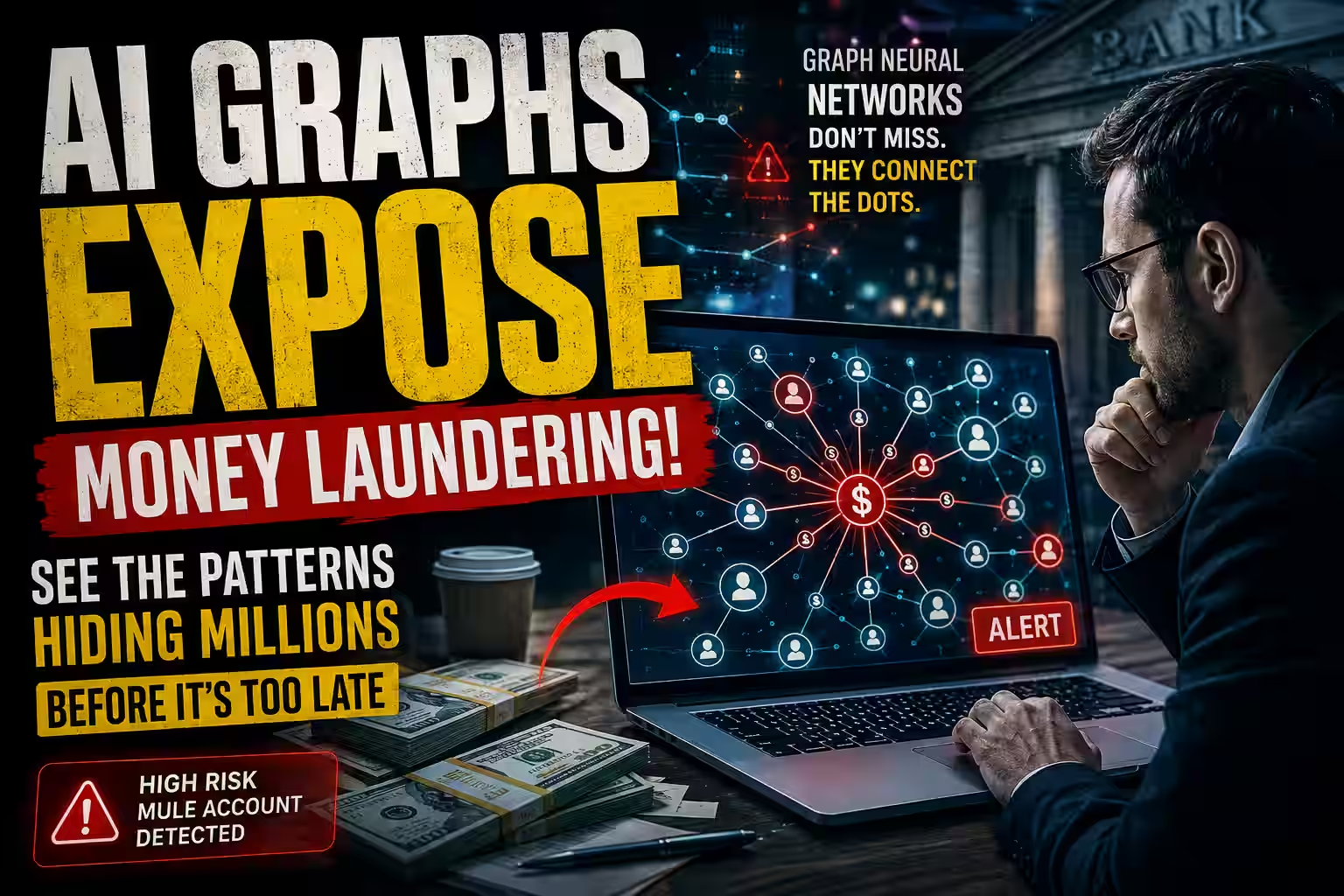
Graph neural networks detect money laundering by mapping accounts as nodes and transfers as edges, then hunting for structural patterns — not dollar amounts. A single $9,000 transfer looks fine in isolation. But ten strangers sending money into one account, which then empties within 48 hours? That shape has a name: a mule signature. It’s one of the clearest fingerprints a laundering network leaves behind.
This article covers how graph neural network AML detection works, why traditional rule-based systems fail against modern schemes, and what real-world cases reveal about money laundering detection using AI.
Quick DefinitionWhat is a graph neural network in AML?
A graph neural network is an AI model that analyzes relationships between connected entities. In anti-money laundering, it treats accounts as nodes and transactions as edges, helping investigators detect suspicious patterns — like fan-in, fan-out, and mule signatures — that rule-based systems often miss.
Table of Contents

How Do Graph Neural Networks Detect Money Laundering?
Graph neural networks detect money laundering by analyzing the shape of transaction networks, not the size of individual transfers. They stop looking at one transaction at a time — and that’s the whole shift.
Think of a bank’s accounts as a map, where every account is a dot and every transfer is a line between two dots. Draw enough lines and patterns start to emerge that no single transfer could ever reveal alone. A person can’t identify a laundering ring by staring at one wire, but the shape becomes clear once those transfers are rendered as a web.
The technology hunts for specific structures within that web. Researchers call these temporal motifs — small, repeating patterns typically involving three accounts and three transfers — that show how money moves between accounts over time. One common shape shows many small accounts feeding into a single hub, which then routes funds to a high-risk exchange. That’s called an aggregation pattern, and it’s the go-to move for pig butchering scam rings and mule networks alike.
Scale makes this matter enormously. According to testimony cited in 2026 financial crime briefings, pig butchering scams took more than $35 billion from American victims in a single recent year. Graph-based transaction monitoring tools exist specifically to catch the money trails these networks try to obscure. For a broader look at how AI tackles financial fraud beyond AML, see Tech Capital Hub’s AI fraud detection category.

Why Do Traditional Rule-Based Systems Miss Modern Laundering Schemes?
Rule-based AML systems fail against modern laundering because the crime is engineered to satisfy every fixed threshold — individually. That’s not luck. It’s the design.
Legacy fraud detection runs on hard limits. Withdraw over $10,000? Flag it. Log in from a new country? Flag it. These rules work well against obvious, high-volume fraud. But they fail decisively against Business Email Compromise (BEC) — the technique where a criminal intercepts and redirects a legitimate payment to a new account. The amount matches the victim’s history. The timing matches the victim’s history. Only the destination changed. A fixed rule sees nothing wrong.
The gap has real financial teeth. According to FBI IC3 data, global BEC losses have exceeded $55 billion over the last decade. In a controlled test on a dataset of 237,669 transactions, rule-based tools scored a flat 0.000 on BEC detection — not low, but zero. A fusion model combining sequence tracking, threshold analysis, and graph mapping was the only approach that caught it.
Researchers call this the “collective anomaly” problem: no single act breaks a rule, but the relationship between events — across accounts and time — is what reveals the crime. This gap also explains why traditional systems struggle with synthetic identity fraud, where individual data points look clean but the pattern across accounts does not.

What Do Fan-In, Fan-Out, and Pass-Through Ratios Actually Mean?
Fan-in, fan-out, and pass-through ratio are the three core graph metrics used to identify mule accounts and layering chains in AML transaction monitoring. Understanding them makes the rest of graph-based detection intuitive.
- Fan-in counts how many distinct senders deposit funds into one account. A normal checking account receiving transfers from ten strangers scores a high fan-in — a red flag for a cash-out hub or mule account gathering scattered victim funds.
- Fan-out measures the reverse: how many recipients pull money from a single account. One account receives a large inbound transfer, then splits it rapidly into a dozen small outbound payments. That’s high fan-out — the classic behavior of a hacker dispersing stolen funds into harder-to-trace fragments.
- Pass-through ratio tracks the proportion of inbound funds that exit an account again within 48 hours. A confirmed mule account typically shows a ratio between 0.85 and 1.05 — nearly all money in, nearly all money out. A layering chain runs slightly wider, between 0.30 and 2.00, as funds step through multiple institutions to obscure their origin.
No single metric proves illicit activity on its own. But stacked together — in the right sequence and timing — they form what investigators call a mule signature or a layering chain. These patterns are structurally difficult to fake and, once visualized on the graph, difficult to hide. The same graph-analysis logic applies to FedNow real-time payment fraud, where the speed of settlement makes pattern recognition even more time-sensitive.
What Do Real Money Laundering Cases Look Like in Graph Analysis?
At the transaction level, real laundering cases look unremarkable. At the graph level, they look obvious. That gap is precisely what graph neural network AML detection is built to exploit.
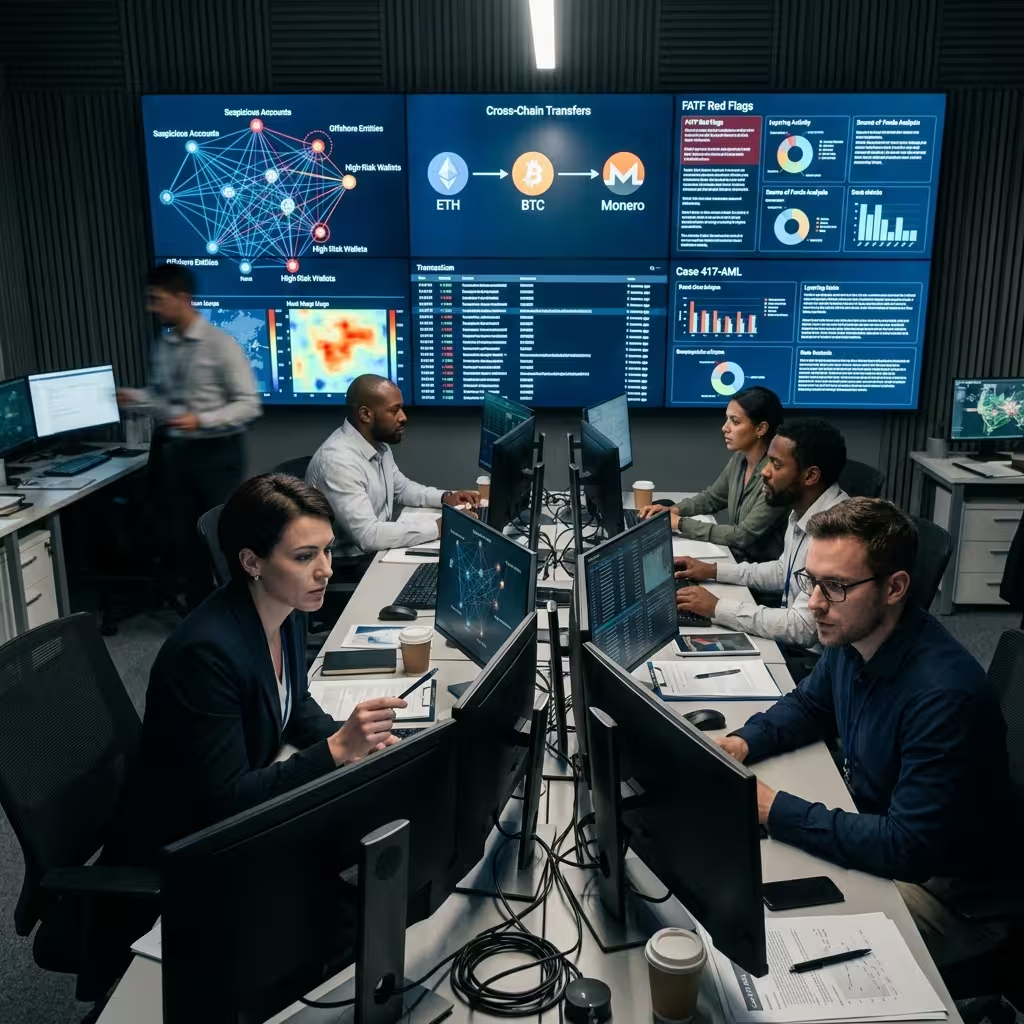
The February 2025 Bybit Hack ($1.5 billion): North Korean state actors stole $1.5 billion from the exchange. Each subsequent transfer appeared consistent with normal high-volume crypto trading. Rule-based systems found nothing irregular. But the transfer sequence matched known structural signatures tied to state-run laundering operations — specifically, fast cross-chain swaps arranged in patterns that graph tools flag as a cover-up chain rather than ordinary trading activity.
Equity Bank Kenya ($15 million insider fraud): The bank terminated more than 1,200 staff following a $15 million internal fraud investigation. Every transaction the implicated staff executed was technically authorized. What exposed the scheme wasn’t the amount — it was the order of events: bulk record access, followed by transfers that deviated sharply from each employee’s established behavioral baseline. This behavioral layer connects closely to what behavioral biometrics in banking can detect at the user session level.
The Flutterwave Breach (~$7 million): Funds moved through multiple banking institutions in a textbook layering sequence designed to obscure their origin. Graph-based AML checks identified the scheme through pass-through ratio analysis: money entered accounts and exited again almost immediately, exposing the mule infrastructure before full cash-out was complete.
Uganda National Context: According to local financial crime data, cybercrime’s share of all economic crime in Uganda rose from 12% in 2020 to 37% by 2024. Approximately UGX 60 billion exited the Bank of Uganda through fraudulent internal payment orders during 2024 and 2025. These cases share one defining trait: each individual transfer appeared legitimate. The cross-network pattern did not.
How Much Better Is AI Detection Than Old Rule-Based Systems?
Much better. And the gap shows up in real test numbers, not just guesswork. Test results give a clear before-and-after view.
| Detection Approach | Transaction Stream F1 | Session Stream F1 | Catches BEC Redirection? | Response Speed |
| Rule-Based (old) | 0.562 | 0.733 | No — scores 0.000 | Manual review only |
| LSTM Sequence Model Only | Lower than fusion on both streams | Lower than fusion on both streams | Partial | Not real-time |
| Fusion Model (LSTM + Threshold + Graph) | 0.787 | 0.867 | Yes | 0.43 ms, 95th percentile |
The F1 score measures how well a detection tool balances two competing demands: catching real fraud while minimizing false positives on legitimate customers. A higher score means it handles both well. The fusion model doesn’t marginally outperform legacy rules — it closes a detection gap that rule-based systems structurally cannot close at all.
One peer-reviewed study on graph learning architecture (TEMG-TTA) found it outperformed earlier graph tools by an average of 54.88% in controlled testing. That’s a structural improvement, not a marginal refinement. It reveals how much diagnostic signal was always embedded in network topology — signal that single-account, one-at-a-time systems were never designed to use.
For a deeper comparison of rule-based and AI detection architectures, see Tech Capital Hub’s article on rule-based vs. AI fraud detection.

Can Graph-Based AML Technology Freeze Funds Before They Disappear?
Yes — and speed is the operative variable. Stolen cryptocurrency typically moves across multiple wallets and blockchains within a 24-to-48-hour window. Any detection system slower than that window documents losses rather than preventing them.
Modern fusion tools operate well under one second. Benchmark tests show top-tier alerts firing at an average of 0.265 milliseconds, with the slowest 5% of alerts still triggering within 0.43 milliseconds. That speed allows a system to freeze an account or block a transfer before an attacker completes their next automated step.
Live systems already operate on this basis. The T3 Financial Crime Unit — a collaboration between Tether, TRON, and TRM Labs — has frozen more than $450 million in illicit USDT since September 2024. Unlike a standard bank hold, this model operates on a “freeze and burn” basis: bad tokens are permanently invalidated and clean value is returned to victims. Separately, the Beacon Network shares real-time risk intelligence across approximately 85% of centralized crypto trading volume, enabling exchanges to flag risky addresses before they interact with new banking infrastructure.
This rapid-response architecture is especially relevant in the context of FedNow real-time payment fraud, where settlement finality means recovery windows are measured in seconds, not hours.
What Are the Risks of AI Agents in Financial Crime Detection?
AI-driven AML is powerful, but regulators are explicitly flagging the risks of unsupervised automated decision-making. The technology doesn’t run itself — and compliance frameworks are saying so clearly.
According to FINRA’s 2026 Oversight Report, key risks associated with AI agents in financial crime detection include:
- Agents executing consequential actions — such as account freezes — without human authorization
- Agents operating beyond their defined scope
- Reward structures that could incentivize systems toward optimization shortcuts that produce compliance-adjacent, rather than compliance-compliant, behavior
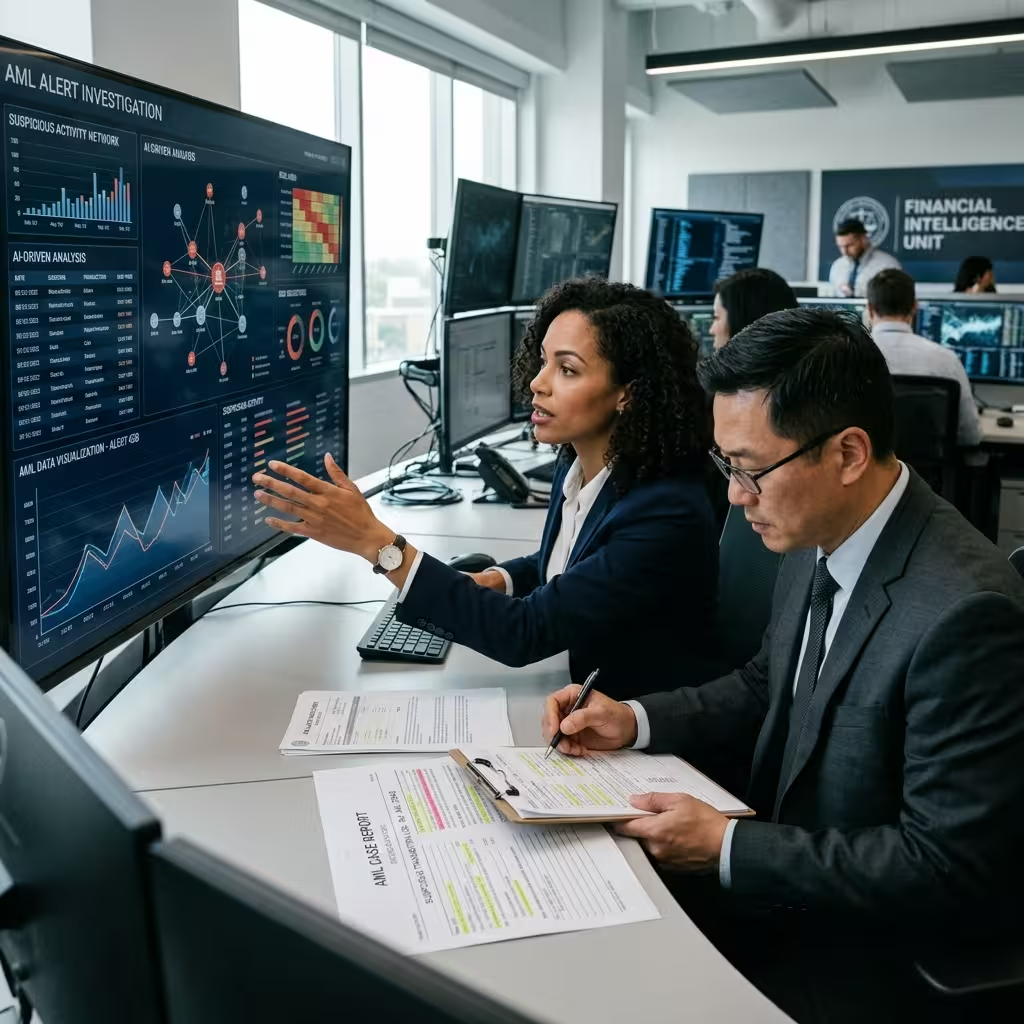
The regulatory response is not to slow adoption. It’s to maintain human review at decision-critical junctures. Under proposed rules, every Suspicious Activity Report (SAR) filing and every full account freeze must carry documented human sign-off. Firms are also required to maintain clear audit trails of model logic and actively monitor for output errors or bias — particularly when third-party vendor AI contributes to AML determinations.
There’s also a structural inefficiency the current framework hasn’t solved: law enforcement acts on approximately 2% of filed SARs. That’s not a detection problem — it’s a noise problem. It’s a core reason why FinCEN’s AML/CFT national priorities are pushing firms to shift from volume-based reporting toward outcome-based disruption. The same human-oversight principle applies to broader AI fraud detection deployments, where explainability and audit trails are increasingly non-negotiable.
Is Graph Neural Network AML Technology Deployed in Live Systems?
Yes — graph-based AML and fusion detection models operate in production environments today, not just in research settings. The tools described in this article run inside banks and crypto compliance teams right now.
Beyond the core detection layer, AI is handling adjacent functions in the compliance workflow:
- A customer-facing identity verification chatbot achieves 96.6% accuracy on identity confirmation tasks, handles “was this you?” escalations, and detects mass password-reset attacks in real time.
- On the investigator side, a case-summary tool converts raw graph data into plain-English incident notes, achieving a 99.3% accuracy rate on recommended next investigative steps — a capability that directly supports SAR documentation quality.
Every SAR requires a clear, auditable rationale behind the flag — not just a model score. Graph AI that explains its outputs in human-readable terms is no longer a nice-to-have; it’s a compliance requirement.
Key TakeawaysHow Graph Neural Networks Detect Money Laundering
- Patterns beat amounts. Graph neural networks analyze how accounts and transfers connect across a transaction network, so they catch schemes designed to slip past fixed dollar thresholds.
- Fan-in, fan-out, and pass-through ratio form a mule signature. Stacked in the right order and timing, these three graph metrics reveal mule accounts and layering chains that look harmless one wire at a time.
- Rule-based systems score 0.000 on BEC detection. In benchmark testing, fixed-threshold tools missed Business Email Compromise entirely because the fake payment matched the victim’s normal size and timing.
- Fusion models outperform legacy AML tools. A model combining sequence tracking, threshold checks, and graph mapping reached F1 scores of 0.787 on transaction streams and 0.867 on session streams.
- TEMG-TTA outperformed older graph tools by 54.88%. That average gain in controlled testing shows how much signal sat in transaction network topology that one-account-at-a-time systems never used.
- T3 Financial Crime Unit froze over $450 million in illicit USDT. Since September 2024, its freeze-and-burn model has wiped out bad tokens and returned clean value to victims.
- FINRA’s 2026 Oversight Report mandates human review. Every AI-driven account freeze and Suspicious Activity Report still needs a person to sign off, with documented audit trails on how each model works.
People Also Ask
How do graph neural networks detect money laundering differently than older software? Older software checks one transaction against a fixed limit. Graph neural networks map accounts and transfers as a network instead. They look for shapes like fan-in, fan-out, and pass-through ratios. These reveal group laundering, even when each transfer looks fine alone.
What is a mule account signature in money laundering detection? It’s a clear pattern. High fan-in from strangers, then almost all that money leaving again within 48 hours. The pass-through ratio usually sits between 0.85 and 1.05.
Can rule-based fraud systems detect Business Email Compromise? Not well. In tests, rule-based tools scored 0.000 on BEC. The fake payment matches the victim’s normal size and timing. Only the new payee gives it away. Catching that needs graph-based checks, not fixed rules.
How fast can AI systems freeze suspicious funds? Modern fusion tools respond in well under half a millisecond, even at the slowest 5% of cases. That’s fast enough to freeze an account before stolen funds cross more banks or blockchains.
Is there human oversight of AI-driven financial crime detection? Yes, and regulators require it. FINRA’s 2026 Oversight Report calls for a person to review AI-driven freezes and Suspicious Activity Reports. It also calls for clear written records on how each model works
DisclaimerImportant notice before you act on this article
This article is general information, not financial, legal, or compliance advice. If your firm is evaluating AML tools, consult a qualified compliance professional and review current FINRA and FinCEN guidance directly.
Editorial Integrity
Sources & Citations
Peer-reviewed research on graph neural networks and anti-money laundering, blockchain subgraph detection, crypto-crime case studies, and FINRA and FinCEN regulatory documentation directly relevant to AML detection
This article draws on peer-reviewed graph neural network research, blockchain money laundering datasets, documented crypto-theft investigations, public-private crime disruption case studies, and official regulatory guidance on AI oversight and AML priorities that shape how modern detection systems map accounts, transfers, and laundering patterns.
View full sources, methodology, and editorial notes ⌄
This article was developed using source material directly related to graph neural networks, anti-money laundering detection, crypto-crime economics, and AI oversight in financial services. Preference is given to peer-reviewed academic research, official government and regulatory documentation, and high-authority blockchain-intelligence reporting where those sources directly support claims about graph-based detection methods, laundering patterns, documented losses, and human-oversight requirements. Because detection techniques, case totals, enforcement actions, and regulatory guidance can change over time, readers should verify current figures and official guidance before relying on any single source operationally.
- Peer-reviewed research on GNN datasets for anti-money laundering: “The Shape of Money Laundering” (arXiv) — cited for scalable graph neural network methods and the temporal-motif approach used to map laundering patterns across transaction networks.
- Peer-reviewed research on GNN classification of crypto transactions: Anti-Money Laundering in Cryptocurrencies Through GNNs (IEEE Xplore) — cited for graph convolutional methods that classify suspicious cryptocurrency transactions beyond fixed-threshold rules.
- Peer-reviewed research on blockchain laundering subgraphs: “Identifying Money Laundering Subgraphs on the Blockchain” (arXiv) — cited for graph-based machine learning that models the web of transactions and surfaces fan-in, fan-out, and pass-through structures.
- Public-private crime disruption case study on stablecoin freezes: T3 Financial Crime Unit: Public-Private Disruption (TRM Labs) — cited for the more than USD 450 million in illicit USDT frozen since September 2024 and the freeze-and-burn recovery model.
- Crypto-theft investigation and Bybit hack context: 2025 Crypto Theft Reaches $3.4 Billion (Chainalysis) — cited for the February 2025 Bybit attack and the cross-chain laundering patterns that fixed rules missed.
- Regulatory guidance on AI oversight in financial crime detection: 2026 FINRA Annual Regulatory Oversight Report — GenAI (FINRA) — cited for human-oversight expectations, model risk, and record-keeping requirements tied to AI agents in crime detection.
- Official government AML/CFT priorities documentation: FinCEN National AML/CFT Priorities (PDF) — cited for the government-wide priorities, including cybercrime, that frame current anti-money laundering obligations.
Our Editorial Standards
Tech Capital Hub applies Google’s E-E-A-T framework to every article on graph neural networks, AML detection, and financial crime AI, prioritizing peer-reviewed research, official regulatory guidance, and documented case studies over generic commentary, sensationalism, or unsupported claims.
View how our editorial standards apply to this article ⌄
Grounded in Real Transaction Graph Patterns
This article is framed around how laundering actually shows up in a transaction graph, not just how it sounds in a headline. We focus on the shapes investigators track in practice — high fan-in from many strangers, rapid fan-out into small payments, and a pass-through ratio near 1.0 — because each transfer can look harmless when you view it one wire at a time.
GNN Methodology and AML System Limits
Coverage explains how graph neural networks map accounts and transfers as a network and hunt for temporal motifs that fixed rules miss. We show where rule-based systems fail on collective anomalies like Business Email Compromise and layering chains, then place those gaps against real fusion-model results, response speeds, and the mule-signature patterns that make the crime hard to hide.
Peer-Reviewed and Regulatory Source Preference
Claims are anchored to peer-reviewed graph-learning research, documented crypto-theft investigations such as the Bybit hack and the T3 Financial Crime Unit freezes, and official regulatory guidance from FINRA and FinCEN. We do not treat vague AI commentary, unverified posts, or broad vendor claims as sufficient support for statements about detection performance, losses, or oversight.
Transparent, Reviewable, and Safety-First
Detection techniques, case totals, enforcement actions, and regulatory guidance can change quickly, so articles are reviewed and updated as stronger source material becomes available. Nothing on this page is legal, financial, or compliance advice. Corrections or source challenges can be submitted directly to our editorial team at editorial@techcapitalhub.com.
About the Author
Marcus Delray
Fintech Analyst | Graph Neural Networks, AML Detection & Financial Crime AI
Marcus Delray writes about graph neural networks, anti-money laundering detection, and the financial crime AI systems that map accounts and transfers as networks. He focuses on turning peer-reviewed GNN research, transaction graph patterns like fan-in and fan-out, and fusion detection models into clear, practical analysis readers can actually use.
View full author bio, credentials, and links ⌄
Marcus Delray is an analyst and founder of Tech Capital Hub, where he covers AI-driven financial crime detection, graph-based anti-money laundering systems, crypto theft investigations, and the regulatory oversight shaping how these tools are used across banks and exchanges.
On AML and detection topics, he focuses on the real mechanics behind how laundering shows up in a transaction graph: how mule accounts collect scattered funds through high fan-in, how stolen money splits into small payments through fan-out, and how a pass-through ratio near 1.0 exposes a mule signature that fixed rules miss when they check one wire at a time.
Rather than repeating headlines or generic AI commentary, he emphasizes source-backed explanation, documented case studies, and the real tradeoffs between automated detection and human oversight. His goal is to help readers understand what graph neural networks can catch, where rule-based systems fail on collective anomalies, and how regulatory guidance shapes the safe use of these tools.
- Covers graph neural networks, AML detection, crypto laundering, and financial crime AI trends
- Explains GNN methodology, temporal motifs, and transaction graph patterns like fan-in, fan-out, and pass-through ratios in practical terms
- Breaks down where rule-based AML systems fail on collective anomalies such as Business Email Compromise and layering chains
- Grounds analysis in FINRA and FinCEN regulatory context, documented crypto theft cases, and peer-reviewed, source-backed research over hype or unsupported claims
Enjoying our content?
Click below to add us as a preferred source. Google will prioritize our latest articles in your Top Stories, AI Mode, and AI Overviews.
Preferred Source on Google






One thought on “The Secret Tech Tracing Illegal Millions: How Graph Neural Networks Detect Money Laundering”