
Real World Asset Tokenization Examples: What’s Already Live in 2026

Fintech Analyst · Founder of Tech Capital Hub
Marcus has spent more than a decade researching blockchain, tokenized markets, and financial technology. In this guide, he breaks down the most credible real world asset tokenization examples already live in 2026, covering Treasuries, real estate, gold, private credit, and blockchain-based public record systems.
Most writing about tokenization still sounds like a forecast. That makes it hard to tell what’s actually running and what’s still a slide deck.
Here’s one that’s running. Bergen County, New Jersey signed a deal to move about 370,000 property deeds onto blockchain-based records. County officials expect deed processing to drop from months to days. When I told a mortgage underwriter friend about it over dinner, he put his fork down.
That reaction is why this page exists. Real world asset tokenization examples in 2026 include tokenized US Treasuries, money market funds, residential and commercial real estate, gold, private credit, and government land records. These aren’t pilots anymore. They’re live platforms and products moving real capital.
In short: The clearest live real-world asset tokenization examples in 2026 fall into two distinct categories. The first is investable tokenized assets — products where you hold a token representing fractional ownership in a financial asset and earn yield or appreciation. These include tokenized Treasuries, money market funds, real estate, gold, and private credit. The second is blockchain-based record infrastructure — where governments or institutions use blockchain technology to manage public records, not to create investment products. Bergen County’s deed registry is the most prominent example. Both categories are real, operating, and worth understanding. They solve different problems.
This page covers only what’s live and operational. You’ll see examples by asset class, by who can access them, and by what each one proves. For the broader picture — how it works, the risks, and the regulations — start with our guide to the tokenization of real world assets.
Key Takeaways
- Treasuries lead on public chains. Tokenized Treasuries held about $12.78 billion of a roughly $27.65 billion tokenized asset market as of April 2026.
- Real estate is the most visible retail category. Platforms like RealT and Lofty let you buy property stakes for about $50.
- Gold has the strongest track record. Tokenized gold has deep secondary trading and published, independently verified reserve data.
- Private credit pays more but locks you in. Yields run about 8–15%, and exits are slow.
- Not every example is an investment. Bergen County’s blockchain deed system is infrastructure, not a product you can buy into.
- Adoption is real but uneven. Some asset classes are mature. Others are still early.
Jump to: Treasuries · Real Estate · Gold · Private Credit · Government & Infrastructure · Retail vs. Institutional · What They Prove · FAQ
Table of Contents
What Counts as a Real-World Asset Tokenization Example?
For this list, a real-world asset tokenization example is any live, operational product or system where blockchain technology is used to represent or manage ownership of a tangible or financial off-chain asset.
An example made the cut only if it met all five tests:
- A real off-chain asset backs the token. A bond, a building, a gold bar, a loan, or a public record.
- It’s live. Operating now, not “launching soon.”
- It does something. Tokens are issued, held, settled, paying yield, or managing records.
- It has real usage. Real users, real assets under management, or real transaction volume.
- It’s not a whitepaper. Pilot-only and concept-stage projects are out.
One structural point matters for every US investable example below. The token usually doesn’t hold the asset directly. It represents ownership in an LLC structure or an SPV (special purpose vehicle) that holds the asset. The blockchain records who owns what. Traditional law still decides what that ownership means in practice.
If your real question is still “what is RWA tokenization?”, our full investor guide covers that in depth. This page assumes you want proof.
Real World Asset Tokenization Examples at a Glance
Here are the most established live examples, side by side. Each represents a different asset class, a different access level, or a different reason tokenization made sense.
Real World Asset Tokenization Examples at a Glance
A premium, full-width comparison table of live real-world asset tokenization examples by asset class, access level, blockchain, and practical market significance.
| Example | Asset Type | Access | What’s Tokenized | Chain | Why It Matters |
|---|---|---|---|---|---|
| BlackRock BUIDL Institutional benchmark | Treasuries / cash | Institutional $5M minimum | Short-term T-bills and repo exposure | Ethereum, Avalanche, Polygon | Shows how tokenized money market exposure can support institutional-scale, 24/7 settlement. |
| Franklin Templeton FOBXX (Benji) Retail-accessible tokenized fund | Government money market fund | Retail $20 minimum | US government securities | Multi-chain | Proves tokenized funds can be packaged for mainstream users at very low entry points. |
| Ondo Finance On-chain fixed income issuer | Treasuries / bonds | Varies by product | Tokenized fixed income exposure | Multi-chain | Shows broad demand for on-chain yield products beyond a single institutional brand. |
| RealT Retail tokenized real estate | Residential real estate | Retail ~ $50 | LLC stakes in US rental homes | Gnosis Chain, Ethereum | Makes fractional property exposure and weekly stablecoin rental income accessible to small investors. |
| Lofty Low-cost rental income model | Residential real estate | Retail ~ $50 | Single-family rental property stakes | Algorand | Shows how low-fee blockchain infrastructure makes daily rent distribution economically viable. |
| RedSwan CRE Commercial property tokenization | Commercial real estate | Accredited / Institutional | Hotels, student housing, commercial property interests | Varies | Demonstrates how tokenization extends beyond retail homes into larger, institution-oriented real estate deals. |
| St. Regis Aspen (Aspen Digital) Early legal precedent | Luxury hotel | Accredited | Minority stake in a resort | Ethereum | Acts as one of the earliest recognizable proofs that tokenized real estate structures can hold up legally. |
| PAXG / XAUT Tokenized gold leaders | Gold | Retail | Allocated vaulted bullion | Ethereum and others | Represents the most mature tokenized commodity category, with reserve verification and active secondary trading. |
| Centrifuge Private credit infrastructure | Private credit | Mostly Institutional | Real estate debt, receivables, trade finance pools | Centrifuge, Ethereum | Shows how on-chain credit markets can improve transparency for high-yield, illiquid lending products. |
| Bergen County, NJ Public record infrastructure | Property deeds | Public Sector Not investable | About 370,000 deed records | Avalanche | Shows blockchain being used as public infrastructure rather than as an investment rail. |
A note on the numbers: market trackers measure this space differently. Some count only tokens that move freely on public chains. Others include loans recorded on private ledgers. That’s why totals range from about $27 billion to $36 billion for the same period. The RWA.xyz market dashboard is a useful live reference for both Treasuries and private credit.
Tokenized Treasury Examples Already Live
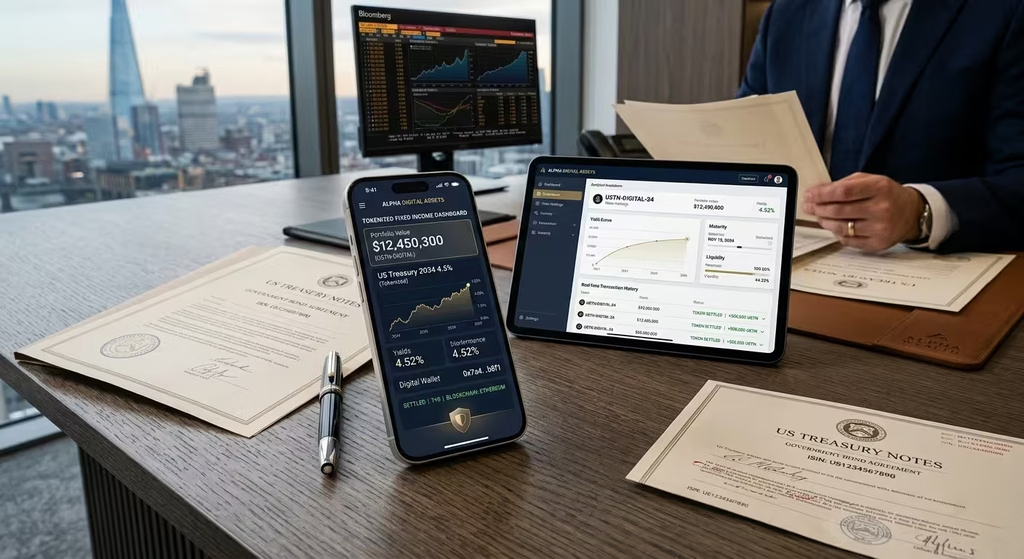
Tokenized Treasuries are the largest and most liquid category of investable tokenized assets in 2026. As of April 2026, they held about $12.78 billion — nearly half the total tokenized asset market on public blockchains.
Most people expect real estate to dominate. It doesn’t. The reason is simple. Treasuries are already the safest, most liquid asset in finance. Putting them on-chain doesn’t change what they are. It changes the plumbing: settlement speed, trading hours, and how yield reaches you.
BlackRock BUIDL
BUIDL is the institutional benchmark for tokenized money market funds. It held about $2.49 billion as of April 2026, invested in short-term T-bills and repo agreements.
Three details make it stand out:
- Yield shows up as new tokens. Interest accrues daily, and new tokens land in your wallet each month automatically.
- Redemption runs 24/7. Holders can redeem into USDC through a smart contract at any hour. Traditional money market funds have cut-off times. BUIDL doesn’t.
- It’s institutional only. The minimum is $5 million, and buyers must be qualified purchasers under the Investment Company Act.
Securitize handles the tokenization infrastructure. That pairing of a major asset manager with a dedicated digital asset infrastructure provider is now the standard institutional model.
Franklin Templeton FOBXX and the Benji App
Franklin Templeton took a different approach. Its OnChain US Government Money Fund (FOBXX) held about $843 million, with 99.5% in US government securities. The fund’s SEC registration filing confirms its structure as a registered investment company that uses blockchain for shareholder recordkeeping.
The interesting part is how wide it distributes. Through the Benji app, you can buy in with just $20.
Compare that to BUIDL’s $5 million minimum. Same asset class. Same basic structure. Two completely different bets on who the customer is. That contrast tells you more about where the institutional RWA market is headed than any forecast.
Ondo Finance
Ondo is one of the largest issuers of tokenized bonds and Treasuries, with more than $3 billion in total value locked. Products like OUSG give eligible investors on-chain exposure to short-term US Treasuries, with daily yield accrual.
Ondo’s scale shows demand isn’t tied to one brand. Multiple issuers are now competing for the same on-chain cash.
What Treasuries prove: tokenization wins fastest when the underlying asset is already trusted. Nobody has to be convinced that a T-bill is real. They just want faster settlement and round-the-clock access.

Tokenized Real Estate Examples
Tokenized real estate is already live in the US through platforms like RealT, Lofty, RedSwan, and Aspen Digital.
This is the category most retail investors see first. You can own fractional ownership in a specific US rental home today for as little as $50. Each example below uses the same basic structure. A property sits inside an LLC. The LLC’s membership interests split into tokens. You hold tokens and collect your share of the income. That’s what makes it tokenized real estate rather than a pooled fund.
RealT (Residential, Retail)
RealT has tokenized hundreds of US rental properties, mostly in Midwest markets. Reported combined value sits around $130 million.
- Entry: under $50 on some properties.
- Income: rent paid out weekly in stablecoins.
- Chain: mostly Gnosis Chain, with Ethereum support.
- Experience: fully passive. No tenant calls. No repair decisions.
That passivity is the selling point and the limit. If you want active control over your properties, this isn’t the right fit.
Lofty (Residential, Retail)
Lofty lists 150+ homes across about 40 US markets, with entry around $50.
Lofty pays rent daily, which is unusual. It can do that because it runs on Algorand. Sending small payouts to hundreds of holders on Ethereum mainnet can cost more in fees than the rent itself. On Algorand, the same payouts cost fractions of a cent. Chain choice decides whether daily payouts are economically possible at retail scale.
RedSwan CRE (Commercial, Institutional)
RedSwan focuses on commercial real estate — hotels and student housing — with about $4 billion in tokenized assets reported. Tickets are larger. Compliance runs deeper. Clients tend to be accredited investors and family offices. The fractional ownership model still applies, just at a different scale.
The St. Regis Aspen Deal (Aspen Digital)
In 2018, Elevated Returns tokenized a minority stake in the St. Regis Aspen Resort in Colorado, raising about $18 million. Distributions were paid, and the legal structure held under US securities rules. It’s one of the first tokenized real estate deals that worked as a real legal precedent, not just a proof of concept.
Across all four examples:
- Structure: an LLC or SPV holds the property. You hold tokens representing membership interests.
- Payout speed: ranges from daily (Lofty) to weekly (RealT) to deal-specific distributions (commercial).
- Exit reality: selling is faster than selling a house. It’s slower than selling a stock. Secondary buyers aren’t guaranteed.
Tokenized Gold and Commodity Examples
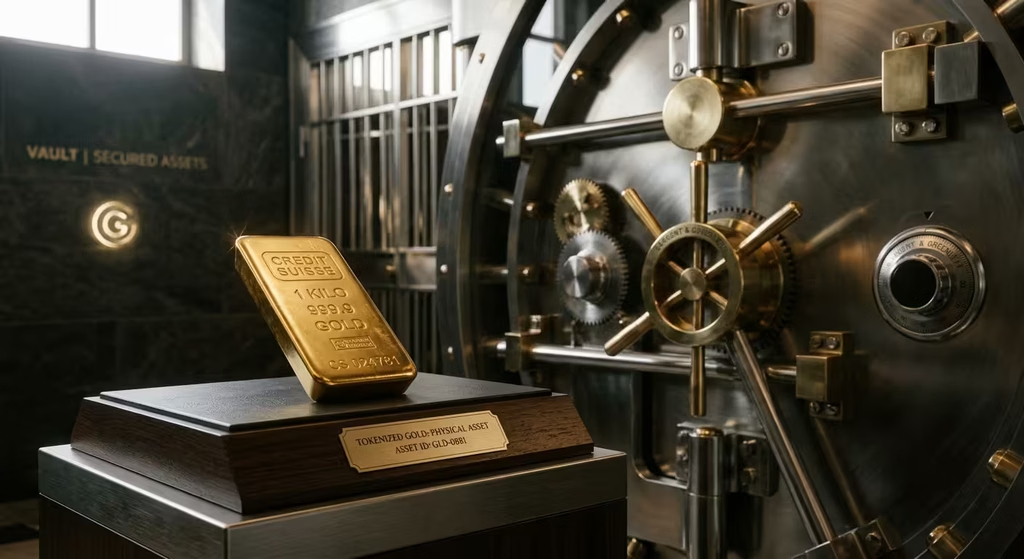
If you want the asset class with the strongest track record, it’s gold. Tokenized gold is proven — it has large AUM, deep secondary markets, and published, independently audited reserve data.
PAXG and XAUT
Pax Gold (PAXG) and Tether Gold (XAUT) are the two leading tokenized gold products. Each token represents a direct claim on one troy ounce of allocated physical gold held in professional vaults.
Two things make them credible:
- Proof of reserves. Paxos publishes monthly attestation reports prepared by an independent accounting firm. These confirm that tokens in circulation match the physical gold in custody, bar by bar.
- Real secondary trading. Both products trade around the clock with meaningful liquidity. You can actually sell when you need to.
Gold makes up about 70% of the roughly $7.37 billion market for tokenized commodities as of early 2026. Other commodity tokens exist — energy and agricultural products — but most have thin trading and little track record.
What gold proves: the tokenization model works best when the underlying asset is simple, easy to audit, and already widely traded. We compare tokenized gold with ETFs and physical bullion in our RWA tokenization investor guide.

Tokenized Private Credit Examples
Tokenized private credit is already live at scale, with about $18–19 billion on-chain as of April 2026, offering yields that typically run 8–15%.
Private credit is where the higher-yield activity sits. It’s also where liquidity gets tight.
Centrifuge
Centrifuge runs pools of real-world loans on-chain. These include real estate bridge loans, trade finance, and tokenized receivables like unpaid invoices.
Here’s how it works in practice. A business has invoices due in 90 days and needs cash now. Those receivables go into an on-chain pool. Investors fund the pool and earn yield as the invoices are paid back. The loan terms, collateral, and repayment schedule are all recorded on-chain. You can track the live market on the RWA.xyz private credit dashboard.
The trade-off is real:
- Lockups apply. Your money may be committed for months or years.
- There’s no quick exit. Secondary markets for these tokens are thin.
- The audience is narrow. Most activity comes from institutions and family offices with long time horizons.
What private credit proves: tokenization widened access and improved transparency. It didn’t remove the liquidity trade-off. A hard-to-sell loan is still hard to sell on a blockchain.
Government and Infrastructure Tokenization Examples
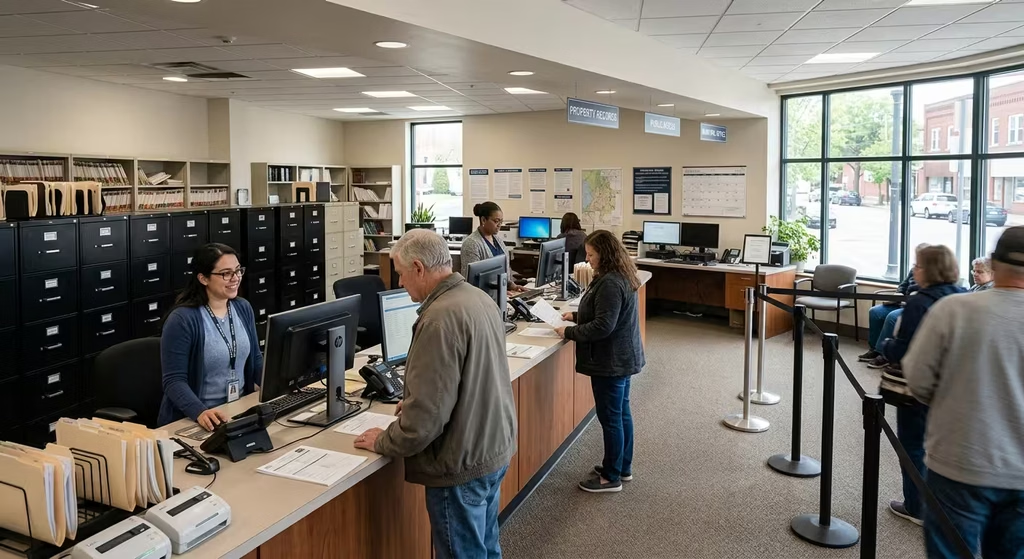
Not every real-world asset tokenization example is an investment product. Some of the most significant examples use blockchain to improve public record systems — with no yield, no tokens to buy, and no wallets required.
Bergen County, New Jersey Deed Registry
The Bergen County Clerk’s Office signed a five-year agreement with Balcony to digitize its property records on Avalanche. The project covers about 370,000 deeds tied to roughly $240 billion in real estate — making it the largest blockchain-based deed project in US history.
What the county expects:
- Faster processing. Officials say deed processing times will drop by more than 90%.
- Less fraud. Tamper-resistant records make deed theft and title disputes harder to execute.
- Fewer errors. Automated record-keeping reduces manual mistakes and lost revenue.
The county chose Avalanche because its custom subnet infrastructure supports private, permissioned environments. A public office needs privacy controls and jurisdiction-specific compliance rules that a fully open public blockchain can’t provide on its own.
This is not an investment. Nobody is buying tokens. No yield is distributed. Bergen County’s system is digital asset infrastructure used as a better filing system. That’s what makes it a valuable proof point — it shows that tokenization solves real operational problems even outside finance.

Why These Examples Run on Different Blockchains
If tokenization is so useful, why isn’t everything on Ethereum? Because each chain makes different trade-offs. The examples above show those trade-offs in practice.
- Ethereum: Deepest institutional liquidity and the most audited smart contract code. Fees are higher, but they barely register for a $2.5 billion fund like BUIDL.
- Polygon: A lower-cost network connected to Ethereum, with fees around a cent. Better for retail-scale activity. BUIDL added Polygon support to reach more holders.
- Algorand: Fast, cheap transactions built for frequent payments. That’s exactly why Lofty can pay rent daily without fees eating the distributions.
- Avalanche subnets: Custom environments with private, rule-controlled settings. That’s why Bergen County chose it over a public chain.
- Tezos: Uses formal verification — math that proves a contract does exactly what it claims. Some long-horizon institutional investors value that level of stability.
Compliance follows the same logic. Most tokenized securities now carry their rules inside the token code itself. The ERC-3643 standard checks buyer identity and eligibility before any transfer executes. Zoniqx builds on that idea with rules that adjust automatically by jurisdiction — a US buyer triggers accreditation checks, an international buyer sees a different rule set, all within the same token.
If DeFi terms like “on-chain liquidity” are still new to you, our beginner’s guide to decentralized finance covers the fundamentals.

Retail vs. Institutional Real-World Asset Tokenization Examples
Not every example here is open to you. Access depends on the product’s legal status, its minimum, and whether you qualify as an accredited investor under SEC rules.
Retail-Accessible Examples
- RealT and Lofty: Fractional stakes in rental homes for about $50.
- Franklin Templeton Benji: A tokenized government money fund with a $20 minimum.
- PAXG and XAUT: Tokenized gold, broadly available through major exchanges.
Institutional or Accredited Examples
- BlackRock BUIDL: A $5 million minimum for qualified purchasers.
- RedSwan CRE: Commercial property for accredited investors.
- St. Regis Aspen (Aspen Digital): Sold to accredited investors only.
- Larger private credit pools: Mostly institutional capital.
Institutional or Accredited Examples
A premium, full-width comparison table showing which live real-world asset tokenization examples are designed primarily for accredited or institutional participants, along with onboarding and access requirements.
| Example | Minimum | Accreditation Required | KYC Barrier | Typical User | Why It Fits This Group |
|---|---|---|---|---|---|
| BlackRock BUIDL Institutional tokenized Treasury fund | $5M | Yes Qualified purchaser | Full institutional onboarding | Funds, DAOs, treasury managers | High minimums, regulated access, and operational design make it clearly institutional-first. |
| RedSwan CRE Commercial real estate tokenization | Varies, typically higher | Yes | Full KYC and accreditation review | Family offices, HNWIs, institutions | Commercial property deals involve larger tickets, deeper compliance, and accredited-investor targeting. |
| St. Regis Aspen (Aspen Digital) Tokenized luxury resort stake | Higher, deal-specific | Yes | Accreditation plus securities onboarding | Accredited private investors | Structured as a securities offering rather than a mass-retail real estate product. |
| Centrifuge Pools On-chain private credit markets | Varies by pool | Often | KYC plus wallet-based access | Institutions, credit funds, sophisticated investors | Private credit products involve illiquidity, underwriting risk, and narrower investor eligibility. |
Every one of these requires KYC. That surprises people who expect crypto-style anonymity. Regulated tokenized assets need verified buyers, and on compliant asset tokenization platforms, the token code enforces it automatically — no manual review queue, no compliance officer making individual calls.
What These Live RWA Examples Prove
Put the live examples together and a clear pattern emerges. Tokenization is operational. It’s uneven. And it’s solving real problems at both ends of the market.
- Tokenization is operational. County governments, trillion-dollar asset managers, and $50 retail apps all run it today.
- Traction follows yield and paperwork. The strongest adoption is in yield-bearing assets like Treasuries and credit, and in record-heavy processes like property deeds.
- Retail access is growing, but unevenly. You can buy a $20 tokenized fund or a $50 rental stake. Institutional products still sit behind high minimums.
- Compliance is built in. Standards like ERC-3643 enforce buyer eligibility at the code level, not through manual review.
- Liquidity varies sharply by asset class. Gold and Treasuries trade easily. Real estate and credit exit slowly.
- The plumbing changes, not the asset. A T-bill is still a T-bill. A rental home is still a rental home. What changes is settlement speed, access hours, and record-keeping.
That last point is the most useful filter you have. Tokenization doesn’t make a bad asset good. It makes a good asset easier to hold, transfer, and verify.

What These Examples Haven’t Solved Yet
The examples are real. So are the gaps. These limitations are tied to specific examples, not vague concerns.
- Thin secondary markets. RealT and Lofty tokens are easier to sell than a house — but nowhere near as liquid as PAXG or a Treasury token. If you need to exit fast, that gap matters.
- Legal enforceability varies by state. An LLC token structure that works in one state may be treated differently in another. As SEC Commissioner Hester Peirce noted in her 2025 statement on tokenization, tokenized securities are still securities — the blockchain doesn’t change the underlying legal obligations.
- Chains don’t connect well. Identical assets can trade at different prices on different chains, and moving capital between them costs money.
- Smart contracts can fail. Even audited code can have bugs. Our guide on how to audit a smart contract without being a developer explains what to check before you commit capital.
- No FDIC insurance. Tokenized products aren’t bank deposits. The FDIC outlines what it doesn’t cover — tokenized assets are not on that list.
- Forecasts are wide enough to be useless. McKinsey projects about $2 trillion in tokenized assets by 2030. Standard Chartered has floated $30 trillion by 2034. A range that wide isn’t a forecast — it’s a shrug.
For a full breakdown of risks and regulatory requirements, see our RWA tokenization investor guide.
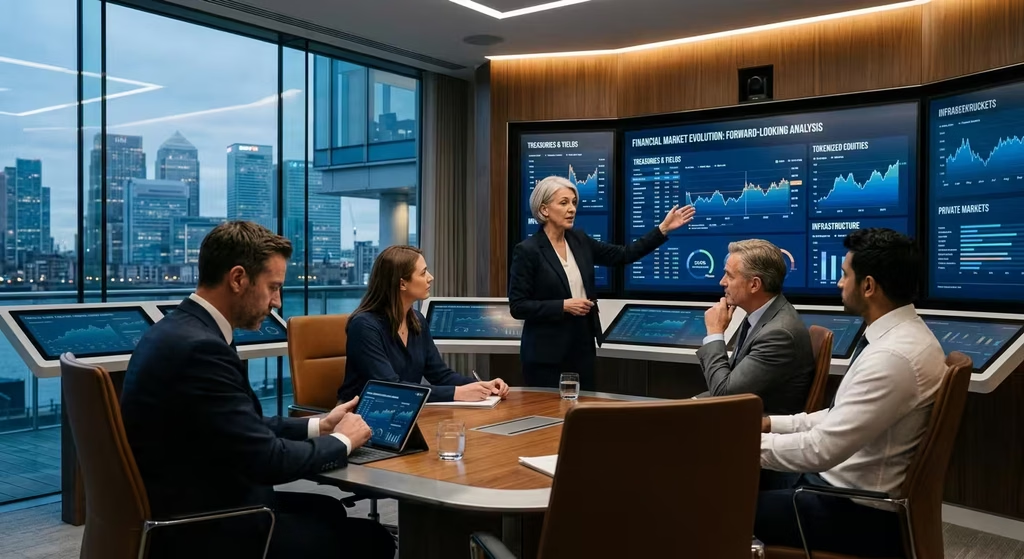
Which Real-World Assets Are Closest to Scaling Next?
Based on what’s already live, here is where the next wave of growth is most likely to come from.
Which Real-World Assets Are Closest to Scaling Next?
A premium, full-width comparison table showing which real-world asset categories are already scaled, which are live but still early, and which remain technically possible but legally uneven.
| Tier | Asset Classes | Current Position | Why This Tier Matters |
|---|---|---|---|
| Scaled and Operating Now Most mature tokenized categories | Scaled US Treasuries, tokenized money market funds, private credit, gold, US residential and commercial real estate, corporate bonds | These categories already have live products, working legal structures, active users, and measurable assets on-chain. | This tier shows where tokenization has already moved beyond theory into repeatable financial infrastructure. |
| Live but Still Early Operational, but not yet fully scaled | Early Tokenized equities and ETFs, infrastructure assets, tokenized receivables at scale | These assets are live in some form, but legal clarity, access, and secondary liquidity still vary by platform and jurisdiction. | This is the category most likely to produce the next wave of major growth if market structure and regulation improve. |
| Technically Possible, Legally Uneven Feasible, but inconsistent in practice | Uneven Some international real estate, private equity, collectibles | These assets can be tokenized technically, but enforceability, investor rights, and transfer rules are often unclear or fragmented. | This tier highlights the gap between what blockchain can represent and what markets can reliably support at scale. |
Tokenized bonds have a longer history than most realize. The European Investment Bank issued a €100 million digital bond on Ethereum back in 2021, using blockchain for settlement and ownership records.
Tokenized equities are moving, but slowly. Platforms like Backed Finance and Ondo are issuing on-chain representations of equities and ETFs. Legal frameworks still vary by jurisdiction, and secondary liquidity is limited outside of select markets.
The consistent pattern across every asset class that has scaled: a clear legal structure, real secondary buyers, and an obvious efficiency gain that wasn’t available before tokenization.
People Also Ask – Real World Asset Tokenization Examples
What are the best real world asset tokenization examples?
The most established investable examples are BlackRock BUIDL and Franklin Templeton FOBXX for tokenized Treasuries, RealT and Lofty for rental homes, PAXG and XAUT for tokenized gold, and Centrifuge for private credit. Bergen County, New Jersey is the leading example of blockchain used as public infrastructure rather than an investment product.
What assets are already tokenized on blockchain?
US Treasuries, money market funds, private credit, gold, residential and commercial real estate, and corporate bonds are all tokenized at meaningful scale. Equities, ETFs, and infrastructure assets are live but early. In the US, tokens in investable products usually represent ownership in an LLC or SPV that holds the actual asset.
Are tokenized Treasury funds live today?
Yes. BlackRock BUIDL held about $2.49 billion as of April 2026. Franklin Templeton’s FOBXX held about $843 million. Ondo Finance also issues tokenized Treasury products with $3B+ in total value locked. Together, tokenized Treasuries make up the largest single share of tokenized assets on public blockchains.
Are there retail examples of tokenized real estate?
Yes. RealT and Lofty both offer fractional ownership in US rental homes starting around $50. RealT pays rent weekly in stablecoins. Lofty pays daily on Algorand. Both require KYC and a crypto wallet to participate.
What is the difference between tokenized real estate and REITs?
A REIT gives you shares in a company that owns many properties. Tokenized real estate typically gives you a stake in an LLC that owns one specific property. You know exactly which building drives your income. Liquidity is generally lower than for publicly traded REITs, and exits depend on secondary market activity.
Are tokenized assets only for institutions?
No. Retail investors can access Benji with a $20 minimum, RealT and Lofty at about $50, and tokenized gold in fractional amounts on major exchanges. Institutional products like BlackRock BUIDL require $5 million and qualified purchaser status. Most private credit pools also skew institutional.
What are the most proven RWA use cases in 2026?
Tokenized Treasuries and tokenized gold are the most proven. Both have large assets under management, published reserve or attestation data, and active secondary trading. Private credit is large but illiquid. Tokenized real estate is widely accessible but trades thinly. Government record systems like Bergen County show a different kind of proven use case outside investing.
What companies are doing real world asset tokenization?
Major players include BlackRock, Franklin Templeton, Securitize, Ondo Finance, Paxos, Tether, RealT, Lofty, RedSwan CRE, and Centrifuge. On the infrastructure side, Balcony is working with Bergen County, and Zoniqx builds compliance tooling for tokenized securities across multiple jurisdictions.
Is RWA tokenization already being used outside finance?
Yes, though it looks different. Bergen County, New Jersey is moving about 370,000 property deeds onto an Avalanche subnet through Balcony. Officials expect processing times to drop by more than 90%. This is a public-records infrastructure use case — no investment tokens, no yield, no wallets required for residents.
The Real Takeaway From Today’s Live Tokenization Examples
Strip away the forecasts and look only at what’s running as of 2026.
A county government is putting its deed records on a blockchain. Franklin Templeton sells a tokenized government fund for $20. RealT deposits rent into wallets every week. BlackRock runs a multi-billion-dollar fund with round-the-clock redemption. Those are four separate proofs that the technology works across very different use cases.
None of it is uniform. Treasuries and gold are mature. Real estate and private credit work, but exits stay slow. Tokenized equities and collectibles are still finding their legal footing. Government record systems show a third track that doesn’t involve investing at all.
My underwriter friend never told me how he updated his timeline. But he stopped calling it a concept.
These examples show what’s live. They don’t tell you whether any of it fits your situation. For the risks, liquidity realities, regulations, and how to evaluate asset tokenization platforms before committing capital, read our full RWA tokenization investor guide.
Important Disclaimer
This article is for information only. It isn’t financial or legal advice. Tokenized assets carry real risks, including illiquidity, smart contract failure, and total loss. Market figures change quickly — verify current data directly with each platform or issuer before making any decisions.
Cryptocurrency · Editorial Integrity
Sources & Citations
Public data, issuer materials, fund documents, and platform disclosures behind this guide to real world asset tokenization examples — covering Treasuries, real estate, gold, private credit, tokenized funds, and blockchain-based public records.
Every major claim in this guide is grounded in public issuer materials, official product pages, fund filings, protocol or platform documentation, and current reporting where needed for context. We prioritized live products and examples with clear evidence of launch, legal structure, asset backing, or operational use. Because market size, yields, tokenized supply, and platform access rules can change quickly, readers should verify the latest figures directly with the issuer, platform, or public filing before making any decision.
View full sources, methodology, and editorial notes
This guide was written using a mix of primary and secondary sources, with preference given to official issuer pages, prospectuses, attestations, legal documentation, public fund materials, and platform documentation. We included only examples that appeared to be live, accessible, or operational in a meaningful way, and we excluded vague pilot announcements that could not be tied to a functioning product or verifiable public implementation. Where exact market figures or access thresholds shift over time, we describe them cautiously and encourage readers to confirm the latest data at the source. This article is educational information, not financial or legal advice.
- Franklin Templeton Benji / FOBXX: Franklin OnChain U.S. Government Money Fund — cited as a primary source for the tokenized fund structure, government securities exposure, and product access details.
- BlackRock BUIDL: Securitize — BlackRock USD Institutional Digital Liquidity Fund — cited as a primary source for the fund’s positioning, eligibility, and tokenized Treasury-style cash management use case.
- Ondo tokenized Treasury products: Ondo Finance — cited for current product context around tokenized fixed-income and on-chain yield exposure.
- RealT real estate structure: RealT — cited as the platform source for fractional rental property exposure, tokenized ownership structure, and investor access model.
- Lofty real estate investing model: Lofty — cited for platform structure, real estate tokenization access, and rent distribution model.
- PAX Gold backing and custody: Paxos — PAX Gold — cited as a primary source for allocated gold backing, custody framing, and tokenized commodity structure.
- Tether Gold product details: Tether Gold — cited for token structure, gold backing claims, and issuer disclosures about XAUT.
- Centrifuge private credit markets: Centrifuge — cited for the tokenization of receivables, credit pools, and private debt infrastructure.
- Backed Finance and tokenized securities context: Backed Finance — cited for tokenized stock and ETF exposure where relevant to the article’s discussion of what may scale next.
- Avalanche / public records example: Avalanche — cited as a platform-level reference for the blockchain infrastructure used in the public-record tokenization example discussed in the article.
- Contextual industry data on RWA market size: RWA.xyz — cited as a market-tracking reference for tokenized asset categories, totals, and sector growth context.
Real World Asset Tokenization Examples · Editorial Standards
Our Editorial Standards
Tech Capital Hub applies Google’s E-E-A-T framework to every crypto and fintech guide by favoring plain-English analysis, public data, official documentation, and verifiable product evidence over hype or unsupported claims. For this article, we prioritized examples that are already live or operational, used issuer materials and product pages wherever possible, and avoided treating vague pilots or marketing announcements as proof of adoption. Where access rules, market size, or tokenized asset totals shift quickly, we describe them cautiously and encourage readers to verify the latest data directly with the source.
View how our editorial standards apply to this article
Built Around Real Examples, Not Abstract Theory
This article is structured around concrete, live examples so readers can see what tokenization looks like in practice. Instead of describing RWAs in vague terms, we walk through operating products across Treasuries, money market funds, real estate, gold, private credit, and public record systems, then explain what each example proves about adoption, liquidity, access, or legal structure.
Tokenized Markets Explained in Plain English
Coverage focuses on the practical questions most readers actually have: what counts as a credible tokenization example, what is truly live versus merely announced, who can access a product, what kind of asset sits underneath the token, and which categories appear closest to scaling next. Technical or legal complexity is translated into clear language without stripping away the important nuance.
Official Product Pages, Fund Materials, and Platform Disclosures
Specific claims are anchored to named sources wherever possible, including issuer pages, fund documentation, custody or backing disclosures, platform materials, and public market trackers used for category-level context. We give more weight to sources that directly describe the structure of a live product than to promotional commentary, recycled summaries, or unsourced social posts.
Clear About Risk, Access Limits, and Fast-Changing Data
We do not present tokenized assets as risk-free or universally accessible. This guide notes that some products remain limited to accredited or institutional investors, that liquidity and investor rights vary by structure, and that asset totals or yield figures can change quickly. Nothing here is financial or legal advice. Readers who spot an outdated figure or source issue can contact the editorial team for review.
Cryptocurrency · About the Author
Marcus Delray
Fintech Analyst · Founder of Tech Capital Hub
Marcus Delray is a fintech analyst and the founder of Tech Capital Hub. In this guide, he breaks down real world asset tokenization examples in plain English, showing which projects are actually live, what asset sits underneath the token, who can access it, and what these examples reveal about where tokenized finance is heading next.
View full author bio, credentials, and links
Marcus Delray has spent over a decade researching financial technology. He built Tech Capital Hub to make that research useful for everyday readers — from total beginners to people who already follow the market. He covers blockchain, DeFi, AI in finance, and digital asset infrastructure, with a consistent focus on turning dense topics into clear, practical guides.
For this guide, Marcus focuses on a simple question with surprisingly messy answers: which real world asset tokenization examples are truly live, and which are still mostly marketing? He walks through tokenized Treasuries, on-chain money market funds, real estate, gold, private credit, and public-record use cases, then explains what each one proves about legal structure, investor access, liquidity, and market maturity. Rather than treating every announcement as adoption, he emphasizes verifiable examples, cautious framing, and source-backed analysis. All articles are educational information, not financial or legal advice.
- Explains real world asset tokenization examples in plain language, with a focus on what is actually live rather than merely announced
- Breaks down tokenized Treasuries, real estate, gold, private credit, and public-record infrastructure for both beginners and experienced readers
- Clarifies what makes an example credible, including asset backing, legal structure, investor access, and operational status
- Compares which tokenized asset categories appear most mature today and which seem closest to scaling next
- Grounds coverage in issuer materials, platform disclosures, market trackers, and public documentation with clear educational framing and no financial advice
Enjoying our content?
Click below to add us as a preferred source. Google will prioritize our latest articles in your Top Stories, AI Mode, and AI Overviews.
Preferred Source on Google
2 thoughts on “Real World Asset Tokenization Examples: What’s Already Live in 2026”