Your Bank Might Be Using Outdated Security: The Shocking Difference Between Rule Based and AI Fraud Detection


Banking Technology & Fraud Detection Writer | AI Fraud Detection, Behavioral Biometrics & Synthetic Identity Fraud
What is rule based vs AI fraud detection?
Rule-based fraud detection uses fixed if-then logic, while AI fraud detection evaluates transactions across behavioral, device, network, and timing signals in real time. In banking, AI-native systems usually reduce false positives and detect account takeover, synthetic identity fraud, and coordinated fraud rings more effectively — but only when they run on unified, high-quality data.
Rule-based systems
Best for narrow, known conditions with fixed thresholds and simple review logic.
AI-native detection
Better for subtle, fast-changing fraud patterns that appear across multiple signals at once.
The practical difference is not just speed. Rule-based systems check whether a predefined threshold was crossed. AI models score whether a transaction looks risky in context, based on how multiple signals align for that specific customer.
That matters because modern fraud often does not present one obvious red flag. A new device, unusual login time, unfamiliar payee, and abnormal transaction velocity may each look harmless alone, but together they can form a pattern that AI can detect more reliably than static rules.
Most people assume any bank advertising “AI fraud detection” already left rule-based systems behind. That’s not true. Sixty-eight percent of banks have moved toward AI-native architectures, yet plenty of those same institutions still generate false-positive rates barely better than the legacy engines they replaced.
The algorithm changed. The result often didn’t. That gap is where the real story sits, and it has almost nothing to do with which model a bank bought. For the bigger picture of all five detection layers banks combine — not just rules versus AI — see how AI detects financial fraud in 2026.
This article is for general informational purposes only and does not constitute financial, legal, or professional advice. Fraud prevention technology and effectiveness vary by financial institution. Figures cited — including false positive rates and detection benchmarks — are sourced from vendor documentation and independent research as of 2026 and may change. Verify current guidance directly with vendors or regulators before acting on any information here.

Table of Contents
What matters most in rule-based vs AI fraud detection
These are the main conclusions readers should keep in mind when comparing rule-based systems with AI-native fraud detection in banking.
Rule-based systems depend on fixed thresholds
They work by applying predefined if-then logic, which makes them useful for narrow, known conditions but slower to adapt when fraud patterns change.
AI fraud detection scores multiple signals at once
AI models evaluate behavior, device data, transaction timing, payee history, and network relationships in real time instead of relying on one static trigger.
False positives are the real operational fault line
Many institutions adopt AI but still see limited gains because their models run on fragmented data and cannot evaluate the full fraud context consistently.
Modern fraud often appears as a pattern, not one red flag
Account takeover, synthetic identity fraud, and coordinated fraud rings usually emerge from multiple weak signals that static rules often miss.
The bigger divide is fragmented data versus unified data
In production, fraud performance often depends less on whether AI is present and more on whether the model can score risk across unified, real-time customer signals.
Where rules still help
Rules are still useful for straightforward controls such as transaction limits, sanctions screening triggers, or narrowly defined review conditions that need clear, auditable logic.
Where AI adds the most value
AI becomes more effective when fraud patterns are subtle, cross-channel, or fast-changing, especially where login activity, device changes, transaction behavior, and account events need to be evaluated together.
What Is the Real Difference Between Rule Based vs AI Fraud Detection?
Rule-based systems run on if-then logic. AI fraud detection scores transactions across hundreds of signals at once, in real time, and catches risk in how those signals align — not whether a single threshold was crossed.
Rule-based engines flag a transaction over $2,000. Flag a purchase from an unfamiliar country. Simple thresholds, decided in advance by a human analyst, applied identically to every account regardless of that customer’s actual habits. A $5,000 transfer is completely routine for one customer and wildly out of character for another — and a fixed threshold cannot tell the difference.
AI fraud detection changes the scoring mechanism. Device fingerprint, transaction velocity, payee history, login timing, and account change events are all weighed simultaneously. The risk score emerges from the combination, not from any single rule breach.
According to Backbase’s overview of AI fraud detection in banking, machine learning models analyze transaction data, behavioral signals, and network patterns in real time in ways a static filter was never designed to replicate (Backbase).
Here is the number that makes this concrete. Rule-based engines generate false positives in 30% to 70% of flagged transactions in high-volume environments. For a mid-tier bank processing 5 million transactions a day, that is roughly 75,000 false alerts every single day. Layered machine learning models cut that figure by 40% to 60%.
Real improvement — but not the whole story, and that is exactly where most comparisons of this topic stop short.
Why Do Rule-Based Systems Actually Fail in Modern Banking?
Two reasons compound each other: static thresholds cannot adapt to new fraud patterns, and every account is evaluated identically regardless of individual customer behavior.
A rule written last year has no mechanism to account for a fraud pattern invented last month. Fraudsters have gotten faster than the rulebook. Generative AI now enables attackers to craft phishing content and bypass one-time passwords at a pace legacy rule systems were never built to anticipate. A static rule does not evolve between manual updates. The attack does, constantly.
That mismatch — a fixed system vs. a continuously adapting threat — is the core failure. Not any single flaw in how the rules are written. The architecture itself is the problem.

How Does AI Actually Score a Transaction Differently?
Speed and breadth, mostly. That’s the whole trick. Advanced models score a transaction in under 100 milliseconds, cross-referencing device fingerprints, transaction velocity, and payee history simultaneously. None of those signals needs to look alarming alone.
It’s the combination that raises risk, which is exactly the kind of pattern a static rule was never designed to catch.
This matters because fraud rarely announces itself with one glaring red flag anymore. A slightly unusual login time, paired with a new device, paired with a payee the account has never used — no single piece triggers an old rule, but together they form a pattern AI can weigh in real time.
That’s the functional difference. Not smarter guessing. More signals, checked at once, faster than a human or a static filter ever could.
What Is Behavioral Biometrics, and Why Can’t Fraudsters Fake It?
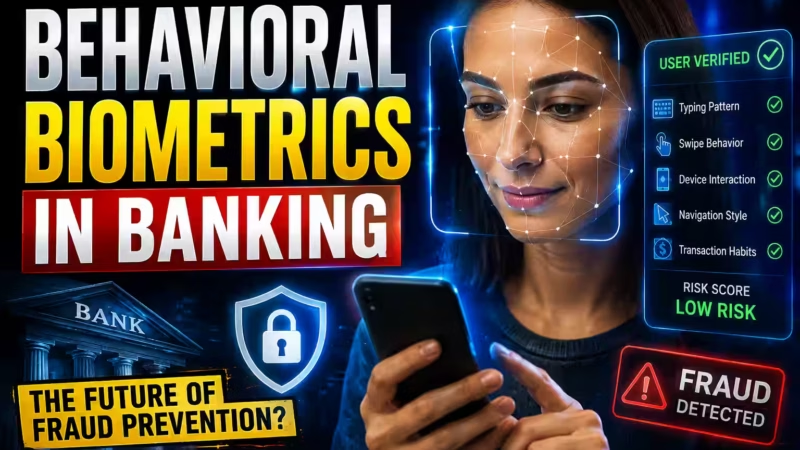
Behavioral biometrics analyzes typing cadence, swipe pressure, scroll rhythm, and device handling angle to build a unique behavioral baseline for each customer — and flags deviations even when stolen credentials appear valid.
This is what makes behavioral biometrics specifically effective against account takeover. A fraudster can steal a password. Steal a one-time code, even. What they cannot easily fake is the exact physical rhythm of how the real account holder types and scrolls, built over months of ordinary use. Credentials transfer. A person’s behavioral baseline does not.
For the full breakdown of how banks turn typing rhythm, swipe pressure, and device handling into a fraud score, see behavioral biometrics in banking.
According to SEON’s research on behavioral biometrics against fraud, typing cadence, swipe pressure, and scroll dynamics enable continuous authentication that catches account takeover even when the attacker presents valid credentials (SEON). The FFIEC interagency guidance also recognizes behavioral biometrics — finger swipes, taps, keystrokes — as an established authentication control for high-risk transactions (Federal Reserve/FFIEC).
Behavioral biometrics runs passively in the background. No additional login step is required from the customer.

How Does Graph Network Analysis Catch Organized Fraud Rings?
Individually, a coordinated fraud ring’s accounts often look fine. Every one of them. Each one, checked alone, passes every reasonable test.
The coordination only shows up at the network level, and that’s exactly what graph network analysis is built to surface — mapping relationships between accounts, devices, IP addresses, and phone numbers to expose shared infrastructure a human investigator might take months to trace by hand.
Picture ten accounts, all opened within a week, all using different names and different Social Security numbers on paper. Nothing alarming there, on its own. Now picture all ten sharing the same device ID.
That’s the shared infrastructure graph analysis exists to catch, and it’s the kind of signal that never shows up in a single-transaction rule check, no matter how well that rule is written. See our deep dive on how graph neural networks detect money laundering for the specific fan-in, fan-out, and pass-through patterns investigators track.

Why Do Some Banks’ “AI Fraud Detection” Still Underperform?
AI fraud models bolted onto siloed, fragmented data pipelines produce inconsistent scores and miss cross-channel signals — even when the underlying model is technically strong. This is the architecture problem.
Banks call it the architecture problem, and it is the actual bottleneck behind most disappointing AI rollouts. A bank buys an AI model, plugs it into existing siloed infrastructure, and sees underwhelming results. Not because the model was weak. Because the data feeding it is fragmented across separate channels with no shared context between them.
The difference in outcomes makes this concrete:
- Standard layered ML on siloed data pipelines: false-positive reduction of 40%–60%
- Alloy’s Fraud Signal model, unifying onboarding data, transactional patterns, and non-monetary events (logins, device changes, account changes) into a single real-time score: one digital provider cut false positives by 82% (Alloy)
Same general category of technology. Wildly different outcome. The performance gap was not in the model — it was in what the model could see.
That is the real lesson hiding inside every “rule-based versus AI” comparison. The bigger divide is not rules versus machine learning. It is fragmented data versus unified data. A bank can buy the best fraud model on the market and still get mediocre results if the second problem never gets solved.

What Does Synthetic Identity Fraud Look Like, and Why Do Old KYC Checks Miss It?
Synthetic identity fraud combines a real Social Security number with fabricated personal details to build a profile that passes point-in-time KYC checks, because part of the identity is genuinely real.
Standard KYC checks verify identity at a single moment. Does this SSN exist? Does the name match? A synthetic identity can pass that exact check cleanly, because part of it is genuinely real. It’s currently the fastest-growing fraud category in North America, with a 311% jump in document fraud recently.
Traditional fraud models miss 85%–95% of synthetic identities, according to the Federal Reserve’s research on synthetic identity fraud in the U.S. payment system (Federal Reserve).
AI catches what a point-in-time check cannot:
- Long-term behavioral patterns, such as a “credit-building” sequence that mirrors known fraud templates
- Metadata analysis on submitted documents to detect deepfake-generated IDs that one-time verification would accept
- Cross-account network signals connecting multiple accounts, devices, IP addresses, and SSNs, the detection method the Federal Reserve explicitly recommends over single-account KYC checks
A one-time verification only ever answers one question. AI keeps watching after that question gets answered, which is exactly where synthetic fraud does its damage. For the full detection playbook — including CBSV verification and cross-bureau checks — see synthetic identity theft: how banks detect it
Rule-Based vs. AI Fraud Detection: Side-by-Side Comparison
| Factor | Rule-Based Systems | AI-Native Detection |
|---|---|---|
| False Positive Rate | 30%–70% in high-volume environments | 40%–60% lower with layered ML; up to 82% lower with unified data models |
| Speed | Instant, but static | Scores transactions in under 100ms |
| Adapts to New Fraud | No — requires manual rule updates | Yes — unsupervised models catch novel, “zero-day” patterns |
| Catches Account Takeover | Only if credentials are also flagged | Yes, via behavioral biometrics even with valid credentials |
| Catches Organized Rings | Rarely — evaluates accounts individually | Yes, via graph network analysis across accounts |
| Requires Unified Data | Not applicable | Yes — fragmented data sharply limits effectiveness |
When Should Banks Use Rule-Based vs AI Fraud Detection?
Rule-based fraud detection still has value for narrow, well-defined scenarios where the risk condition is obvious and stable, such as blocking transactions from sanctioned geographies or flagging a specific transfer threshold for review. It is simple to audit, simple to explain, and useful as one control inside a broader fraud stack.
AI fraud detection is better suited to modern banking fraud because most real attacks do not appear as one obvious violation. Account takeover, synthetic identity fraud, mule networks, and cross-channel fraud usually emerge from combinations of small anomalies across device behavior, login context, transaction velocity, payee history, and network relationships.
The strongest fraud programs use both — rules for fixed controls and machine learning for adaptive risk scoring. But when a bank wants lower false positives and better detection of novel fraud patterns, the decisive factor is usually not whether AI is present. It is whether the model can see unified, real-time data across the customer lifecycle.
People Also Ask
Is AI fraud detection always better than rule-based systems?
Only when it’s implemented on unified data. A bank running AI models on the same siloed data pipes as its old rule-based system often sees a smaller improvement than expected, sometimes cutting false positives by only 40% to 60% instead of the 82% seen with a fully unified approach.
Why do rule-based fraud systems generate so many false positives?
Because they apply the same fixed thresholds to every customer regardless of that person’s actual habits, flagging 30% to 70% of transactions in high-volume environments as suspicious when most are legitimate.
Can AI fraud detection stop fraud types it hasn’t seen before?
Yes, through unsupervised machine learning, which establishes a statistical baseline of normal behavior for each customer and flags any deviation, regardless of whether that specific fraud type has a historical label.
What is the “architecture problem” in AI fraud detection?
It refers to fraud models running on fragmented, siloed data instead of a unified operational context, which causes inconsistent risk scores and missed cross-channel signals even when the underlying AI model itself is strong.
Does behavioral biometrics require extra steps from the customer?
ffNo. It runs passively in the background, analyzing typing cadence, swipe pressure, and similar interaction patterns as the customer uses their device normally, without any additional login step.
This article is for general informational purposes only and does not constitute financial or professional advice. Fraud prevention technology and effectiveness vary by financial institution.
Editorial Integrity
Sources & Citations
Primary vendor documentation, federal regulatory guidance, and independent research tied directly to AI fraud detection, behavioral biometrics, synthetic identity fraud, and banking security
This article draws on primary and near-primary sources covering rule-based versus AI fraud detection, false-positive reduction, behavioral biometrics, graph analytics, synthetic identity fraud, and federal authentication guidance.
View full sources, methodology, and editorial notes ⌄
This article was built around source material tied directly to bank fraud detection, including vendor performance data, federal regulatory guidance, and industry research on behavioral biometrics, graph network analysis, and synthetic identity fraud. Where possible, claims link to primary or near-primary documentation. Because fraud tactics, model performance, and regulatory expectations shift quickly, readers should verify current figures and guidance directly with each vendor or regulator before acting on them.
- Unified-data AI model and 82% false-positive reduction: Alloy — Fraud Signal Machine Learning Fraud Detection — cited for the finding that a digital provider cut false positives by 82% after deploying Fraud Signal, and for how unifying onboarding data, transaction patterns, and non-monetary events (logins, device and account changes) into one real-time score beats models bolted onto siloed data.
- False positives, detection accuracy, and behavioral analytics: FICO — Understanding Fraud Detection in Financial Services — cited for the tradeoff between catching genuine fraud and minimizing false positives, the role of real-time behavioral analytics and anomaly detection, and why account takeover detection depends on non-monetary signals such as new-device and new-location logins.
- Layered security, behavioral biometrics, and identity verification: Federal Reserve / FFIEC — Authentication and Access to Financial Institution Services and Systems — cited for the interagency position that single-factor authentication is inadequate for high-risk transactions, for behavioral biometrics software (finger swipes, taps, keystrokes) as a recognized authentication control, and for fraud and anomaly detection monitoring across transaction velocity and login activity.
- Synthetic identity fraud, KYC gaps, and network detection: Federal Reserve — Detecting Synthetic Identity Fraud in the U.S. Payment System — cited for synthetic identity fraud as the fastest-growing financial crime, the finding that traditional fraud models miss 85%–95% of synthetics, and for why detection requires connecting multiple accounts, devices, IP addresses, and SSNs rather than relying on point-in-time KYC checks.
- Behavioral biometrics against account takeover: SEON — What Is Behavioral Biometrics and How Does It Stop Fraud? — cited for how typing cadence, swipe pressure, scroll dynamics, and device handling build a hard-to-spoof behavioral baseline, enabling continuous authentication that catches account takeover even when stolen credentials appear valid.
- Revised Model Risk Management guidance (2026): Federal Reserve, FDIC & OCC — Revised Interagency Model Risk Management Guidance — cited for the 2026 interagency update calling for a risk-based approach to model governance calibrated to each institution’s risk profile, customer base, and use cases, rather than a one-size-fits-all fraud model.
- AI fraud detection techniques in banking: Backbase — AI Fraud Detection in Banking — cited for the overview of how machine learning models analyze transaction data, behavioral signals, and network patterns in real time, supporting the article’s explanation of how AI scores a transaction across many signals at once instead of checking a single static rule.
Our Editorial Standards
Tech Capital Hub applies Google’s E-E-A-T framework to every article on bank fraud detection, prioritizing verified vendor data, federal regulatory guidance, and practical relevance for fraud and risk teams over hype.
View how our editorial standards apply to this article ⌄
Grounded in Real Fraud Detection Systems
Every claim here was checked against how live fraud detection tools actually behave, including machine learning scoring models, behavioral biometrics, and anomaly monitoring under real banking conditions. We traced how unified-data models cut false positives, how continuous authentication catches account takeover even with valid credentials, and how detection performance shifts across payment types — not vendor demos or surface-level summaries.
Fraud-Specific Knowledge
Coverage spans how modern fraud detection works at a technical level, including rule-based versus AI scoring, behavioral biometrics like typing cadence and swipe pressure, graph analytics for fraud rings, and synthetic identity detection. We break down why point-in-time KYC checks miss so many synthetics — and explain why that gap matters for both consumer and business account protection.
Primary Source Verification
Claims trace back to primary and near-primary sources — including FFIEC and Federal Reserve interagency authentication guidance, the Federal Reserve’s synthetic identity fraud research, and documented vendor performance data such as the 82% false-positive reduction reported by Alloy. No claim rests on marketing materials or secondhand summaries alone.
Transparent & Correctable
Affiliate relationships are disclosed. Fraud tactics, model performance, and regulatory expectations shift quickly, so this content is reviewed and updated as new data and guidance arrive. Nothing here is legal, compliance, or security advice. Corrections can be submitted directly to our editorial team at editorial@techcapitalhub.com.
About the Author
Marcus Delray
Banking Technology & Fraud Detection Writer
Marcus Delray covers bank fraud detection for readers who want the real story — cutting through vendor claims to explain what actually reduces false positives, stops account takeovers, and holds up in production.
View full author bio, credentials, and links ⌄
Marcus Delray writes about bank fraud detection for readers tired of marketing language dressed up as technical explanation. A bank buys an AI model, plugs it into siloed data, and wonders why false positives barely move.
That gap between the pitch and the production result is what he covers. He breaks down on rule based vs ai fraud detection systems, how AI scores a transaction across hundreds of signals in under 100 milliseconds, and why behavioral biometrics catch account takeovers that stolen passwords sail right past.
His work benchmarks what actually holds up at scale — from graph network analysis that exposes coordinated fraud rings to the metadata checks that catch deepfake IDs a one-time KYC pass never will. The goal is simple: give people specific, honest information about the technology guarding their money, without the hype.
- Explains the difference between rule-based and AI-native fraud detection in plain language, including why 68% adoption does not equal 68% improvement
- Covers behavioral biometrics, graph network analysis, and unsupervised anomaly detection with a focus on what stops real attacks
- Tracks synthetic identity fraud, deepfake document detection, and where point-in-time KYC checks fall short
- Benchmarks the architecture problem behind underperforming AI rollouts, comparing siloed pipelines against unified real-time scoring models like Alloy’s Fraud Signal
Enjoying our content?
Click below to add us as a preferred source. Google will prioritize our latest articles in your Top Stories, AI Mode, and AI Overviews.
Preferred Source on Google