Tokenization of Real World Assets Explained: Platforms, Market Data, Risks & Regulations

Tokenized Asset Analyst · Founder of Tech Capital Hub
Marcus tracks the tokenization of real world assets for everyday investors. In this guide, he walks you through how RWA tokens actually work, from tokenized gold and $50 property tokens to private credit and tokenized Treasuries. You’ll learn how to check custody, reserve proof, and regulation, plus the one question that matters most: could you sell it if you needed to?
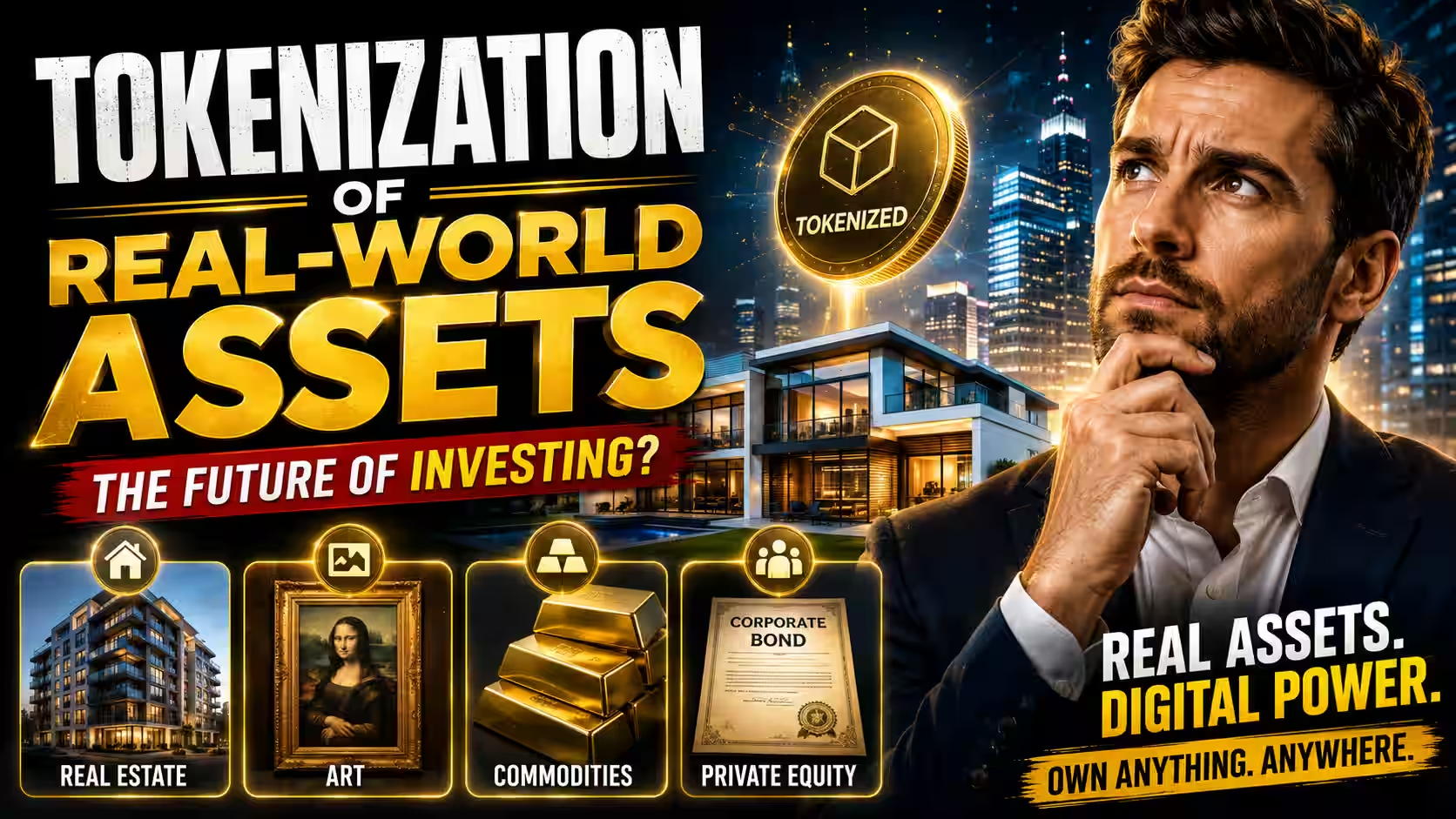
Tokenization of real world assets turns ownership of a physical or financial asset into a digital token on a blockchain. These assets include real estate, gold, Treasury bills, and private loans. Each token represents a defined legal or economic claim on that asset. You can own a small fraction, earn your share of income, and sometimes trade around the clock.
This guide is for evaluation. It explains what RWA means, how RWA tokenization works, which tokenization platforms lead the market, and how to judge the risks before you put in a single dollar.
Executive Summary
RWA Tokenization at a Glance
Want the big picture in under a minute? Here are the six answers that matter most. Tap any row to unpack the details!
-
What is it?
Converting ownership of real assets into blockchain tokens that represent fractional claims.
Imagine a rental home, a gold bar, or a pool of business loans sliced into small digital pieces. Each token is a claim on a share of the real thing, recorded on a shared ledger that nobody can quietly edit.
- Real estate
- Gold
- Treasuries
- Private credit
Helpful tip: Not every token means direct ownership. Some represent an LLC interest or a fund share, so check what yours legally represents.
-
Why does it matter?
It lowers entry points, speeds up settlement, and opens markets that once required large minimums.
Some property tokens start around $50, and atomic settlement can complete trades in seconds instead of a business day. Markets that used to be reserved for big-money investors are finally within reach!
- Lower minimums
- Faster settlement
- 24/7 trading
- On-chain transparency
-
Where is it proven?
Tokenized gold and tokenized U.S. Treasuries, where audits and active secondary trading exist.
Tokenized gold recorded about $178 billion in trading volume in 2025. Leading tokens like XAUT and PAXG each represent one troy ounce of allocated gold held in professional vaults.
Helpful tip: New to this? Start with these well-traded categories. They’ve already been stress-tested in real markets.
-
What are the biggest risks?
Thin liquidity, cross-chain price gaps, uneven reserve auditing, and platform risk.
Identical assets can trade at 1% to 3% price gaps across blockchains, and moving capital between chains can cost another 2% to 5%. Outside gold and leading Treasury products, finding a buyer at a fair price can be tough.
- Liquidity
- Fragmentation
- Reserve gaps
- Platform
Helpful tip: Before you buy anything, ask one simple question: could I sell this if I needed to?
-
Who can invest?
Tokenized gold is broadly accessible. Many tokenized securities require accredited investor status or exclude U.S. persons.
Accredited investors generally earn over $200,000 individually ($300,000 jointly) or have over $1 million in net worth, excluding their primary home.
Helpful tip: Read each platform’s offering documents before assuming you qualify. Eligibility can vary by product, not just by platform.
-
Key 2026 regulation
FinCEN’s Residential Real Estate Reporting Rule, effective March 1, 2026.
Non-financed transfers of U.S. residential property to an LLC or trust now require a report identifying the entity’s beneficial owners. That’s important for LLC-based real estate tokens.
Helpful tip: Ask any real estate token platform exactly how it handles these reporting requirements.
For informational purposes only. Not investment, tax, or legal advice.
Table of Contents

What Is RWA? What RWA Means in Crypto and Finance
Let’s start with the basics. Search “what is RWA” and you’ll get a few different answers, so here is the short version.
RWA Means “Real-World Assets”
In crypto, RWA means real-world assets. These are things of value that exist outside a blockchain. Picture a rental home in Ohio, a gold bar in a Swiss vault, or a short-term U.S. Treasury bill. All three are real-world assets.
RWA crypto refers to tokens that bring these assets on-chain. A token might track one ounce of gold. Another might represent a share in a Treasury fund. A third might stand for a membership interest in a property LLC.
That’s the big shift. Crypto has spent years trading assets that only exist online. RWA tokens connect blockchains to assets with independent, real-world value.
RWA in Finance: A Quick Note on the Other Meaning
Here’s a helpful heads-up! In traditional banking, “RWA” can also mean risk-weighted assets. Banks use that measure to set capital requirements. This guide does not cover that meaning. When we talk about RWA finance here, we mean tokenized real-world assets.
What Counts as a Real-World Asset?
Most tokenized real world assets fall into six groups:
- Commodities: Gold, silver, and a few niche products
- Government debt: Short-term U.S. Treasuries and money market funds
- Private credit: Business loans, invoices, home equity lines, and trade receivables
- Real estate: Single-family rentals, multifamily buildings, and commercial property
- Funds and equities: Tokenized funds, private equity, and tokenized stocks
- Corporate bonds: Investment-grade and high-yield bond strategies
How Tokenized Assets Differ From ETFs and REITs
An ETF or REIT gives you shares in a fund, and the fund owns the assets. Many RWA tokens work differently. Depending on the structure, your token can represent:
- A claim on specific allocated assets, like gold bars held by a custodian
- A membership interest in a single-property LLC
- A share in a tokenized fund, which works much like a traditional fund
- Economic exposure only, with no right to the underlying asset
That last group surprises a lot of people. Some products give you price exposure without ownership rights. Always read what your token legally represents.
How RWA Tokenization Works
Every platform has its own legal setup. Most projects still follow the same basic path.
Step-by-Step: From Asset to Token
- The issuer picks and values an asset. It could be a property, a gold reserve, a loan pool, or a fund.
- Lawyers build a legal wrapper. Real estate often goes into an LLC. Gold sits with a custodian. Funds use a registered or exempt structure.
- The issuer divides ownership into tokens. Each token equals a defined share.
- The platform verifies investors. Know-your-customer (KYC) checks confirm who can legally buy.
- The issuer mints tokens on a blockchain. Ethereum is common, but Solana, Stellar, and other networks host RWAs too.
- Income flows to holders. Rent, interest, or yield arrives in proportion to each holder’s tokens.
- Holders sell or redeem. You exit through a secondary market, if one exists, or redeem with the issuer.
Helpful tip: Spend the most time on step 7! How you get out matters as much as how you get in.
ERC-3643: Compliance Built Into the Token
Early crypto tokens were permissionless. Anyone could send them to anyone. That’s great for open networks. It’s a real problem for securities, which only verified, eligible buyers can hold.
The ERC-3643 token standard, also called T-REX, fixes this. It links each wallet to an on-chain identity. Before a transfer goes through, the token checks two things. First, it confirms the receiver is verified. Second, it checks the offering’s compliance rules, such as investor caps or country limits. If either check fails, the transfer simply stops.
The standard also lets issuers freeze tokens and recover them if an investor loses a private key. People call this approach “compliance by design.” It’s one of the key building blocks behind regulated RWA tokenization.
Atomic Settlement: Trades in Seconds
U.S. stock trades settle one business day after the trade, known as T+1. During that window, cash and shares sit in clearing systems.
Atomic settlement moves the token and the payment in one transaction. Either both move, or neither does. Institutions free up capital that would otherwise sit idle. You get faster, cleaner trades.
Proof of Reserve: Checking the Backing
Proof of reserve shows that tokens are backed by real assets. Leading gold issuers publish reserve reports and bar-level data. That’s real progress! Most reports still fall short of a full traditional audit, though. We cover this gap in the risk section below.
Where AI and DeFi Fit In
RWA tokens increasingly plug into decentralized finance. Some can serve as collateral or earn yield inside DeFi protocols. New to that world? Our beginner’s guide to decentralized finance covers the basics. To see how analytics and automation shape these systems, read our breakdown of AI and blockchain in finance.ial audit. More on that in the risks section.

Why RWA Finance Is Growing So Fast
So why are BlackRock, J.P. Morgan, and Franklin Templeton paying close attention? Here are the benefits that hold up under scrutiny.
Lower Entry Points
Fractional tokens open markets that once needed huge checks. Some tokenized funds now start in the hundreds of dollars. Property tokens have historically started even lower.
Faster Settlement
Atomic settlement can finish trades in seconds instead of a business day or more.
Around-the-Clock Markets
Many RWA tokens trade 24/7. Traditional markets close nights, weekends, and holidays.
Transparency
Ledgers record ownership in real time. Many issuers publish reserve and performance data on-chain.
Programmable Payouts and Rules
Smart contracts can send income automatically and enforce who may hold a token.
Real Institutional Adoption
This is no longer a small experiment. Here’s what the market looked like at the time of writing:
- BlackRock’s tokenized fund, BUIDL, held about $2.2 billion, according to CoinGecko’s BUIDL page.
- Ondo Finance, Kinexys by J.P. Morgan, Mastercard, and Ripple completed a cross-border, cross-bank redemption of tokenized U.S. Treasuries in 2026.
- New York Life Investment Management partnered with Centrifuge to tokenize a U.S. high-yield corporate bond strategy.
- Infrastructure on the Canton Network is preparing for DTCC’s tokenization service for DTC-custodied Treasuries, equities, and ETFs.
That’s a remarkable lineup! Traditional finance is building on these rails right now.

RWA Crypto Projects to Know in 2026
Want to see what’s already live? These RWA crypto projects show the market’s strongest categories. For a deeper tour, explore our roundup of real world asset tokenization examples.
XAUT (Tether Gold)
XAUT is a gold-backed token from Tether. Each token represents one troy ounce of physical gold held in a Swiss vault. XAUT’s CoinGecko page showed a market cap of about $3.3 billion at the time of writing.
PAXG (PAX Gold)
PAXG comes from Paxos, a New York–regulated trust company. Each token also represents one troy ounce of allocated gold, stored in London vaults. PAXG’s CoinGecko page showed a market cap of about $1.8 billion at the time of writing.
BUIDL (BlackRock)
BUIDL is BlackRock’s tokenized U.S. dollar liquidity fund. Securitize serves as its tokenization partner. It’s built for institutional and qualified investors.
OUSG and USDY (Ondo Finance)
OUSG offers exposure to short-term U.S. Treasuries. Only accredited investors and qualified purchasers can access it. USDY offers Treasury-linked yield, but Ondo doesn’t offer it in the U.S.
Private Credit Pools
Tokenized private credit is one of the biggest RWA segments. Centrifuge, Figure, and other issuers bring loans and credit funds on-chain.
Side-by-Side Comparison
Tokenized Gold vs. Gold ETFs vs. Physical Bullion
Three ways to own gold, three very different experiences! See how each one stacks up on ownership, cost, access, and risk, then pick the option that fits the way you actually invest.
Tokenized Gold
Round-the-clock access and a claim tied to specific allocated bars, all in small, flexible amounts.
Gold ETF
Easy gold exposure inside the brokerage account you already use. Hard to beat for simplicity!
Physical Bullion
Metal you can hold, store, and control yourself for the long haul.
For informational purposes only. Not investment, tax, or legal advice.

Tokenization Platforms and RWA Tokenization Companies Compared
No single platform is “best.” The right fit depends on the asset you want, where you live, and whether you qualify as an accredited investor. Here’s how the leading tokenization companies stack up.
RealT: Tokenized U.S. Rental Homes
RealT tokenizes single-family and multifamily rental homes in the United States. Each property sits in its own LLC. Tokens represent membership interests, and rent is paid out in stablecoins. Token prices have historically started around $50.
Good for: Investors who want exposure to specific rental properties.
Watch for: Access limits. RealT’s site currently states it is not open to U.S. citizens or residents. Check availability where you live.
Ondo Finance: Tokenized Treasuries and Funds
Ondo Finance builds tokenized Treasury products, tokenized stocks, and new portfolio tokens. Its products hold assets with third-party qualified custodians and receive annual audits.
Good for: Conservative investors seeking Treasury-linked yield.
Watch for: Strict eligibility. Many Ondo products exclude U.S. persons or require accreditation.
Centrifuge: Private Credit and Fund Infrastructure
Centrifuge is an open tokenization platform for asset managers. It brings treasuries, credit, and structured products on-chain. It reports more than $1.8 billion in total value locked and works with firms like Janus Henderson and Apollo.
Good for: Experienced investors comfortable with credit risk.
Watch for: Borrower defaults, pool-specific terms, and limited secondary trading.
Securitize: Institutional Tokenized Funds
Securitize operates as a registered transfer agent and broker-dealer. It’s the tokenization partner for BlackRock’s BUIDL. It also hosts tokenized funds from Apollo, KKR, Hamilton Lane, and ARK Invest. Some fund minimums start at $500.
Good for: Investors who want tokenized private funds and institutional-grade structures.
Watch for: Eligibility rules and fund-level liquidity limits.
Platform Comparison
Best RWA Platforms, Side by Side
Four standout platforms, four very different ways to put your money to work! Compare what each one offers, who can join, and how easy it is to cash out. Then tap any platform to see who it suits best.
-
RealT Real Estate Asset type U.S. rental real estate Typical entry point Around $50 per token Investor eligibility Varies by offering; some U.S. offerings require accreditation Liquidity profile Limited; depends on secondary market activity
Good for
Investors who want direct exposure to specific rental properties, with rental income paid out in stablecoins.
Watch for
Property quality, management track record, and limited liquidity on individual tokens.
-
Ondo Finance Fixed Income Asset type Treasuries and bonds Typical entry point Varies by product Investor eligibility Often qualified investors or non-U.S. persons Liquidity profile Moderate to strong for core products
Good for
Conservative investors seeking steady, Treasury-linked yield without typical crypto price swings.
Watch for
Eligibility rules. Many products are limited to qualified investors or exclude U.S. persons.
-
Centrifuge Private Credit Asset type Private credit Typical entry point Varies by pool Investor eligibility Varies by pool Liquidity profile Generally thin
Good for
Experienced investors seeking higher yield from invoices, trade receivables, and small business loans.
Watch for
Borrower defaults, pool-specific risks, and limited secondary trading.
-
Securitize Institutional Funds Asset type Tokenized funds and private equity Typical entry point Often high Investor eligibility Usually accredited or institutional Liquidity profile Varies; BUIDL has broader trading access
Good for
Accredited and institutional investors interested in tokenized funds, including BlackRock’s BUIDL.
Watch for
High minimums and strict eligibility on many offerings.
Liquidity indicators are editorial estimates based on the profiles above. For informational purposes only. Not investment, tax, or legal advice.
How to Choose Among Asset Tokenization Companies
Before you pick one of these asset tokenization companies, ask five quick questions:
- Is the company regulated? Look for registered broker-dealers, transfer agents, or investment advisers.
- Who holds the asset? Find a named, regulated custodian.
- Can you access it? Check residency and accreditation rules.
- How do you exit? Look for redemption terms or an active market.
- What’s the track record? Years of operation matter in a young market.
Helpful tip: Treat “tokenization platform” as a starting label, not a guarantee. Some tokenization companies serve issuers. Others serve investors. Know which one you’re dealing with.

Real Estate Tokenization Platforms: How They Work
Real estate is where many people first meet RWAs. And it’s easy to see why! Owning a slice of a rental home for a small amount is an exciting idea.
The Typical Structure
- An LLC buys the property. Often, one LLC holds one home.
- The LLC’s ownership becomes tokens. Each token is a membership interest.
- Investors buy tokens. Entry points can be very low.
- Net rent goes to holders. Payments often arrive in stablecoins after expenses.
- The property may sell later. Proceeds go out by token count.
How Property Tokens Compare to REITs
A REIT pools dozens or hundreds of properties. You can’t pick one building. With single-property tokens, you know the exact address. That gives you more control. It also concentrates your risk. One bad tenant or one roof repair hits your return directly.
What to Check Before You Buy
- Property condition and location: Read inspection reports and neighborhood data.
- Property manager: Management quality drives rental income.
- Occupancy and expense history: Projected yields aren’t guaranteed yields.
- Exit options: Is there an active market, or will you wait for a sale?
- Eligibility: Many real estate tokenization platforms restrict U.S. investors.
Helpful tip: Holding tokens in a self-directed IRA? Talk to your custodian first. Single-property LLC interests can raise reporting and prohibited-transaction questions that REITs usually don’t.
RWA Tokenization Regulation: What You Need to Know
Regulation is maturing fast. These are the rules most likely to affect U.S. investors.
The 2026 FinCEN Residential Real Estate Reporting Rule
FinCEN, the Financial Crimes Enforcement Network, is the U.S. Treasury bureau that fights money laundering. Its Residential Real Estate Reporting Rule took effect on March 1, 2026.
What it covers: Transfers of U.S. residential property to a legal entity or trust without bank financing. That includes many all-cash, crypto-funded, and privately financed deals.
Who files: Usually the title company, closing attorney, or another settlement professional.
What gets reported: Details about the entity and its beneficial owners. These are the people who control it or own 25% or more.
Why it matters for tokenization: Many property token platforms buy homes through LLCs without a mortgage. Those purchases can trigger a report. Whether buying tokens in an existing LLC affects you as an investor is a separate question. Ask the platform how it handles compliance.
The bottom line: Legitimate investors mostly face extra paperwork. Anonymous all-cash property buys through shell entities are largely over.
SEC Rules and Accredited Investor Status
Many tokenized assets count as securities under U.S. law. Issuers must register them or use an exemption. Common exemptions limit sales to accredited investors. That generally means over $200,000 in individual income, $300,000 jointly, or over $1 million in net worth, excluding your primary home.
Tokenized gold usually sits outside these limits. Tokenized funds, private equity, and many debt products don’t.
Compliance Standards Like ERC-3643
Standards like ERC-3643 don’t replace the law. They make it easier to enforce. The token itself blocks transfers to wallets that fail identity or eligibility checks.

RWA Tokenization Risk Assessment: A Practical Framework
This is the section most promotional articles skip. Please don’t skip it! A solid RWA tokenization risk assessment protects you far more than any yield figure.
1. Liquidity Risk
Outside gold and leading Treasury products, markets stay thin. A thin market means you may not find a buyer at a fair price. Market cap figures hide this risk completely.
2. Cross-Chain Fragmentation
The same asset can live on several blockchains. Industry estimates suggest identical tokens can trade 1% to 3% apart across chains. Moving between chains can cost another 2% to 5% in bridging and friction costs.
3. Reserve Verification Gaps
Many reserve reports are attestations, not full audits. Check who performs them and how often.
4. Smart Contract Risk
Bugs can cause losses, even in audited code. Learn the warning signs with our guide on how to audit a smart contract, even if you aren’t a developer. Then see why one smart contract audit is no longer enough for today’s higher bar.
5. Platform and Counterparty Risk
If a platform fails, your recovery depends on the legal structure. Is the asset in a bankruptcy-remote entity? Who holds it? These details matter a lot.
6. Regulatory Risk
Rules keep changing. A product open to you today may face new limits tomorrow.
7. Underlying Asset Risk
Tokenization doesn’t fix a bad asset. A poorly run rental stays poorly run. A defaulted loan stays defaulted.
8. Key Management Risk
Lose your private key, and recovery depends on the issuer. Some standards support recovery. Many tokens don’t.
Your RWA Risk Scorecard
Score each factor before you buy. More “red flag” answers mean more caution.
Due Diligence Tool
Your RWA Risk Scorecard
Thinking about buying a tokenized asset? Score it here first! Tap the answer that matches each factor, and watch your tally update as you go. More red flags mean more caution.
- Green light
- Red flag
This scorecard is an educational checklist, not a rating. For informational purposes only. Not investment, tax, or legal advice.
Helpful tip: AI monitoring tools are getting better at flagging odd on-chain activity. Our explainer on AI in DeFi shows how they help, and where they fall short.
Who Is RWA Tokenization Best For?
A Good Fit If You:
- Want small, fractional exposure to gold, Treasuries, or property
- Feel comfortable with crypto wallets and stablecoins
- Value 24/7 access and fast settlement
- Can hold positions without needing quick cash
- Enjoy researching legal structures and custodians
Probably Not a Good Fit If You:
- Need guaranteed access to your money on short notice
- Prefer the protections of a standard brokerage account
- Feel uneasy managing private keys
- Want a set-it-and-forget-it investment
- Can’t afford to lose what you invest
Frequently Asked Questions
What is RWA?
RWA stands for real-world assets. These are assets that exist outside a blockchain, such as real estate, gold, Treasury bills, bonds, and private loans. In crypto, RWA usually refers to tokens that represent ownership or economic exposure to those assets.
What does RWA mean in finance?
In crypto and fintech, RWA means real-world assets. In traditional banking, RWA can also mean risk-weighted assets, a measure banks use for capital rules. Context tells you which one applies.
What is real world asset tokenization?
Real world asset tokenization converts ownership of a physical or financial asset into blockchain tokens. Each token represents a defined claim on that asset. Holders can own fractions, earn proportional income, and sometimes trade 24/7.
What are the leading RWA crypto projects?
Leading RWA crypto projects include XAUT and PAXG for tokenized gold, BlackRock’s BUIDL for tokenized cash management, and Ondo’s Treasury products. Centrifuge leads in tokenized credit and fund infrastructure.
Which RWA tokenization companies lead the market?
Securitize, Ondo Finance, Centrifuge, and RealT are well-known RWA tokenization companies. Each focuses on different assets and investors. Your best choice depends on your goals, residency, and eligibility.
How do real estate tokenization platforms work?
They place a property into an LLC and split its ownership into tokens. Investors buy tokens, receive a share of net rent, and get a portion of sale proceeds. Availability often depends on where you live.
How do I do an RWA tokenization risk assessment?
Check six things: the legal claim, the custodian, reserve verification, liquidity, smart contract audits, and the issuer’s track record. Then review fees and eligibility. If you can’t explain how you’d exit, pause.
Is tokenized gold backed by real gold?
For leading products, yes. XAUT and PAXG each represent one troy ounce of allocated gold in professional vaults. Both issuers publish reserve data, though reports aren’t yet equal to full traditional audits.
Do I need to be an accredited investor?
It depends on the product. Tokenized gold is broadly available. Tokenized funds, private equity, and many debt products often require accreditation. Some exclude U.S. persons entirely.
Is RWA tokenization safe?
It carries real risk, including total loss. Tokenized gold and Treasuries have the strongest track records. Newer and niche tokens often have thin liquidity, weaker verification, and higher platform risk.
The Bottom Line on Real World Asset Tokenization
RWA tokenization isn’t magic. It won’t make anyone rich overnight, and tokenized assets can lose value.
But the shift is real, and it’s genuinely exciting! Tokenized gold works at scale. BlackRock, J.P. Morgan, and other giants are building on these rails. Regulators are writing permanent rules around them. That’s not what a passing fad looks like.
So where should you start? Stick with assets that have proven liquidity. Learn exactly what your token represents. Check who holds the asset and how they prove it. Then ask one simple question: Could I sell this if I needed to?
Answer that clearly, and choosing among tokenization platforms becomes the easy part.
How This Guide Was Researched
We built this guide from official platform documentation from RealT, Ondo Finance, Centrifuge, and Securitize. We also reviewed the ERC-3643 Ethereum Improvement Proposal, public market data for XAUT, PAXG, and BUIDL, and FinCEN’s published guidance on the Residential Real Estate Reporting Rule. Market figures, platform access, and regulations change quickly. Always verify current details with each platform or regulator.
Tokenization of Real World Assets · Risk Disclaimer
RWA Tokenization · Editorial Integrity
Sources & Citations
The market data, platform documents, and regulations behind this guide to the tokenization of real world assets, covering tokenized gold, $50 property tokens, Treasuries, private credit, and the rules that shape who can buy.
Every key claim in this guide traces back to a source you can check yourself! Market caps and trading volumes come from live token data. Platform details, minimums, and investor rules come straight from RealT, Ondo Finance, Centrifuge, and Securitize. Compliance and regulation points follow the ERC-3643 standard and FinCEN’s official guidance. Prices, access rules, and regulations move fast in this market, so here’s a helpful tip: confirm the latest details with each platform before you invest a single dollar.
View full sources, methodology, and editorial notes
We built this guide on primary and near-primary sources tied directly to real-world asset tokenization, not generic crypto commentary or bold price predictions. We favor official platform documentation, live market data, published standards, and government guidance wherever they support a claim about ownership structures, entry points, reserve backing, investor eligibility, or secondary-market liquidity. A few figures, like market caps and liquidity, change daily, so we describe them as of the time of writing. Nothing here is investment, tax, or legal advice.
- Tokenized gold market data: CoinGecko — Live Token Market Data — cited for the combined tokenized commodity market of about $7.13 billion as of February 2026 and the $178 billion in tokenized gold trading volume in 2025, compared against major gold ETFs.
- XAUT (Tether Gold) market cap and backing: CoinGecko — Tether Gold (XAUT) — cited for XAUT’s market cap and its structure of one token per troy ounce of allocated gold held in a Swiss vault.
- PAXG (PAX Gold) market cap and backing: CoinGecko — PAX Gold (PAXG) — cited for PAXG’s market cap and its one-ounce allocated gold backing issued by Paxos, a New York–regulated trust company.
- Real estate tokenization and $50 entry points: RealT — Fractional U.S. Residential Real Estate Tokenization — cited for the single-property LLC structure, historical token prices around $50, stablecoin rent payouts, and current access limits by jurisdiction.
- Tokenized U.S. Treasuries and bonds: Ondo Finance — Tokenized Fixed Income Products — cited for Treasury-linked products like OUSG and USDY, third-party qualified custody, and eligibility rules that often exclude U.S. persons or require accreditation.
- Tokenized private credit infrastructure: Centrifuge — Real-World Asset Lending Protocol — cited for tokenized invoices, trade receivables, and business loans, plus pool-specific terms, borrower default risk, and generally thin secondary trading.
- Institutional tokenized funds and BlackRock’s BUIDL: Securitize — Institutional Digital Asset Infrastructure — cited for its role as BUIDL’s tokenization partner, its registered transfer agent and broker-dealer status, and fund-level eligibility and minimums.
- BUIDL fund size: CoinGecko — BlackRock USD Institutional Digital Liquidity Fund (BUIDL) — cited for BUIDL’s assets at the time of writing, supporting the point that major institutions now build on tokenization rails.
- Compliance by design with permissioned tokens: Ethereum Improvement Proposal — ERC-3643 (T-REX) — cited for how the token checks investor identity and offering rules before any transfer goes through, plus freeze and recovery features for lost keys.
- 2026 FinCEN Residential Real Estate Reporting Rule: FinCEN — Residential Real Estate Reporting Rule (Effective March 1, 2026) — cited for the beneficial ownership reporting required on non-financed transfers of U.S. residential property to LLCs and trusts, including many LLC-based property token purchases.
- Cross-chain price gaps and friction costs: Canton Network — Cross-Chain RWA Research — cited for the 1% to 3% price gaps on identical assets across blockchains and the extra 2% to 5% lost when moving capital between chains.
Tokenization of Real World Assets · Editorial Standards
Our Editorial Standards
Tech Capital Hub applies Google’s E-E-A-T framework to every guide on real-world asset tokenization. We put verified data, primary documents, and practical investor relevance ahead of hype. This guide draws on official documentation from RealT, Ondo Finance, Centrifuge, and Securitize; live market data for XAUT, PAXG, and BUIDL; the ERC-3643 token standard; and FinCEN’s 2026 Residential Real Estate Reporting Rule. Our goal is simple: help you understand what a token legally gives you, who holds the asset, and whether you could actually sell it if you needed to.
View how our editorial standards apply to this article
Checked Against Live Platforms, Not Vendor Demos
We reviewed how live tokenization platforms actually work, from RealT’s single-property LLCs and stablecoin rent payouts to Ondo’s Treasury-linked products, Centrifuge’s credit pools, and Securitize’s tokenized funds. We traced how rental income reaches token holders, how redemption works, and how secondary-market liquidity behaves across tokenized gold, real estate, Treasuries, and private credit. That hands-on view shapes every comparison table and scorecard you see here.
Legal Structure and Mechanics in Plain English
We explain the details that really decide your outcome. What’s the difference between a claim on allocated gold, an LLC membership interest, a fund share, and economic exposure only? How does ERC-3643 block transfers to unverified wallets? What does atomic settlement change? We also break down accredited investor thresholds and why many tokenized securities exclude U.S. persons. Every term is defined before we use it, so you’re never left guessing.
Primary Sources Behind Every Key Claim
Specific figures trace back to sources you can check yourself. Market caps and trading volumes for XAUT, PAXG, and BUIDL come from live token data. Platform minimums and eligibility rules come straight from each platform’s own documentation. Compliance points follow the ERC-3643 proposal, and real estate reporting details follow FinCEN’s official guidance. Cross-chain price gaps reference Canton Network research. We never lean on marketing copy or secondhand summaries to support a point.
Honest About Liquidity, Reserves, and Risk
We cover the risks most promotional articles skip. Secondary markets stay thin outside gold and leading Treasury products. Many reserve reports are attestations, not full audits. Smart contracts can fail, and platforms can go under. Because market data, platform access, and rules shift quickly, we review and update this guide over time. Nothing here is investment, tax, or legal advice. Spot an error? Send corrections or source challenges to editorial@techcapitalhub.com.
Tokenization of Real World Assets · About the Author
Marcus Delray
Tokenized Asset Analyst · Founder of Tech Capital Hub
Marcus Delray is a tokenized asset analyst and the founder of Tech Capital Hub. In this guide, he shows you how the tokenization of real world assets actually works, from gold bars in a vault to $50 property tokens, Treasury products, and private credit pools. He skips the hype and focuses on what matters to your money: what your token legally gives you, who holds the asset, and whether you could sell it if you needed to.
View full author bio, credentials, and links
Marcus has spent more than a decade researching financial technology. He built Tech Capital Hub to make that research genuinely useful for everyday investors, especially people who’ve spent years locked out of assets like allocated gold, direct real estate, and private credit. His grandfather kept his savings in a coffee can above the washing machine. That story still shapes how Marcus writes: honest, specific, and built for regular buyers instead of insiders.
For this guide, Marcus tracks the platforms, regulations, and infrastructure reshaping who gets access to real-world assets. He compares tokenized gold like XAUT and PAXG with gold ETFs and physical bullion. He breaks down how RealT places single rental homes into LLCs, how Ondo Finance packages Treasury-linked yield, how Centrifuge brings private credit on-chain, and how Securitize powers institutional funds like BlackRock’s BUIDL. He explains the legal difference between a claim on allocated assets, an LLC membership interest, a fund share, and economic exposure only. And he covers the rules that decide who can buy, including accredited investor thresholds, offerings closed to U.S. persons, and FinCEN’s Residential Real Estate Reporting Rule, which took effect on March 1, 2026.
Here’s his most helpful tip: spend more time on your exit than your entry! Outside gold and leading Treasury products, secondary markets are still thin, and many reserve reports are attestations rather than full audits. Marcus benchmarks what’s actually proven in live markets so you can stick to the deep end of the pool. All articles are educational information, not investment, tax, or legal advice.
- Covers tokenized gold, real estate, Treasuries, and private credit with a focus on proven liquidity and real secondary-market trading
- Benchmarks RealT, Ondo Finance, Centrifuge, and Securitize against real investor entry points, eligibility rules, and risk profiles
- Explains legal structures in plain English, from single-property LLCs and allocated gold claims to tokenized fund shares
- Breaks down the ERC-3643 permissioned token standard, atomic settlement, and proof of reserve without the jargon
- Tracks regulation that affects everyday buyers, including FinCEN’s 2026 real estate reporting rule and SEC accredited investor requirements
- Grounds coverage in official platform documentation, public market data, and government guidance, with clear educational framing and no financial advice
Enjoying our content?
Click below to add us as a preferred source. Google will prioritize our latest articles in your Top Stories, AI Mode, and AI Overviews.
Preferred Source on Google