
What Is Cryptocurrency and How Does It Work? The Beginner Guide That Ties It All Together


Fintech Analyst · Founder of Tech Capital Hub
Marcus is a fintech analyst and founder of Tech Capital Hub, with over a decade of experience researching financial technology. He covers AI in finance, blockchain, DeFi, and business accounting tools, turning complex fintech topics into clear, actionable reads.
One in four American adults — roughly 67 million people — now owns cryptocurrency, and 12 million of them started in 2025 alone. That’s not a speculative fringe anymore; it’s a population the size of New York City and Los Angeles combined, deciding in a single year that crypto was worth learning. What is cryptocurrency and how does it work for beginners starts with that number, because it changes the question. This isn’t about whether crypto is a fad. It’s about understanding a tool that a quarter of the country already uses.
What Is Cryptocurrency and How Does It Work for Beginners? The Quick Answer
Cryptocurrency is digital money that runs on a shared public record — a blockchain — instead of a bank’s private database. When you send it, your transaction gets broadcast to a network of computers, verified by miners or validators, and permanently recorded, with no company or government sitting in the middle approving the transfer.
When you send it, your transaction gets broadcast to a network of computers, verified by miners or validators, and permanently recorded. If you want the deeper mechanics behind that step, see how miners and validators confirm crypto transactions.
That’s the mechanical answer. The more useful answer, given where the market stands in 2026, is this: crypto has stopped being primarily a speculative bet and become a functional tool people use for ordinary reasons.
Among current holders, 41% use it to send money to friends and family, 40% use it for everyday shopping, and 54% say it’s given them a stronger sense of financial independence — ahead of pure investment gains as the top-cited benefit. Understanding how it works matters now for the same reason understanding a bank account matters: a lot of people are actually using it.
Once you understand the mechanics, the next question is economic: why cryptocurrency has value in the first place.

What Is Cryptocurrency, in Plain English?
Cryptocurrency is a digital cash paired with a public notebook that everyone can see but no single person controls. Every transaction gets written into that notebook, and once it’s written, it can’t be erased or secretly changed by anyone — not even the people who built the network.
This is fundamentally different from how your bank account works. When you send money through your bank, that bank’s private database is the single source of truth, and the bank alone can adjust it.
That still leaves the bigger market question of what gives cryptocurrency value when no bank or government stands behind it.
With cryptocurrency, thousands of independent computers around the world hold identical copies of the same notebook, and they all have to agree before a new entry gets added. No bank, no company, no government owns that notebook — which is both the whole appeal and the reason you’re fully responsible for your own funds.
Table of Contents
What Are the Key Crypto Terms You Need to Know?
A handful of words come up constantly. Get these right, and everything else clicks into place!
- Cryptocurrency: Digital money recorded on a shared public ledger instead of a bank’s private books.
- Blockchain: The shared public ledger itself. It’s the notebook everyone holds a copy of.
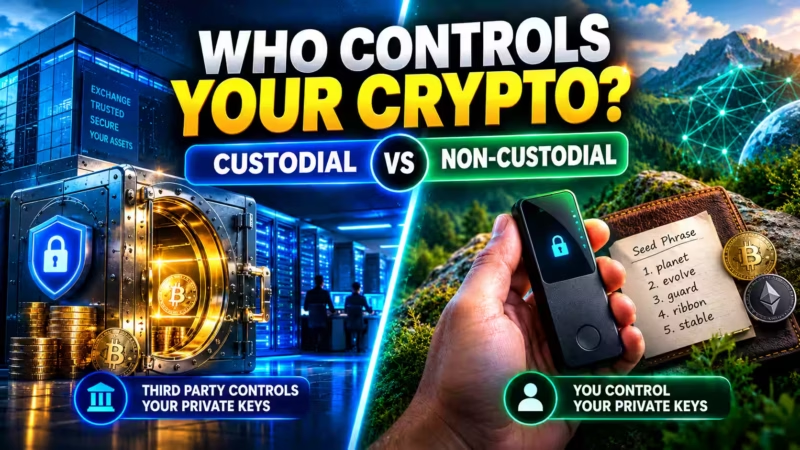
- Wallet: Software that holds your keys, not your coins. It proves you own your crypto and lets you spend it.
- Private key: The secret credential that authorizes spending. Lose it, and there’s no customer service line to recover your funds.
- Exchange: A company, like a well-known trading platform, that holds crypto on your behalf, similar to how a brokerage holds stocks.
- Miner: A participant on proof-of-work networks who uses specialized hardware to confirm transactions and add new blocks.
- Validator: A participant on proof-of-stake networks who locks up crypto as collateral to confirm transactions instead of mining. If those two roles still feel abstract, this guide to Bitcoin miners vs Ethereum validators explains what each group does, how they stay honest, and why the difference matters.
Everything else — DeFi, staking, tokenization — builds on this base layer, so it helps to review the common crypto terms explained for beginners before you make your first purchase.

How Does Cryptocurrency Actually Work, Step by Step?
Cryptocurrency works by signing a transaction with your private key, broadcasting it to a network, letting miners or validators confirm it, and recording it permanently on the blockchain. Here’s exactly what happens between “send” and “received.”
Step 1: You create and sign the transaction
Using your wallet, you enter the recipient’s address and the amount. Your wallet uses your private key to create a digital signature, proving you — and only you — authorized this transfer.
Step 2: The transaction broadcasts to the network
Your signed transaction goes out to thousands of independent computers (nodes) that check whether it’s valid before it can move forward.
Step 3: It waits in a queue
Unconfirmed transactions sit in the mempool, a holding area for transfers that haven’t been picked up by a miner or validator yet.
Step 4: Miners or validators confirm it
On proof-of-work networks like Bitcoin, miners compete using specialized hardware to solve a cryptographic puzzle and earn the right to add the next block. On proof-of-stake networks like Ethereum, validators lock up cryptocurrency as collateral and get randomly selected to confirm transactions instead. For a full breakdown of who actually confirms a crypto transaction, including mining vs staking, see our detailed guide.
Step 5: It gets permanently recorded
Once your transaction is included in a block, it’s confirmed, and every block added after it makes the record harder to alter — which is why more confirmations mean more security.
That five-step cycle is the entire mechanism underneath every transaction — and if you want each stage broken down further, our step-by-step walkthrough of how cryptocurrency works for beginners unpacks what happens at every stage.

What Makes Cryptocurrency Different From Regular Money?
Regular money is a liability of a government, backed by a central bank, with transaction costs set by policy and kept stable regardless of demand. Cryptocurrency has no central issuer — its cost to transact is set by real-time network demand, which is why fees can be low one hour and spike the next.
Regular money can be reversed by your bank if there’s fraud; a confirmed crypto transaction cannot be undone by anyone, for any reason. And where the Federal Reserve can expand or contract the dollar supply at its own discretion, Bitcoin’s 21-million-coin cap is fixed permanently by code, immune to any single institution’s decision.
None of that makes one categorically better than the other — but if you want the full breakdown, see our guide on crypto vs regular money for beginners and what actually changes when you ditch the bank.
| Feature | Cryptocurrency | Regular Money |
|---|---|---|
| Who controls it | A decentralized network of computers | A government and central bank |
| Transaction fees | Set by real-time network demand | Set by policy, usually stable |
| Reversibility | None once confirmed, transfers are final | Banks can reverse fraud or errors |
| Supply | Often fixed by code, like Bitcoin’s cap | Adjusted by a central bank |
| Access | Open to anyone with an internet connection | Requires a bank account and approval |
| Transaction speed | Seconds to minutes, any time of day | Instant to several days, depending on the bank |
| Transparency | Every transaction is publicly recorded | Records are private to the bank |
| Responsibility | You, you hold and protect your own funds | Your bank helps safeguard your money |
Neither is better overall. They solve different problems, with different trade-offs built in.
What Mistakes Do Beginners Make Most Often?
The most expensive mistakes aren’t about picking the wrong coin — they’re about basic handling errors that have nothing to do with market timing.
- Sharing a seed phrase is at the top of the list: no legitimate exchange or wallet will ever ask for it, and anyone who does is attempting a scam.
- Sending funds to the wrong network is another common and often irreversible error, since some blockchains use identical-looking address formats even though the underlying networks are completely incompatible.
- Leaving your entire balance on a single exchange indefinitely adds counterparty risk on top of ordinary market risk — a real concern given that 72% of current holders cite scams and security as an ongoing worry according to Security.org’s 2026 Cryptocurrency Adoption and Sentiment Report.
- And buying into a coin purely on social media hype, without checking whether real development or adoption backs the hype, remains one of the most repeated patterns across every market cycle.
Security-conscious habits are non-negotiable here, and our deeper guide to beginner crypto mistakes to avoid covers the costly errors new users repeat every single cycle.

What Legal Categories Does Crypto Fall Into Now?
This is the part most beginner content skips, and it’s genuinely new information as of 2026. Federal regulators have sorted crypto assets into distinct legal categories that determine how each one is treated under US law. Here’s what that means for you.
Digital Commodity
Coins like Bitcoin or Ether that derive their value from network use and supply and demand.
How it’s treated: As a non-security, overseen by the CFTC.
Digital Security
A tokenized version of a traditional financial instrument, or a token sold with specific promises of profit from someone else’s managerial effort.
How it’s treated: As a security that requires full SEC registration.
Stablecoin
A coin pegged to a stable reference asset — usually the US dollar — that meets the requirements set out under the GENIUS Act, signed into law in July 2025.
How it’s treated: As a non-security payment instrument, not a security, when compliant.
Digital Tool
A token that performs a specific practical function — a membership, a credential, an identity badge — often without being transferable at all.
How it’s treated: Outside investment-contract territory entirely.
Comparison Table: The Core Legal Categories for Beginners
| Category | What It Is | Legal Treatment | Example |
|---|---|---|---|
| Digital Commodity | Value from network use and supply/demand | Non-security (CFTC) | Bitcoin, Ether |
| Digital Security | Tokenized financial instrument or investment-contract sale | Security (SEC) | Tokenized stocks/bonds |
| Stablecoin | Pegged to a stable reference asset (usually USD) | Non-security if GENIUS Act compliant | USDC, compliant payment stablecoins |
| Digital Tool | Practical, often non-transferable utility asset | Non-security | Membership credentials, ID badges |
This reflects the general regulatory framework described in 2026. Crypto regulations can change, so always check the current rules where you live before you buy.
For a deeper breakdown of functional vs legal crypto categories, see our guide to why so many cryptocurrencies exist and how to sort them meaningfully.
How Are Americans Actually Using Crypto in 2026?
The honest, current picture looks less like Silicon Valley speculation and more like ordinary financial behavior spread across the country. Adoption now tracks closely with regional population density — the South leads at 38%, followed by the West at 27%, with the Northeast and Midwest each around 18%. It’s no longer concentrated among the wealthy either: more than half of holders earn under $150,000 in household income, and 23% earn under $75,000.
Usage has shifted decisively from pure speculation toward daily utility — for a closer look at these patterns, explore what crypto is used for in real life and the real-world use cases beyond speculation.
Sending money to friends and family (41% of holders), everyday shopping (40%), and gaming or micro-transactions (28%, up from 20% the prior year) now define how most people actually interact with crypto, while purely speculative NFT activity has cooled, dropping from 32% to 30% of holders.
Trust has crossed a symbolic threshold too: 69% of holders now say they trust crypto as much as or more than traditional banking, compared to 65% who trust banks — and notably, 76% of holders say they want their existing bank to offer crypto services, which points toward integration rather than replacement as the likely direction from here.
This article is general educational information, not financial or investment advice. Cryptocurrency values, regulations, and market conditions change frequently; consult a licensed financial professional before making investment decisions.
People Also Ask
What is cryptocurrency and how does it work step by step? Cryptocurrency is digital money recorded on a public, shared ledger called a blockchain. When you send it, your wallet signs the transaction with your private key, it broadcasts to the network, miners or validators confirm it, and it’s permanently recorded — typically within seconds to about ten minutes depending on the network.
How does crypto work behind the scenes, really? Behind the interface, thousands of independent computers (nodes) hold identical copies of the transaction ledger. No single company or government controls it; instead, the network reaches agreement through either proof-of-work (mining) or proof-of-stake (validator staking), depending on which blockchain is used.
What’s the very first thing a beginner should understand about crypto? The difference between your wallet and your private key. Your wallet stores the key that proves ownership and authorizes spending — lose that key, and there is no password reset or customer service line to recover your funds.
Is cryptocurrency legal and regulated in the US? Yes, and more clearly than before 2026. Federal guidance now sorts crypto assets into distinct legal categories — digital commodities, digital securities, stablecoins, and digital tools — each with different regulatory treatment, giving beginners a clearer picture of what they’re actually buying according to BVNK’s 2026 global stablecoin and crypto regulation overview
Do most people use crypto to invest, or for something else? Both, increasingly split toward everyday use. Current data shows 41% of holders use crypto to send money to friends and family and 40% use it for shopping, while financial independence — not pure investment return — is the most commonly cited benefit among users.
Editorial Integrity
Sources & Citations
Public data and current reporting behind this beginner guide on money supply, U.S. crypto adoption and usage, security and scam concerns, and the legal treatment of digital assets
The points in this guide are supported by public data and current industry or research reporting. Money supply context draws on Federal Reserve figures, adoption and usage patterns reference national survey reporting, and security concerns reflect published consumer sentiment research. Regulatory descriptions follow the general framework seen in 2026. Because market conditions, adoption trends, and rules change over time, always check the latest figures and regulations before acting on them.
View full sources, methodology, and editorial notes ⌄
This guide was written for total newcomers using public data sources, dated survey reporting, and official regulatory context. We give preference to named data providers, government releases, and current consumer research where they directly support a claim about money supply, adoption, security sentiment, or legal treatment. Some points are described in general terms where exact sourcing is still evolving. This article is educational information, not financial advice.
- Central bank money supply context: Federal Reserve — Money Stock Measures (H.6) — cited for how a central bank tracks and adjusts the money supply, supporting the comparison between regular money and crypto’s fixed-supply design.
- Historical money supply data: FRED — M2 Money Stock, Federal Reserve Bank of St. Louis — cited as reference data on how broad money measures are reported and change over time.
- Crypto security and scam concerns: Security.org — Cryptocurrency Adoption and Sentiment Report — cited for consumer sentiment showing many holders view scams and security as an ongoing worry, supporting the guide’s focus on safe-handling habits.
- Scam exposure and prevention context: Security.org — Scam Prevention Research — cited as general context on how often crypto owners are targeted, used to frame the beginner-mistakes section.
- U.S. crypto usage and adoption: Pew Research Center — Americans and Cryptocurrency Use — cited for the broad picture of how many U.S. adults have used or invested in crypto, framing the shift toward everyday, practical use.
- Legal categories and regulatory treatment: General 2026 regulatory framework — descriptions of digital commodities, digital securities, stablecoins, and digital tools reflect the general framework observed in 2026, including stablecoin rules introduced that year. Exact classifications can vary by asset and jurisdiction, so readers should confirm the current rules where they live.
Our Editorial Standards
Tech Capital Hub applies Google’s E-E-A-T framework to every beginner crypto guide, favoring plain-English explanations, public data, and current reporting over hype, price predictions, or unsupported claims. This guide relies on trusted references where they support specific points, including Federal Reserve money supply data, national survey reporting on U.S. adoption, and published consumer research on crypto security and scams. Where rules are still evolving, we describe the general 2026 regulatory framework rather than overstate certainty.
View how our editorial standards apply to this article ⌄
Written for Total Newcomers, Step by Step
This guide meets beginners where they are. We explain crypto as digital money on a shared public ledger, then walk through a real transaction from signing with your private key to final confirmation. Everyday moments frame the lessons: sending money to family, paying for an online purchase, or setting up a wallet for the first time, so the ideas actually stick.
Blockchain, Wallets, and Keys Explained Clearly
Coverage breaks down the concepts that matter most early on. We clarify what a blockchain is, why a wallet holds your keys rather than your coins, how proof-of-work and proof-of-stake confirm transactions, and how crypto differs from bank money on control, reversibility, and supply. Every term is defined in plain language before it is used.
Public Data and Named Sources Where They Fit
Specific claims are anchored to trusted references. Money supply context draws on Federal Reserve figures, adoption and usage patterns reference national survey reporting, and security concerns reflect published consumer sentiment research. Regulatory descriptions follow the general framework observed in 2026. We avoid promotional content and unverified numbers as support for any point.
Honest About Risk, Limits, and Updates
We state the trade-offs as plainly as the benefits: crypto is volatile, confirmed transactions cannot be reversed, and self-custody puts full responsibility on you. Because adoption trends, market conditions, and regulations change, this guide is reviewed and updated over time. Nothing here is financial or investment advice. Corrections or source challenges can be sent to editorial@techcapitalhub.com.
About the Author
Marcus Delray
Fintech Analyst | Cryptocurrency, Blockchain & Beginner Education
Marcus Delray writes crypto explainers for people who are starting from zero. In this guide, he keeps things plain and practical: what cryptocurrency really is, how a blockchain records a transaction, why your wallet holds keys instead of coins, and the simple handling mistakes new users make most. His goal is clarity, not hype, so beginners can act with confidence.
View full author bio, credentials, and links ⌄
Marcus Delray is a fintech analyst and founder of Tech Capital Hub, where he covers AI in finance, blockchain technology, DeFi, and business accounting tools. With over a decade of experience researching financial technology, he focuses on turning complex topics into clear, actionable reads for investors, entrepreneurs, and everyday newcomers.
His approach to crypto starts with the basics that trip people up first. He explains cryptocurrency as digital money recorded on a shared public ledger, then walks through a transaction step by step: signing with your private key, broadcasting to the network, confirmation by miners or validators, and the permanent record on the blockchain. He treats the wallet-versus-private-key distinction as the single most important idea a beginner can learn.
Rather than chasing price predictions, Marcus grounds his coverage in plain-English explanation and current, trusted reporting. He compares crypto to regular money on control, reversibility, and supply, and he flags the handling errors that cost beginners the most, from sharing a seed phrase to sending funds on the wrong network. Where rules are still evolving, he describes the general regulatory picture rather than overstate certainty, and he is clear that his articles are educational information, not financial advice.
- Explains cryptocurrency, blockchain, wallets, and private keys in plain language for total beginners
- Breaks down a crypto transaction step by step, from signing to final confirmation on the blockchain
- Compares crypto and regular money on control, reversibility, and fixed versus adjustable supply
- Highlights the most common beginner mistakes and the safe-handling habits that prevent them
- Grounds coverage in public data and current reporting, with clear educational framing and no financial advice
Enjoying our content?
Click below to add us as a preferred source. Google will prioritize our latest articles in your Top Stories, AI Mode, and AI Overviews.
Preferred Source on Google





4 thoughts on “What Is Cryptocurrency and How Does It Work? The Beginner Guide That Ties It All Together”