
Who Confirms Crypto Transactions? Mining vs Staking Without the Confusing Jargon


Fintech Analyst · Founder of Tech Capital Hub
Marcus has spent more than a decade researching blockchain and financial technology. In this guide, he breaks down who confirms crypto transactions, comparing Bitcoin miners with Ethereum validators, and explains why that choice shapes security, energy use, and regulation.
There’s no bank teller, no clearinghouse, and no company employee approving your crypto transaction. Who confirms crypto transactions comes down to one of two groups: miners, who burn electricity solving math puzzles, or validators, who lock up their own money as collateral. Which group does the job depends entirely on which blockchain you’re using — and in 2026, that choice has consequences well beyond speed and cost, including which federal regulator oversees your asset and whose backyard the power plant sits in.
At a Glance
Key Takeaways
The five points below explain who really confirms your crypto transactions — tap any item to expand it.
Bitcoin uses miners under proof of work
On Bitcoin, miners compete using specialized hardware to solve a hard math puzzle. Whoever solves it first adds the next block and confirms the transactions inside it. This system is called proof of work.
Ethereum uses validators under proof of stake
On Ethereum, validators lock up 32 ETH as collateral and get randomly selected to propose and check blocks. There is no puzzle-solving race. This system is called proof of stake.
Miners spend electricity; validators risk staked capital
The two systems put different things on the line. Miners spend real electricity and hardware to win a block, while validators risk losing their staked ETH if they cheat. Both make dishonesty cost real money.
Ethereum uses far less energy after The Merge
Bitcoin’s network uses roughly 160–204.4 TWh of electricity a year, while Ethereum uses about 7.87 GWh. That is a drop of more than 99.98% after Ethereum switched to proof of stake in the 2022 upgrade known as The Merge.
The choice affects security, power, and regulation
Who confirms a transaction reaches well beyond speed and fees. It shapes how a network stays secure, how much strain it places on local power grids, and which federal regulator — the SEC or the CFTC — oversees the asset.
New to all this? It helps to first understand what cryptocurrency is and how it works before diving into who confirms each transaction.
Who Confirms Crypto Transactions? The Quick Answer
Crypto transactions are confirmed by miners on Proof of Work networks like Bitcoin and by validators on Proof of Stake networks like Ethereum — never by a bank or central company.
Two systems handle this job today. Proof of Work (PoW), used by Bitcoin, relies on miners who compete using specialized computers to solve a cryptographic puzzle; whoever solves it first gets to add the next block and collect the reward. Proof of Stake (PoS), used by Ethereum, relies on validators who lock up cryptocurrency as collateral and get randomly selected to propose and confirm blocks, with no computational race involved.
Both systems solve the same underlying problem — how do thousands of computers with no central boss agree on a single, honest transaction history — but they solve it in fundamentally different ways, with different costs, different security assumptions, and increasingly, different regulatory treatment.
Table of Contents
What Do Miners Actually Do to Confirm a Bitcoin Transaction?
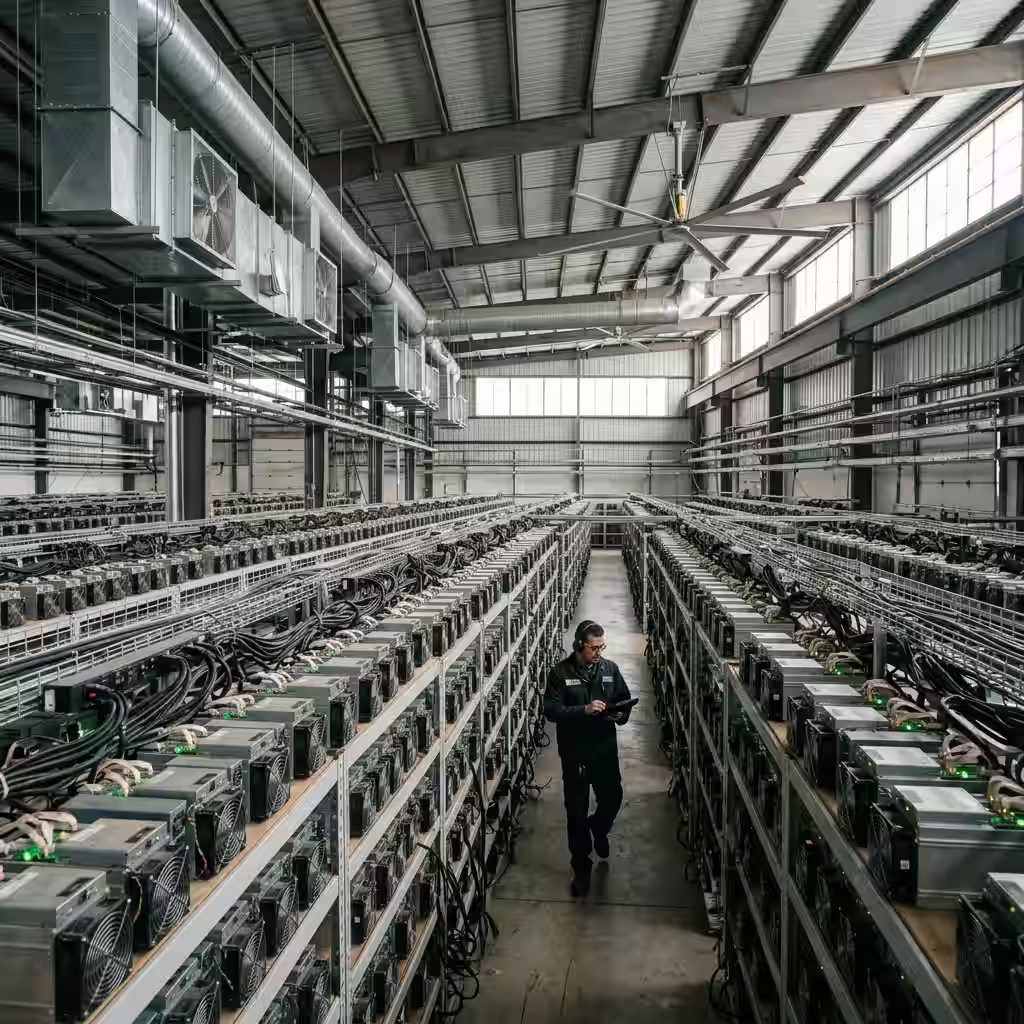
Miners confirm Bitcoin transactions by grouping them into blocks and racing to solve a hard math puzzle; the first to solve it adds the block and earns the reward, while full nodes check the work.
Before a transaction ever reaches a miner, it goes through an ownership check. Private keys allow a sender to sign a transaction, providing cryptographic proof that only the rightful owner authorized the transfer — a mechanism laid out in Satoshi Nakamoto’s original Bitcoin whitepaper. That signed transaction then broadcasts to the network and lands in the mempool, a queue of pending transfers waiting for confirmation. If the wallet-and-key side of that step still feels fuzzy, our guide to how wallets, private keys, and blockchain transactions fit together breaks it down from the ground up.
From there, miners take over. They use specialized hardware called ASICs (Application-Specific Integrated Circuits) to compete in a mathematical lottery known as hashing, racing to find a specific value that satisfies the network’s difficulty requirement. The difficulty is deliberately set so high that rewriting the ledger’s history would cost more energy than any realistic attacker could afford.
Miners aren’t the network’s only authority, though. Full nodes — separate computers that validate every block against the protocol’s rules — serve as the actual referee. If a miner proposes an invalid block, say one that tries to duplicate coins, full nodes simply reject it. Because the miner has already spent real money on electricity and hardware to “solve” that block, a rejected block means the miner eats the entire cost with nothing to show for it. That financial pain is what keeps miners honest — not trust, but math and money working against fraud.
Today, Bitcoin’s network runs on serious hardware. The newest ASIC models, like the Antminer S23 Hyd, reach an efficiency of 9.5 joules per terahash, a tenfold improvement over models from eight years ago. Even with that efficiency gain, total network consumption keeps climbing because more miners keep joining the competition — a pattern economists call the Jevons Paradox, where efficiency gains fuel more total usage rather than less. The Cambridge Centre for Alternative Finance tracks this consumption in real time through the Cambridge Bitcoin Electricity Consumption Index.
What Do Validators Do to Confirm an Ethereum Transaction?
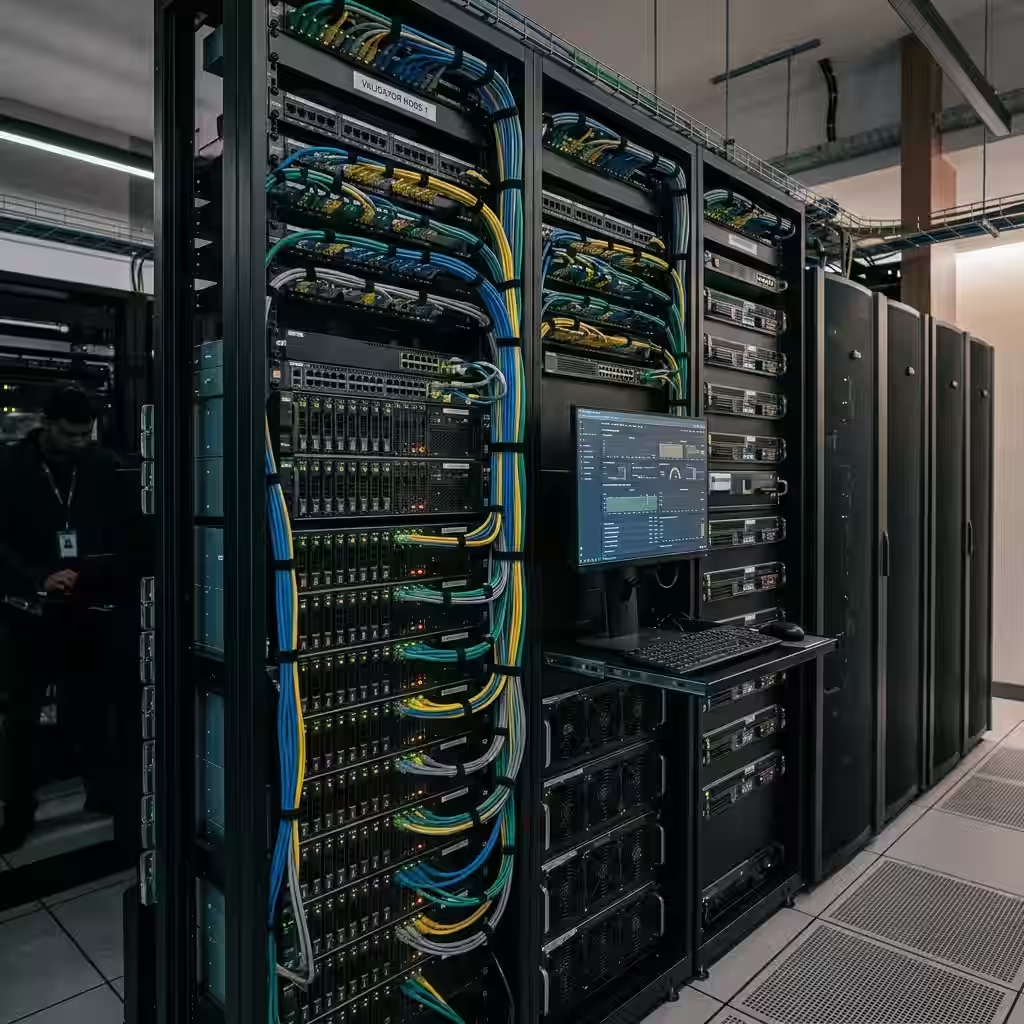
Validators confirm Ethereum transactions by staking 32 ETH as collateral and getting randomly selected to propose and check blocks — no puzzle-solving race required.
Ethereum used to run on the same proof-of-work model as Bitcoin, but that changed permanently in September 2022 with an upgrade known as “The Merge.” Since then, Ethereum has run on Proof of Stake, and the job of confirming transactions falls to validators instead of miners. The full technical specification for how validators operate is documented in Ethereum’s developer documentation.
To become a validator, a participant deposits 32 ETH into a deposit contract as collateral — not a fee, but a financial guarantee of good behavior. Rather than racing to solve a puzzle, the network uses a pseudo-random selection process called RANDAO to choose which validator proposes the next block, in a 12-second window. As of mid-2026, roughly 33% of the total ETH supply is staked, securing the network through collective financial commitment rather than computing power.
Honesty is enforced differently here. If a validator tries to cheat — for example, by double-signing two conflicting versions of a block — a portion of their staked ETH is “slashed,” permanently destroyed, and they’re ejected from the validator set. Simply going offline also costs a validator money through smaller inactivity penalties. The incentive structure is the same core idea as mining — cheating costs you real money — but the resource at risk is staked capital instead of spent electricity.
Mining vs Staking: What’s Actually Different?
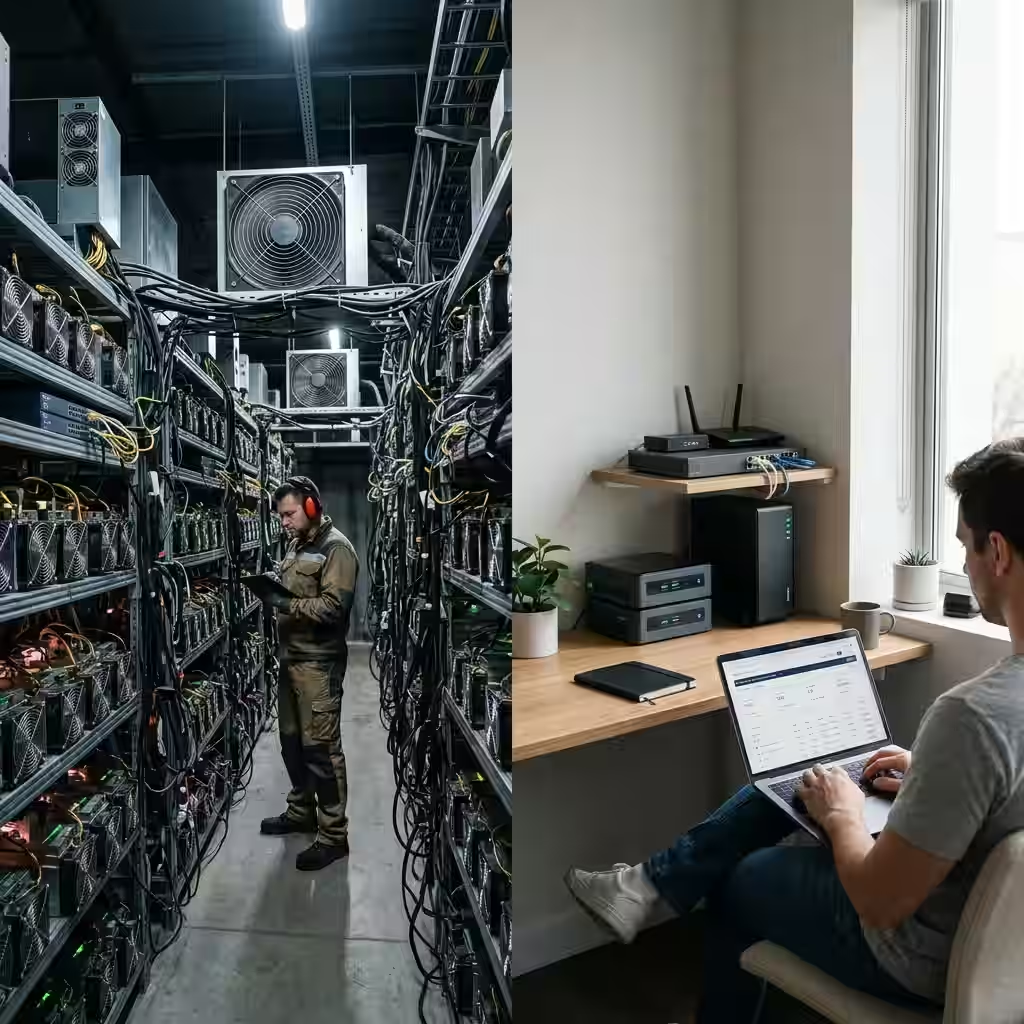
Mining spends electricity and hardware to win a race, while staking risks locked-up cryptocurrency and picks confirmers at random — the same goal reached through two very different resources.
Here’s the difference at a glance:
- Who does the work: Miners with ASIC rigs (Bitcoin) vs validators staking ETH (Ethereum)
- Resource on the line: Electricity and hardware vs 32 ETH in collateral
- How they’re chosen: Competitive hashing race vs pseudo-random RANDAO selection
- Cost of cheating: A wasted, rejected block vs slashed and destroyed ETH
The mechanics diverge in almost every practical way, from the hardware involved to what happens if someone tries to attack the network.
Comparison Table: Proof of Work vs. Proof of Stake
Side-by-Side
Comparison Table: Proof of Work vs. Proof of Stake
| Feature | Proof of Work Bitcoin | Proof of Stake Ethereum |
|---|---|---|
| Who confirms transactions | Miners, using ASIC hardware | Validators, staking ETH as collateral |
| Primary resource spent | Electricity and computing hardware | Staked cryptocurrency (32 ETH per validator) |
| Selection method | Competitive mathematical race (hashing) | Pseudo-random selection (RANDAO) |
| Penalty for dishonesty | Wasted electricity and hardware cost on a rejected block | Staked ETH is “slashed” and destroyed |
| Annual energy use (network-wide) | 160–204.4 TWh | ~7.87 GWh |
| 2026 staking/mining yield | Mining profitability varies with electricity cost and hardware | Roughly 2.82% average staking rewards rate (Consensus Layer) |
The energy gap here is the most dramatic number in the whole comparison. Bitcoin’s proof-of-work network consumes between 160 and 204.4 terawatt-hours annually — comparable to the electricity use of a mid-sized country. Ethereum’s proof-of-stake network, by contrast, runs on approximately 7.87 gigawatt-hours a year, a figure smaller than the annual electricity draw of the British Museum’s climate control and lighting systems alone. That’s not a rounding difference; it’s a reduction of more than 99.98% following The Merge.
If some of these terms are still new, our roundup of common crypto terms explained for beginners covers the vocabulary you’ll keep running into.

Why Does It Matter Who Confirms Your Transaction, Beyond Speed and Fees?
Who confirms your transaction shapes three things most people never connect to crypto: local power bills, federal regulation, and your personal security. This is where the topic stops being purely technical and starts touching your actual life, whether or not you own crypto.
The Grid Connection
Bitcoin mining has become physically tied to the US electricity grid. In Texas, mining demand reached 4,288 megawatts by late 2025, and miners like Riot Platforms now function as flexible loads that grid operators can call on during stress events. Riot Platforms alone earned $30.6 million in curtailment credits in a single quarter of 2025 by powering down during extreme weather to free up electricity for residential use.
But this arrangement isn’t free of side effects: conservative estimates suggest mining operations have raised electricity costs for non-mining Texas residents by roughly 4.7%, or $1.8 billion annually.
Meanwhile, residents in Granbury, Texas, have reported health complaints, including elevated heart rates and migraines, linked to the constant industrial noise of nearby mining facilities. The U.S. Energy Information Administration launched a phased pilot reporting program in March 2026 covering Virginia, Washington, and Texas, specifically to give grid operators better visibility into this kind of load.

The Regulatory Connection
Who confirms your transaction is also becoming a legal question, not just a technical one. Under the Digital Asset Market Clarity Act framework, a blockchain network can apply for “Mature Blockchain System” certification — and once it demonstrates a sufficient level of decentralization, oversight of that asset shifts from the SEC to the CFTC.
Mining and staking activities themselves are treated as ministerial, not managerial, functions under this framework, meaning the people confirming transactions generally aren’t treated as offering securities. That distinction exists specifically because both mining and staking are decentralized processes with no single controlling party — the same property that makes them expensive or complicated is what keeps regulators from treating them as centralized financial products.
The Custody Connection
There’s a physical security angle too, particularly relevant if you’re considering solo staking or self-custody. During the first half of 2026, there were 52 confirmed “wrench attacks” — physical coercion targeting crypto holders — resulting in $124 million in stolen assets. That risk has pushed institutional operators toward multi-signature architectures and air-gapped hardware signers, and it’s a real consideration for any individual holding meaningful value directly rather than through a custodian. If you’re handling your own keys, it’s worth reviewing the beginner crypto mistakes to avoid that cost new users the most every cycle.

What Happens If a Miner or Validator Tries to Cheat?
Cheating fails because it costs more than it could ever earn: a dishonest miner loses the energy already spent, and a dishonest validator loses a chunk of staked ETH through slashing.
Both systems are built so that cheating is financially irrational, not just technically difficult.
A dishonest miner who proposes an invalid block — attempting to spend the same coin twice, for instance — gets rejected by full nodes across the network. The electricity and hardware time already spent on that block is gone, with nothing recovered.
A dishonest validator who double-signs a block faces slashing, an automatic and permanent loss of a portion of their staked ETH, on top of ejection from the validator set. In both cases, the network doesn’t rely on goodwill. It relies on making dishonesty more expensive than honesty, every single time.
Which Method Is More Secure — Proof of Work or Proof of Stake?
Neither system has definitively “won” this argument, and the honest answer depends on what kind of attack you’re worried about.
Proof of Work’s security rests on physical cost: an attacker would need to out-hash the entire Bitcoin network, which as of 2026 has surpassed 1 zettahash per second — a real-world energy expenditure so large it acts as a natural deterrent. Proof of Stake’s security rests on financial cost: an attacker would need to acquire and risk losing a massive amount of staked ETH, with roughly a third of the total supply already staked and subject to slashing if used maliciously.
Institutions focused on ESG compliance tend to favor proof of stake for its dramatically lower energy footprint, while those who want security anchored in physical, real-world cost — rather than financial capital that could theoretically be manipulated — tend to favor proof of work.
Ethereum’s upcoming Glamsterdam upgrade, targeted for the end of August 2026, adds another security layer specific to proof of stake: Enshrined Proposer-Builder Separation is projected to reduce Maximal Extractable Value extraction — a form of transaction reordering that can disadvantage ordinary users — by up to 70%, making the network more predictable for everyday transactions.

What Should Beginners Know Before Choosing a Network?
You don’t actually choose who confirms your transaction — that’s determined by which blockchain the asset runs on, not by you. But understanding the trade-off helps explain the fees, confirmation times, and even the news headlines you’ll run into.
If you’re using Bitcoin, you’re relying on a network secured by real-world energy expenditure, with a settlement rhythm of roughly one block every ten minutes and a security model that has never been fundamentally broken since 2009.
If you’re using Ethereum, you’re relying on a network secured by staked financial collateral, with faster block times, a dramatically smaller environmental footprint, and an active upgrade pipeline aimed at reaching institutional-grade throughput.
Neither is objectively “better” — they’re different tools built on different trust assumptions, and both have now become embedded in questions well beyond the blockchain itself, from Texas power bills to federal securities law.
Once you understand who confirms a transaction, the next natural questions are why these assets are worth anything at all and what people actually do with them. For that, see why cryptocurrency has value in the first place and what crypto is used for in real life.
This article is general educational information, not financial or investment advice. Cryptocurrency mining, staking, and regulatory classifications can change; consult a licensed financial professional before making investment decisions.
People Also Ask
Who verifies cryptocurrency transactions? On proof-of-work networks like Bitcoin, miners verify transactions by solving cryptographic puzzles. On proof-of-stake networks like Ethereum, validators verify transactions by staking cryptocurrency as collateral and getting randomly selected to propose blocks.
What’s the difference between mining and staking, explained simply? Mining uses computing hardware and electricity to compete for the right to confirm transactions. Staking uses locked-up cryptocurrency as collateral instead, with validators randomly selected rather than racing to solve a puzzle.
What do validators actually do on Ethereum? Validators lock up 32 ETH as collateral, get randomly selected to propose or attest to new blocks, and earn rewards for honest participation. If they act dishonestly, a portion of their staked ETH is destroyed through a process called slashing.
Is proof of stake more environmentally friendly than proof of work? Yes, dramatically so. Ethereum’s proof-of-stake network uses approximately 7.87 gigawatt-hours annually, while Bitcoin’s proof-of-work network uses between 160 and 204.4 terawatt-hours annually — a difference of several orders of magnitude.
Does it matter to a beginner which consensus method a cryptocurrency uses? Yes. It affects transaction speed, environmental footprint, and increasingly, regulatory classification, since networks can apply for decentralization certification that shifts oversight from the SEC to the CFTC based partly on how confirmation is decentralized.
Cryptocurrency · Editorial Integrity
Sources & Citations
Public data and current reporting behind this guide on who confirms crypto transactions — covering Bitcoin mining, Ethereum staking, validators, miners, network security, energy use, and regulation.
Every claim in this guide is backed by public data and current industry or research reporting. Mining and validator mechanics reference official protocol documentation, energy and grid figures draw on named research and government reporting, and security details follow published network data. Legal context follows the 2026 SEC and CFTC framework. Because network figures, energy use, and rules change fast, always check the latest data before you act on it.
View full sources, methodology, and editorial notes
This beginner guide was written using official protocol documentation, on-chain analytics, named energy and grid research, and current regulatory releases. We give preference to primary developer docs, dated research, and named platforms where they directly support a claim about how miners or validators confirm transactions, how each system enforces honesty, network energy use, or legal classification. A few points are described in general terms where exact figures shift daily. This article is educational information, not financial advice.
- Proof of work and how mining confirms transactions: Bitcoin Whitepaper — A Peer-to-Peer Electronic Cash System — cited as the primary source for how miners compete to add blocks and why the proof-of-work model deters fraud.
- Proof of stake and validator selection: Ethereum.org — Proof-of-Stake (PoS) — cited as official documentation on how validators stake ETH, get selected to propose blocks, and confirm transactions.
- The Merge and Ethereum’s shift to staking: Ethereum.org — The Merge — cited for the September 2022 transition from mining to staking and its impact on how Ethereum confirms transactions.
- Consensus mechanisms compared: Ethereum.org — Consensus Mechanisms — cited to explain how proof-of-work and proof-of-stake differ in resources, selection, and penalties for dishonesty.
- Validator staking and slashing: Ethereum.org — Staking — cited for the 32 ETH deposit requirement, staking rewards, and how slashing penalizes dishonest validators.
- Bitcoin network energy use: Cambridge Bitcoin Electricity Consumption Index — cited as dated research on Bitcoin’s network-wide electricity use, supporting the energy comparison between mining and staking.
- Grid impact and mining load reporting: U.S. Energy Information Administration — Tracking Electricity Use by Cryptocurrency Miners — cited for government context on how mining demand affects the U.S. electricity grid and reporting programs.
- Live network hashrate and mining data: Blockchain.com — Bitcoin Hash Rate Chart — cited as a live reference for Bitcoin’s total hashrate, supporting the point that mining security rests on physical energy cost.
- Staking participation and network data: beaconcha.in — Ethereum Beacon Chain Explorer — cited for live validator counts and the share of ETH staked, supporting the discussion of proof-of-stake security.
- Legal classification of crypto assets: Ropes & Gray — SEC and CFTC Joint Guidance on Crypto Asset Classification (March 2026) — cited for the framework that shifts oversight from the SEC to the CFTC based on decentralization, and how mining and staking are treated.
- Regulatory interpretation (secondary): Norton Rose Fulbright — SEC and CFTC Joint Interpretation on Crypto Asset Regulation — cited as a second legal summary of the March 2026 interpretation, supporting the regulatory context around who confirms transactions.
Who Confirms Crypto Transactions? · Editorial Standards
Our Editorial Standards
Tech Capital Hub applies Google’s E-E-A-T framework to every beginner crypto guide, favoring plain-English explanations, public data, and official documentation over hype or unsupported claims. This guide relies on trusted references where they support specific points — including the Bitcoin whitepaper and Ethereum’s developer docs for how miners and validators confirm transactions, the Cambridge index and government reporting for energy use, and live network explorers for hashrate and staking data. Where classification is still evolving, we describe the general 2026 SEC and CFTC legal framework rather than overstate certainty.
View how our editorial standards apply to this article
Written for Total Newcomers, Step by Step
This guide meets beginners where they are. We start with the simple question of who actually approves a crypto payment, then walk through how Bitcoin miners compete to add blocks and how Ethereum validators are chosen to do the same job a different way. Everyday framing anchors the lessons — from why a transaction takes a few minutes to why your coin sits under one regulator and not another — so the ideas actually stick.
Mining vs Staking Explained Without the Jargon
Coverage breaks down the concepts that matter most early on. We clarify how proof of work uses computing power to secure Bitcoin, how proof of stake uses locked-up ETH to secure Ethereum, why the 2022 Merge changed the way Ethereum confirms transactions, and how slashing punishes dishonest validators. Every term — miner, validator, consensus, hashrate — is defined in plain language before it is used.
Official Docs and Named Data Where They Fit
Specific claims are anchored to trusted references. Mining and validator mechanics draw on the Bitcoin whitepaper and Ethereum’s developer documentation, energy figures reference the Cambridge index and U.S. Energy Information Administration reporting, and live security data comes from network explorers for hashrate and staked ETH. Legal classification follows the 2026 SEC and CFTC joint framework. We avoid promotional content and unverified numbers as support for any point.
Honest About Trade-offs, Energy, and Updates
We state the hard truths as plainly as the mechanics: proof of work is secure but energy-hungry, proof of stake is lighter but raises its own centralization questions, and no single design wins on every measure. Because network figures, energy use, and rules change fast, this guide is reviewed and updated over time. Nothing here is financial or investment advice. Corrections or source challenges can be sent to editorial@techcapitalhub.com.
Cryptocurrency · About the Author
Marcus Delray
Fintech Analyst · Founder of Tech Capital Hub
Marcus Delray is a fintech analyst and the founder of Tech Capital Hub. In this guide, he explains who actually confirms crypto transactions in plain terms — comparing how Bitcoin miners and Ethereum validators do the same job in very different ways, and why that choice shapes security, energy use, and regulation. His focus is on clarity and practical understanding, not hype.
View full author bio, credentials, and links
Marcus Delray has spent over a decade researching financial technology. He built Tech Capital Hub to make that research useful for everyday readers — from total beginners to people who already follow the market. He covers blockchain, DeFi, AI in finance, and business accounting tools, with a consistent focus on turning dense topics into clear, actionable guides.
For this guide, Marcus answers a question most beginners ask but rarely get a straight answer to: who confirms a crypto transaction? He walks through proof of work step by step, showing how Bitcoin miners race to solve a puzzle and add the next block, then contrasts it with proof of stake, where Ethereum validators lock up ETH and get chosen to do the same job. He explains what changed with the 2022 Merge, how slashing punishes dishonest validators, and why mining burns real energy while staking does not. He also lines up the trade-offs — security, speed, energy use, and centralization — against the 2026 SEC and CFTC framework that decides which regulator oversees each asset. Where classification is still evolving, he describes the general regulatory picture rather than overstate certainty. All articles are educational information, not financial advice.
- Explains who confirms crypto transactions — from Bitcoin miners to Ethereum validators — in plain, jargon-free language
- Breaks down proof of work versus proof of stake, including how each system selects who adds the next block and enforces honesty
- Clarifies what the 2022 Merge changed and how slashing penalizes validators who try to cheat the network
- Compares the real trade-offs between mining and staking across security, speed, energy use, and centralization
- Grounds coverage in official protocol docs, network data, and the 2026 SEC and CFTC framework, with clear educational framing and no financial advice
Enjoying our content?
Click below to add us as a preferred source. Google will prioritize our latest articles in your Top Stories, AI Mode, and AI Overviews.
Preferred Source on Google



One thought on “Who Confirms Crypto Transactions? Mining vs Staking Without the Confusing Jargon”