AI in DeFi Explained: How Artificial Intelligence Is Making Decentralized Finance Smarter (and Safer)
Let me be honest with you — when I first heard "AI agents managing DeFi protocols," I rolled my eyes a little. It sounded like the kind of buzzword salad that crypto Twitter loves to cook up every six months.
But then I looked closer at what's actually happening on-chain right now. And yeah — this one's real.
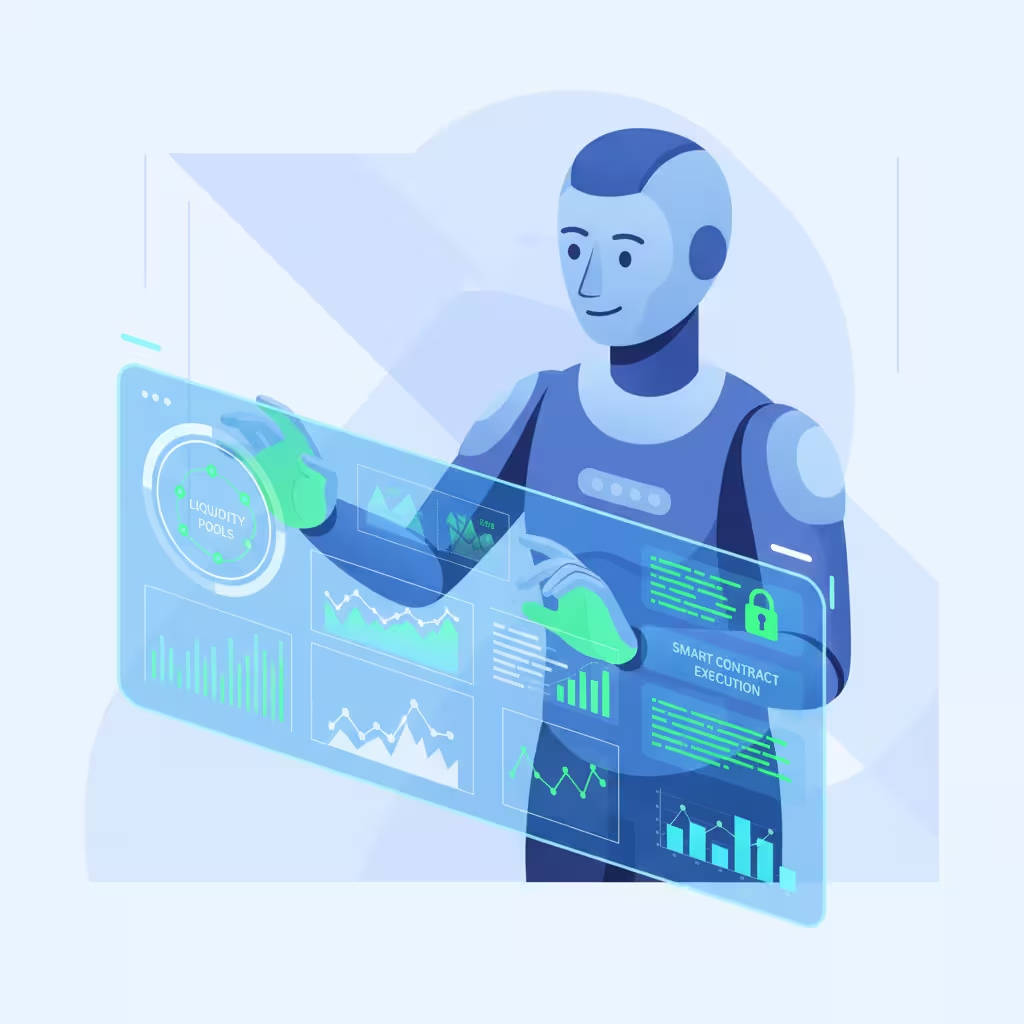
AI in DeFi isn't some far-off concept anymore. It's already managing liquidity pools. It's catching exploits before they drain funds. It's doing yield optimization faster than any human trader ever could. If you're using decentralized finance in any capacity — whether for passive income, trading, or just holding — you're probably already benefiting from it without knowing.
So let's talk about what's actually going on. No jargon walls. No textbook definitions. Just a real breakdown of how artificial intelligence is quietly becoming the backbone of decentralized finance in 2026.
Why DeFi Needed Help in the First Place
Here's the thing most people forget: early DeFi was kind of fragile.
The whole system ran on fixed rules. If your collateral dropped below a certain percentage — say 150% — you got liquidated. Didn't matter if the price dip lasted two minutes. Didn't matter if it was a flash loan attack that caused the drop. The rule was the rule, and the code executed it.
That worked okay when markets were smaller and slower. But DeFi grew up. Fast.
Flash loan arbitrage became a real threat. MEV bots — programs that rearrange transactions to profit at your expense — became a billion-dollar industry. Liquidity fragmented across dozens of chains and hundreds of protocols. And the old "set it and forget it" rule systems just couldn't keep up anymore.
Something had to change. And that something turned out to be machine learning.
So What Do AI Agents Actually Do?
Think of an AI agent in DeFi like a really, really attentive fund manager — except it never eats, never sleeps, and processes thousands of data points per second.
These agents pull in information from everywhere. On-chain transactions. Oracle price feeds. Even social media sentiment. Then they run that data through predictive models to figure out what's likely to happen next — and act on it before it does.
In practice, that looks like this:
A liquidity pool starts showing unusual outflow patterns late on a Sunday night. A human watching it might not notice for hours. An AI agent flags it in seconds, cross-references it against known exploit signatures, and either alerts the protocol team or — in some systems — automatically adjusts parameters to reduce exposure.
That's the shift. From reacting to problems after they happen, to catching them before they do.
The agents work across four main areas: data collection, risk modeling, automated execution, and governance reporting. None of those are new concepts. What's new is having a system that handles all four simultaneously, around the clock, without needing a break or a Slack notification to wake it up.

Yield Optimization: Where AI Really Shines for Everyday Users
Okay, this is the part most people actually care about. How does AI help you make more money in DeFi?
If you've done any yield farming, you know the drill. You find a pool offering 40% APY, you move your funds, and by the time you're done paying gas fees and bridging, the APY has dropped to 12%. Or worse — the pool gets hit with an exploit and you lose everything.
AI-powered yield optimization tackles this in a few ways.
First, it monitors opportunities across multiple chains at once. Not one chain — all of them. And it factors in gas fee optimization automatically, so it won't make a move that costs more than it earns.
Second, it actually models impermanent loss before committing to a pool. Traditional yield farming tools give you a snapshot of current APY. AI systems run forward-looking simulations. They look at historical volatility, current liquidity depth, and projected trading volume to estimate what your actual return will be — not just what it says on the tin right now.
Third — and this is the part that's honestly kind of wild — the best systems are adaptive. If market conditions change mid-position, the agent adjusts. It doesn't wait for you to log in and figure out what happened.
For anyone using DeFi as a passive income strategy, this changes the game significantly. You're not just getting automation. You're getting smarter automation that learns from market conditions over time.
The Safety Side: How AI Is Protecting Your Funds
Let's talk about something nobody likes to think about: smart contract vulnerabilities.
By late 2025, on-chain exploits had racked up roughly $15 billion in losses. That's not a typo. Fifteen. Billion. Dollars. And a huge chunk of that came from bugs that had been sitting in code for months — sometimes years — before someone found them.
The old approach was periodic audits. You hire a security firm, they spend a few weeks reviewing the code, they publish a report, and everyone moves on. The problem? New vulnerabilities get introduced all the time, and a quarterly audit isn't going to catch something that was added in last Tuesday's contract upgrade.
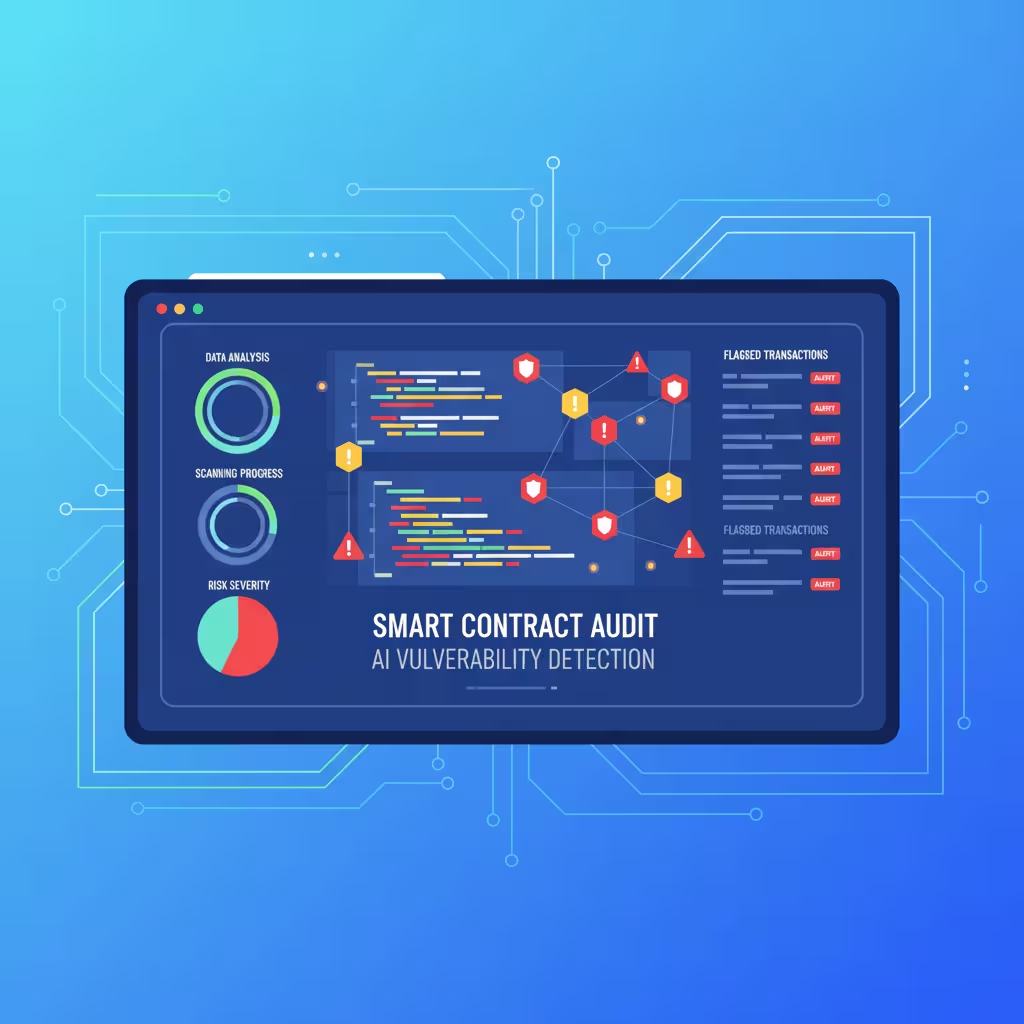
AI changes this with continuous monitoring. These systems watch contract behavior in real time — every transaction, every function call, every gas usage pattern. They compare what's happening against a database of known attack signatures. If something smells wrong, they flag it immediately.
There's also a newer approach called agentic security auditing — specifically something called the PoCo framework. Here's the basic idea: a security researcher describes a potential vulnerability in plain English, and an AI agent automatically generates working exploit code to prove the bug is real.
Why does that matter? Because in security, "this might be exploitable" is very different from "here is proof it's exploitable." The PoCo approach closes that gap, making it much harder for a known vulnerability to sit unpatched while developers debate whether it's actually a risk.
The Dark Side: AI and Financial Crime
I'd be doing you a disservice if I only talked about the good stuff.
The same technology making DeFi safer is also making financial crime faster. Automated money laundering — splitting funds across dozens of wallets, moving them across chains, covering tracks — can now happen in seconds. Not hours. Seconds.
Illicit crypto volume hit $158 billion in 2025. AI-enabled scams grew by 500% year over year. That's not a small problem.
What makes this especially tricky is accountability. When an AI agent does something illegal — or enables something illegal — who's responsible? The agent doesn't have a legal identity. It can't go to court.
The framework being developed basically works backward through the chain of humans involved. Developers who built the system. Operators who configured and deployed it. Beneficiaries who profited from it. Infrastructure providers who enabled it knowingly.
The principle is straightforward: the AI may have executed the act, but a human made the decisions that led to it. That human is accountable.
And on the defense side — the response is more AI. Compliance tools that can trace complex multi-chain fund movements, recognize layering patterns, and flag suspicious activity in real time. It's a bit of an arms race, honestly. But the defensive tools are catching up fast.
Multi-Agent Systems: The Hidden Complexity
Most people think of AI in DeFi as one smart system doing everything. The reality is messier — and more interesting.
A lot of advanced DeFi protocols actually use multiple AI agents working together. One handles data ingestion. Another runs risk models. Another executes trades. Another monitors governance. They're a team, basically.
The tricky part is: how do you fairly reward a team where everyone contributed differently?
This is where something called the Shapley value comes in. It's a concept from game theory that calculates exactly how much each participant contributed to a group outcome. Not equally — proportionally, based on actual marginal contribution.
In practical terms, this means an AI agent that did 60% of the work gets 60% of the reward. One that did 10% gets 10%. No freeloading, no gaming the system.
The catch is that calculating Shapley values is computationally expensive. It gets exponentially harder as you add more agents. Running those calculations directly on a blockchain would cost a fortune in gas fees.
The solution is elegant: do the heavy math off-chain, then verify the result on-chain using a cryptographic proof. This "Compute Off-chain, Verify On-chain" approach can cut on-chain costs by up to 99.9%. What would otherwise be a prohibitively expensive calculation becomes a routine transaction.

Privacy Without Sacrificing Trust: ZK-ML Explained Simply
Here's a tension that shows up a lot in AI-driven DeFi: transparency vs. privacy.
On one hand, users and regulators want to be able to verify that AI systems are making fair, correct decisions. On the other hand, the AI's strategy might be proprietary — and the data it uses might be sensitive.
How do you prove you did the math right without showing your work?
That's exactly what Zero-Knowledge Machine Learning (ZK-ML) solves. It lets an AI system generate a cryptographic proof that a computation was done correctly — without revealing the underlying data or the model itself.
Think of it like this: imagine proving you know the combination to a safe without ever saying the numbers out loud. A zero-knowledge proof is the mathematical equivalent.
For DeFi protocols, this means users can trust that AI risk calculations are legitimate, even if they can't see the proprietary model that produced them. For regulators, it means they can audit AI decisions without needing access to sensitive user data. For the ecosystem overall, it replaces "trust us" with "here's the math."
That's a pretty significant shift in how financial systems establish credibility.
What the SEC Is Watching
US regulators have been paying close attention to all of this — and not just in crypto. The SEC's Division of Investment Management has been openly exploring how AI can modernize the investment process, while still protecting retail investors.
One of the more interesting proposals is rethinking how investment disclosures work. Right now, when you invest in a fund, you might receive a 200-page prospectus. Realistically, almost nobody reads the whole thing. Important information about fees, conflicts of interest, and risks gets buried.
The proposal: replace that with an AI agent trained on all of the fund's documentation. You ask it a question in plain English, it answers. What are your fees? What's your short position exposure? How did the fund perform during the 2024 market correction?
This could genuinely help everyday US investors who are currently at a disadvantage compared to institutional players with dedicated research teams.
But regulators are also clear-eyed about the risks. As AI takes on more autonomy, humans shift from active decision-makers to what's being called "remote supervisors." That's a meaningful change in accountability — and it's something the SEC is still actively working through.
A Quick Word on the Future of Financial Accounting
This one might seem out of left field, but stick with me.
The accounting system most of the world uses right now — double entry accounting — is about 600 years old. It's the same basic system Venetian merchants used in the 1400s. And in a world where AI agents are executing thousands of transactions per second across multiple blockchains, it's starting to show its age.
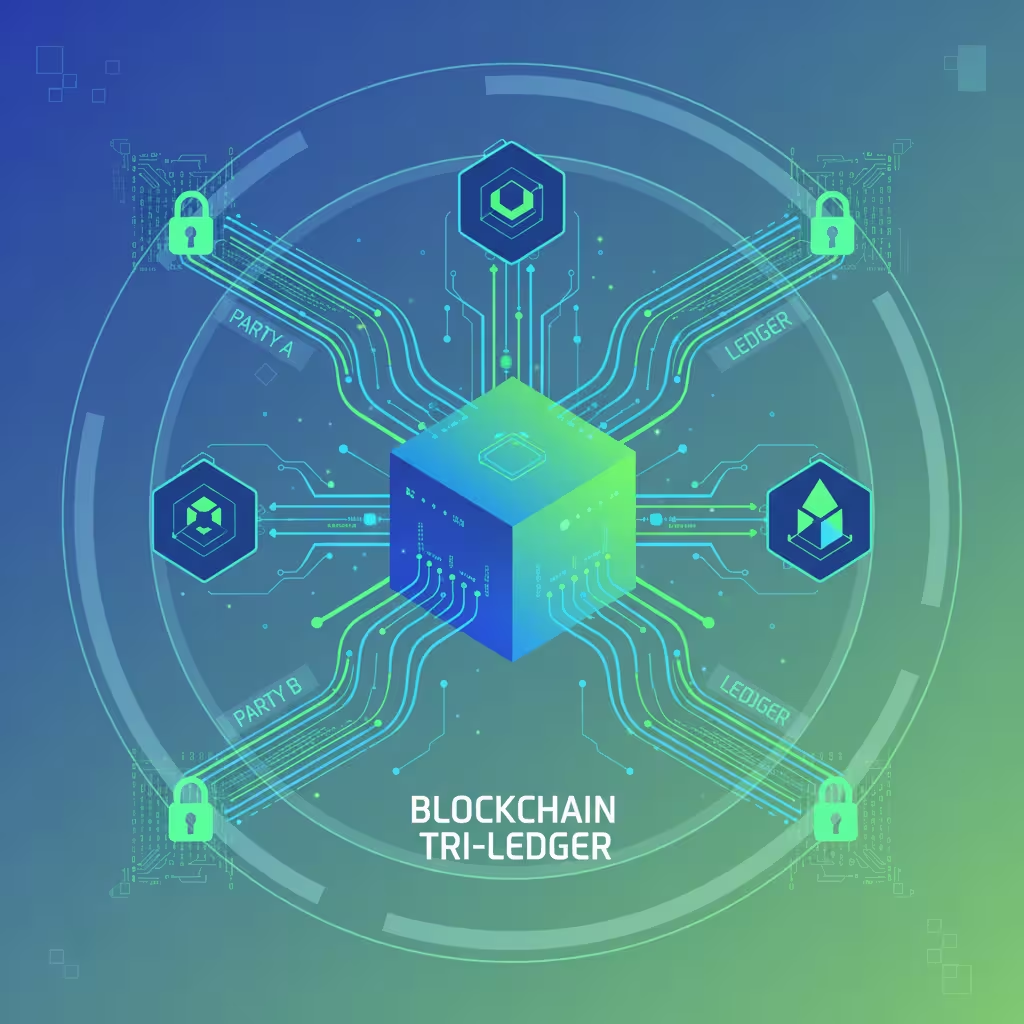
A newer approach called Triple Entry Accounting adds a third record to every transaction — one stored on a blockchain, immutable and cryptographically protected. Instead of two parties keeping their own separate books that have to be reconciled later, there's a shared, verifiable record that both parties can trust from the moment the transaction happens.
The financial inefficiencies of the current system are estimated to cost the global economy $36 trillion annually. That's a staggering number. Triple Entry Accounting, combined with AI-driven financial infrastructure, could start to chip away at that.
It's not a tomorrow problem. But it's also not as far off as it used to sound.
Where Does This All Leave You?
If you're using DeFi — or thinking about it — here's what actually matters from all of this:
The protocols you interact with are getting smarter. Risk management is moving from "hope the rules hold" to "predict and adapt." Yield optimization is becoming less about timing the market and more about letting intelligent systems work the angles for you.
Security is improving, though it's not perfect — and the threat landscape is evolving just as fast as the defenses.
And the regulatory environment in the US is actively developing frameworks to handle all of this. That's actually a good sign. It means the technology is being taken seriously, not dismissed.
AI in decentralized finance isn't going to replace your judgment as an investor. But it is changing what the tools available to you can do — and understanding that is genuinely useful, whether you're farming yields, building on DeFi protocols, or just watching where this all goes.
The smart money, it turns out, is increasingly running on artificial intelligence. And the more you understand how it works, the better positioned you are to use it well.
Financial Disclaimer
The information published on Tech Capital Hub is intended for educational and informational purposes only. Nothing on this website — including articles, guides, analysis, or commentary on AI, fintech, blockchain, cryptocurrency, or stocks — should be interpreted as financial advice, investment advice, trading recommendations, or any other form of professional financial guidance.
All investments carry risk, including the potential loss of principal. Past performance of any financial instrument, strategy, or technology is not a reliable indicator of future results. Cryptocurrency and blockchain-based assets are particularly volatile and speculative in nature, and their value can fluctuate significantly in short periods of time.
Tech Capital Hub, Marcus Delray, and any associated contributors do not hold responsibility for any financial decisions you make based on content published on this site. Before making any investment or financial decision, we strongly encourage you to conduct your own independent research and consult with a licensed financial advisor, accountant, or legal professional who understands your personal financial situation.
Any links to third-party websites, tools, or platforms are provided for convenience and informational purposes only. Tech Capital Hub does not endorse or take responsibility for the content, accuracy, or practices of any third-party sites.