Blockchain, Web3 & AI: The $10 Trillion Convergence That’s Rewriting the Rules of Money
Nobody sent a memo.
That's the thing that gets me. There was no announcement, no headline moment, no bell ringing on Wall Street. While most Americans were arguing about interest rates and watching the S&P, the architecture underneath the financial system just... changed.
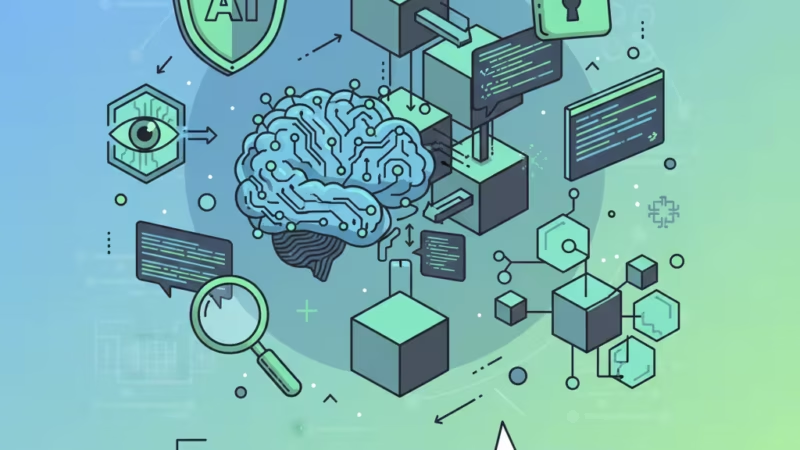
AI blockchain technology isn't a trend anymore. It's infrastructure. It's the thing running underneath, right now, whether you know about it or not.
Stablecoins moved $15.6 trillion in 2024 — more than Visa and Mastercard combined. Think about that for a second. Not Bitcoin. Not NFTs. Stablecoins, doing volume that the legacy card networks can't touch. The global Web3 market is on track to hit $109 billion by 2032. AI agents are already managing real portfolios, casting governance votes, and making compliance calls in the time it takes you to blink.
You're not too late. But you're not early, either.
This is where things stand right now, and I'm going to try to explain it without the hype.

The Original Promise of Blockchain Was Half True
Remove the middleman. Let math do what banks do. Give regular people the same power as institutions.
Good idea. Real problems with the execution.
Human-led decentralized systems kept crashing into the same wall. Low participation. Decisions moving at the speed of email threads and Discord debates. And vulnerability — serious, expensive vulnerability — to social engineering that made the whole "trustless" pitch feel like a joke.
DAOs were supposed to democratize finance. And in a way, they did. They just also created a new version of the same old problem. Big token holders had time to read proposals, show up, vote. Everyone else had jobs. Kids. Lives. So power concentrated anyway, just under a different label.
Meanwhile, fraud scaled up faster than anybody expected.
In 2026, crypto theft crossed $2.17 billion. (That's not a typo.) The scary part — $1.6 billion of that didn't come from technical wizardry. It came from employees who got tricked. Users who got manipulated. Legitimate accounts that authorized their own draining.
Security researchers call it the all-green problem. The scammer doesn't break your password. They break you — a deepfake video call, a cloned voice, a fake support agent who sounds exactly like the real one. Every system check passes. Everything looks normal. The money moves. It's gone.
You can't fix that with a stronger password.
That's the gap that AI stepped into. And once you see it, the whole convergence starts making more sense.
Okay, So How Do AI and Blockchain Actually Work Together?
I want to be straight with you: most of what you'll read about this is either too technical or too vague.
Here's the honest version.
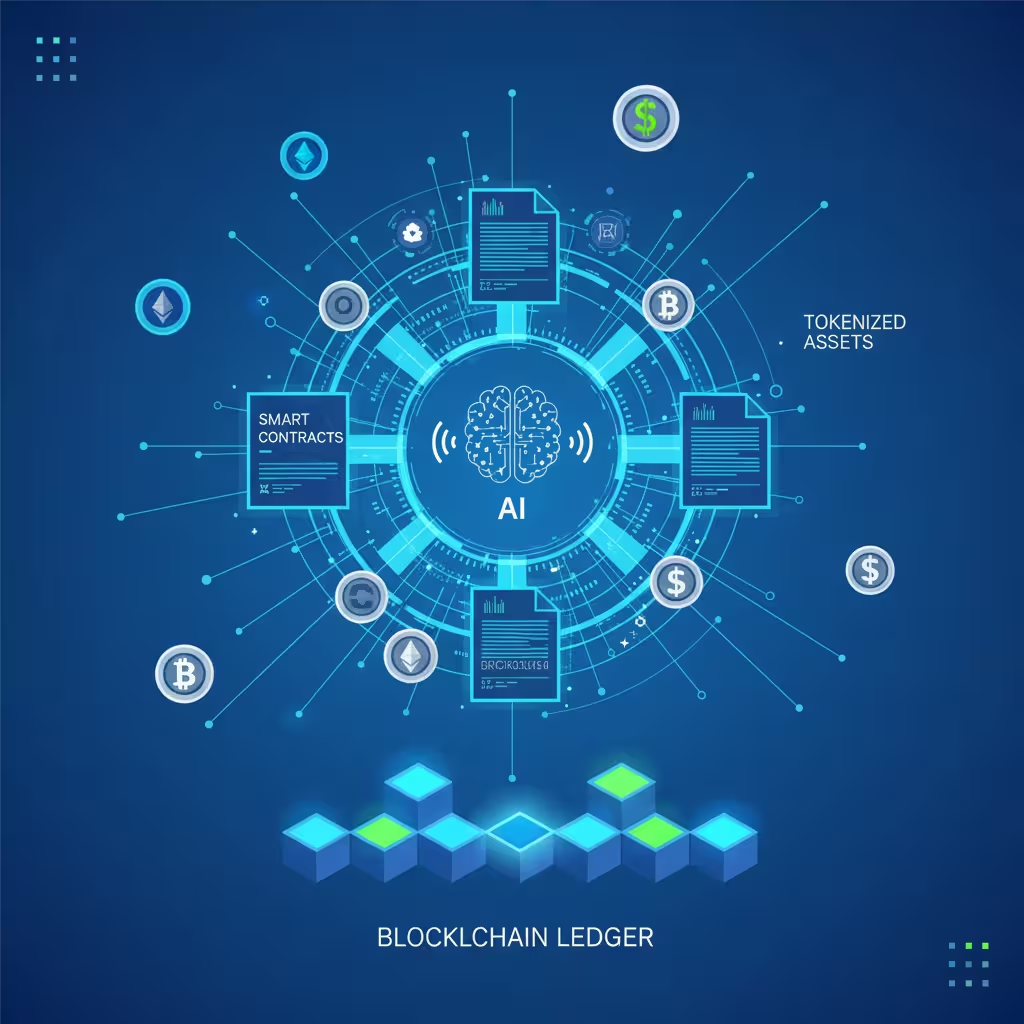
Blockchain is the rails. Permanent, tamper-proof records. Contracts that execute automatically when conditions are met — no human has to approve anything, no bank has to clear it. Settlement between strangers who don't know each other and don't have to trust each other, because the code handles it.
AI is the decision-maker that rides those rails. Pattern recognition at a scale no human team can match. Real-time choices across thousands of variables simultaneously. Doesn't sleep, doesn't get tired, doesn't need a meeting to decide.
Together, they're something that didn't exist five years ago.
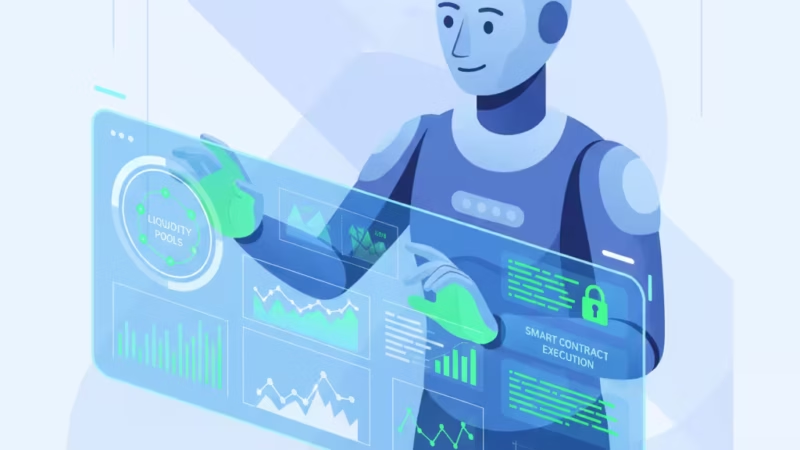
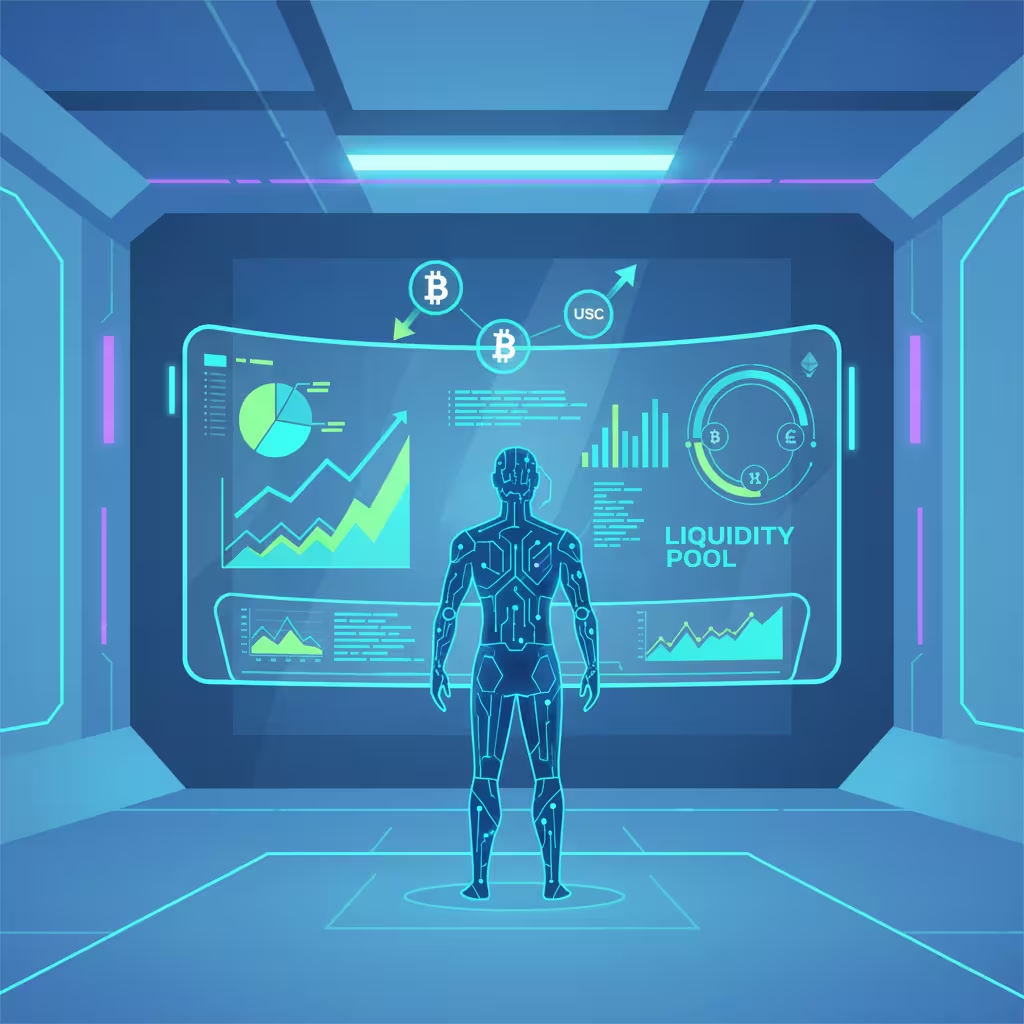
Here's a real example. An AI agent is watching a DeFi liquidity pool — basically a pot of money people use to trade without a central exchange. Markets shift. A big trader moves a position that, historically, signals a price swing in the next few minutes. The agent rebalances before human traders even see the signal. It executes through a smart contract. The whole thing is on-chain, logged, auditable. No phone call. No approval chain.
Or take governance. Vitalik Buterin — Ethereum's co-founder, not exactly a casual observer — proposed something that sounds wild until you think about it: train a personal AI agent on your values, your financial views, your risk tolerance, and let it vote in DAO proposals on your behalf. Zero-knowledge proofs mean even you can't see how your agent voted after the fact, which means nobody can pressure you to change it. Can't bribe someone for a vote they genuinely can't prove they have.
That's not a future concept. That's being built and deployed right now, in 2026.
For anyone trying to understand artificial intelligence Web3 in real terms — this is the actual shift. AI doesn't just speed up old processes. It replaces the human coordination layer. Faster, cheaper, and harder to manipulate when done right.
The Identity Problem Nobody Saw Coming
Here's something that caught a lot of institutions flat-footed.
You can engineer perfect financial rails. You can write airtight smart contracts. Doesn't matter if you can't figure out who — or what — is actually sitting on the other end of a transaction.
Synthetic identity fraud isn't what it used to be. We're not talking about bad fake IDs. We're talking about AI-generated composites: a real Social Security number from a data breach, a face built by a generative model, a voice cloned from three minutes of audio scraped off LinkedIn. Traditional KYC? A photo upload, a document scan? A motivated attacker with a $20 tool walks right through that.
The response has split into two directions.
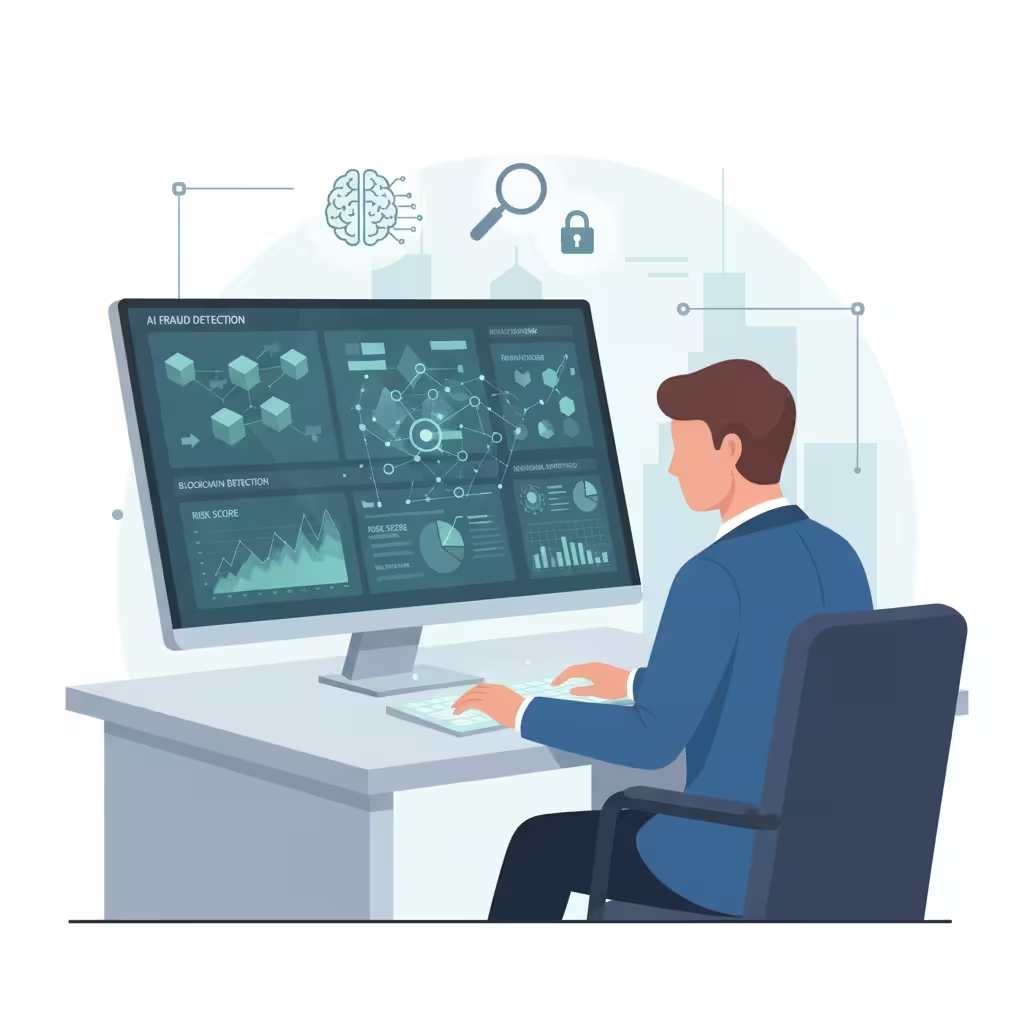
Behavioral biometrics. How you hold your phone. Your typing rhythm. The small pause — maybe half a second — before you approve a large transfer. These signals are harder to fake than a password. An AI watching your session can catch the moment the behavioral pattern stops matching, even when every credential checks out. That's the tell.
Intent verification. Companies like t54 Labs — backed by institutional money including Franklin Templeton, which is not a small or gullible investor — are building infrastructure specifically for autonomous trading agents. Their framework assigns verifiable identities to AI agents operating across the XRP Ledger, Solana, and Base. The question has moved from "who are you" to "what are you trying to do — and does that match everything you've done before?"
AI in DeFi isn't optional anymore. It's the only infrastructure that can run at the threat level the current environment demands.
I know that sounds like a sales pitch. But $1.6 billion in access control failures in a single year makes the argument pretty clearly.
What's Actually Being Built — The Specific Stuff
I find the abstract explanations exhausting. Let's get into specifics.
Ethereum in 2026. Two major upgrades are rolling out: Glamsterdam and Hegotá. The Glamsterdam upgrade introduces block-level access lists. If you've ever been stuck in a single-lane traffic jam that clears instantly when the road opens to four lanes — that's what this does to transaction processing. Instead of one-at-a-time, sequential execution, the network starts running parallel lanes. Gas limits are pushing past 100 million. Some people are targeting 200 million. For the first time, Ethereum can handle transaction volume at the scale of a real national financial system.
Hegotá is about something different. Post-quantum security research. Building signature algorithms that quantum computers can't crack. That sounds like overkill until you realize trillion-dollar settlement layers plan on 15-year horizons. It's not paranoia. It's what responsible infrastructure looks like.
Solana in 2026. The Alpenglow consensus rewrite stabilizes block production under heavy load — less dropped transactions, more predictable behavior when things get busy. Firedancer, the validator client Jump Crypto built from scratch in C, adds redundancy so that no single codebase failure can take the whole network down. And Application Controlled Execution, or ACE, lets DeFi apps define their own transaction ordering rules. This directly kills the MEV — Maximal Extractable Value — problem that has drained hundreds of millions from regular traders through front-running bots and sandwich attacks.
WisdomTree brought regulated money market funds to Solana. Matrixdock deployed tokenized gold on-chain. These are real institutional products with real capital behind them — not prototypes.
On-chain analytics have matured to where institutional treasuries can watch their entire DeFi exposure update in real time. Tokenization of real-world assets — property, Treasury bills, commodities — is moving from pilot to production. Zero-knowledge proofs now let protocols verify compliance without ever seeing your private data, which sounds like a small thing until you realize it's the reason institutional money could start flowing into DeFi at all.
This is what blockchain AI applications look like when they grow up.
The Thing Most People Get Wrong About All of This
I want to push back on something, because I think a lot of the coverage gets this backwards.
The biggest risk in this convergence isn't technical. The protocols are getting stronger. Security architecture is advancing. What isn't keeping pace is human understanding — and bad actors are exploiting that gap aggressively.
Fraud tied to AI blockchain technology is industrial now. Not opportunistic. Researchers have documented direct links between high-tech crypto fraud and overseas scam compounds — operations that combine human trafficking with AI-powered deception, running attacks around the clock in shifts. For financial institutions, this isn't just a balance sheet problem. It's a board-level ESG liability.
The all-green scenario will get harder to spot, not easier. A deepfake of your CFO — live video call, correct voice, correct mannerisms — asking you to authorize an emergency wire will be indistinguishable from real within 18 months at current improvement rates. That's not speculation. That's a projection from where deepfake fidelity sits right now.
The only real defense is continuous behavioral monitoring. Not a gate you pass through at login. A running profile of normal behavior — with AI flagging anything that deviates, in real time, through the whole session.
And here's the thing that I think is genuinely underappreciated: the AI layer that enables autonomous trading and the AI layer that enables autonomous fraud detection are built on the same tools. Builders and defenders are working with identical infrastructure. This isn't a one-sided arms race. It's a race where the same weapons work for both sides, and the question is who deploys them faster and smarter.
Frequently Asked Questions - FAQs
How do AI and blockchain work together in finance?
AI handles decisions — pattern recognition, behavioral analysis, risk assessment. Blockchain handles settlement — permanent records, automatic contract execution, trustless value transfer. Together they create financial systems that run without a human in the loop for every transaction. That's faster, cheaper, and removes a lot of the manipulation risk that comes from human intermediaries.
What are AI-powered DeFi protocols, explained for beginners?
DeFi protocols that run AI use machine learning to manage liquidity pools, spot risk, and execute trades automatically. No bank approves anything. An AI agent evaluates conditions against pre-set rules and executes through a smart contract — instantly, on-chain, with a permanent record. Think of it as a financial system that runs on logic instead of phone calls.
What is the future of Web3 and artificial intelligence convergence?
By 2030, AI agents are projected to drive up to $9 trillion in global online economic activity. The direction is toward AI agents holding verified financial identities, managing autonomous treasuries, and participating in governance alongside human voters. Not as tools. As participants.
What are zero-knowledge proofs and why do they matter?
A zero-knowledge proof lets you prove something is true without revealing the underlying data. In finance, a DeFi protocol can confirm you meet compliance requirements without ever seeing your personal information. It bridges the gap between privacy and regulation — which is why institutions care about it.
Are DAOs actually working in 2026?
The well-run ones fixed the participation problem by combining AI agents with prediction markets. Agents vote based on the owner's pre-specified values. Prediction markets filter bad proposals by requiring participants to stake money on a proposal's outcome. More real participation, less noise.
What You Should Actually Do With This
Here's the honest bottom line.
If you're a DeFi investor — AI is already inside your protocols whether you know it or not. The question is whether the protocols you're in have deployed it well, and whether their security matches the fraud environment those protocols now operate in. Go find out.
If you're in finance professionally — the window to build real fluency with on-chain analytics, tokenized assets, and autonomous compliance tools is getting shorter. The firms doing this now are building structural advantages. That gap compounds.
If you're just trying to figure out where money is going — here's the short version.
Trust is migrating from institutions to infrastructure. Used to be, you trusted a bank because of its reputation, its branches, the FDIC sticker on the door. Now the question is whether you trust a protocol, a smart contract, an AI agent — and those things are verifiable. You can audit them on-chain. In real time. Without asking anyone for permission.
That's not a worse system. It's more honest.
The $10 trillion projection is real. The convergence is already running. The only open question is whether you understand it well enough to move — or whether you read about it after the wave already passed.
Start here. Keep going..
Financial Disclaimer
The information published on Tech Capital Hub is intended for educational and informational purposes only. Nothing on this website — including articles, guides, analysis, or commentary on AI, fintech, blockchain, cryptocurrency, or stocks — should be interpreted as financial advice, investment advice, trading recommendations, or any other form of professional financial guidance.
All investments carry risk, including the potential loss of principal. Past performance of any financial instrument, strategy, or technology is not a reliable indicator of future results. Cryptocurrency and blockchain-based assets are particularly volatile and speculative in nature, and their value can fluctuate significantly in short periods of time.
Tech Capital Hub, Marcus Delray, and any associated contributors do not hold responsibility for any financial decisions you make based on content published on this site. Before making any investment or financial decision, we strongly encourage you to conduct your own independent research and consult with a licensed financial advisor, accountant, or legal professional who understands your personal financial situation.
Any links to third-party websites, tools, or platforms are provided for convenience and informational purposes only. Tech Capital Hub does not endorse or take responsibility for the content, accuracy, or practices of any third-party sites.