AI Cash Flow Forecasting: How to Predict Your Business’s Financial Future With Scary Accuracy
Your income statement says you're profitable.
Your bank account says otherwise.
That gap has killed more businesses than bad products ever did. SCORE found that 82% of small business failures tie back to cash flow problems. Not bad ideas. Not weak demand. Cash.
Here's what stings most. By the time a spreadsheet shows the problem, you're already two weeks behind. You're reacting. And reacting costs money — especially when interest rates are high and clients are paying late.
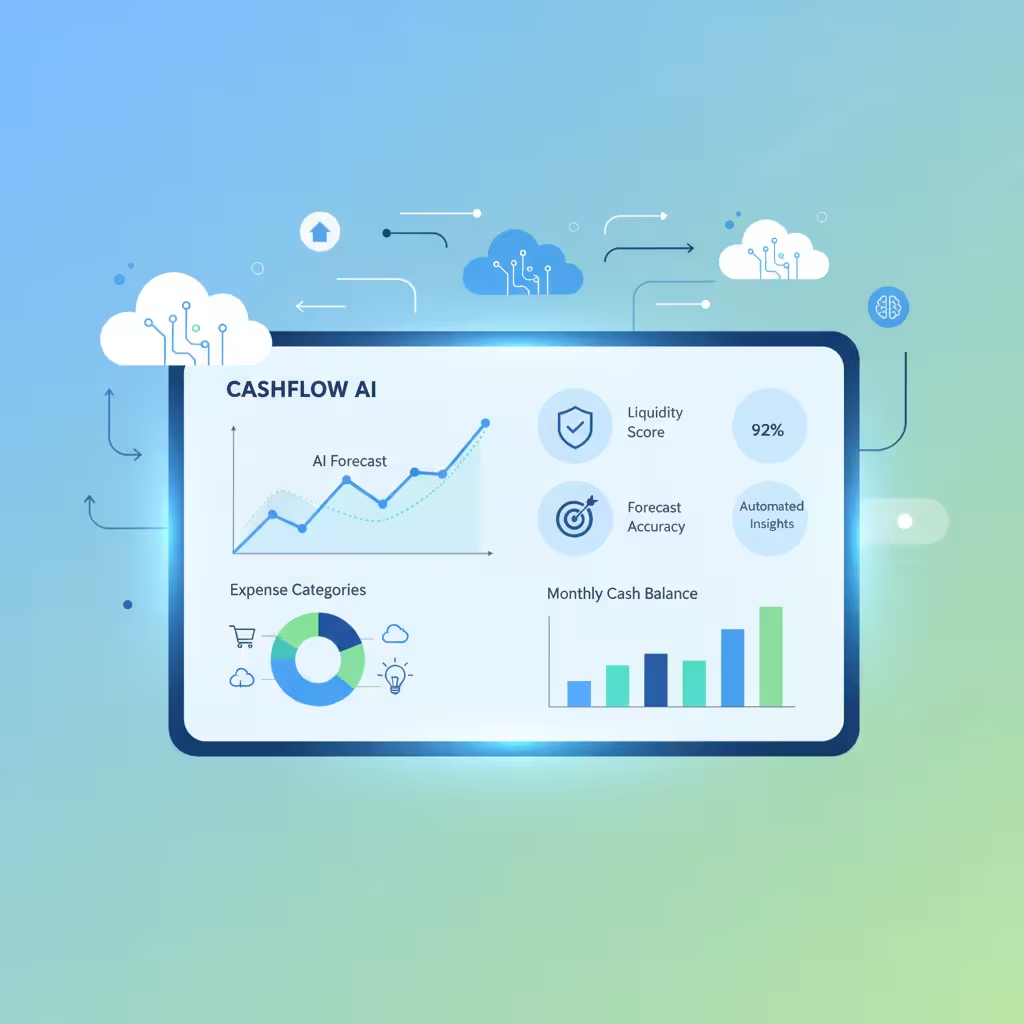
That's the case for AI cash flow forecasting. It doesn't just track your money. It tells you where your money is going before it gets there.
This guide covers how it works. What the accuracy numbers actually look like. And which tools make sense for a real small business.
The Real Problem With Forecasting in a Spreadsheet
Most business owners forecast cash the same way.
Open Excel. Look at last month. Project it forward.
That method has a name — ARIMA modeling. Sounds fancy. The idea is simple: take past averages and draw a straight line forward. Hope the future cooperates.
It usually doesn't.
Your clients don't pay on day 30 exactly. Your biggest bill of the quarter lands the same week a large invoice goes late. One rough December wrecks your whole Q1 model.
Research benchmarks show that manual spreadsheet forecasting has a Mean Absolute Percentage Error — MAPE — of around 50%. That means your forecast could be off by half. Running $200,000 in monthly receivables? That's a $100,000 blind spot.
AI forecasting tools use Long Short-Term Memory networks. LSTM, for short. They've pushed that error rate below 10%.
That's not an upgrade. That's a different sport.

What Predictive Cash Flow AI Actually Does
The word AI gets attached to everything these days. So let's get concrete.
Real predictive cash flow AI does three things a spreadsheet can't touch.
It learns how your customers actually pay. Not how they're supposed to. How they do. The system builds a payment profile for each client. Client A almost always pays on day 38, even though your terms say net 30. Client B is solid in Q1 but always drags in Q3. The AI learns this. It flags the risk before the invoice goes late.
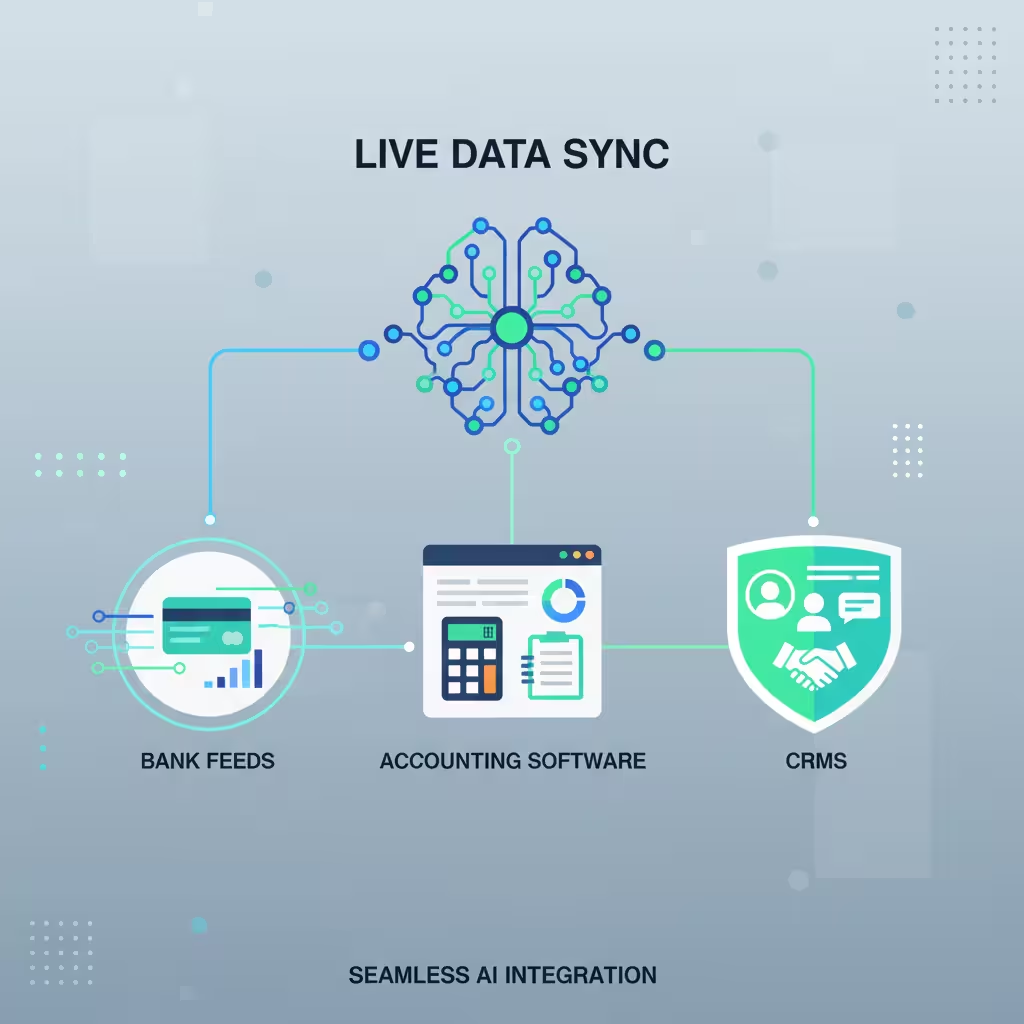
It pulls live data — automatically. No CSV exports on Friday afternoons. No copy-paste from QuickBooks. The best tools sync directly with your bank feeds, your accounting software, and your CRM. What you see reflects today. Not last week.
It runs scenarios on demand. This is where automated financial forecasting earns its keep. Want to know what happens to your runway if you hire two people in March? Ask. Need to see the impact if your biggest client pays 45 days late instead of 30? The system models it in seconds, using your real numbers — not industry averages.
For founders tracking burn rate, that last one alone changes how you prep for board meetings.
Three Cash Flow Buckets — And Where AI Helps Most
Before any tool can help, you need to know what it's measuring.
Cash flow splits into three categories.
Operations is day-to-day. Customer payments in. Payroll and vendor bills out. This is where most cash problems start. It's also where receivables prediction delivers the fastest results.
Investing covers big asset moves. Equipment. Property. Long-term purchases. Less volatile, but AI helps you see when those outlays will pinch your operating cash.
Financing is debt and equity. Loan draws, repayments, investor money. Tools that pull in your lender data show you how financing moves affect your runway.
Most small businesses live in the Operations bucket. Start there. But the businesses that grow well are watching all three at once.
The Thing Nobody Tells You: It's About Timing, Not Dashboards
Most cash flow guides miss this completely.
Working capital management isn't about having prettier reports. It's about changing when you act.
Old way: Receivables start aging. You chase payments. You cover the shortfall with your line of credit at 8%. Do it again next quarter. That interest quietly grinds down your margins for years. (Most business owners don't notice until year three.)
New way: The system spots Client B trending late on day 18 of their invoice. Before it's overdue. Your team emails early. Payment comes in on time. You never touch the credit line. Companies using this approach cut borrowing costs by 20% or more. Not by luck. By knowing sooner.
The staffing industry makes this crystal clear. Staffing agencies pay workers weekly. Clients pay invoices every 60 days. You can look profitable on paper and still miss payroll on week three. The 13-week rolling cash forecast — the standard tool for this — is what keeps those agencies running.
What is a 13-week forecast? It covers one quarter. It updates weekly with actual numbers. Then it rolls forward another week. It never goes stale. And AI tools that automate it pull from live bank data — not last month's file.
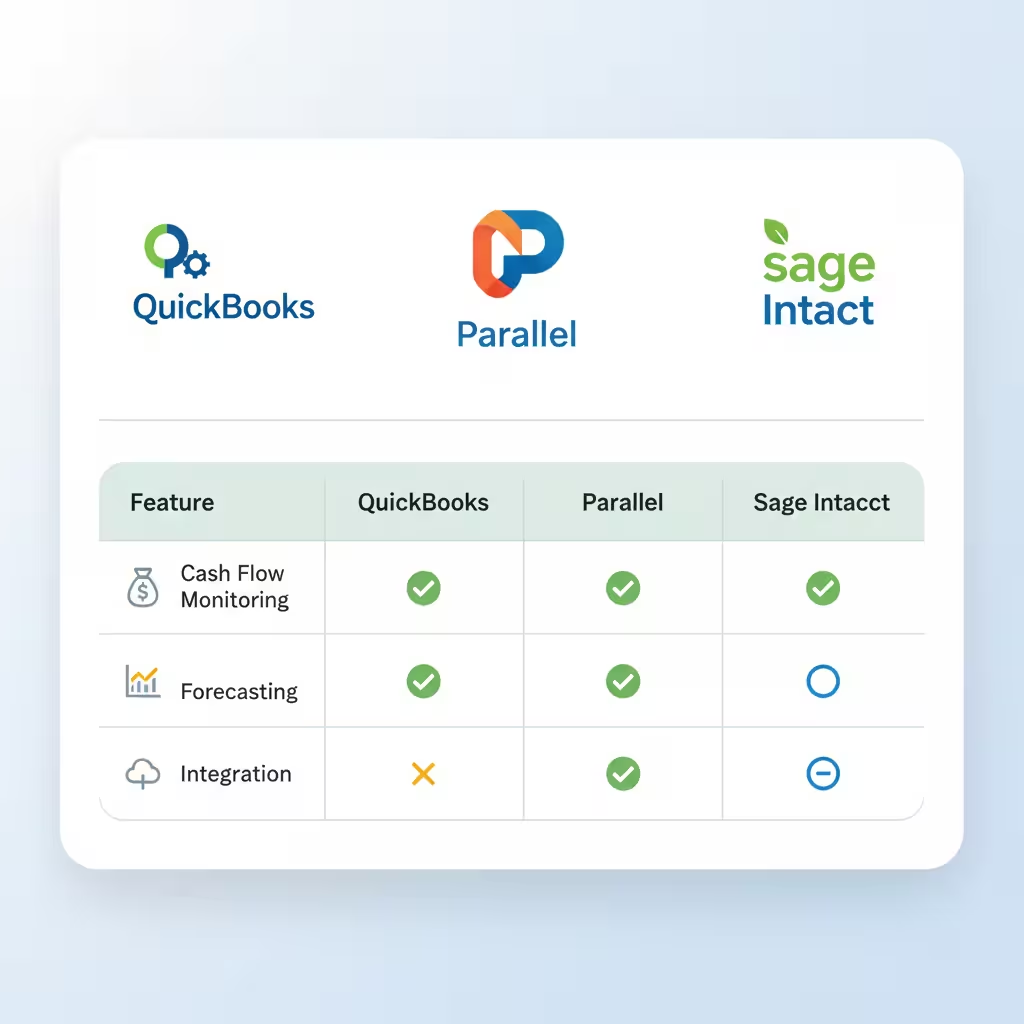
Best AI Tools for Cash Flow Forecasting (By Business Size)
Different businesses need different tools. Here's what I'd actually tell a client.
Small Businesses and Solo Operators
QuickBooks Online Advanced is the most practical starting point. Already on QuickBooks? This upgrade layers a 13-week cash view right into your existing data. No new system to learn. No migration headache. It flags anomalies too — payment gaps, expense spikes, timing mismatches — before they turn into problems.
Using it feels genuinely different from the base plan. The projections update on their own. You stop refreshing a spreadsheet every Friday hoping the numbers changed.
Knolli and Aura are AI CFO tools built for founders who need investor-ready financials fast. Ask "What's our current runway?" and you get a plain-English answer — not a dashboard you have to decode. Great for solo operators who don't have a finance team but still need to talk numbers with investors.
Growth-Stage Companies
Parallel is built for runway forecasting. It connects your payroll system, your ERP, and your CRM. Over 300 data points. It models how every hire and every expense affects your cash-out date. Managing a team of 15 or more? Parallel's scenario depth goes well past what QuickBooks can do.
Sage Intacct updated in February 2026. The new Close Assistant flags month-end bottlenecks in real time. Its Subledger Reconciliation tool runs all day. It matches your AR and AP to the general ledger without anyone manually checking. For companies with multiple departments or revenue streams, this saves real hours every week.
Enterprise and Document-Heavy Work
Hebbia (Matrix) handles financial analysis at scale. It pulls data from SEC filings, contracts, and virtual data rooms. It cites every source. If your cash flow picture depends on reading complex agreements, no accounting tool does what Hebbia does.
HighRadius automates over 90% of Order-to-Cash reconciliations for large enterprises. Priced for that scale. But for companies running thousands of invoices monthly, the savings are documented.
| Tool | Best For | What It Does Well | Price |
| QuickBooks Online Advanced | Small business | 13-week cash view, anomaly alerts | ~$200/mo |
| Knolli / Aura | Solo founders | Plain-English runway answers | Free tiers available |
| Parallel | Funded startups | Runway modeling, 300+ data points | Custom |
| Sage Intacct | Mid-market | Real-time close + subledger matching | Custom |
| HighRadius | Enterprise | 90%+ O2C automation | Enterprise |
| Hebbia Matrix | Document analysis | Citation-backed financial synthesis | Enterprise |
AI cash flow forecasting tools as of February 2026. Prices change — confirm with each vendor.
How to Use AI for Cash Flow Forecasting in Your Small Business
No six-month rollout needed. Here's where to start.
Hook up your bank feeds first. Everything depends on live data. Still exporting CSV files from your bank manually? Fix that before anything else. Every tool on this list works better — usually a lot better — with a direct bank connection.
Run two forecasts, not one. Use the 13-week view for week-to-week calls. Use a 12-month rolling forecast for bigger planning — hires, new products, fundraising. These answer different questions. Combining them into one view makes both worse.
Give it 90 days before you judge it. AI forecasting tools get smarter over time. They need to see your actual payment history before their predictions mean much. Don't write off the tool in week two. Let it build real customer profiles first.
Ask one "what if" question per week. Every Monday. Pick one scenario. What if the Miller account pays 45 days late this month? What if we bring on a part-time bookkeeper in April? What if we lose our second-biggest client? Inside a month, you'll start seeing your cash differently — and catching risks you used to miss.
Frequently Asked Questions - FAQs
How accurate is AI cash flow forecasting compared to spreadsheets? AI tools using LSTM models hit MAPE below 10%. Spreadsheet forecasting runs around 50% error. That's a five-times improvement. Big enough to actually change your decisions.
What's the best AI tool for predicting business cash flow in a small business? QuickBooks Online Advanced is the easiest option if you're already on QuickBooks. For startups watching burn rate and runway, Parallel goes deeper on scenario modeling.
What is automated financial forecasting and how does it work? It pulls live data from your bank and accounting software. Then machine learning models where your cash is heading. You stop updating a spreadsheet. The system updates itself — and flags you when something looks off.
Can AI help with working capital management? Yes — and this is one of its best uses. Knowing when clients will actually pay — not just when they're supposed to — lets you act early. You chase receivables before they're late. You skip the credit line. Borrowing costs drop over time.
What about AI errors in financial forecasting? It's a real concern. Stick to platforms that show their reasoning and cite their sources. And for any high-stakes decision — especially anything over $100,000 — keep a human in the loop. No AI tool should run fully on its own at that level.
The Bottom Line
Cash flow is the oxygen your business runs on. You can be profitable and still suffocate.
For years, real predictive cash flow tools were enterprise-only. Too expensive. Too complex. That's not true anymore. Good options exist at every price point now. Including tools built for a solo founder or a team of ten.
The businesses that survive a tough economy won't be the ones who got better at spreadsheets. They'll be the ones who stopped reacting and started predicting.
Pick one tool from this list. Get your bank feeds connected today. Run your first 13-week forecast this week. Then ask the system one "what if" question.
That's how AI cash flow forecasting starts paying off.
Financial Disclaimer
The information published on Tech Capital Hub is intended for educational and informational purposes only. Nothing on this website — including articles, guides, analysis, or commentary on AI, fintech, blockchain, cryptocurrency, or stocks — should be interpreted as financial advice, investment advice, trading recommendations, or any other form of professional financial guidance.
All investments carry risk, including the potential loss of principal. Past performance of any financial instrument, strategy, or technology is not a reliable indicator of future results. Cryptocurrency and blockchain-based assets are particularly volatile and speculative in nature, and their value can fluctuate significantly in short periods of time.
Tech Capital Hub, Marcus Delray, and any associated contributors do not hold responsibility for any financial decisions you make based on content published on this site. Before making any investment or financial decision, we strongly encourage you to conduct your own independent research and consult with a licensed financial advisor, accountant, or legal professional who understands your personal financial situation.
Any links to third-party websites, tools, or platforms are provided for convenience and informational purposes only. Tech Capital Hub does not endorse or take responsibility for the content, accuracy, or practices of any third-party sites.