How AI Fraud Detection in Finance Is Stopping Billions in Theft Before It Happens
Let me tell you something that surprised me when I first started covering financial fraud.
The scariest fraudsters aren't hackers. They're not running elaborate scams from overseas server farms. A lot of them are ordinary customers. They made a real purchase, got what they ordered, and then disputed the charge. It was easier than sending a cancellation email.
That's where a lot of the money is going. And it's been hiding in plain sight for years.
By 2026, transaction disputes are growing four times faster than eCommerce itself. LexisNexis data puts the true cost of one disputed transaction at overfour times the original amount. That's fees, labor, and penalties all added up. So a $50 dispute doesn't cost $50 to deal with. It costs $200+. And if you're running a subscription service or a BNPL platform, that math gets ugly fast.
Honestly, AI fraud detection in finance isn't an upgrade anymore. It's a survival tool.
The Old
Way Isn't Working — And Hasn't Been for a While
Here's something fraud teams know but don't say out loud enough: rule-based fraud systems are exhausting to maintain and increasingly bad at their job.
They work like this. Someone sets a rule — flag any transaction over $500 in a new city. Or two charges in two minutes. Makes sense on paper. But criminals figured those rules out years ago. They test stolen card data with a $1.99 purchase first. They spend three weeks mimicking normal behavior before making a bigger move. They use AI-generated video to pass biometric checks during account sign-up.
And on the bank's side? False alarms — constantly. Some legacy systems fire false positives up to 95% of the time. Think about that. Fraud analysts spending most of their shift clearing fake alerts while actual fraud slips through. It's a staffing problem only on the surface. The real issue is architecture.
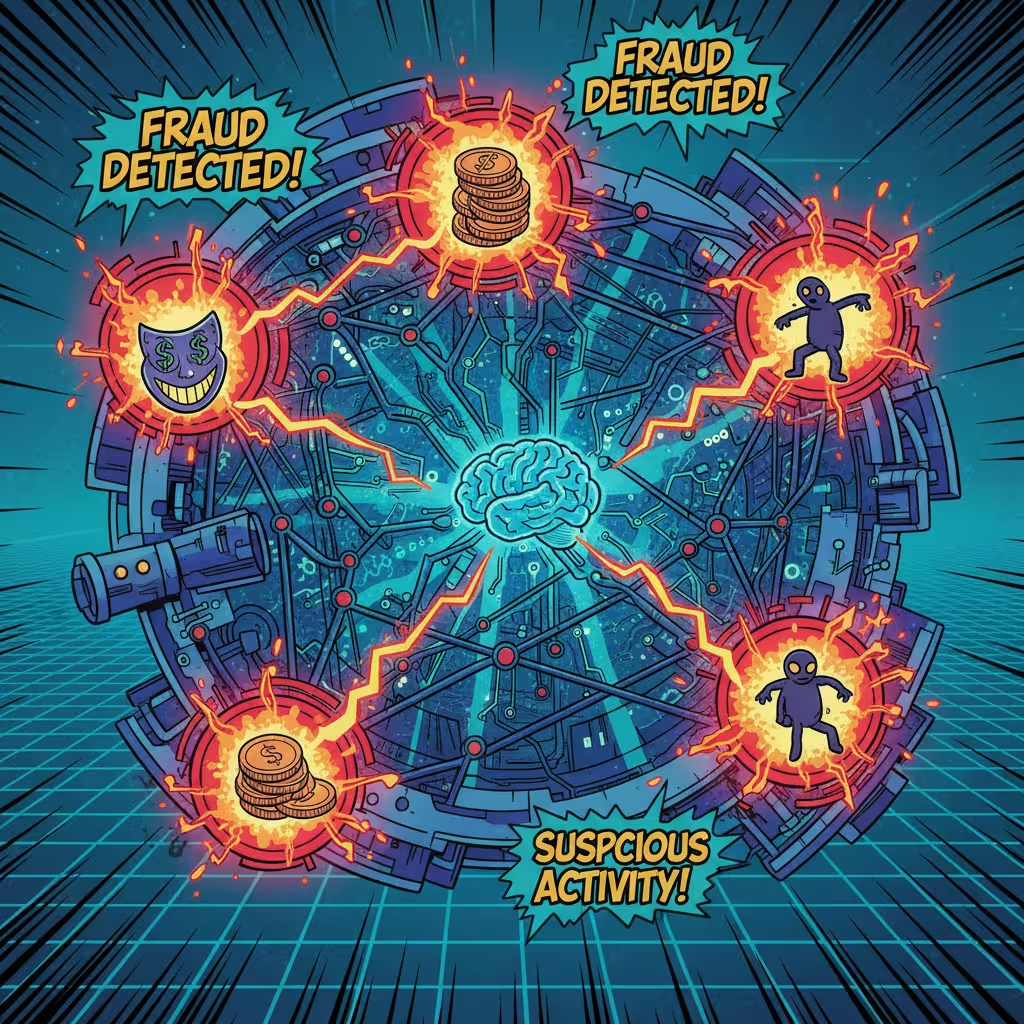
Machine learning fraud prevention works differently. It doesn't match transactions against a rule list. It learns what "normal" looks like for each account. Your usual spending hours. Your home city. The device you always use. When something new comes in, it gets scored against that profile — in milliseconds. The charge doesn't get flagged because it broke a rule. It gets flagged because it doesn't look like you.
That's a different approach — a real one. And for high-volume payment systems, it changes everything.
So How
Does Real-Time AI Transaction Monitoring Actually Work?
I get this question a lot. How does a bank know — in two seconds — that a charge looks wrong?
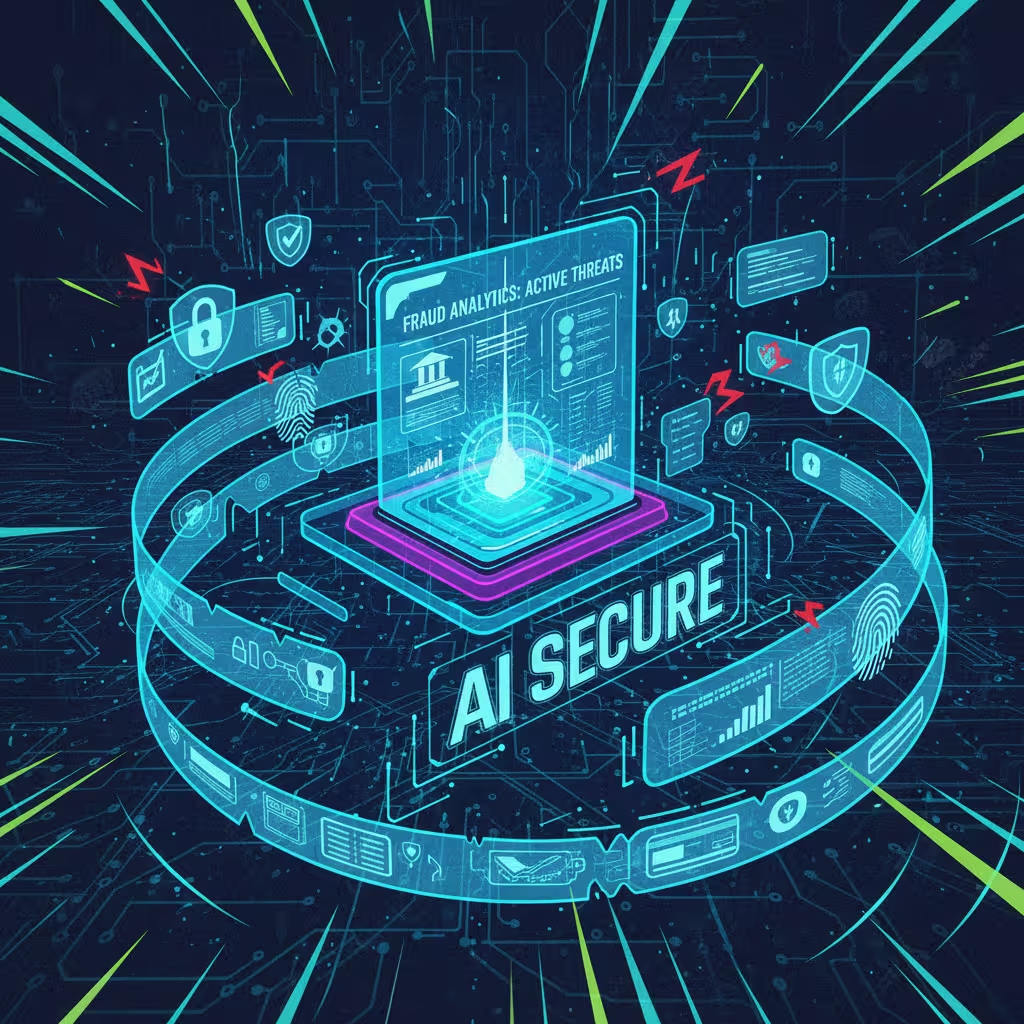
The short version: AI transaction monitoring is checking dozens of signals at once before anything clears. Here's the process.
Step 1 — Data collection. The system pulls data from the transaction itself: amount, merchant type, location, time of day. The device — browser fingerprint, IP address, how the user typed their password. And outside sources too. Breach databases. Open-source intelligence feeds that track fraud patterns across institutions.
Step 2 — Baseline building. Every account gets a behavioral profile. This isn't a snapshot from six months ago. It updates after every transaction. It knows your patterns better than you probably do.
Step 3 — Anomaly scoring. The new transaction gets compared to that baseline instantly. A high risk score doesn't automatically block the transaction. Good systems don't work that way — that's how you frustrate legitimate customers. Instead, it triggers step-up authentication. A face scan. A one-time code. Real customers breeze through. Threats get stopped.
JPMorgan Chase runs this at enormous scale. After rolling out AI, it cut fraud costs per unit by 11%. Accounts handled per employee went up by 6%. The bank spends close to $20 billion a year on technology. That number is hard to wrap your head around.
Three
Technologies Doing the Heavy Work
1. Graph Neural Networks — Finding the Ring, Not Just the Transaction
Most fraud tools look at one transaction at a time. That's fine for catching obvious stuff, but fraud rings don't operate through single transactions. They use shared devices, shell companies, and chains of mule accounts to move money before anyone notices.
A Graph Neural Network — GNN for short — looks at relationships between accounts, not individual charges.
Picture it like a web. Every account is a node. Every link between accounts is an edge. That could be a shared device ID, a phone number, or a pattern of small transfers. When several clean-looking accounts all act the same suspicious way, the GNN finds the ring. Even if each account looks fine on its own.
Real-world tests show GNNs hitting 95% accuracy in catching fraud rings that rule-based systems miss entirely. At millions of transactions per day, that gap represents a lot of money.
2. Behavioral Biometrics — Catching Fakes That Look Exactly Like You
Both account takeover and synthetic identity fraud work the same way. The attacker has to look like you.
That used to mean stealing a password. Now it can mean submitting a deepfake video to pass a liveness check during account sign-up. Generative AI has made that a lot easier than it sounds.
Modern detection tools catch signals no human reviewer could track. Micro-movements in skin texture under video. The way light hits a face at 60 frames per second. Typing rhythm. Mouse speed. No password ever came close to that level of accuracy.
For BNPL apps, digital wallets, and neobanks — it's the line between safe growth and serious losses. Fraud during a growth phase is brutal. The volume multiplies the damage fast.
3. Document AI — It's Not Reading the Words
Here's something most people outside compliance don't know. One of the most common fraud entry points is a submitted document. A forged bank statement. A fake proof-of-income letter.
These can fool a human reviewer. Document AI doesn't read the text — it reads the metadata. The digital fingerprints left by whatever software made or edited the file.
Resistant AI can detect when a PDF was saved through photo-editing software the originating bank never uses. It's not catching a visual error. It's catching the tool behind the forgery. That's a different kind of identity verification. And it runs at sign-up automatically — not months later in a manual audit.
Here's
the Part Nobody Talks About Enough: The Chargeback Problem
Ask most people what the biggest fraud threat is for US merchants in 2026, and they'll say hackers. Stolen card numbers. Account takeovers.
They're wrong.
The industry calls it "friendly fraud." Real cardholder. Real purchase. Dispute filed anyway. Seven out of ten chargebacks today come from legitimate customers disputing real charges.
And the math here is genuinely broken.
A $5 dispute costs nearly the same to process as a $500 one. In the US, UK, and EU, fixed bank fees can top the original charge on small transactions. In subscriptions and digital goods, this plays out thousands of times a day. The operational cost to fight a $5 dispute tops the $5. So banks write it off — which accidentally tells customers that disputing works.
And once it works, people do it again. Chargebacks911 data shows a 50% chance of repeat behavior after a customer gets an undeserved refund. Each invalid chargeback generates 1.5 future ones. That's the chargeback flywheel. It feeds itself.
Chargeback prevention through AI works at two levels. First, real-time monitoring catches early warning signs. A customer re-reading the refund policy three times. Odd contact with support. The system flags them for outreach before any dispute gets filed. Second, dispute intelligence platforms help merchants respond inside the 24-hour window where evidence wins most cases.
For small business owners: AI fraud detection tools for small businesses aren't enterprise-only anymore. Platforms like SEON and Sift plug into checkout flows through simple APIs. Pricing scales to thousands of monthly transactions, not only major banks. Running a Shopify store at $30K a month? Think about this now

What the
Law Actually Requires Right Now
Two regulations are reshaping how AI fraud tools must operate in 2026. I'll keep this practical.
The EU AI Act — Regulation EU 2024/1689 — puts credit scoring AI in the "high-risk" category. Human oversight is required. Decisions need to be explainable. Consumers have the right to ask why an AI denied their loan or flagged their account. If your institution has EU customers, this applies to you now, not later.
In the US, the CFPB's Personal Financial Data Rights Rule runs through 2030. Banks must share consumer data through secure APIs when customers request it. This kills the security risks of screen scraping. The Homebuyers Privacy Protection Act took effect in March 2026. It requires lenders to get opt-in consent before using credit inquiry data for mortgage marketing.
The "One Big Beautiful Bill" Act wants to freeze state-level AI regulation for ten years. But California and Colorado are still applying UDAP laws to discriminatory AI behavior in lending. Banks can't wait for that fight to resolve.
Bottom line: any AI system touching credit decisions, fraud scoring, or identity checks needs explainable AI (xAI) built in. A black-box model that gets results but can't say why is a compliance risk — full stop
What This
Means If You Run a Business
Three things matter, and I'd argue one of them is more urgent than most teams admit.
Real-time isn't a feature — it's the floor. Instant payment rails move money in seconds. If your fraud system scores threats in 30 minutes, the money is gone before the alert fires. AI transaction monitoring has to work in milliseconds. Anything slower is theater.
Running five separate fraud tools is not a fraud strategy. Most businesses use different systems for card fraud, AML, and identity checks. Each one scores the same transaction on its own. That creates coverage gaps, duplicate alerts, and noise. The industry is moving to FRAML platforms. That's Fraud and AML combined — with a "1 Customer 1 Alert" model. This can cut false positives by up to 90%. The consolidation is coming whether companies plan for it or not.
The humans didn't go away at JPMorgan — they moved. The bank cut back-office roles by 4% through automation. It added 4% more client-facing staff. People moved from processing alerts to handling complex investigations and high-value client work. That's the hybrid model that holds up. Pure automation breaks down on edge cases. Pure human review doesn't scale. The combination is what works.
AI fraud detection in finance isn't only a defense tool. Businesses that treat dispute resilience as a growth metric build something that compounds over time.
The fraud is happening right now, at scale. The question is whether your systems see it before the money moves.
Frequently Asked Questions - FAQs
How do banks use AI to detect credit card fraud in real time?
Banks build a behavioral profile for every account — typical spending times, amounts, locations, and devices. When a new transaction doesn't match that profile, the system scores the risk in milliseconds. The result is a block, a step-up challenge like a face scan, or an approval. All of this happens before the transaction clears.
What are the best AI fraud detection tools for small businesses?
SEON works well for device fingerprinting in eCommerce. Feedzai is known for explainable AI decisions in banking. Sift offers real-time decisioning across industries with a global fraud data network. All three have API-based setups and pricing that works at smaller transaction volumes.
What's the difference between friendly fraud and true fraud?
True fraud means unauthorized use. Someone else accessed your account without permission. That includes stolen credentials, fake identities, and account takeover. Friendly fraud is when the real account holder disputes a charge they made. In 2026, friendly fraud drives roughly 7 in 10 chargebacks in the US. That ratio catches most merchants off guard.
Does the law require AI fraud detection?
Not in a blanket way. But the EU AI Act requires human oversight and explainability for credit scoring AI. In the US, CFPB rules and state UDAP laws govern AI-driven financial decisions. Non-compliance carries real penalties.
How does anomaly detection work in finance?
The system builds a normal behavioral baseline per account. New activity gets scored against that baseline. A deviation doesn't trigger an automatic block — it triggers a risk score. That score determines the next step: approve, challenge with step-up authentication, or escalate to a human reviewer.
––––––––––––––––––––––––––––––––––––––––––––––––––––––––––––––––––––––––––––
Financial Disclaimer
The information published on Tech Capital Hub is intended for educational and informational purposes only. Nothing on this website — including articles, guides, analysis, or commentary on AI, fintech, blockchain, cryptocurrency, or stocks — should be interpreted as financial advice, investment advice, trading recommendations, or any other form of professional financial guidance.
All investments carry risk, including the potential loss of principal. Past performance of any financial instrument, strategy, or technology is not a reliable indicator of future results. Cryptocurrency and blockchain-based assets are particularly volatile and speculative in nature, and their value can fluctuate significantly in short periods of time.
Tech Capital Hub, Marcus Delray, and any associated contributors do not hold responsibility for any financial decisions you make based on content published on this site. Before making any investment or financial decision, we strongly encourage you to conduct your own independent research and consult with a licensed financial advisor, accountant, or legal professional who understands your personal financial situation.
Any links to third-party websites, tools, or platforms are provided for convenience and informational purposes only. Tech Capital Hub does not endorse or take responsibility for the content, accuracy, or practices of any third-party sites.