Fintech Trends 2026: How AI Is Blowing Up the $22 Trillion Financial Services Industry
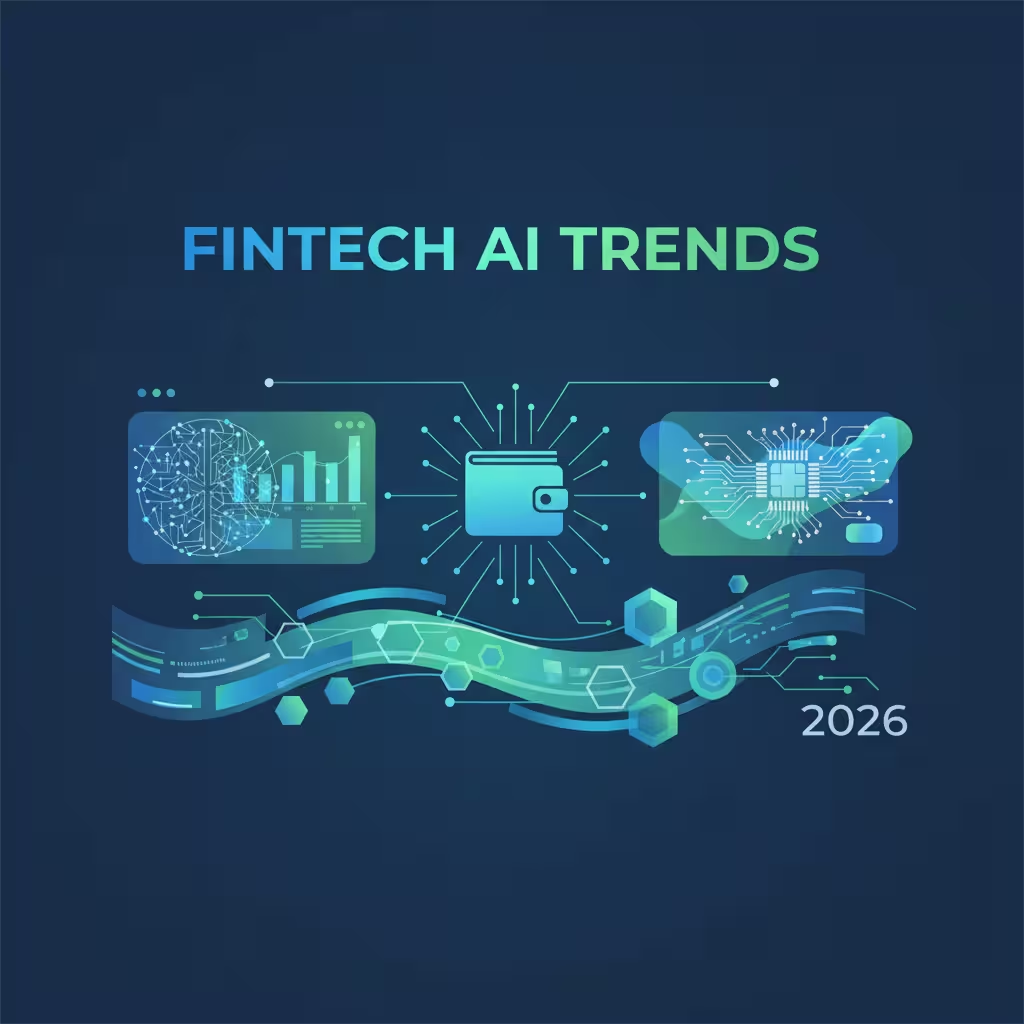
The numbers don't lie. The global financial services industry sits at roughly $22 trillion — and right now, fintech AI trends are tearing through it like a wrecking ball through drywall. Banks that took a century to build their systems are suddenly competing with neobanks that launched three years ago, run leaner teams, and offer faster loan decisions than a human ever could. If you've been watching the space, you know something seismic is happening. If you haven't — buckle up.
This isn't hype. AI in fintech is no longer a pilot program or a buzzword in a VC pitch deck. It's live, it's scaling, and it's rewriting the rules for everyone — from the big four banks in New York to a credit union in rural Ohio. Here's what's actually going on, why it matters, and where things are headed by the end of 2026.
Why AI Is Moving So Fast in Finance Right Now
A few years back, financial technology innovation mostly meant adding a mobile app to your checking account. That was the bar. Today? AI is underwriting loans, detecting fraud in real time, and giving personalized financial advice to people who've never had access to a human advisor. The pace of change is stunning.
Three things collided to make this happen. First, the explosion of open banking — the regulatory and technical shift that lets third-party developers access financial data through APIs. Second, the rise of API-first banking infrastructure that makes it dead simple to plug in new services. Third, machine learning models finally got good enough to handle the messy, high-stakes nature of financial data.
Put those three together, and you get an environment where a startup can build a full-stack lending product, connect it to real-time data, and go from idea to live users in months. Traditional banks can't move that fast. That's the core tension playing out across the whole industry.
The Biggest Fintech AI Trends to Watch in 2026
1. Hyper-Personalized Banking at Scale
Here's the thing about most banking apps: they show you a balance, a transaction history, and maybe a pie chart of your spending. That's it. AI is changing that completely.
Banks are now using predictive models to anticipate what customers need before they ask. Think: "You've got a $1,200 bill coming next Thursday, but your paycheck lands Friday — want to move some funds now?" That kind of proactive nudge, powered by AI banking trends, used to require a personal financial advisor charging hundreds of dollars an hour. Now it's built into your phone.
Neobanks like Chime, Dave, and SoFi are leading this charge in the US market. They've built entire business models around using behavioral data to serve customers better — and the incumbents are scrambling to catch up.
2. Embedded Finance Is Eating Everything
Embedded finance is one of those terms that sounds complicated until you realize you've been living it for years. When you check out on Amazon and instantly get a "pay in 4" option, that's embedded finance. When Uber offers its drivers a debit card tied to their earnings, that's embedded finance. Financial products baked right into the moment of need — no bank branch, no application, no waiting.
AI makes embedded finance smarter. It allows real-time credit decisions, dynamic pricing, and instant fraud checks — all invisible to the end user. By 2026, analysts expect embedded finance to account for a growing share of US consumer lending and payments. The traditional bank relationship? For a lot of people, it's slowly becoming irrelevant.
3. AI-Powered Fraud Detection Is Saving Billions
Financial fraud cost Americans over $10 billion in 2023, according to the FTC. And it's getting more sophisticated — deepfakes, synthetic identities, account takeovers that move faster than any human team can catch.
This is where AI in fintech is doing some of its most impressive work. Modern fraud detection systems don't just look for known patterns — they model normal behavior for each individual user and flag anything that deviates. Someone in Chicago suddenly initiating a wire transfer to a foreign account at 2 a.m.? Flagged, reviewed, potentially blocked before it clears.
Mastercard claims its AI fraud detection catches fraudulent transactions with significantly higher accuracy than previous rule-based systems. Visa, JPMorgan Chase, and dozens of fintech companies are investing heavily in the same. It's genuinely one area where AI is delivering massive, measurable value right now.
4. Regulatory Technology Is Finally Growing Up
Compliance is one of the most expensive, tedious parts of running a financial institution. Regulatory technology — "regtech" — uses AI to automate the boring stuff: transaction monitoring, KYC (Know Your Customer) checks, anti-money laundering screening, regulatory reporting.
What used to take teams of analysts weeks now takes AI systems minutes. And with new rules around digital assets, open banking mandates, and data privacy coming out of Washington, the demand for smart compliance tools is only going up. Companies like ComplyAdvantage and Alloy are building platforms that let banks stay ahead of regulators instead of scrambling to keep up.
5. AI-Driven Lending Is Changing Who Gets Credit
Traditional credit scoring is deeply flawed. FICO scores miss millions of creditworthy Americans — especially younger people, immigrants, and those who've historically been underserved by the banking system. AI is starting to fix that.
Alternative lending platforms are using AI to analyze thousands of data points — rent payments, utility bills, cash flow patterns, even device behavior — to make more accurate lending decisions. The result is broader credit access, faster approvals, and in many cases, lower default rates than traditional models would predict.
This is financial technology innovation at its most consequential. It's not just about efficiency — it's about equity.
Digital Wallets and the Battle for Your Financial Life
American consumers carried out over $1.5 trillion in digital wallet transactions in 2024. Apple Pay, Google Pay, Cash App, PayPal — digital wallets are no longer a novelty. They're becoming the primary financial interface for millions of people, especially younger adults who've never really bonded with a physical bank branch.
AI is what makes modern digital wallets actually useful rather than just convenient. Smart spending insights, instant peer-to-peer transfers, buy-now-pay-later options, even crypto integration — it all runs on AI-powered infrastructure working behind the scenes. The competition here is brutal, and whoever builds the best AI layer wins a massive share of consumer attention.
The wild card is Big Tech. Apple's push into financial services — savings accounts, credit cards, payment infrastructure — is forcing banks to think hard about what they actually offer that can't be replicated by a company with a $3 trillion market cap and better software engineers.
How Is AI Actually Changing the Fintech Industry?
People ask this a lot — how is AI changing the fintech industry in ways that matter to regular users, not just engineers and executives? The honest answer is: in ways both visible and completely invisible.
Visible changes include things like chatbots that can actually help you dispute a charge, apps that explain your spending in plain English, and instant loan decisions that would've taken weeks a decade ago.
The invisible changes are bigger. The risk models that decide whether to approve your mortgage. The algorithms scanning billions of transactions every day for fraud. The systems routing your international transfer through the cheapest, fastest path available. All of that runs on AI, and most people have no idea.
But here's the catch: AI disruption in traditional banking isn't painless. Thousands of back-office jobs have disappeared. Smaller community banks are getting squeezed between fintech startups above and Big Tech below. And the regulatory picture is murky — policymakers are still trying to figure out how to oversee AI systems that make consequential decisions about people's financial lives.

What Traditional Banks Are Actually Doing About It
JPMorgan Chase now employs more technologists than most fintech companies have total employees. They've spent billions building proprietary AI systems, acquiring startups, and rebuilding infrastructure from the ground up. Bank of America's AI assistant Erica has crossed 1 billion interactions. Wells Fargo is rolling out AI tools for everything from customer service to risk management.
So the narrative of "big banks vs. fintech startups" is a bit oversimplified. The reality is messier — it's an arms race, and incumbents with balance sheets in the hundreds of billions can absolutely afford to compete. What they're really fighting is their own legacy systems, decades of technical debt, and a culture that historically moved slow by design.
The banks that figure out how to combine their scale, trust, and regulatory expertise with genuine AI capability will be formidable. The ones that treat digital transformation as a marketing exercise will get eaten.
Frequently Asked Questions - FAQs
What are the biggest AI fintech trends to watch this year?
The most impactful fintech AI trends right now are hyper-personalized banking, AI-driven fraud prevention, embedded finance, and the rapid growth of regulatory technology (regtech). Each of these is actively reshaping how money moves and how financial products are built and delivered.
How is AI changing the fintech industry in 2025 and 2026?
AI is automating underwriting decisions, improving fraud detection accuracy, enabling real-time personalization, and powering the embedded finance products that are showing up inside non-financial apps and platforms. It's also making financial services more accessible to people who've historically been underserved by traditional banking systems.
What is open banking and why does it matter?
Open banking refers to the practice of banks sharing financial data with authorized third-party providers through secure APIs. It's the technical foundation that makes much of modern fintech innovation possible — from personal finance apps to AI-powered lending platforms that can access real-time account data to make better decisions.
Are neobanks safe to use?
Most major US neobanks partner with FDIC-insured banks, meaning your deposits are covered up to $250,000 just like a traditional bank account. Always check for FDIC insurance before depositing significant funds. The safety profile of neobanks has improved dramatically as the industry has matured and come under greater regulatory scrutiny.
Will AI replace bank tellers and financial advisors?
Some roles will shrink significantly — routine customer service, basic transaction processing, and standard report generation are already being automated. But complex advisory work, relationship banking, and oversight roles that require judgment and accountability are proving harder to fully automate. The industry is restructuring rather than simply eliminating jobs wholesale.
The Bottom Line on Fintech AI Trends in 2026
We're in the middle of the biggest transformation in financial services in a century. The fintech AI trends shaping 2026 aren't future speculation — they're already running in the background of products millions of Americans use every day. From the digital wallet on your phone to the fraud alert that saved your checking account, AI is already deeply woven into modern finance.
The question isn't whether AI will reshape the $22 trillion financial services industry. It already is. The real question is: which institutions will adapt fast enough to matter, and which will still be debating it when the window closes?
Whether you're a consumer trying to make sense of your options, a professional tracking financial technology innovation, or just someone who wants to understand why banking feels so different than it did ten years ago — the answer is the same. AI is at the center of it all. And it's just getting started.
Financial Disclaimer
The information published on Tech Capital Hub is intended for educational and informational purposes only. Nothing on this website — including articles, guides, analysis, or commentary on AI, fintech, blockchain, cryptocurrency, or stocks — should be interpreted as financial advice, investment advice, trading recommendations, or any other form of professional financial guidance.
All investments carry risk, including the potential loss of principal. Past performance of any financial instrument, strategy, or technology is not a reliable indicator of future results. Cryptocurrency and blockchain-based assets are particularly volatile and speculative in nature, and their value can fluctuate significantly in short periods of time.
Tech Capital Hub, Marcus Delray, and any associated contributors do not hold responsibility for any financial decisions you make based on content published on this site. Before making any investment or financial decision, we strongly encourage you to conduct your own independent research and consult with a licensed financial advisor, accountant, or legal professional who understands your personal financial situation.
Any links to third-party websites, tools, or platforms are provided for convenience and informational purposes only. Tech Capital Hub does not endorse or take responsibility for the content, accuracy, or practices of any third-party sites.