Best AI Stock Screeners in 2026: Find Winning Stocks Before the Crowd Does
Look, I'll be upfront with you.
I wasted a lot of time before I figured this stuff out. We're talking months of manually pulling up company after company, running the same filters everyone else was running, and wondering why my picks weren't performing any better than just buying an index fund and calling it a day.
The thing nobody really tells you when you start investing is that the tools most people use — the free screeners, the basic filters — they're fine. They work. But they're also being used by literally millions of other people at the same time. So whatever "edge" you think you have? It's not really an edge. It's just noise.
That's where AI stock screeners started changing things for me personally. And I'm not talking about some magical system that predicts the future. I'm talking about tools that process information faster and smarter than any human possibly could, and then surface opportunities you'd have never found on your own.
Let me walk you through the ones actually worth your time in 2026.
Why Your Current Screener Probably Isn't Cutting It
Anymore
Here's a question worth sitting with. When you filter for stocks with low P/E ratios and strong earnings growth — who else do you think is running that same search?
Everyone. That's who.
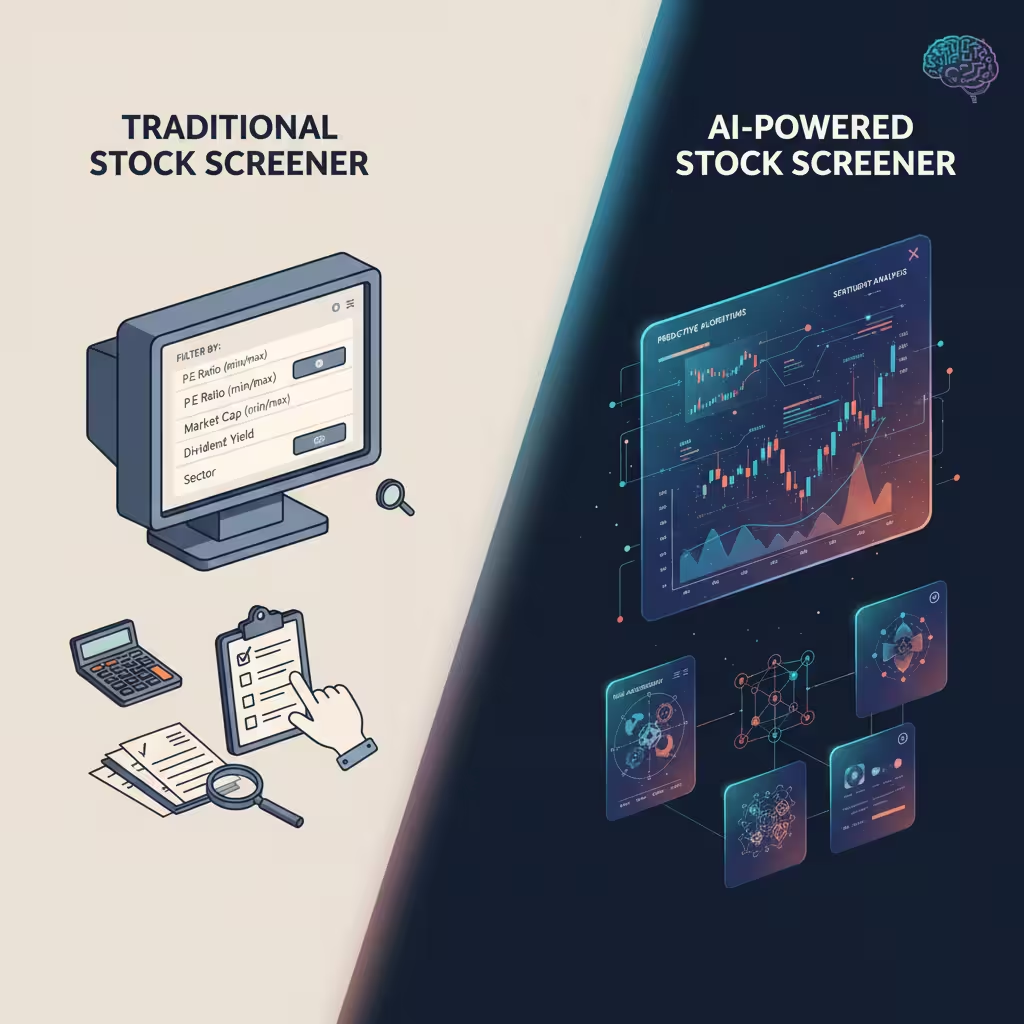
Finviz, Yahoo Finance, even the slightly fancier tools — they all work the same basic way. You set parameters. They filter. You get a list. The problem is it's the same list thousands of other investors pulled this morning, last night, and the week before that.
An AI stock screener does something different. Instead of filtering what already happened, it tries to predict what's about to happen. It chews through data that no human could realistically process — satellite images showing how full retail parking lots are, job posting trends that hint at where a company is heading, social media sentiment shifting weeks before earnings, supply chain signals buried in obscure reports.
And the newer platforms in 2026 have actually gotten good at showing you why they're flagging something. Early AI tools were infuriating in this way — you'd get a signal with zero explanation, zero context. You were just supposed to trust it. The better tools now break down every recommendation into plain language. That matters a lot when real money is on the line.

The Tools I'd Actually Tell a Friend To Use
Kavout — Good When You Want
More Than One Opinion
Kavout does something I find genuinely
clever. It doesn't just run one AI strategy on a stock. It runs several
completely different ones — value-focused, momentum-focused, quality-focused,
growth-focused — and if five or more of them independently land on the same
stock, it flags that as a "Golden Trade."
They call this the "Most
Agreed" feature, and conceptually it makes a lot of sense. It's sort of
like asking five analysts who work in completely different ways and don't talk
to each other, and if they all say the same thing — you probably shouldn't
ignore that.
The platform itself pulls from SEC
filings, satellite data, alternative economic indicators. It's a lot of data
crunching under the hood. The output is what they call a Kai Score — a simple
1-to-9 rating. Easy to act on, even if the backend is anything but simple.
If you're the type who needs multiple
signals confirming something before you feel comfortable acting, Kavout is
probably built for you.
Best fit:People who want consensus before they commit capital
Danelfin — Probably My
Favorite for Value Investing
I'll just say it — if I had to pick
one platform for someone serious about value investing, this would be the one
I'd point them toward.
Danelfin scores stocks 1 to 10 based
on the probability of beating the market over the next three months. Pretty
standard so far. But then it does something most AI stock pickers don't bother
with — it shows you the breakdown. They call these Alpha Signals, and they
split out how much of the score came from technical indicators, how much from
fundamentals, how much from sentiment.
So you're not just staring at a number
hoping it's right. You can actually look under the hood and decide if the
reasoning makes sense to you.
As far as track record goes — US
stocks that hit a 10/10 score have shown annualized outperformance of over 21%
since 2017. That's a meaningful number tracked over a decent stretch of time,
not a cherry-picked six-month window.
Best fit:Value investors, anyone who needs to understand the why before acting
Zen Ratings — Surprisingly
Simple, Seriously Effective
Here's one that flies under the radar
a bit but has arguably the most impressive long-term numbers on this list.
Zen Ratings evaluates thousands of
stocks across 115 different factors and then — and this is where it gets
refreshingly simple — it spits out a letter grade. A-rated stocks have returned
around 32.5% annualized going back to 2003. That's over two decades of data
across every kind of market condition you can imagine. Recessions, crashes,
bubbles, recoveries. All of it.
You don't need to dig into the 115
factors yourself. That's the whole point. The platform does the heavy lifting
and gives you something you can actually act on without spending three hours
analyzing it.
For US investors focused on building
long-term wealth rather than catching intraday momentum swings, this one is
worth bookmarking.
Best fit:Long-term investors, people who want high conviction without high complexity
Trade Ideas — This One's
Specifically For Active Traders
Different tool entirely from
everything else on this list. Trade Ideas isn't really trying to help you find
the next great long-term holding. It's built for people who are actively
trading positions on a daily basis.
The AI behind it is called Holly.
Every single night, Holly runs millions of simulated trades — and by the time
markets open, she's already identified the best setups for the day, complete
with entry prices, targets, and stop-losses. During market hours, the scanning
continues in real time.
I'll be honest — $89 a month is a
commitment. But if you're actively trading every day, the alternative is doing
all of this manually. And nobody has time for that.
Best fit:Day traders, momentum traders, active retail investors working positions daily
TrendSpider — For Traders
Who Are Done Drawing Lines by Hand
I used to draw trendlines manually. I
am not proud of how long I did that before I found something better.
TrendSpider automates the entire
technical analysis side of things. More than 220 chart patterns. Over 150
candlestick formations. Identified automatically, no manual drawing required.
Its AI Strategy Lab lets you train custom models on your preferred setups — and
you don't need to write a single line of code to do it.
The Sidekick AI feature is the one I
find myself showing people when they ask for a demo. You just type what you're
looking for in plain English — something like "show me stocks breaking out
on heavy volume with a clean base" — and it returns results. That's it. No
filter menus, no dropdown hell.
Best fit:Technical traders, swing traders, chart-focused investors
Koyfin — The Deep Research
Tool Serious Investors Use
If you're doing real fundamental
research, Koyfin is where you want to be doing it.
Over 500 metrics. More than ten years
of historical financial data per company. And the feature that I think gets
underrated — Percentile Ranks. This puts any metric you're looking at on a
0-to-100 scale compared to the company's own history or its industry peers.
Here's why that matters. Knowing a
stock has a P/E of 13 is one thing. Knowing that a P/E of 13 puts it in the 6th
percentile of its own 10-year range — meaning it's cheaper than 94% of the time
over the last decade — that's a completely different level of information.
That's the kind of context that actually tells you whether something is
undervalued or just broken.
Best fit:Value investors, anyone trying to screen for genuinely undervalued stocks
AltIndex — The Signals
Nobody Else Is Looking At
This one is worth paying close
attention to, especially if you're interested in getting ahead of earnings
surprises.
AltIndex tracks what it calls the
"digital footprint" of a company. TikTok engagement trends. App
download rates. Job postings. Credit card spending data pulled from real
consumer behavior. None of this shows up on a balance sheet. But all of it
tends to show up weeks or even months before official financial results do.
If a company's app downloads are
climbing fast and they're hiring aggressively, something is probably going well
at that business before the quarterly report tells the world about it. That gap
between what the data is showing and what the market has priced in — that's the
edge.
There's also a free tier, which is
genuinely useful and not just a watered-down teaser. Good starting point for
investors who want to dip into alternative data without a big subscription
commitment upfront.
Best fit:Growth investors, earnings surprise hunters, anyone wanting early signals
TradingView — The One Most
People Already Know About
More than 100 million people use
TradingView. Probably some of them are in your feeds already talking about it.
There's a reason for the popularity.
It's not just a charting tool — it's charting, screening, news, community
analysis, broker integration, and custom scripting all in one place. The Pine
Script v6 language lets you build and share custom indicators. The community
library alone has tools built by thousands of contributors.
If you want one platform that does
most things reasonably well without juggling separate subscriptions,
TradingView is still the benchmark everything else gets measured against.
Best fit:All levels, especially investors who want community plus charts in one place
How I'd Actually Combine These If Starting Fresh Today
Eight tools sounds like a lot. You don't need all of them. But knowing how they fit together is useful.
Here's the workflow I'd suggest:
1. Start with AltIndex and look for early signals — companies where the digital footprint data is moving in an interesting direction before the market picks up on it.
2. Take whatever looks interesting over to Kavout or Danelfin to see if the quant models agree. When alternative signals and AI probability scores point at the same stock — that's worth investigating further.
3. Then look at the chart in TrendSpider. Confirm the technical picture is clean. A solid fundamental setup in a broken chart is still a bad trade.
4. Finally, run it through Koyfin. Check the valuation in historical context. Make sure you're not buying into a story the market has already fully priced in.
Start to finish, that process takes maybe 20-30 minutes per stock once you have the tools set up. Before, it would've taken me most of a morning and I still wouldn't have had this much information.
A Few Things Worth Being Honest About
None of this is a guarantee. The track records these platforms publish are real. The historical data checks out. But past performance in investing is genuinely not predictive of future results in any individual case. Markets change, conditions shift, and even good AI models can be wrong.
Overfitting is something worth understanding. A lot of these AI models were trained heavily on data from the 2010s bull market. They do well in stable, trending conditions. Whether they hold up equally well in genuinely ugly markets is still something being tested in real time.
Taxes don't disappear because a bot made the trade. Every profitable position is a taxable event, regardless of how it was executed. Tools like Koinly can help you track and calculate everything across the year. But the obligation is yours, not the algorithm's.
And honestly — more tools isn't always the answer. I know it's tempting to subscribe to everything on this list and build some elaborate system. Two or three tools you actually understand and use consistently will beat eight tools you're half-paying attention to almost every time.
Which One Should You Actually Start With?
Value investor focused on undervalued stocks? Danelfin plus Koyfin is a seriously capable combination. Start there.
Day trader who needs live signals? Trade Ideas was literally built for your use case.
Long-term investor who wants simplicity without sacrificing quality? Zen Ratings. One letter, decades of data behind it.
Not ready to spend money yet? AltIndex's free tier is real and useful. TradingView's free version is better than most paid tools from five years ago.
Pick based on how you already think about markets — not based on which one has the most impressive feature list. The best AI stock screener is whichever one you'll actually open tomorrow morning before you start looking at positions.
Most people are still running Yahoo Finance filters from 2019. That's good news if you're not.
Financial Disclaimer
The information published on Tech Capital Hub is intended for educational and informational purposes only. Nothing on this website — including articles, guides, analysis, or commentary on AI, fintech, blockchain, cryptocurrency, or stocks — should be interpreted as financial advice, investment advice, trading recommendations, or any other form of professional financial guidance.
All investments carry risk, including the potential loss of principal. Past performance of any financial instrument, strategy, or technology is not a reliable indicator of future results. Cryptocurrency and blockchain-based assets are particularly volatile and speculative in nature, and their value can fluctuate significantly in short periods of time.
Tech Capital Hub, Marcus Delray, and any associated contributors do not hold responsibility for any financial decisions you make based on content published on this site. Before making any investment or financial decision, we strongly encourage you to conduct your own independent research and consult with a licensed financial advisor, accountant, or legal professional who understands your personal financial situation.
Any links to third-party websites, tools, or platforms are provided for convenience and informational purposes only. Tech Capital Hub does not endorse or take responsibility for the content, accuracy, or practices of any third-party sites.