
AI Crypto Trading Bots in 2026: Which Ones Actually Make Money (And Which Are Hype)”

Nobody warns you about this before you put in your card number.
The same AI powering the best AI crypto trading bots right now is also powering the most convincing crypto scams ever built. The two look nearly identical on your screen.
Not a scare tactic. Just 2026.
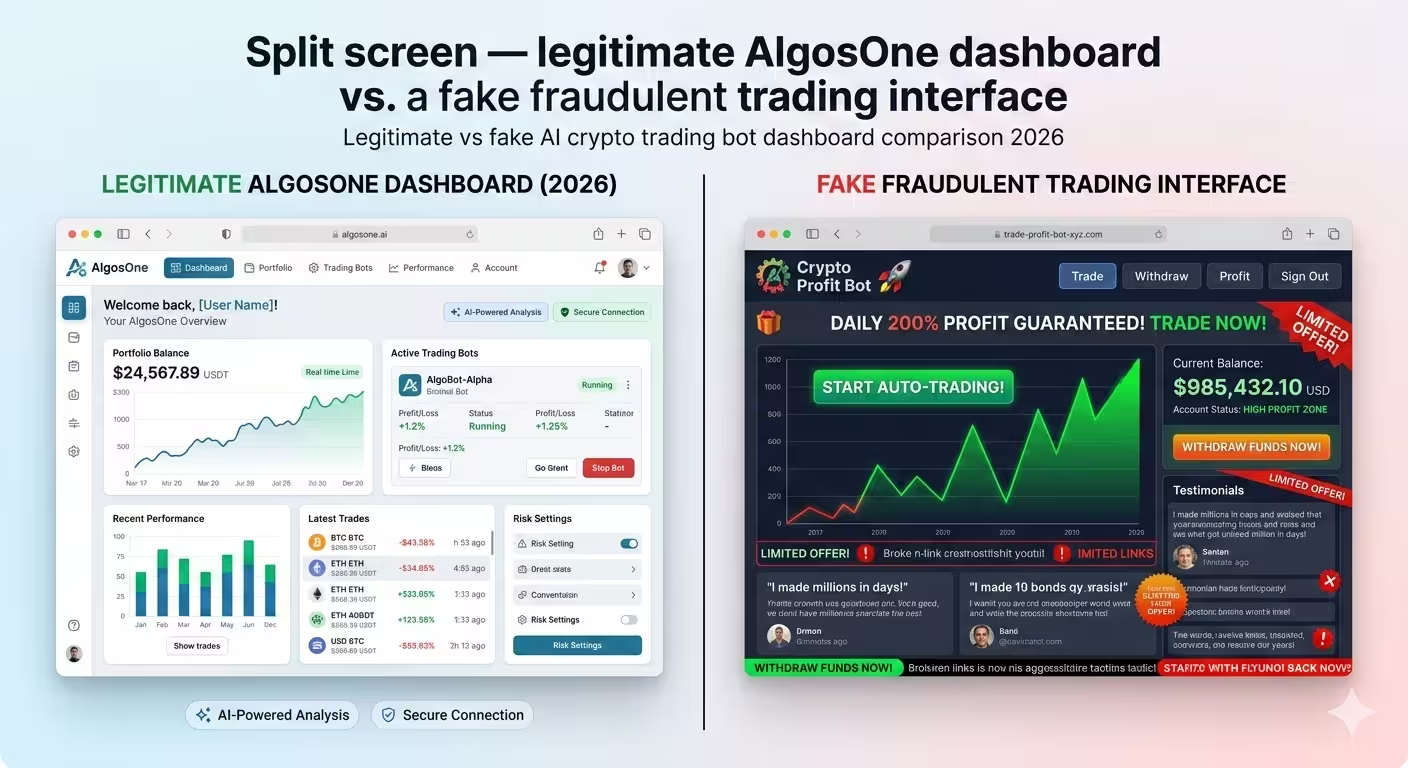
Real platforms exist – AlgosOne, 3Commas, Pionex. They have real track records. Real compliance teams. Real third-party reviews. But criminal networks have cloned their interfaces down to the font. You see profits grow. You add more money. You try to withdraw. It's gone.
So before this post touches returns, strategies, or platform comparisons – you need the one thing most reviews skip: how to tell real from fake.
Do AI Crypto Trading Bots Actually Make Money?
Yes. Short answer.
But "actually" is doing a lot of work in that question.
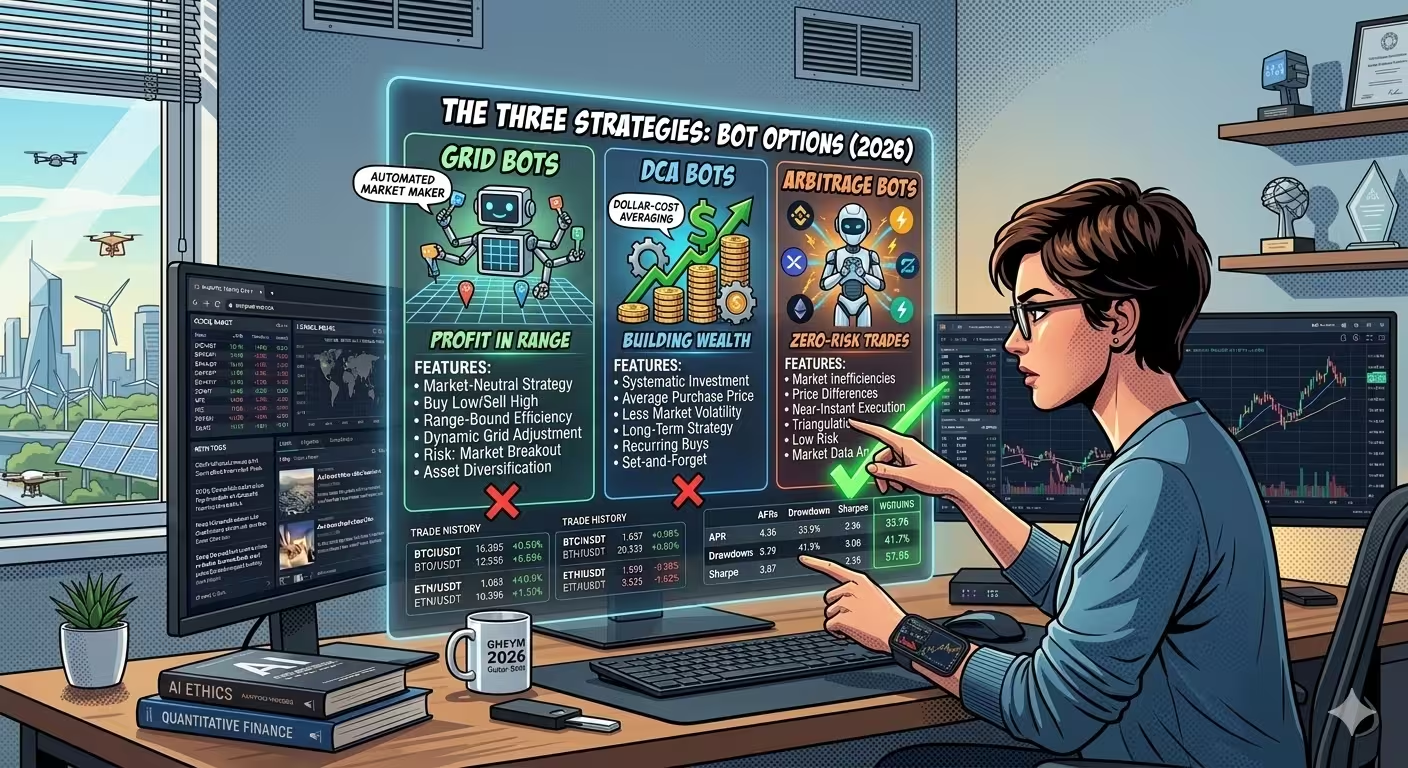
Bots earn through three basic moves. They spot price gaps between exchanges and trade them (arbitrage). They buy and sell within a tight price band over and over (grid trading). Or they buy on a fixed schedule no matter what the market does (DCA – dollar-cost averaging). Real methods. They work when conditions fit. None of them earn in every environment.
AlgosOne reports an 80%+ annual trade win rate for 2023–2024. ROI targets of 50%–250% were hit on two-year contracts ending in late 2024. Solid. But "win rate" means trades that closed green – not your total return. A bot can win 85% of its trades and still produce modest gains if the losing 15% are big losses.
3Commas doesn't hold your money. It links to 14+ exchanges – Binance, Kraken, OKX. You set the strategy yourself. Their AI helps you configure it. Returns average around 10% per year on moderate setups. Some traders tune it much higher.
Pionex is the bare-bones option. Sixteen free bots. A flat 0.05% fee. No monthly plan. It pulls liquidity from Binance and Huobi. Great starting point for beginners. The catch: no fiat withdrawal, no demo account, no tools for managing anyone's money but your own.
These platforms make money for some people. In some conditions. Not all the time. That's the truth.
The Three Bot Strategies That Work in 2026
Pick the wrong strategy and even a good platform drains your account. This is what to understand before choosing anything.
Grid Bots: Made for Sideways Markets
A grid bot drops buy orders below the price and sell orders above it. Think of it like a stacked net. Price dips, it buys. Price pops, it sells. Small gain, repeated again and again.
Pionex made grid bots popular with free tools baked into its exchange. Setup is fast. The logic is simple: as long as the price bounces inside your range, the bot earns on every wiggle.
Where it falls apart: say you set a BTC range of $90,000–$110,000. Bitcoin blows past $130,000 and stays there. Your sell orders trigger early. You're sitting in cash. The market runs without you. Infinity Grid versions (no ceiling) help — but they bring other tradeoffs.
For sideways or choppy markets – which covers roughly 60–70% of any crypto year — grid bots are one of the most useful tools a regular trader can run.
DCA Bots: Made for Volatile Markets
Dollar-cost averaging is the "just keep buying" approach. Same amount, same intervals, regardless of price. Prolonged dip? Your average buy cost drops. That's the whole point.
What makes modern DCA bots worth using is Trailing Buy. It doesn't buy on a timer. It waits for a drop to reverse, then buys near the bottom. Trailing Sell works the same way going up — holds the position through upward momentum, exits only when the price starts to pull back.
3Commas has the best DCA configuration in this comparison. Custom deviation steps, safety order sizes, take-profit targets. AlgosOne folds DCA logic into its AI engine — no settings to touch, the system rebalances on its own.
Arbitrage Bots: Expert Territory Only
Arbitrage means buy low here, sell high there, at the same moment. In theory, free money. At the institutional level, it is.
The reality for everyone else is more complicated.
On Ethereum, over 90% of trades route through private channels via MEV-Boost. The top two block builders run over 90% of all block auctions. The bots competing for these trades — called Searchers — often pay over 90% of their profit just to get processed first. Without serious capital and real infrastructure, you don't compete here.
Solana runs faster (400ms blocks). But it's not easier. The Jito-Solana client controls 92% of all network stake. One bot — E6YoRP — owns 42% of sandwich attack volume and earns around $300,000 per day. This is not a retail market.
Flash loan arbitrage lets you borrow large sums with no collateral. You execute, repay within the same blockchain transaction block, keep the difference. No credit risk. But if the trade doesn't earn enough to cover fees, it fails. You lose the gas cost. That's not catastrophic — but you need precise simulation tools to run it without burning through fees on failed attempts.
New to DeFi trading? Don't start here. Grid or DCA first.
AlgosOne vs. 3Commas vs. Pionex: What Actually Differs
This is what separates them when it matters for real automated crypto trading decisions.
| Feature | AlgosOne | 3Commas | Pionex |
| How It Works | Fully autonomous AI — no setup needed | You build and configure the strategy | Pre-built bots in a built-in exchange |
| Your Time Required | None | High — ongoing management | Low to moderate |
| Exchange Access | Proprietary engine only | 14+ exchanges (Binance, OKX, Kraken) | Aggregated Binance and Huobi |
| Fees | Commission on winning trades only | Monthly subscription | 0.05% flat per trade |
| Security | Reserve Fund + live human oversight | API isolation, IP whitelisting | Centralized exchange custody |
| Bot Choices | Fully automated — no manual options | 23+ strategy types | 16 free pre-built bots |
| Best For | Hands-off retail and institutional | Pro traders who want full control | Beginners learning the basics |
| Reported Returns | 80%+ win rate (2023–2024) | ~10% avg. ROI, varies by setup | User-defined |
| Demo Mode |
|
|
|
| Fiat Withdrawal |
|
|
|
| Verified Reviews | Trustpilot 4.7/5, 2,600+ reviews | Mixed; widely used by pros | Mixed; beginner-heavy |


AlgosOne
Zero setup. That's the pitch — and for many users, it delivers.
The deep learning engine reads news feeds, social sentiment, and live order books. It retrains every day. No manual parameters. The AI handles allocation, timing, and when to exit.
The Reserve Fund matters here. AlgosOne puts 50% of all trading commissions into it. It covers client balances in worst-case scenarios. High-tier holders get partial trade loss reimbursement. The fund balance is visible on the dashboard in real time. That's not a brochure claim — it's there to look at.
The AIAO token runs on ERC-20 with a fixed 1 billion supply. Hold it and you get governance votes, dividend payouts from trading commissions, and higher account tiers. Stage 1 presale holders reportedly saw 9,880% gains by October 2025. Wild number. Also means tokenomics are their own speculative bet — separate from how the trading platform performs.
The weak spot: no visible trade logic. You see your balance, win rate, reserve coverage. You don't see which trades the AI placed or why. For anyone who needs full audit trails — institutional mandates, compliance teams — that's a real gap.
Pros: Zero config, 80%+ win rate, visible Reserve Fund, KYC/AML verified, human oversight layer, Trustpilot-verified Cons: No trade transparency, token system adds complexity, contract-specific ROI — not a blanket promise
This is what professional traders use when managing multiple accounts. You connect it to 14+ exchanges via API. You clone strategies from high-performing traders. One dashboard covers all your accounts. API isolation per client, IP whitelisting, key expiration, full audit logs. Best security setup in this comparison.
Two issues worth knowing. First: input lag. On some hardware, fields show 20–30 second delays during fast manual adjustments. In a moving market, that's a risk, not just an annoyance. Second: the AI assistant caps at 1 million tokens. A busy firm hits that in one active trading week. If you're running 10+ accounts and using AI guidance for ongoing configuration, plan around this limit.
Pros: Full strategy control, 14+ exchanges, top API security, the go-to for professional multi-account work Cons: Steep curve for beginners, AI token cap is a real problem at scale, interface lag under pressure
Wins on cost. No subscription. Sixteen free bots. Flat 0.05% fee. Binance and Huobi liquidity means tight spreads on major pairs.
The downside is scale. No fiat withdrawal. No demo account. No multi-account tools. Running a personal portfolio under $10,000 and want to learn grid or DCA with no upfront cost? Pionex works. Need anything beyond that, and you'll hit its limits fast.
Pros: Free bots, lowest fees, quick setup for beginners Cons: No demo, no fiat withdrawal, second-tier exchange, not built for pro or institutional use

The Threat Most Reviews Don't Mention (This One Can Wipe You Out)
Here's the part nobody talks about.
Your biggest risk in 2026 isn't a bad bot setting. It's a fake platform that looks indistinguishable from a real one.
Criminal operations — many based in Cambodia — run what the FBI labels "pig butchering" schemes. The name comes from fattening livestock before slaughter. A scammer builds a relationship with you online. Takes weeks or months. Then they introduce you to a "trading platform" inside their network. Your balance grows on screen. They push you to deposit more. You try to pull your money. It's gone.
In 2026, they run it with AI at three points.
Fake identities first. AI-generated profile photos that pass every reverse image search. No recycled stock photos. No trace. Then Large Language Models. One operator manages thousands of victim conversations at once. The AI reads emotional cues and adjusts tone in real time — harder when you're excited, gentler when you hesitate. Then fake dashboards. They mirror platforms like Binance with live market data feeds. The illusion holds until you try to withdraw.
Northern California alone: romance fraud losses climbed from $22 million in 2024 to over $40 million in 2025. National figures are worse.
The Romance Scam Prevention Act cleared the US House in June 2025. Tinder's Face Check verification reportedly cut bad actor exposure by 60%. None of it helps after you've sent money to a wallet.
Run this check before trusting any platform:
- Video call feels slightly off — Audio doesn't match lip movement, or face lighting shifts oddly. Deepfake injection.
- Someone online sent you there — WhatsApp, Telegram, Instagram, a dating app. Stop.
- Withdrawal requires a fee or "tax" — Legitimate platforms don't charge you to access your own balance.
- No third-party reviews you found yourself — Trustpilot, Reddit's r/CryptoCurrency, BBB. Not links the platform gave you.
- Guaranteed daily profit — Not possible. Always a scam.
Crystal Intelligence's "Scam Alert" tool lets you report suspicious wallet addresses. Exchanges use that data to flag and freeze stolen funds. Bookmark it.
Best AI Crypto Trading Bots for Passive Income: Who Should Use What
Passive income from bots is real. Which platform fits depends on your situation.
Starting fresh, under $5,000? Use Pionex. Run a grid bot on BTC/USDT or ETH/USDT. Set conservative parameters. Put no more than 10–20% of capital in any single bot. The first 90 days are for learning — don't scale until you've seen the bot handle a real market move.
Intermediate, your own portfolio? Go with 3Commas. Learn the SmartTrade terminal. Run DCA with trailing on volatile assets. Connect to Binance or OKX for the best liquidity. Pay for the Starter or Advanced plan — the free tier won't cut it for serious work.
Want hands-off for 12–24 months? AlgosOne. Check the Reserve Fund balance yourself before depositing. Your AIAO token tier affects your loss coverage — higher tiers get more protection. Don't put in money you can't leave locked for the full contract term.
Managing client money professionally? 3Commas is the only choice in this comparison built for that. But plan around the AI token cap — at scale, it's an operational gap, not a minor nuisance.
Frequently Asked Questions - FAQs
Do AI crypto trading bots actually make money?
Yes. AlgosOne and 3Commas generate real returns for users. But results shift a lot based on strategy, market conditions, and how the bot is configured. No bot earns in every environment. Any platform claiming guaranteed daily profit is a scam.
What are the best AI crypto trading bots for passive income in 2025–2026?
AlgosOne ranks first for passive income — fully autonomous, 80%+ reported win rate, zero config. Pionex is the top pick for beginners who want grid or DCA bots without paying a subscription. 3Commas suits traders who want hands-on control over their strategy.
What is a grid bot and when does it work?
A grid bot sets automated buy and sell orders at set price intervals inside a range. It earns on every price bounce within that range. Best in sideways or ranging markets. When the market trends hard in one direction, it underperforms.
Is flash loan arbitrage risk-free?
Credit risk is zero — the loan repays inside the same block, with no collateral. But if the trade doesn't cover fees, it fails. You lose the gas, not the principal. "Risk-free" covers credit only, not execution. Getting this right takes serious tooling.
How do I spot a crypto trading platform scam?
Watch for: guaranteed returns, platforms pushed by someone you only know online (WhatsApp, Telegram), fees required to withdraw your own funds, no reviews you found on your own, video calls where face movements look slightly off. Check Trustpilot, Reddit, and the BBB. Never use links the platform provides.
What is the AIAO token?
It's AlgosOne's ERC-20 utility token. Fixed supply: 1 billion. Holders get governance votes, dividend payouts from trading commissions, and better account tiers with more Reserve Fund coverage. Stage 1 presale holders saw big gains — but token value is a separate speculative bet from the trading platform itself. Research before treating it like a return vehicle.
What is MEV and why does it matter?
MEV — Maximal Extractable Value — is the profit earned by controlling the order of transactions on a blockchain. On Ethereum, professional bots pay over 90% of their gross profit in block inclusion fees. On Solana, speed is the variable. For users of AlgosOne or 3Commas, MEV is handled inside the platform. But it explains why arbitrage on major chains isn't open to individual traders.
Can I use a crypto trading bot with zero experience?
Yes. AlgosOne needs no setup — the AI runs it. Pionex has step-by-step wizards for grid and DCA. But no bot takes away the need to understand what you're investing in. Read the docs. Run a demo for 30 days. Then go live.
The Bottom Line
The AI crypto trading bot space in 2026 is not hype. It's also not a
money printer. It's a real category — legitimate platforms, verifiable track
records, real security systems. And it exists beside one of the most advanced
fraud networks ever built, using the same tools.
Your move is simple. Match the platform to your profile. Verify the track
record yourself — not through the platform's own links. Run the scam checklist
before trusting anything new. Never invest money you can't afford to lose or
have locked up.
Grid bots for sideways markets. DCA for volatile ones. Arbitrage only if
you know the infrastructure. AlgosOne for set-and-forget income. 3Commas for
pros who need control. Pionex for beginners who don't want to pay first.
Not a complicated framework. But skip any part of it and you're exposed.
Start with a demo. AlgosOne and 3Commas both offer them. Run it for 30 days before putting
real money in. A strategy that reads well on paper has to hold up in a live
market — and 30 days of simulated trading tells you more than any review can.
Financial Disclaimer
The information published on Tech Capital Hub is intended for educational and informational purposes only. Nothing on this website — including articles, guides, analysis, or commentary on AI, fintech, blockchain, cryptocurrency, or stocks — should be interpreted as financial advice, investment advice, trading recommendations, or any other form of professional financial guidance.
All investments carry risk, including the potential loss of principal. Past performance of any financial instrument, strategy, or technology is not a reliable indicator of future results. Cryptocurrency and blockchain-based assets are particularly volatile and speculative in nature, and their value can fluctuate significantly in short periods of time.
Tech Capital Hub, Marcus Delray, and any associated contributors do not hold responsibility for any financial decisions you make based on content published on this site. Before making any investment or financial decision, we strongly encourage you to conduct your own independent research and consult with a licensed financial advisor, accountant, or legal professional who understands your personal financial situation.
Any links to third-party websites, tools, or platforms are provided for convenience and informational purposes only. Tech Capital Hub does not endorse or take responsibility for the content, accuracy, or practices of any third-party sites.